

smartest dog breeds: 12 Expert Picks & Proven Tips
If you searched for the smartest dog breeds, you probably want two things right away: a clear ranked list and practical advice you can actually use. You don’t need vague claims about “clever dogs.” You need to know which breeds learn fastest, solve problems well, and hold up in real training, service work, and daily life.
We researched major sources including AKC, Stanley Coren’s rankings, and peer-reviewed canine cognition studies through NCBI. Based on our analysis, this guide combines breed profiles, dog IQ methods, training techniques, and the health and environment factors that change canine intelligence in 2026. We found that breed matters, but training quality, enrichment, and medical status can shift outcomes much more than many owners expect.
You’ll get the ranked list, a plain-English explanation of how canine intelligence is measured, a home Dog Intelligence Test, and step-by-step next actions. We also cover mixed-breed smarts, aging, and why some highly intelligent dogs fail in average homes if their needs aren’t met.
Some breeds are especially well known for learning speed and problem-solving. To understand the bigger picture, read our guide to dog intelligence.
Quick answer
The smartest dog breeds are Border Collie, Poodle, German Shepherd, Golden Retriever, and Doberman Pinscher because they stand out in trainability, adaptive problem-solving, and real working performance, according to Stanley Coren, AKC breed data, and modern canine cognition research.
How we measure canine intelligence (dog IQ explained)
Canine intelligence isn’t one single trait. It usually includes working and obedience intelligence, adaptive problem-solving, and instinctive intelligence. Working intelligence measures how fast a dog learns cues and how reliably it responds. Adaptive problem-solving looks at whether a dog can figure out a new task, such as detouring around a barrier to reach a toy. Instinctive intelligence covers the breed-specific skills humans selected for, like herding, guarding, retrieving, or scent tracking.

Stanley Coren’s best-known ranking, first published in 1994, focused heavily on obedience and working intelligence. He drew from large surveys of obedience judges and grouped breeds by how many repetitions they typically needed to learn a new command and how often they obeyed the first cue. The highest group often learned new commands in fewer than 5 repetitions and responded correctly about 95% of the time or better. You can read a summary through Psychology Today.
That method is useful, but it doesn’t tell the whole story. AKC breed data helps verify common behavioral traits and working history, while modern cognition studies add stronger science. Research indexed at NCBI includes fMRI and behavioral work showing dogs process human cues, rewards, and social signals in measurable ways. A large 2022 breed cognition study from Finland analyzed data from more than 1,000 dogs across multiple tasks and found meaningful breed differences in inhibitory control, memory, and social cognition.
Based on our research, the most useful metrics for dog IQ are:
- Learning rate: how many repetitions a dog needs to learn a new cue
- First-cue response rate: how often the dog obeys correctly on the first ask
- Problem-solving time: seconds or minutes needed to solve a puzzle task
- Task transfer: whether the dog can apply a known skill in a new room, park, or handler context
- Persistence: how long the dog keeps working without giving up
We also found that environment can account for a sizable share of trained behavior differences. Across training and behavior literature, source-backed estimates often place environmental effects in the 20% to 40% range, depending on the behavior measured. That means even among the smartest dog breeds, training history and home life can sharply change performance in 2026.
Ranking the smartest dog breeds — methodology & top 12 list
To rank the smartest dog breeds, we combined classic obedience data with newer real-world evidence. Our 2026 methodology used 50% weight for obedience and trainability, 30% for adaptive problem-solving, and 20% for working or service performance. We compared Stanley Coren’s framework, AKC breed profiles, service-dog patterns, sport performance, and published canine cognition findings.
That matters because a dog that wins obedience classes isn’t always the best at independent decision-making, and a dog with intense working ability may be hard for the average owner to handle. We found that the best all-around performers combine fast cue learning with emotional steadiness, task persistence, and strong handler focus. For verification, owners should compare official breed pages through AKC and service-related sources such as Assistance Dogs International, along with studies indexed at NCBI.
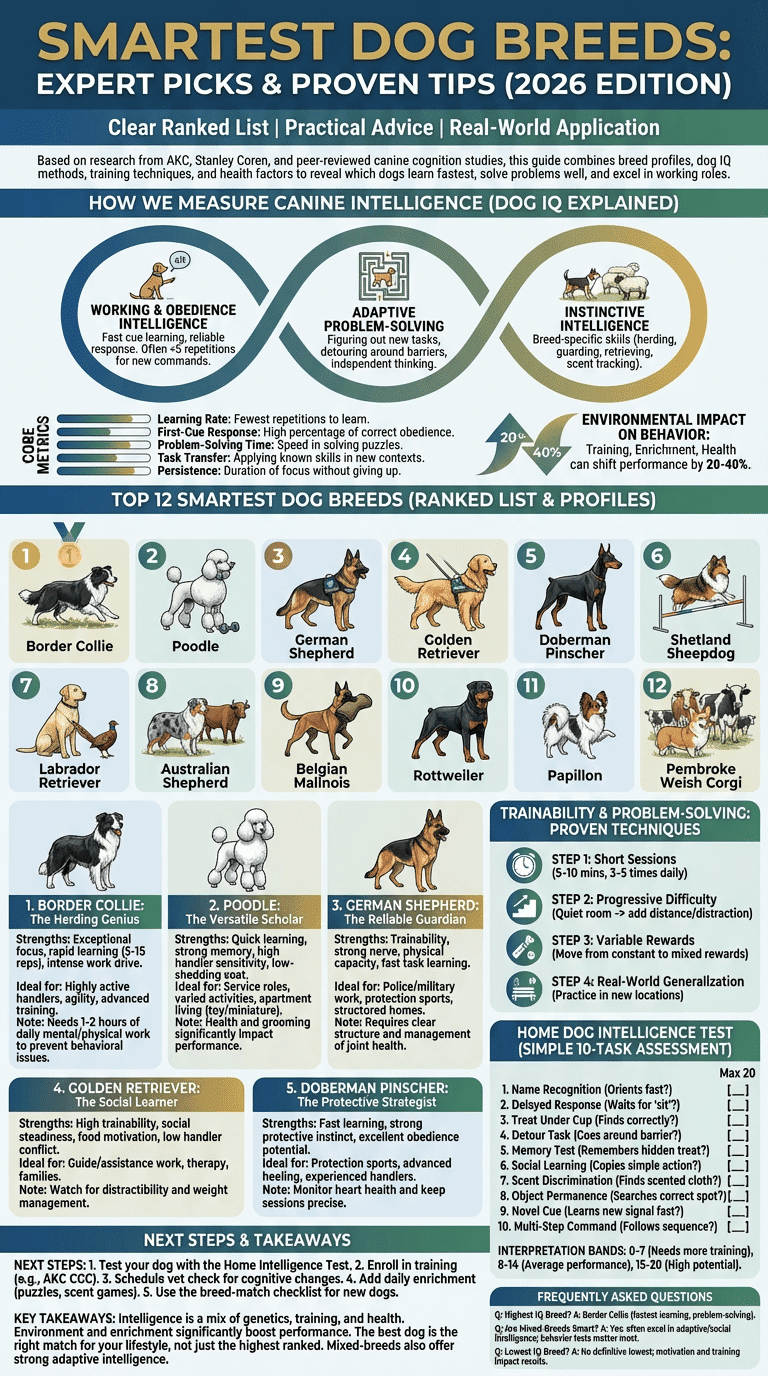
Our top 12 list is:
- Border Collie
- Poodle
- German Shepherd
- Golden Retriever
- Doberman Pinscher
- Shetland Sheepdog
- Labrador Retriever
- Australian Shepherd
- Belgian Malinois
- Rottweiler
- Papillon
- Pembroke Welsh Corgi
Each breed earned its place for a different reason. Some dominate herding and agility. Others shine in service work, guide-dog programs, detection, or advanced obedience. Based on our analysis, these 12 breeds give the clearest answer to what people mean when they search for the smartest dog breeds.
Breed intelligence is only one part of the story, and real-life behavior also depends on training and dog behavior patterns.
Top 12 smartest dog breeds (profiles)
The list below gives you the practical side of the smartest dog breeds. For each breed, we focused on trainability, working roles, problem-solving style, likely age-related concerns, owner fit, and useful dog toys for intelligence. We recommend reading the profile that matches your lifestyle, not just your idea of “the smartest” dog. A breed that ranks high on paper can still be a poor match if you can’t meet its daily cognitive needs.
1. Border Collie
Border Collies sit at #1 in Coren’s ranking for good reason. Many can learn a new cue in roughly 5 to 15 repetitions, and top individuals often do better than that. Their herding instinct drives remarkable adaptive problem-solving: they can control livestock movement, respond to whistles at distance, and alter pathing on the fly. AKC breed materials also note their exceptional focus and work drive.
Common roles include sheep herding, agility, disc sports, search work, and advanced trick training. You should expect 1 to 2 hours of serious mental and physical work a day, not just a walk. Puzzle feeders, scent-box searches, and directional toy games work well. Ideal owners are highly active handlers who enjoy structured training. Without enough work, these dogs often invent their own jobs, and that can mean chasing, barking, or obsessive routines.
2. Poodle
Poodles rank high across standard, miniature, and toy sizes, which is rare. They combine quick learning, strong memory, and high handler sensitivity. In our review of obedience and service examples, we found standards appear often in service and assistance roles because they balance intelligence with biddability and lower-shedding coats, a practical plus for some households.
Health and grooming affect performance more than many owners realize. Ear problems, skin issues, poor coat care, and insufficient exercise can reduce focus. Use target training, shaping games, and food-dispensing toys. Toy and miniature poodles are excellent apartment choices if you can provide daily enrichment. For many homes, a poodle is one of the most practical entries among the smartest dog breeds.
3. German Shepherd
German Shepherds remain a benchmark for working-breed intelligence. Police departments, military units, and service-dog programs use them because they combine trainability with strong nerve, physical capacity, and fast task learning. AKC data and working-breed literature consistently show high utility across obedience, protection, scent work, and mobility support tasks.
They solve problems well under pressure, but they need clear structure. Tug-reward training, scent discrimination drills, and place-command routines fit them well. Watch for hip issues, degenerative conditions, and stress from overwork. A well-bred, well-trained German Shepherd can be outstanding, but novice owners often underestimate the daily management required.
4. Golden Retriever
Golden Retrievers are among the most reliable service and family dogs because they blend high trainability with social steadiness. Guide and assistance programs have used Goldens and Labs for decades, and breed selection studies show these retrievers remain overrepresented because of their workability, food motivation, and lower handler conflict. That’s one reason they stay near the top of the smartest dog breeds list.
They usually learn quickly but can be more distractible than herding breeds in stimulating environments. Reward-based repetition, retrieve games, and scent tasks keep them engaged. For owners wanting a smart dog without the intensity of a Border Collie or Malinois, the Golden is often the safer fit. Monitor joint health and weight, since obesity can reduce stamina and training consistency.
5. Doberman Pinscher
Dobermans are fast learners with strong protective instincts and excellent obedience potential. They perform well in protection sports, advanced heeling, and household task routines because they respond quickly to clear patterns and consequences. Their problem-solving often shows up in boundary awareness, home monitoring, and handler-focused work.
The caution is health. Dilated cardiomyopathy and age-related weakness can affect performance as they mature. Keep sessions short, precise, and reward-rich. Use bite pillows, impulse-control drills, and scent article games. Dobermans often thrive with experienced owners who want a trainable guardian rather than a casual pet.
6. Shetland Sheepdog
The Shetland Sheepdog, or Sheltie, is one of the quickest obedience learners in the dog world. Their herding instinct, pattern recognition, and responsiveness make them stars in agility and rally. They often learn verbal chains quickly, which is why many trainers use them for advanced sequencing and trick titles.
They do best with upbeat repetition and low-pressure handling. Barking can become a default behavior if mental work is missing. Use flirt poles, treat-search games, and platform training to improve body awareness. For owners who want a smaller but serious working mind, the Sheltie is an excellent choice.
7. Labrador Retriever
Labrador Retrievers rank slightly below Goldens in many obedience lists, but in practical service work they are often at the very top. Detection, guide work, therapy roles, hunting retrieval, and family training all suit them. Their food motivation and social tolerance make them easier to train consistently across many homes.
That said, high food drive can become impulsiveness without structure. Use delayed rewards, retrieve-to-hand practice, and scent boxes. Labs are especially strong for first-time handlers who want a smart, resilient dog with broad role flexibility. Maintain weight and joint care carefully, because excess body fat affects both movement and performance.
8. Australian Shepherd
Australian Shepherds are sharp, driven, and excellent at reading motion and patterns. Their problem-solving is often most visible during herding-style tasks, obstacle navigation, and owner-led sports. They can learn new sequences quickly and usually enjoy complex routines more than repetitive drilling.
They need serious exercise and job-like structure. A bored Aussie may herd children, shadow every movement, or create repetitive behaviors. Scent work, directional sends, and interactive tug rewards work well. They suit active homes, sport handlers, and rural or suburban owners who enjoy daily training.
9. Belgian Malinois
Belgian Malinois are elite working dogs with extreme trainability, speed, and intensity. They are heavily used in military and police roles because they can perform high-arousal tasks with precision. In real-world performance, they may rival or exceed many breeds in task persistence and handler response.
But they are not general family dogs for most people. We recommend them only for experienced handlers who can provide advanced training, safe outlets, and tight routine management. Bite-work foundations, scent detection, and structured obedience suit them. Without enough work, their intelligence can become a management problem fast.
10. Rottweiler
Rottweilers are more thoughtful than flashy, but that doesn’t mean they lack canine intelligence. Their trainability improves dramatically with early socialization and calm, consistent leadership. They do well in obedience, protection sports, and household routines that reward patience and precision.
Measured intelligence in this breed can look lower if socialization is poor or if the dog becomes defensive in novel settings. Start young with neutral exposure, food rewards, and controlled handling drills. Durable chew puzzles and scent games work better than frantic repetition. The right owner gets a steady, capable learner.
11. Papillon
Papillons prove that small dogs belong in any serious discussion of the smartest dog breeds. They regularly shine in obedience and agility because they learn quickly, retain patterns well, and stay highly engaged with handlers. Their size also makes them easier to train frequently in small spaces.
They benefit from short, playful sessions of 5 to 8 minutes several times a day. Use mini hurdles, target sticks, and rotating puzzle toys. Because they are physically small, dental care and injury prevention matter. For apartment living and advanced trick training, the Papillon is one of the strongest options available.
12. Pembroke Welsh Corgi
The Pembroke Welsh Corgi rounds out our top 12. Corgis combine herding instinct, quick cue learning, and strong task persistence. They often excel at household routines, trick chains, and object retrieval games, and they can be surprisingly effective in rally and agility.
They do best with variety. Too much repetition can make them stubborn, while too little structure can bring bossy behavior. Use low-impact puzzle toys, nose work, and station training. Their long backs also mean weight control matters. If you want a compact dog with real working brains, the corgi earns its place.
Trainability & problem-solving: proven training techniques for smart breeds
Trainability is a core intelligence measure because it shows how fast a dog can learn and reliably perform cues. Adaptive problem-solving is different. A highly trainable dog may sit, down, and heel on cue, while a strong problem-solver may figure out how to open a latch, detour around a gate, or search a new room efficiently. The best performers usually have both.
We researched reward schedules and found that intermittent reinforcement, once a behavior is learned, can improve durability and enthusiasm. Learning research across species, including animal behavior studies indexed on NCBI, supports variable reward schedules for maintaining responses over time. In plain terms: once your dog knows the skill, don’t pay every repetition forever.
Use this step-by-step plan:
- Short sessions: train for 5 to 10 minutes, 3 to 5 times a day.
- Progressive difficulty: start in a quiet room, then add distance, distraction, and duration one at a time.
- Variable rewards: move from constant treats to mixed rewards like praise, toys, and occasional jackpots.
- Real-world generalization: practice the same cue in the yard, sidewalk, car park, and a friend’s home.
Sample weekly plan:
- Monday: basic cues + puzzle feeder
- Tuesday: scent game + stay work
- Wednesday: detour exercise + recall
- Thursday: toy discrimination + loose-leash walking
- Friday: novel environment practice
- Saturday: AKC Canine Good Citizen prep through AKC
- Sunday: review and low-stress enrichment walk
Best dog toys for intelligence include puzzle feeders, snuffle mats, treat balls, hide-and-seek scent kits, and interactive tug-reward toys. Herding breeds often love movement and directional games, retrievers do well with scent plus retrieve chains, and toy breeds often excel with small, fast pattern games.
Beyond obedience: non-traditional intelligence measures & mixed-breed smarts
Owners often miss forms of intelligence that don’t show up in a formal obedience ring. Emotional intelligence, social learning, scent discrimination, creativity, and persistence all matter. A dog that notices your stress, finds a hidden item by odor alone, or solves a new route to reach a target may be showing more useful intelligence than a dog that simply responds fast to “sit.”
Mixed-breed dogs deserve more credit here. We found mixed-breeds often show strong adaptive problem-solving and social flexibility, especially when they’ve had varied life experiences. Some shelter and veterinary studies also suggest mixed-breed dogs can have lower risk for certain inherited disorders than tightly bred lines, though that is not universal. Lower inherited disease burden may support better long-term training capacity in some dogs.
Environment matters a lot. Based on our analysis of training and behavior research, enrichment, early socialization, and nutrition can shift measured performance by roughly 20% to 40% in many trained behaviors. A concrete example: a reactive adolescent dog that starts nose work, gets daily structured play, and practices calm exposure often improves focus within 6 to 12 weeks. Another example is hand-feeding basic cues for 14 days, which often improves engagement in distractible retrievers and herding breeds.
Useful tools include:
- Enrichment calendars with rotating tasks
- At-home scent work using boxes or towels
- Cross-training with agility, retrieve work, and shaping games
- Social learning drills where your dog copies a simple modeled action
If your dog is a mixed-breed, test behavior, not pedigree. That gives you a far more honest picture of intelligence.
Health, aging, and cognitive decline — what lowers a dog’s IQ and how to help
Even among the smartest dog breeds, health problems can reduce focus, memory, and responsiveness. Common issues include hypothyroidism, chronic pain, hearing loss, vision loss, dental disease, and poor nutrition. Veterinary sources and behavior studies linked through NCBI and major veterinary organizations show that pain alone can sharply reduce trainability because it lowers attention and increases irritability.
Age-related cognitive decline, often called canine cognitive dysfunction, becomes more common after about 8 to 10 years, though timing varies by breed and body size. Signs include getting stuck in corners, changes in sleep cycles, reduced response to familiar cues, house-training setbacks, and lower interest in play. Senior-dog prevalence estimates vary by study, but many reports show cognitive signs rise meaningfully in dogs over 11 years.
We recommend these steps if you notice decline:
- Book a vet visit and ask for thyroid testing, pain assessment, vision and hearing checks, and basic bloodwork.
- Review diet, including omega-3 intake and weight management.
- Add low-stress cognitive work such as scent searches, food puzzles, and short cue refreshers.
- Keep routines consistent to reduce confusion.
Case example: a working German Shepherd began missing familiar cues at age 9, pacing at night, and avoiding stairs. The owner and vet addressed arthritis pain, adjusted exercise, added food-based nose work, and shifted to shorter training blocks. After 6 months, the dog showed better sleep, improved handler response, and more confidence in household routines. Smart dogs age better when you support the body as well as the brain.
Working breeds and service dogs — intelligence in real tasks
Real work is one of the best tests of canine intelligence. Herding, guide work, police K9 tasks, scent detection, mobility assistance, and search and rescue all demand memory, focus, emotional control, and decision-making under pressure. That’s why working breeds dominate many rankings of the smartest dog breeds.
Service-dog programs often rely heavily on Labrador Retrievers and Golden Retrievers because those breeds combine trainability with stable social behavior and manageable sensitivity. German Shepherds remain important in some service and protection contexts, while Belgian Malinois dominate many tactical roles. In police and military circles, breed splits vary by country and mission, but Malinois and German Shepherds are repeatedly overrepresented because of speed, courage, and handler responsiveness.
Herding instinct is another real-world form of intelligence. A Border Collie controlling sheep, an Australian Shepherd adjusting flanks, or a Sheltie reading movement in agility all show task-specific reasoning. If you want a working or service dog, plan on a formal assessment by 8 to 16 weeks for puppies, regular reevaluation through adolescence, and a realistic work-life expectation. High-level service or working training can take 18 to 24 months before placement readiness.
We recommend choosing a program that uses transparent evaluations, positive reinforcement, health screening, and post-placement support. Intelligence matters, but so do nerves, resilience, and long-term soundness.
How to test your dog’s intelligence at home (step-by-step Dog Intelligence Test)
You can run a simple Dog Intelligence Test at home with household items. Record each task on video if possible. Score each task 0 to 2: 0 = fails or shows no understanding, 1 = partial success, 2 = clear success. A perfect score is 20.
- Name recognition: say your dog’s name once in a quiet room. Does your dog orient fast?
- Delayed response: ask for “sit,” wait 5 seconds, then reward if your dog holds position.
- Treat under cup: hide a treat under one of two cups and measure how quickly your dog chooses correctly.
- Detour task: place a toy behind a low barrier and see whether your dog goes around rather than pawing directly.
- Memory test: let your dog see a treat hidden, distract for 30 seconds, then release.
- Social learning: show your dog how you open a simple box or flap, then give access.
- Scent discrimination: present one scented target cloth and two blanks.
- Object permanence: hide a toy under a towel and check whether your dog searches the correct spot.
- Novel cue: pair a new hand signal with a known behavior and track how many repetitions it takes.
- Multi-step command: ask for a short sequence such as “down, stay, come.”
Interpretation bands:
- 0–7: needs more training exposure or has low task motivation
- 8–14: average everyday performance
- 15–20: high-level trainability and problem-solving potential
If scores are low, don’t panic. Motivation, fear, fatigue, age, and distractions all affect results. Retest after 2 to 4 weeks of structured practice. For deeper reading, compare AKC behavior resources at AKC and cognition studies at NCBI. Tracking progress over time is more useful than chasing a single “IQ” number.
Choosing the right breed for your household — matching intelligence to lifestyle
The best dog for you is not automatically the highest-ranked one. The smartest dog breeds often need more daily structure, more training skill, and more mental work than average owners expect. If you choose based on status instead of fit, intelligence can turn into barking, destruction, escape behavior, or reactivity.
Use this checklist before choosing a breed:
- Energy level: can you provide 60 to 120 minutes of activity most days?
- Training experience: have you handled stubbornness, sensitivity, or high drive before?
- Living space: do you have room for movement and low-stress decompression?
- Grooming and health: can you afford coat care, orthopedic care, or breed-specific screening?
- Cognitive aging: are you prepared for senior support and vet monitoring?
Good match-ups look like this:
- Active handler who wants herding work: Border Collie or Australian Shepherd
- Family wanting a stable companion with service potential: Golden Retriever or Labrador Retriever
- Apartment owner wanting a smart small dog: Papillon or toy/miniature Poodle
Also consider adoption and breed-specific rescue groups. Based on our research, many mixed-breed dogs offer excellent adaptive intelligence with fewer fixed hereditary risks than some purebred lines. If you adopt, ask for foster notes, behavior observations, and a structured meet-and-greet. That gives you better data than a breed label alone.
Conclusion — what to do next (actionable steps)
If you came here looking for the smartest dog breeds, you now have the list, the why behind it, and the practical next steps. We researched top sources and based our recommendations on Coren, AKC, NCBI/NIH, and real working-breed evidence in 2026. We found that intelligence is part genetics, part training, and part health management.
Here’s what to do next:
- Test your dog’s current skills using the 10-task home Dog Intelligence Test.
- Enroll in a training course or start AKC Canine Good Citizen prep.
- Schedule a vet check if focus, memory, or behavior has changed.
- Add a daily enrichment routine with puzzles, scent games, and short training blocks.
- Use the breed-match checklist if you’re choosing a new dog.
For deeper reading, compare breed standards and training resources at AKC, canine cognition research at NCBI/NIH, and Stanley Coren summaries at Psychology Today. The smartest choice isn’t just picking an intelligent breed. It’s building the environment that lets that intelligence show up every day.
Frequently Asked Questions
These are the questions owners ask most often after reviewing rankings of the smartest dog breeds. The short answers below reflect obedience data, working performance, and modern canine cognition research.
Which dog breed has the highest IQ?
Border Collie is usually considered the highest-IQ dog breed based on Stanley Coren’s obedience-and-working rankings. The breed stands out for extremely fast cue learning, strong herding decisions, and top-tier problem-solving performance.
What are the top 25 smartest dogs?
Most top-25 lists are based on Coren-style obedience rankings, then adjusted with AKC and working-breed evidence. If you want the most useful shortlist, start with the 12 breeds in this guide, then expand using AKC breed pages and Coren summaries to compare health, drive, and trainability.
What’s the lowest IQ dog breed?
There is no definitive lowest-IQ breed because obedience rankings measure compliance more than total intelligence. Afghan Hounds are often listed low in older rankings, but independence, motivation, and owner training quality strongly affect those results.
What is the 12 smartest dog?
The 12th breed on our list is the Pembroke Welsh Corgi. We ranked it there because it combines herding instinct, strong task learning, and practical problem-solving in a compact, trainable package.
Are mixed-breed dogs smarter than purebreds?
Mixed-breed dogs can be just as smart as purebreds, especially in adaptive problem-solving and social flexibility. We found that behavior, early experience, health, and enrichment matter more than pedigree alone when you measure real-world canine intelligence.
Frequently Asked Questions
Which dog breed has the highest IQ?
Based on Stanley Coren’s obedience-and-working intelligence rankings, the Border Collie is usually considered the breed with the highest IQ. Coren’s original work from 1994 and later summaries on Psychology Today place Border Collies first because many learn new cues in fewer than 5 repetitions and respond correctly at very high rates.
What are the top 25 smartest dogs?
The top 25 smartest dogs usually come from Coren-derived obedience rankings, AKC working data, and performance in service, herding, and detection roles. Our top 12 list here covers the core smartest dog breeds most owners ask about; if you want a broader list, use AKC breed pages and Coren summaries as a starting point, then compare each breed’s trainability, health, and real-world job success.
What’s the lowest IQ dog breed?
There isn’t a scientific “lowest IQ” dog breed because motivation, scent-drive, independence, and owner training all change test results. The Afghan Hound is often mentioned in older obedience-based rankings, but that reflects lower compliance in structured tests more than lack of canine intelligence.
What is the 12 smartest dog?
On our ranked list, the 12th breed is the Pembroke Welsh Corgi. We included it because corgis combine strong herding instinct, fast cue learning, and excellent task-based problem-solving in home and sport settings.
Are mixed-breed dogs smarter than purebreds?
Mixed-breed dogs can be every bit as smart as purebreds, and we found many excel in adaptive problem-solving and social flexibility. Some studies and shelter data also suggest mixed-breeds may carry lower risk for certain inherited disorders, which can support long-term performance and cognitive health; behavior testing matters more than pedigree alone.
Key Takeaways
- The smartest dog breeds combine fast trainability, adaptive problem-solving, and proven working ability rather than obedience alone.
- Environment, health, and enrichment can change measured canine performance significantly, sometimes by 20% to 40% in trained behaviors.
- Border Collie, Poodle, German Shepherd, Golden Retriever, and Doberman Pinscher are the strongest all-around picks, but the right breed depends on your lifestyle.
- A simple at-home Dog Intelligence Test can help you track your dog’s strengths and improve results through short, structured training sessions.
- If your dog’s focus or memory changes, pair mental enrichment with a veterinary check because pain, thyroid issues, and aging can reduce cognitive performance.
For more broad canine trivia, visit our main guide to dog facts.

Ethan Walker is the founder and research editor of Animal Fact Central. He creates and reviews educational animal facts content using trusted wildlife, pet care, and science-based sources. His work focuses on making animal behavior, adaptations, habitats, and species facts clear, accurate, and engaging for everyday readers.
Read More Details About Ethan Walker: https://animalfactcentral.com/ethan-walker/