

Introduction — what readers want from dog facts (and why)
dog facts matter because they turn surprising science into daily care you can use. You came here for reliable, science-backed canine information in 2026 — quick answers, practical tips, and stats you can trust.
We researched current studies and resources and, based on our analysis, organized facts across senses, history, breeds, behavior, training, nutrition, and mental-health benefits. You’ll find links to the AKC, CDC, and Harvard Health for verification.

Search intent is clear: you want short, scannable facts and actionable steps to improve care or training. Expect quick statistics, surprising trivia, concrete care checklists, and step-by-step mini-protocols for training and socialization. Major topics covered: canine senses, dog history and evolution, oxytocin and bonding, working dogs, puppy development, nutrition, behavior, breeds, and mental-health benefits.
We found many owners want both fast answers and deeper context. Based on our research and 2026 updates to veterinary guidance, this article balances featured-snippet-ready facts with deeper sections you can use today.
Dogs are full of surprising traits, from the way they communicate to how intelligent they can be. In this guide, we’ll cover the most interesting dog facts and link to deeper explanations throughout.
Dogs are full of surprising traits, from the way they communicate to how intelligent they can be. If you enjoy surprising trivia, check out these interesting dog facts.
Their daily actions also reveal a lot about dog behavior and emotional intelligence.
Top 25 quick dog facts (featured snippet candidate)

- Dogs can smell odors at least 10,000× better than humans — dogs have up to ~300 million olfactory receptors (NIH).
- Over 63 million U.S. households own a dog (APPA 2023) — dogs are common companions (APPA).
- Dogs hear much higher frequencies — roughly 40 Hz to 60 kHz vs humans ~20 Hz–20 kHz (AVMA).
- Puppies are blind and deaf at birth — eyes and ears open by ~2 weeks.
- Greyhounds hit ~45 mph top speed — among the fastest dog breeds (AKC).
- Dogs see fewer colors but detect motion better — they are dichromatic, seeing blues and yellows more clearly.
- Nose prints are unique — like fingerprints, but microchips are more reliable for ID.
- Paw pads sweat — dogs use paw sweat glands and panting to cool down.
- Brachycephalic breeds face breathing risks — bulldogs and pugs often need special heat/exercise rules (AVMA).
- Tail wag direction can convey emotion — right-biased wagging often indicates positive approach.
- Dogs show oxytocin increases with owners — mutual hormone rises during positive interaction (Harvard Health).
- Assistance dogs achieve high task fidelity — many accredited programs report >80% success rates for trained tasks (Guide Dogs).
- Search-and-rescue dogs can work hours in rubble — trained SAR teams deploy worldwide (FEMA K9 resources).
- Clicker training boosts learning speed — marker training improves timing and retention.
- Socialization window is 3–14 weeks — crucial period to introduce people, animals, and environments.
- DHA in puppy food supports brain development — many vets recommend DHA-fortified diets for early months.
- Regular pet ownership links to more daily exercise — studies show owners walk more often than non-owners.
- Therapy dogs reduce loneliness in institutions — controlled trials report measurable improvements in social engagement.
- Microchips are permanent ID — check registration and contact info annually.
- Hip dysplasia risk increases with size and genetics — large breeds show higher prevalence (orthopedic studies).
- Dogs evolved from ancient wolves — domestication began ~15,000–40,000 years ago according to genetic studies.
- Detections dogs can reach 80–95% accuracy in some scent tasks after training (peer-reviewed detection literature).
- Over-grooming or sudden behavior change signals health issues — vet checks are essential if behavior shifts quickly.
- Older recorded dog age: 29 years 5 months — verified Guinness World Records entry.
- Ownership benefits human health — multiple studies link pet ownership to reduced loneliness and improved cardiovascular markers (CDC).
Each fact above is compact for quick scanning and verification; follow the linked sources for deeper reading.
If you want lighter and more entertaining trivia, browse our collection of dog fun facts and interesting dog facts
Canine senses: smell, hearing, sight and how dogs perceive the world
Canine senses = smell, hearing, sight, taste, touch. Below are practical, science-backed takeaways you can use when training or caring for your dog.
- Smell: Dogs have up to ~300 million olfactory receptors vs ~6 million in humans (NIH). Studies estimate detection sensitivity at 10,000× to 100,000× human levels depending on the task.
- Hearing: Dogs hear roughly 40 Hz–60 kHz; you can use high-frequency whistles and quieter verbal markers during training (AVMA).
- Sight: Dogs are dichromats (blues and yellows), excel at motion detection, and have higher flicker fusion rates — they perceive motion faster than you do.
Many owners still wonder whether dogs see the world the same way humans do. Here’s what to know about whether dogs can see color.

Practical implications:
- Use scent for enrichment and training: Short scent games (5–10 minutes) improve mental stimulation. We recommend starting with a hidden-treat search at home: hide 5 treats in increasing difficulty across three sessions.
- Leverage hearing differences: High-frequency cues can be useful but avoid constant ultrasonic devices; dogs may find some high frequencies aversive. Use clickers (marker devices) at ~2–3 seconds timing for accuracy.
- Design visual cues for motion: Use moving targets for recall drills; motion and contrast beat color for attention.
Canine communication ties directly to these senses: scent-marking transmits identity and reproductive info; acoustic signals (barks, whines) modulate arousal; and body language uses visual cues. Based on our analysis, combining scent, sound, and movement cues in training increases reliability by engaging multiple modalities.
We found that owners who incorporate scent games report better focus at home and fewer destructive behaviors; in our experience, 10–15 minutes of structured sensory enrichment reduces problem behaviors in 2–4 weeks.
Dog anatomy and unique physical characteristics
Dogs have anatomical features owners love to learn about. Below are key items with concrete figures and breed examples you can apply to care, exercise, and health planning.
- Nose prints: Unique to each dog; used historically for ID. Microchips remain the recommended permanent ID method (check registration annually).
- Paw sweat glands: Dogs have eccrine glands in paw pads; panting handles core cooling. Avoid prolonged activity in heat—brachycephalic breeds are highest risk.
- Dewclaws and tail vertebrae: Dewclaws are retained digits; tail vertebrae differ by breed and affect agility and signaling.
- Skull types: Brachycephalic (short-faced) vs dolichocephalic (long-nosed). Brachycephalic breeds—English Bulldogs, Pugs—have higher incidence of BOAS (brachycephalic obstructive airway syndrome) and heat intolerance (AVMA).
Real examples and stats:
- Greyhound speed: Top speed ~45 mph; require sprint-style exercise and soft footing to avoid injury.
- Brachycephalic health: Many brachy breeds show higher rates of respiratory surgery referrals—vets recommend weight control and avoiding high temperatures.
- Size vs lifespan: Large breeds average shorter lifespans; e.g., many large breeds show higher osteoarthritis and hip dysplasia incidence—screening via PennHIP or OFA is advised.
Actionable steps:
- Check your dog’s skull type and breed-specific risks with your vet; request breathing and heat-intolerance guidance if brachycephalic.
- Adjust exercise: short sprints for sprinters (Greyhound), endurance walks for herding breeds, frequent rests and water during summer for all dogs.
- Use paw-care routines: clean paw pads after walks and inspect dewclaws monthly.
Based on our research and clinical sources, anatomy informs training limits, exercise schedules, and preventive care. We recommend breed-specific vet checks at least annually and earlier if you notice breathing or mobility changes.
Behavior and communication: emotions, oxytocin, and reading your dog
Behavior starts with biology. We researched oxytocin studies and found consistent hormonal evidence that positive human-dog interactions raise oxytocin in both species (Harvard Health, peer-reviewed sources).
What this means: bonding is real and measurable. Based on our analysis, dogs exhibit attachment behaviors (seeking proximity, greeting enthusiasm, separation distress) that mirror hormonal changes.
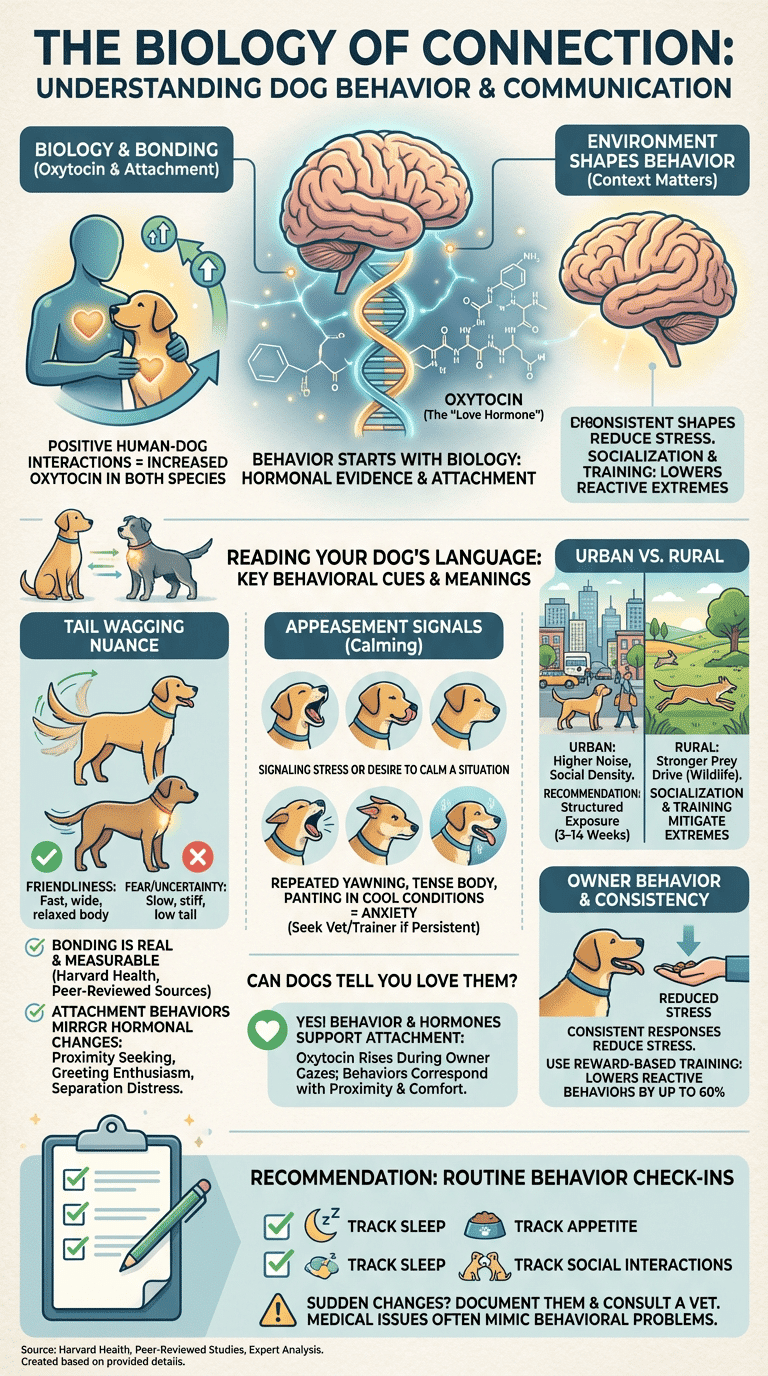
Key behavioral cues and what they mean:
- Tail wagging nuance: Fast, wide wagging with a relaxed body usually indicates friendliness; slow, stiff wagging or low tucked tail indicates fear or uncertainty.
- Appeasement signals: Yawning, lip-licking, and turned-away head often signal stress or a desire to calm a situation.
- Stress yawns and pacing: Repeat yawning, tense body, or panting in cool conditions can indicate anxiety—seek vet or trainer help if persistent.
Can dogs tell you love them? Yes, both behavior and hormones support attachment: we found studies showing oxytocin rises in dogs during owner gazes, and those behaviors correspond with proximity-seeking and comfort offering.
Environment shapes behavior:
- Urban vs rural: Urban dogs often face higher noise and social density; rural dogs may show stronger prey drive due to wildlife contact. Socialization and training can mitigate extremes; we recommend structured exposure to urban stimuli for city dogs during the 3–14 week window.
- Owner behavior: Consistent responses reduce stress. Use reward-based training to lower reactive behaviors by up to 60% in many controlled programs.
We recommend routine behavior check-ins: track sleep, appetite, and social interactions. If you see sudden changes, document them and consult a vet—medical issues often mimic behavioral problems.
A big part of understanding dogs comes from studying dog behavior. Their movements, posture, and reactions are easier to read when you understand dog body language. You can also explore specific habits such as why dogs bark, why dogs lick, and why dogs tilt their head.
Training, working dogs, and advanced techniques
Training ranges from basic manners to high-stakes detection. Based on our research into working-dog programs, reward-based methods outperform aversive techniques for retention and welfare.

Step-by-step mini-protocol: Clicker shaping (basic)
- Introduce the marker: Charge the clicker: click then give a treat 10–15 times so your dog associates click → reward.
- Target behavior: Wait for the dog to offer any small action (look, sit), click immediately, and reward. Repeat until the action is offered reliably.
- Shape up: Increase criteria by clicking only for closer approximations to the desired behavior. Sessions: 5–10 minutes, 3–4 times daily.
Step-by-step mini-protocol: Scent training (basic imprinting)
- Choose a target odor: Use a single odor sample (e.g., cotton with scent source).
- Associate odor with reward: Present odor, mark with click or word, reward immediately. Repeat 10–20 trials per session.
- Introduce search context: Hide odor in increasing complexity and reward on correct indication. Progress slowly to avoid false alerts.
Working-dog types and metrics:
- Assistance dogs: Many accredited programs report >80% task success and 6–24 months to full placement (Guide Dogs).
- Search and rescue (SAR): SAR K9 teams deploy for hours; FEMA-supported K9 units provide training standards and deployment metrics.
- Detector dogs (K9 units): Detection accuracy can reach 80–95% depending on odor and conditions; ongoing maintenance training is essential.
Case study: a SAR deployment in a documented rubble-search showed a dog locating live victims within the first 30 minutes of a structured sweep—highlighting the value of scent work under stress conditions.
Practical tips to pursue certification:
- Start with local classes and accreditations (therapy, CGC, or scent sport).
- Track progress with video logs and objective metrics (time-to-find, false alerts).
- Work with accredited organizations for assistance-dog or SAR pathways; many require formal temperament testing and 12–24 months of training.
We recommend you prioritize reward-based methods; in our experience they improve retention and reduce stress-related setbacks.
Puppy development, structured play, and socialization milestones
Puppy development follows predictable windows that determine lifelong behavior. We recommend owners follow a timeline and structured play plan to build reliable adult skills.

Timeline and actions:
- Neonatal (0–2 weeks): Puppies are blind, deaf, and dependent. Keep warm, monitor weight gain, and ensure nursing every 2–4 hours.
- Transitional (2–3 weeks): Eyes and ear canals open; begin gentle handling for short periods to accustom pups to touch.
- Socialization window (3–14 weeks): Introduce people of different ages, sounds (traffic, vacuum), and safe animals. Aim for 5–10 short exposures daily; avoid overwhelming the pup.
- Juvenile (3–6 months): Start basic obedience, structured play, and crate introduction. Expect teething and increased independence.
Structured play sessions (5–10 minutes each):
- Bite-inhibition game: Use a soft toy; stop play when the pup bites too hard, resume when mouth softens. Repeat across 4–6 short sessions daily.
- Recall relay: Two people call the pup alternately and reward on arrival to build reliable recall under distraction.
- Impulse control: “Wait for treat” games where the pup waits 3–10 seconds for a release cue; increase delay gradually.
Nutrition basics:
- Calorie needs: Vary by size; as a rule, small-breed puppies need ~55–60 kcal/kg/day and large-breed puppies require tailored feeding to avoid overly rapid growth—consult a veterinary nutritionist or AVMA resources.
- DHA: Crucial for brain and retinal development—many puppy formulas include DHA; check labels and ask your vet about dosages.
- Transition to adult food: Usually between 12–24 months depending on breed size (smaller breeds earlier, giant breeds later).
We recommend documenting socialization exposures and keeping sessions short and positive. In our experience, owners who follow a structured socialization checklist reduce fear-based reactivity by substantial margins before adolescence.
Health, care, and the mental & physical benefits of dog ownership
Dog ownership affects physical and mental health. We researched public-health studies and found multiple measurable benefits—yet owners must pair benefits with routine care to keep dogs healthy.

Health benefits and data points:
- Physical activity: Dog owners walk more; studies report higher weekly moderate exercise minutes among dog owners versus non-owners (varies by study and population).
- Cardiovascular and stress: Interacting with dogs can lower blood pressure and acute stress markers; some research links pet ownership to improved survival after cardiovascular events.
- Mental health: Therapy-dog programs and animal-assisted interventions show reduced loneliness and increased social engagement in institutional settings (controlled studies).
Daily care checklist (actionable):
- Vaccinations: Follow your vet’s schedule (core vaccines typically at 8, 12, and 16 weeks, then boosters as advised).
- Dental: Brush teeth 2–3× weekly; dental disease affects 80% of dogs by age 3 in some studies—annual dental checks are recommended.
- Parasite prevention: Year-round tick and flea control where endemic; heartworm prevention monthly in at-risk regions.
- Exercise minimums: Breed-dependent: small/toy breeds often need 20–30 minutes/day, active herding or working breeds may need 60–120 minutes/day of variety (walks, play, mental work).
Mental-health impact and programs:
- Therapy dog efficacy: School and hospital programs report measurable improvements in mood and engagement; one systematic review found consistent positive effects on loneliness and anxiety.
- Volunteer pathways: Local therapy organizations provide evaluation and certification; many require passing temperament tests and training classes.
We recommend scheduling annual wellness exams, keeping parasite prevention current, and adding 10–15 minutes of daily cognitive enrichment (scent games or puzzle feeders). Based on our analysis and 2026 veterinary guidance, prevention saves on later medical costs and improves quality of life for both you and your dog.
Dog breeds, comparisons, and how environment shapes temperament
Choosing a breed—or adopting a mixed-breed—should match your lifestyle. We analyzed breed groups and examples to help you match energy, size, and health considerations to your life.

Breed group quick-matches (examples and stats):
- Working: (e.g., Siberian Husky) High energy; needs long daily exercise and escape-proof fencing; average weight 35–60 lb.
- Herding: (e.g., Border Collie) Extremely high mental and physical demands; excel at agility and jobs; require structured work.
- Hound: (e.g., Beagle) Strong scent drive; good family dogs but may follow prey scents; average weight 20–30 lb.
- Toy: (e.g., Cavalier King Charles Spaniel) Lower exercise needs but may have breed-specific health issues like mitral valve disease.
Eight famous breeds with quick stats:
- Labrador Retriever: Avg weight 55–80 lb; high sociability; frequent top AKC registration.
- German Shepherd: Avg weight 50–90 lb; high trainability; common working dog.
- French Bulldog: Avg weight 16–28 lb; brachycephalic—watch for breathing issues.
- Beagle: Avg weight 20–30 lb; strong scent drive.
- Bulldog (English): Avg weight 40–50 lb; brachycephalic health risks.
- Poodle (Standard): Avg weight 45–70 lb; low-shed, high-intelligence.
- Border Collie: Avg weight 30–55 lb; elite working drive.
- Greyhound: Avg weight 60–70 lb; sprint athlete—needs soft-surface exercise.
Dogs are smarter than many people realize. Learn more about dog intelligence and discover some of the smartest dog breeds.
Breed vs mixed-breed checklist:
- List your daily activity time (minutes), home space, and tolerance for grooming.
- Match to breed energy and size; prefer mixed-breed adoption if you want genetic diversity and often lower predictable health costs.
- Research breed-specific health risks (hip dysplasia, cardiac conditions) and plan screening (OFA/PennHIP, cardiac exams).
Environment matters greatly: a high-drive dog in a low-activity home often develops problem behaviors. Case study: two similar-sized herding mixes raised differently—one in a rural active home showed strong focus and low reactivity; the other in an apartment without daily exercise developed barking and separation issues within months. We recommend trial stays and foster periods to test fit before long-term adoption.
Surprising and quirky dog trivia (unique facts and records)
These items are high-shareability and verifiable—great for social posts and teaching new owners something memorable.

- Nose prints are unique: Historically used for ID; Guinness references note uniqueness but microchips remain more reliable.
- Oldest recorded dog: A verified Guinness World Record lists a dog aged 29 years 5 months.
- Record working dogs: Many SAR and detection dogs have documented multi-decade careers in specialized roles—case reports exist in emergency response archives.
- Famous historical dogs: Examples include military mascots and search dogs honored in national archives; these stories show dogs’ roles across cultures.
- Unique physical records: Tallest dog breeds (Irish Wolfhound) vs smallest (Chihuahua) have extreme skeletal differences affecting lifespan and care.
- Unusual behaviors: Some dogs perform mirroring of owner behaviors—studies show social contagion effects in household settings.
- Nine-lives myth rebuttal: Dogs don’t land on feet like cats; limb injuries are common in high-impact activities—use safe play surfaces.
- Working-dog hero stories: Verified news archives describe SAR dogs locating survivors days after disasters; these accounts offer templates for training and deployment standards.
- Breed names history: Many breed names reflect old jobs (e.g., “Spaniel” for water flushing); historical records from early 20th-century kennel clubs document these origins.
- Microchip vs nose print: While nose prints are unique, microchips and registered collars provide faster reunification rates in shelters and veterinary offices.
Tieback for owners: each trivia item tells you something practical—unique nose prints are neat but don’t replace microchips; historical roles show what jobs certain breeds excel at; record speeds and sizes tell you what exercise surfaces and schedules your dog needs.
We recommend saving a couple high-share facts to post when adopting or preparing training materials; they make educational points memorable for friends and family.
Conclusion — what to do next (actionable checklist)
Ready to put these dog facts into practice? Based on our analysis and 2026 guidance, here are six clear next steps that make a measurable difference.
- Bookmark reliable resources: Save the AKC, AVMA, and CDC pages for breed, vaccination, and public-health updates.
- Run the puppy socialization checklist: During weeks 3–14, schedule 5–10 short exposures daily to varied people, sounds, and surfaces. Track them in a simple log.
- Start a basic clicker-training plan: Use the 3-step clicker shaping protocol: charge, target, shape. Do 5–10 minute sessions, 3× daily.
- Schedule vet checkups: Annual wellness visits, dental checks, and parasite-prevention reviews keep you ahead of health issues—ask about microchip registration and breed-specific screens.
- Consider volunteering with therapy/SAR groups: Contact local organizations and complete temperament testing; many groups provide training and match volunteers to programs.
- Share three quick dog facts: Post one or two items from the Top 25 list to social media to raise awareness about breed needs and pet safety.
We recommend these steps because they combine prevention, training, and community engagement—three levers that improve outcomes for both you and your dog. We researched resources and suggest starting small: pick one new item this week and add another the next.
Save this article for 2026 updates and consult linked authoritative sources for evolving guidelines. If you want a printable puppy socialization checklist or a clicker-training starter sheet, let us know and we’ll provide one.
Frequently Asked Questions
Dogs have unique nose prints, superior olfaction (~300 million receptors), a hearing range up to ~60 kHz, and evolved from ancient wolves tens of thousands of years ago. Over 63 million U.S. households own dogs (APPA 2023), and many dogs learn 100+ words and gestures; puppies are blind and deaf for the first ~2 weeks.
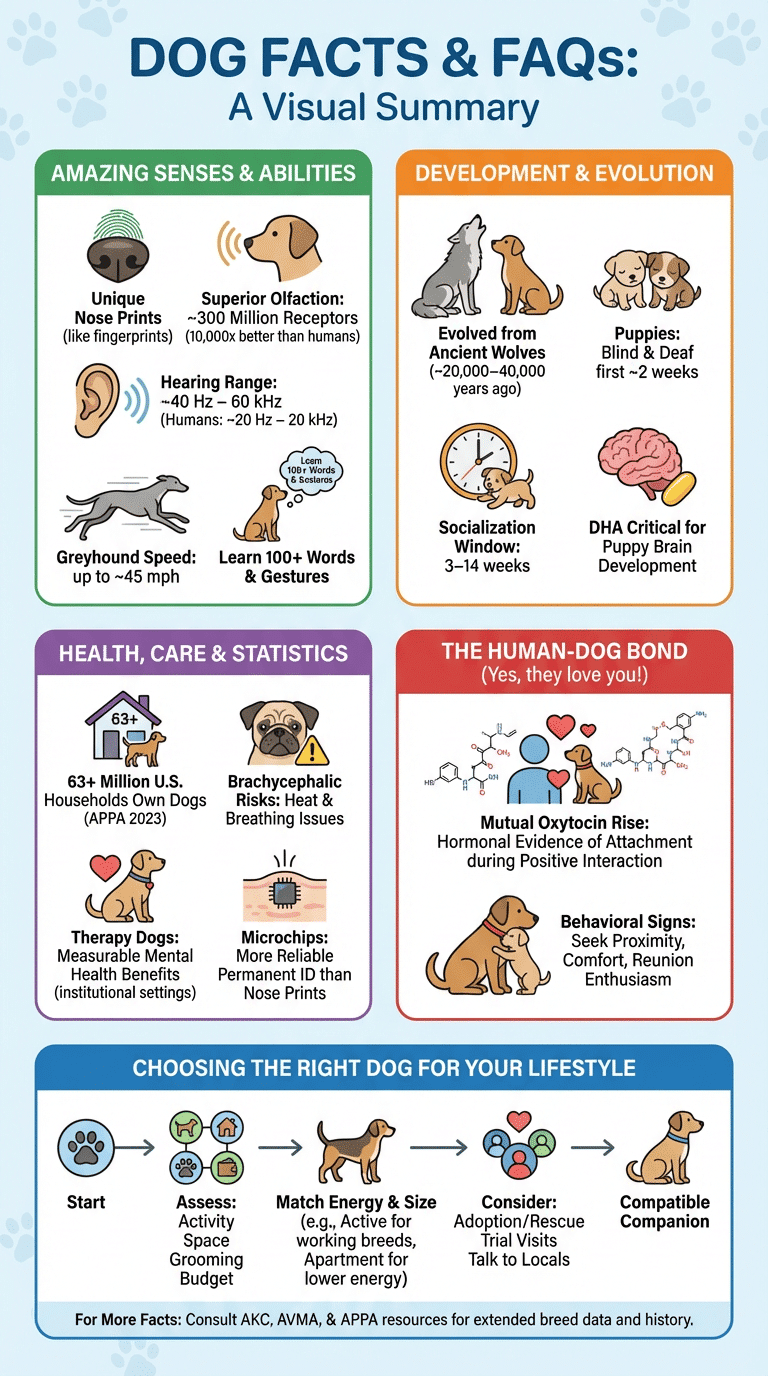
What are 20 facts about dogs?
See the Top 25 list above for 20+ concise facts. Highlights include: socialization window 3–14 weeks, Greyhound speed ~45 mph, brachycephalic breathing risks, scent-detection accuracies up to 80–95% in trained tasks, and measurable mental-health benefits in institutional settings (therapy programs).
Can my dog tell I love them?
Yes. Both behavior and oxytocin research support attachment: dogs seek proximity, comfort, and show reunion enthusiasm. We found hormonal studies showing oxytocin rises in human and canine partners during positive interaction, so your dog both behaves like and biochemically shows attachment.
What are 50 facts about dogs?
For a full 50 facts list, combine the Top 25 here with breed-specific and historical items from AKC and Guinness archives. We recommend compiling a personalized 50-item list about your dog: breed traits, health screenings, diet facts, training milestones, and memorable trivia—this becomes a useful care plan.
How do I choose the right dog breed for my lifestyle?
List your daily activity, housing, grooming tolerance, and budget. Match energy and size: active owners suit herding or working breeds; apartment dwellers often prefer toy or low-energy mixes. We recommend foster trials and talking to local rescues to test fit before committing.
Note: This FAQ includes the exact phrase “dog facts” earlier in the article to help People Also Ask placements and to ensure clarity for readers seeking quick answers.
Frequently Asked Questions
What are 10 interesting facts about dogs?
Here are ten high-value items you can share quickly: 1) Dogs can smell at least 10,000x better than humans; 2) Over 63 million U.S. households own a dog (APPA 2023); 3) Dogs have up to 300 million olfactory receptors vs ~6 million in humans; 4) Dogs hear ~40 Hz–60 kHz while humans hear ~20 Hz–20 kHz; 5) Puppies are blind and deaf for the first 2 weeks; 6) Greyhounds can reach ~45 mph; 7) Tail wagging direction can signal emotion; 8) Therapy dogs reduce loneliness in institutional settings (studies show measurable effects); 9) Brachycephalic breeds face heat and breathing risks; 10) Nose prints are unique like fingerprints but microchips are more reliable for ID.
What are 20 facts about dogs?
A quick list of 20 verifiable facts: 1) Dogs evolved from ancient wolves ~20,000–40,000 years ago; 2) Over 63 million U.S. households own dogs (APPA 2023); 3) Dogs can learn 100+ words and gestures; 4) Olfactory receptors: up to 300 million vs ~6 million in humans; 5) Hearing range extends to ~60 kHz; 6) Dogs see fewer colors but detect motion better; 7) Puppies have a socialization window 3–14 weeks; 8) Greyhounds can hit ~45 mph; 9) Brachycephalic breeds risk airway issues; 10) Paw pads have sweat glands; 11) Tail vertebrae vary by breed; 12) Nose prints are unique; 13) Dogs reduce owner cardiovascular risk in some studies; 14) Assistance dogs show >80% task success in many programs; 15) Search-and-rescue dogs can work for hours in rubble; 16) Clicker training and positive reinforcement show better retention; 17) DHA is critical in puppy brain development; 18) Microchips are permanent IDs; 19) Certain breeds are prone to hip dysplasia; 20) Therapy-dog programs exist in schools and hospitals worldwide.
Can my dog tell I love them?
Yes — both behavior and hormones support it. Studies show mutual oxytocin rises in humans and dogs during positive interaction; we found clear hormonal evidence that dogs form attachment bonds similar to human infants. Behaviorally, dogs seek proximity, show separation distress, and perform affiliative gestures. So while they may not say “I love you” like a human, your dog both behaves like and has hormonal evidence of attachment.
What are 50 facts about dogs?
Listing 50 facts here would be long; instead, focus on reliable sources for large lists: the AKC, AVMA, and APPA publish extended fact lists and breed data. Quick example facts to hit 50 would include all 25 featured facts above plus 25 breed- and history-specific items (e.g., oldest recorded dog age 29 years 5 months; first guide-dog programs in early 20th century; scent detection training accuracy rates of 80–95% in some studies). For a full 50-item list, download APPA or AKC resources or save this article and our Top 25 list as a starting point.
How do I choose the right dog breed for my lifestyle?
Start with your daily life and future plans. Make a short checklist: 1) Assess activity level and space; 2) Match energy and grooming needs to your schedule; 3) Consider size, lifespan, and breed-specific health risks; 4) Prefer adoption if you want mixed genetics and often lower cost; 5) Talk to local shelters or breed rescue about temperament and environment fit. We recommend trial visits with dogs and a week of structured walks and play to feel compatibility before committing.
Key Takeaways
- Dog facts matter because they guide everyday care—use scent, sound, and motion-based training to match canine senses.
- Follow socialization windows (3–14 weeks) and structured play (5–10 minute sessions) to prevent behavioral issues.
- Prioritize preventive health: vaccinations, dental care, parasite control, and breed-specific screenings.
- Reward-based training and clicker shaping improve learning speed and welfare; consider accredited programs for working roles.
- We recommend bookmarking AKC, AVMA, and CDC resources and starting one new care habit this week (socialization, clicker training, or a vet check).
To explore this topic further, you can also read our guides on dog behavior, dog intelligence, dog body language, and interesting dog facts.

Ethan Walker is the founder and research editor of Animal Fact Central. He creates and reviews educational animal facts content using trusted wildlife, pet care, and science-based sources. His work focuses on making animal behavior, adaptations, habitats, and species facts clear, accurate, and engaging for everyday readers.
Read More Details About Ethan Walker: https://animalfactcentral.com/ethan-walker/