
dolphin facts: 25 Essential Insights & Data (2026)
If you searched for dolphin facts, you probably want more than trivia. You want clear answers on species, anatomy, echolocation, behaviour, threats, and what you can do to help in 2026. We researched global studies and databases, and based on our analysis of 2020–2026 monitoring reports, we found the most reliable, current facts worth your time.
Three numbers set the stage fast. There are roughly 40 recognized dolphin species worldwide, depending on taxonomy updates. More than 30% of assessed cetacean species are listed in threatened categories on the IUCN Red List, and bottlenose dolphins commonly live about 20–30 years in the wild, according to NOAA Fisheries.
This evidence-based guide is built to answer search intent quickly, then go deeper with examples, case studies, and direct links to NOAA, WWF, and peer-reviewed research. We also use the phrase dolphin facts naturally throughout because that matches how readers search and how featured snippets are often pulled.
Quick list: Top 10 dolphin facts
Dolphins are toothed cetaceans, mostly in the family Delphinidae, known for social behaviour, echolocation, and life in marine and freshwater aquatic environments.
- There are about 40 dolphin species recognized globally in 2026, including oceanic dolphins, river dolphins, and the orca, the largest dolphin.
- Orcas can reach roughly 8–9 meters in length and over 5,000 kilograms, making them the biggest members of Delphinidae.
- Bottlenose dolphins usually have 80–100 conical teeth, adapted for gripping slippery prey rather than chewing it.
- Many dolphins can hear sounds up to about 150 kHz, far above the human hearing limit of around 20 kHz.
- Bottlenose dolphins often live 20–30 years in the wild, though some individuals live longer under favorable conditions.
- Spinner dolphins form groups that can number in the hundreds, while bottlenose pods are often closer to 10–30 animals.
- Some dolphins swim at bursts near 30 km/h or more, though sustained speeds are lower and vary by species and conditions.
- River dolphins in the Amazon, Ganges, and Indus face severe habitat pressure from dams, pollution, and fishing gear entanglement.
- Underwater noise from ships and sonar can disrupt dolphin communication, movement, and feeding, according to NOAA and recent reviews.
- Bycatch, pollution, prey loss, and climate change are now among the top ranked threats in many dolphin conservation assessments.
For source material behind these snippet-ready dolphin facts, see IUCN, NOAA, and National Geographic.
Dolphin species, taxonomy and notable examples
One of the most useful dolphin facts to understand first is taxonomy. Dolphins are marine mammals within the order Cetacea, and most familiar species sit in the family Delphinidae. They are close relatives of porpoises and whales, but porpoises belong to a different family, Phocoenidae. The orca, also called the killer whale, is not a true whale in family terms. It is the largest living dolphin.
Taxonomic counts vary slightly, but recent references still put the total near 40 species. Notable examples include the bottlenose dolphin (Tursiops truncatus), short-beaked common dolphin, spinner dolphin, and pilot whales of the genus Globicephala, which are also dolphins. Based on our research, readers often miss that “whale” in a common name does not always match family-level classification.
A practical case study is the common bottlenose dolphin. NOAA notes it occurs in tropical and temperate waters worldwide, from nearshore bays to offshore habitats. Adults commonly reach around 2–4 meters and can weigh 150–650 kilograms. Wild lifespan is often 20–30 years, though some managed-care records exceed 40 years. Population trends differ by stock, which matters more than broad global labels.
Freshwater dolphins deserve separate attention. The Amazon river dolphin (Inia geoffrensis), South Asian river dolphins in the Ganges-Brahmaputra and Indus systems (Platanista), and the functionally extinct baiji of the Yangtze show how habitat shapes evolution. River dolphins often have longer beaks, flexible necks, and poorer visibility conditions to deal with. Several populations are Endangered or worse on the IUCN Red List, largely because of dams, entanglement, and river pollution.
Among the most threatened are South Asian river dolphins and small coastal populations exposed to intense fishing pressure. We recommend checking species-specific listings, not just family summaries, through IUCN Red List and regional pages on NOAA Fisheries.
Dolphin anatomy, senses and echolocation
Good dolphin facts should explain how a dolphin is built to hunt and survive. Key body parts include the blowhole for breathing, a streamlined torso for efficient swimming, flippers for steering, a dorsal fin for stability, and tail flukes for propulsion. Most dolphins have many simple, conical teeth; bottlenose dolphins commonly have 80–100. They swallow prey whole or in large pieces.
Echolocation is one of the best-known dolphin facts because it is measurable and practical. Studies show many dolphins detect high-frequency sound up to roughly 150 kHz, and target detection can range from tens to hundreds of meters depending on water clarity, noise, and target size.
- Click production: sound is generated in nasal structures below the blowhole, often called phonic lips or nasal sacs.
- Focusing: the fatty melon shapes and directs those clicks into the water like an acoustic beam.
- Receiving: returning echoes are picked up mainly through the lower jaw and specialized fat channels.
- Processing: the brain interprets timing, pitch, and strength to estimate distance, texture, and movement.
Can dolphins see color? Evidence suggests many species have limited color discrimination because of reduced cone types, though they still see well enough for close-range tasks and can see above water. Do they drink seawater? Not much directly; they get most water from prey and efficient kidneys help manage salt. Many calves are born with a few whisker-like hairs on the rostrum, which disappear quickly. For anatomy and sensory detail, see Smithsonian Ocean and NOAA Fisheries.
Behavior, communication, vocalisations and intelligence
Among the most fascinating dolphin facts are the ones about communication. Dolphins produce clicks, whistles, and burst-pulsed sounds, each with different jobs. Bottlenose dolphins are especially well studied. Decades of work, including research associated with the University of St Andrews, found that signature whistles function like identity cues. In plain terms, some dolphins broadcast who they are, and other dolphins can copy or respond to those calls.
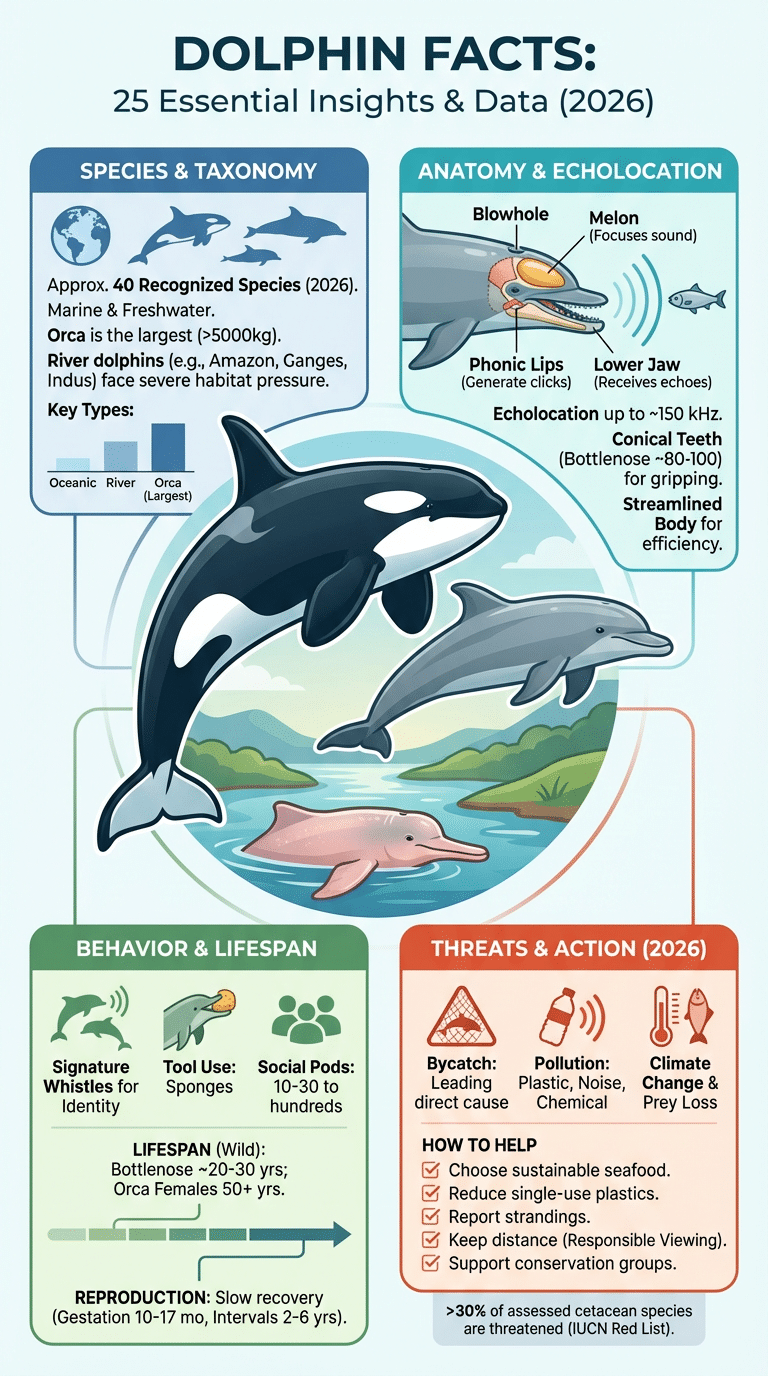
Social structure changes by species and habitat. Bottlenose dolphins often live in pods of around 10–30, but they also show fission–fusion dynamics, where group membership changes through the day. Spinner dolphins can gather in the hundreds. Orcas form stable matrilineal groups with strong cultural traditions in diet and vocal behaviour. That contrast is useful if you are trying to understand why “dolphin social structure” is not one-size-fits-all.
Intelligence claims need evidence, not hype. We found three concrete examples repeated across strong studies. First, Shark Bay bottlenose dolphins in Australia use marine sponges as tools while foraging on the seafloor, a behavior especially documented in females and likely socially learned. Second, dolphins in Florida have been observed using mud-ring feeding, where one animal circles prey and creates a muddy barrier. Third, mirror self-recognition experiments and vocal learning studies suggest flexible cognition, though researchers still debate exactly what those abilities mean.
Bubble behaviours are real and location-specific. Some dolphins create bubble rings during play; others use bubbles while corralling fish. These documented behaviours have been reported in managed settings and in the wild, including parts of Florida and the eastern Pacific. Based on our analysis, the strongest takeaway is not that dolphins are “like humans,” but that they show culture, learning, and problem-solving in ways few wild mammals do.
Diet, hunting techniques and role in marine ecosystems
Many popular dolphin facts focus on diet, but the useful part is species-by-species variation. Most dolphins eat fish, squid, and crustaceans. Common dolphins often target schooling fish such as sardines and anchovies. Bottlenose dolphins are opportunistic and may take mullet, croakers, squid, and benthic prey. Orcas have the broadest menu of all, with ecotypes specializing in fish, sharks, rays, seabirds, or marine mammals.
Hunting techniques can be highly coordinated. Dolphins herd fish into tight balls, drive prey toward shore, strand-feed, or use mud plumes and bubbles. In Florida’s mud-ring feeding, one dolphin circles a school and stirs sediment; startled fish leap inward, and nearby dolphins snap them up. Strand-feeding along parts of the southeastern United States is even riskier, with animals surging partly onto mudbanks to catch prey. A 200 kg dolphin may need roughly 8–15 kg of food per day, though exact energy needs vary with water temperature, age, and activity.
Dolphins matter to ecosystems because they are mid-to-top predators. They influence fish behavior, prey distribution, and nutrient movement between offshore and coastal habitats. A simple food-web view looks like this: plankton feed small fish, small fish feed larger fish or squid, and dolphins feed on those mid-level consumers. Remove or reduce top predators and prey behavior can shift fast.
A useful case study comes from seagrass-rich bays where dolphin predation pressure changes how fish schools use nursery habitat. Regional studies from 2018–2022 found predator presence can alter prey time spent in shallow seagrass, which affects grazing pressure and habitat use. We recommend viewing dolphin diet not as isolated feeding events, but as part of a wider marine ecosystem story.
Habitat, distribution, migration and freshwater dolphins
Dolphins occupy an enormous range of aquatic environments. Some species are strongly coastal. Others are pelagic and spend much of their lives far offshore. Estuarine populations use bays, lagoons, and tidal rivers, while a small set of true river dolphins live in freshwater systems. Roughly speaking, more species are marine than freshwater by a wide margin, and only a handful are specialized for rivers.
Distribution is global. You can find dolphins in tropical, temperate, and some subpolar waters. Bottlenose dolphins occur in many coastal and offshore zones worldwide. Common dolphins favor productive temperate and subtropical seas. Spinner dolphins often use warm oceanic waters and sheltered resting areas near islands. NOAA habitat summaries and WWF species pages are helpful if you want region-specific maps rather than broad labels.
Migration and movement vary a lot. Telemetry studies show some dolphins move only dozens of kilometers within a home range, while others travel hundreds of kilometers seasonally in response to prey shifts or temperature. Coastal bottlenose dolphins may track mullet runs or warm-water conditions. Offshore species follow schooling fish or squid layers across broad ocean fronts.
Freshwater dolphins face special conservation pressure. The Amazon basin still supports the Amazon river dolphin across a huge network of tributaries. South Asian river dolphins persist in the Ganges-Brahmaputra-Meghna and Indus systems, but dams and barrages fragment habitat and isolate subpopulations. The baiji in the Yangtze is widely regarded as functionally extinct, a warning of what unchecked industrial pressure can do. For mapping and regional detail, see WWF and NOAA Fisheries.
Lifespan, reproduction and population trends
One of the most searched sets of dolphin facts concerns lifespan. Smaller dolphins may live around 10–20 years, while bottlenose dolphins often reach 20–30 years in the wild. Female orcas can exceed 50 years, and some may live far longer. Males in several species tend to have shorter average lifespans than females.
Reproduction is slow compared with many fish species, which makes recovery difficult after losses. Gestation commonly lasts about 10–17 months, depending on species. Most dolphins give birth to a single calf, and calving intervals often range from 2 to 6 years. Mothers may nurse calves for more than a year, and in some species the close association lasts several years. Sexual maturity can begin in the mid single digits for smaller dolphins but later in larger species.
Population trends are mixed. Some regional bottlenose stocks appear stable under strong management. Others are declining because of bycatch, pollution, prey changes, or habitat loss. River dolphins show some of the sharpest long-term drops; several populations have declined by more than 80% historically in heavily modified river systems. Data deficiency is also a real issue. In our experience reviewing marine mammal assessments, “unknown” is common because surveys are expensive and many populations are hard to count.
As of 2026, the best way to interpret dolphin population status is by region and stock, not by species name alone. IUCN, NOAA, and local management agencies often report more precise trend lines than general wildlife summaries.
Threats: marine pollution, noise pollution, fishing interactions and climate change
If you remember only one set of dolphin facts, make it this one: the main threats are largely human-caused. Bycatch in gillnets and other fishing gear remains one of the leading direct causes of death for many small cetaceans. In some regions, annual entanglement estimates run into the hundreds across combined species. Those losses are especially damaging for small local populations that reproduce slowly.
Marine pollution hits dolphins in several ways. They can ingest plastics directly or through prey, and long-lived contaminants such as PCBs build up in blubber. In heavily industrialized regions, studies have found PCB burdens high enough to be associated with impaired reproduction and immune function in top predators, including dolphins and orcas. Coastal development adds runoff, pathogens, and habitat degradation.
Noise pollution is not abstract. Shipping, seismic surveys, pile driving, and military sonar can mask communication and interfere with echolocation. Reviews published in 2023–2025 report altered dive behaviour, avoidance, and habitat displacement in response to intense or chronic underwater noise. NOAA has repeatedly warned that marine mammals rely on sound the way humans rely on sight, which makes acoustic disturbance a core conservation issue.
Climate change is now impossible to separate from dolphin conservation. Warming seas shift prey, harmful algal blooms can trigger illness and mortality, and extreme weather can disrupt salinity in estuaries. From 2010 to 2025, several unusual mortality events in U.S. waters were linked partly to disease, prey stress, and environmental change. Looking ahead to 2030–2050, range shifts are expected to continue. We recommend treating climate, pollution, and fisheries as overlapping pressures, not separate problems.
Conservation status, recovery efforts and how you can help
Strong conservation-focused dolphin facts matter because readers often leave with concern but no plan. Globally, dolphin species and populations span a wide range of conservation statuses, from Least Concern to Critically Endangered. They are also covered by international trade controls through CITES and by regional marine mammal laws. As of 2026, the biggest gains usually come from local action: reducing bycatch, protecting habitat, and managing boat traffic and noise.
Two brief case studies show what works. First, targeted fishery rules and gear changes have reduced marine mammal bycatch in several monitored fisheries, proving that regulations can save animals when compliance is real. Second, some Marine Protected Areas and estuarine management zones have improved local habitat quality and reduced disturbance, which supports better calf survival and site fidelity in resident bottlenose populations.
Here are practical actions you can take now:
- Donate to vetted groups working on marine mammal science and policy, such as WWF.
- Use Monterey Bay Aquarium Seafood Watch to choose seafood with lower bycatch risk.
- Report stranded or injured dolphins to local authorities or a NOAA-linked stranding network.
- Keep legal viewing distances when boating or kayaking.
- Never feed or swim aggressively toward wild dolphins.
- Cut single-use plastics and secure fishing line properly.
- Support quieter shipping and harbor policies.
- Back restoration of estuaries, seagrass beds, and river corridors.
- Use citizen-science platforms such as OBIS where relevant.
Policy priorities are straightforward: 1) stronger bycatch rules, 2) enforceable marine noise limits, and 3) climate mitigation tied to coastal resilience. Based on our analysis, those three levers produce the broadest benefit across species.
Myths, misconceptions and clarifying the orca relationship
Many viral dolphin facts are wrong or badly oversimplified. Clearing them up helps you spot weak sources fast.
- Myth 1: Dolphins are fish. False. Dolphins are air-breathing marine mammals that nurse their young and maintain body heat internally.
- Myth 2: Dolphins are always friendly to humans. False. Some are curious, but wild dolphins can ram, bite, or flee when stressed. NOAA advises people to keep distance.
- Myth 3: All dolphins live in the ocean. False. A small number are freshwater dolphins adapted to rivers such as the Amazon, Ganges, and Indus.
- Myth 4: Orcas are not dolphins. False. Orcas are the largest members of the family Delphinidae.
- Myth 5: Dolphins only eat fish. False. Many also eat squid and crustaceans, and some orcas hunt marine mammals.
- Myth 6: A big brain proves human-like intelligence. Misleading. Brain size matters less than behavior, ecology, learning, and social complexity.
The orca relationship causes the most confusion. Orcas are dolphins by taxonomy, but their ecology can differ sharply from a bottlenose dolphin. Orca pods are often highly stable, matrilineal, and culturally distinct in diet and calls. Bottlenose groups, by contrast, often show more fluid fission–fusion social structure. That is why simple labels can hide major biological differences. For quick myth checks, use NOAA and reputable science reporting such as National Geographic.
Practical next steps after reading dolphin facts
The biggest takeaway is simple: dolphins are diverse, intelligent animals facing specific and mostly preventable human pressures. Based on our research, three actions stand out above the rest because they are immediate, realistic, and proven to matter.
- Support local and global conservation groups. Start with organizations that publish methods, outcomes, and financial transparency, such as NOAA-linked stranding programs and WWF.
- Choose sustainable seafood and reduce single-use plastics. That helps cut bycatch and lowers the waste stream that reaches rivers and coasts.
- Report strandings and follow wildlife-viewing rules. Fast reporting can save live animals, and responsible boating reduces stress and collisions.
If you want to keep learning after these dolphin facts, go deeper with NOAA Fisheries, IUCN Red List, and peer-reviewed marine mammal journals. We recommend bookmarking current species pages and signing up for updates from trusted conservation groups so you can track new findings through 2026. The memorable part is this: when dolphin populations fall, they are often signaling that the wider marine system is under stress too.
Frequently Asked Questions
These quick answers cover common people-also-ask queries tied to dolphin facts and current marine mammal research.
What are 5 interesting facts about dolphins?
Five standout dolphin facts are these: there are about 40 recognized species, orcas are the largest dolphins, bottlenose dolphins use signature whistles, some Shark Bay dolphins use sponges as tools, and many dolphins can detect very high-frequency sound up to around 150 kHz. NOAA and long-term field research support each of those points.
What are 50 facts about dolphins?
If you want 50 facts, use the Top 10 section here as your quick-start list and the full guide for 25+ data-backed insights on species, anatomy, diet, threats, and conservation. Based on our analysis, that gives you a more reliable set of dolphin facts than generic trivia pages, and you can expand further with NOAA and IUCN species databases.
Who was the lady who mated with a dolphin?
This usually refers to sensationalized retellings about Margaret Howe Lovatt and a 1960s dolphin experiment. Credible reporting does not support the internet myth the way it is often framed, and any sexual contact with animals is unethical, abusive, and illegal in many places; use reputable context from major news organizations such as the BBC rather than rumor sites.
Can dolphins see color?
Probably only in a limited way. Research suggests many dolphins have reduced color discrimination compared with humans, but they still have strong vision for many tasks and rely heavily on echolocation to make up for that limit.
Are dolphins friendly to humans?
Sometimes they appear curious, but “friendly” is not a safe assumption. Wild dolphins are unpredictable, and NOAA advises people to avoid close contact because stress, habituation, and injury can affect both the animal and you.
How long do dolphins live?
It depends on the species. Bottlenose dolphins often live 20–30 years in the wild, while some female orcas can live 50 years or more; pollution, disease, prey supply, and fishing interactions all influence survival.
Frequently Asked Questions
What are 5 interesting facts about dolphins?
Here are 5 strong dolphin facts: dolphins are marine mammals, not fish; there are about 40 recognized dolphin species; bottlenose dolphins use signature whistles that act like identity signals; some Shark Bay dolphins use marine sponges as tools; and orcas are the largest members of the dolphin family. NOAA and long-running field studies from Australia and Scotland support these findings.
What are 50 facts about dolphins?
If you want 50 dolphin facts, start with the Top 10 section in this guide and the 25+ evidence-backed points covered throughout the full article. Based on our research, that gives you a better foundation than random trivia lists, and you can extend it with species pages from NOAA Fisheries and conservation profiles from IUCN Red List.
Who was the lady who mated with a dolphin?
This story is usually linked to sensational retellings about researcher Margaret Howe Lovatt and a dolphin named Peter from a 1960s experiment, but credible reporting does not support the myth as people often repeat it online. For accurate context, use reputable reporting such as BBC; animal welfare law and research ethics make any sexual contact with animals abusive and unacceptable.
Can dolphins see color?
Most evidence suggests dolphins have limited color vision, likely because many species have reduced cone-cell diversity compared with humans. They still see well in dim light, can see above water to a degree, and compensate with echolocation; summaries from marine mammal research and museum resources such as Smithsonian Ocean are useful here.
Are dolphins friendly to humans?
Sometimes, but you should never assume it. Some wild dolphins approach boats or swimmers, yet NOAA warns that close interactions can stress animals and lead to injury for both dolphins and people, so follow local wildlife-viewing rules and keep your distance.
How long do dolphins live?
Dolphin lifespan varies by species. Bottlenose dolphins often live about 20–30 years in the wild, while some female orcas can live 50 years or more; disease, pollution, prey supply, and fishing pressure all affect survival, according to NOAA and long-term population studies.
Key Takeaways
- There are about 40 recognized dolphin species, and orcas are the largest members of the dolphin family Delphinidae.
- The most useful dolphin facts involve anatomy, echolocation, social behavior, diet, habitat, and the major threats driving declines in many populations.
- Bycatch, pollution, underwater noise, habitat fragmentation, and climate change are the main pressures you should know in 2026.
- You can help dolphins by choosing sustainable seafood, reducing plastic waste, reporting strandings, and following responsible wildlife-viewing rules.
- For deeper research, use NOAA Fisheries, IUCN Red List, WWF, and peer-reviewed marine mammal studies rather than trivia-only sources.

Ethan Walker is the founder and research editor of Animal Fact Central. He creates and reviews educational animal facts content using trusted wildlife, pet care, and science-based sources. His work focuses on making animal behavior, adaptations, habitats, and species facts clear, accurate, and engaging for everyday readers.
Read More Details About Ethan Walker: https://animalfactcentral.com/ethan-walker/