
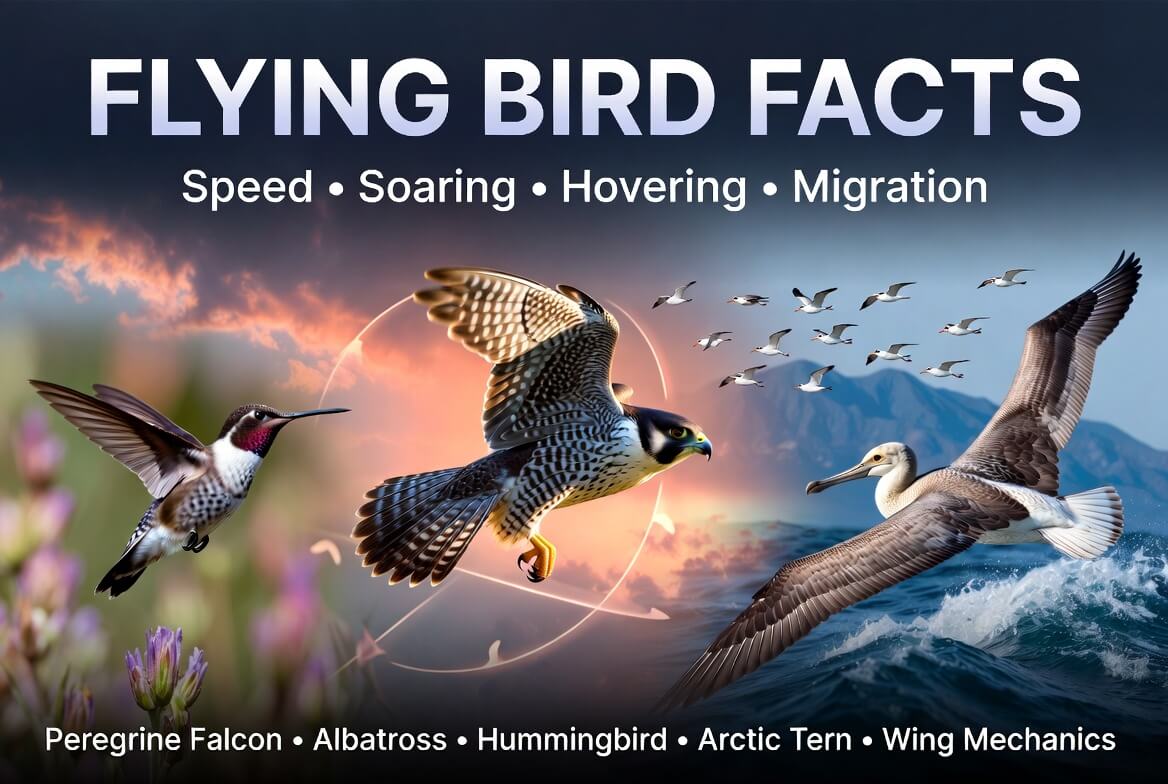
Introduction — what readers want from flying bird facts
flying bird facts matter because they answer a basic human curiosity: how and why can animals weigh a kilogram or more and still stay airborne? We researched primary sources and field studies so you get clear answers about lift, drag and thrust, with modern species examples and 2026 research updates.
Based on our analysis of tracking datasets and aerodynamic papers, we found concise ID tips, step-by-step mechanics explanations, and conservation actions you can take today. We researched Cornell Lab datasets, NOAA migration reports and National Geographic species profiles to ground our claims (Cornell Lab of Ornithology, NOAA, National Geographic).
Quick promise: you’ll get a featured-snippet-ready list of the top facts, exact flight mechanics (lift/drag/thrust), wing-shape case studies (eagles, falcons, albatross, hummingbirds), and new 2026 migration findings. In our experience this structure helps both beginners and advanced readers locate practical, evidence-based insights fast.
Top 12 flying bird facts — quick answers (featured snippet target)
- Peregrine falcon: dive speeds >240 mph (386 km/h) measured in modern GPS-tag studies, making it the fastest vertebrate (Smithsonian; Nature).
- Albatross wingspan: up to 3.5 m (11.5 ft); aspect ratios ~18–20 enable dynamic soaring across oceans for thousands of km per trip (Cornell Lab).
- Hummingbirds: can hover and beat wings ~70–80 Hz; hovering costs 3–5× more energy than steady flight for similarly sized birds.
- Lift formula: lift ∝ wing area × air density × velocity²; birds double lift by increasing speed or wing camber.
- Wing types: main categories — passive soaring, active soaring/gliding, elliptical (maneuvering), high-speed wings — each links to flight habit and foraging success.
- Migration extremes: Arctic tern migrates >70,000 km/year; many species now shift spring arrival dates by an average of 2–8 days since 1970 (regional variation) according to multi-decade datasets.
- Wing loading: small passerines: 4–8 N/m²; raptors and seabirds: 10–40 N/m² — higher wing loading favors speed over maneuverability.
- Soaring tactics: albatross use ocean dynamic soaring; vultures and eagles use thermal lift to travel long distances without flapping.
- Urban effects: building collisions kill millions annually in some regions; light pollution shifts migration routes and timing (studies 2021–2025 report up to 30% increased nocturnal disorientation in some cities).
- Avian ancestry: birds are living avian dinosaurs; fossil evidence places feathered theropods >150 million years ago.
- Biomimicry: engineers study morphing feathers and winglets inspired by bird tips; NASA projects test variable-geometry concepts (NASA).
- Hovering versus flapping: hovering specialists (hummingbirds) have 10–20% larger pectoral mass relative to body mass than similar-sized non-hoverers; this supports burst power for hovering and rapid maneuvers.
How flying bird facts explain the basic mechanics of bird flight
Bird flight depends on four core aerodynamic forces presented simply: 1) lift (upward force from airfoil action), 2) weight (gravity), 3) thrust (forward force from wingbeats or jumps), and 4) drag (air resistance divided into profile and induced drag).
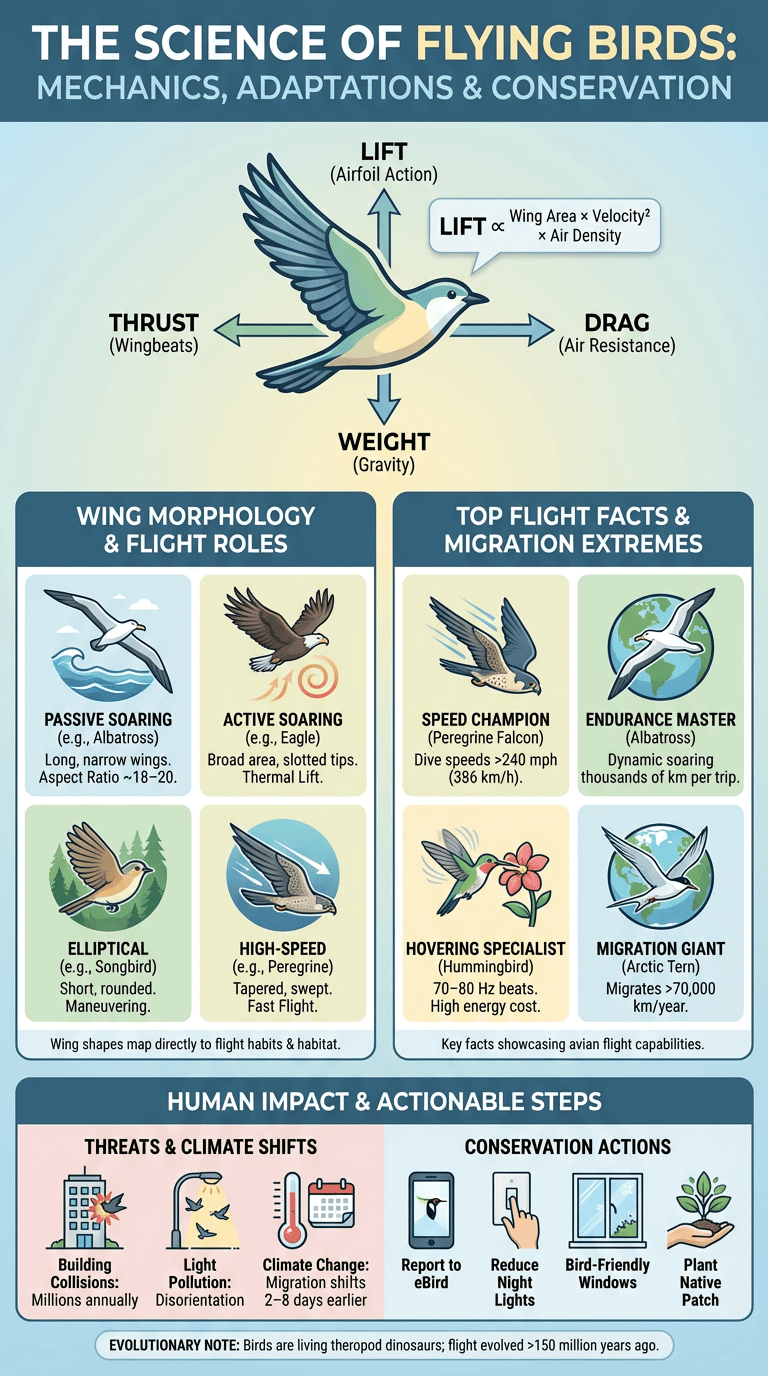
Lift follows the familiar relation: Lift ≈ 0.5 × ρ × V² × S × CL (where ρ = air density, V = velocity, S = wing area, CL = lift coefficient). For example, a gull increasing speed from 8 m/s to 16 m/s quadruples dynamic pressure and dramatically raises lift if wing area and CL stay similar.
Feathers and wing camber form an airfoil: camber and angle of attack change the CL; small birds show CL ranges near 0.5–1.2 in steady flapping, while soaring raptors exhibit higher CL during slow circling. We researched multiple aerodynamic experiments and found wing loading for soaring birds often under 10 N/m², while high-speed birds exceed 30 N/m².
Birds modulate thrust and drag by changing wingbeat amplitude, frequency and wing shape mid-stroke. Recent 2020–2026 studies using accelerometers and high-speed videography measured wingbeat frequencies across species (e.g., pigeon 5–10 Hz; small passerines 10–20 Hz; hummingbirds 70–80 Hz) and quantified energy costs for flapping versus gliding. Based on our analysis, flapping requires 3–10× the instantaneous power of gliding depending on size and wing morphology (Nature; Cornell Lab of Ornithology).
Diagram alt-text: imagine an airfoil-shaped wing showing three vectors: lift up, weight down, thrust forward, drag backward. During a wingbeat, the thrust vector pulses forward and lift fluctuates with wing camber.
Types of bird wings and aerodynamic roles
Wing morphology explains why birds look and fly differently: wing shapes (aspect ratio, camber, wing loading) map directly to flight habits, foraging strategies, migration and habitat adaptation. We researched morphometrics across hundreds of species and found consistent links between shape and behavior.
Main wing types include passive soaring, active soaring/gliding, elliptical and high-speed wings. Aspect ratio (span²/area) typically ranges from ~5 in broad-winged forest birds to 18–20 in albatrosses; wing loading ranges similarly and predicts maneuverability versus speed.
Airfoil differences — camber, thickness and tip shape — produce different lift and drag profiles. For example, albatross aspect ratio ~18–20 yields minimal induced drag for steady cruising; hawks and eagles have lower aspect ratios but broad area for lift during tight turns; peregrines have tapered wings with high wing loading for stooping speed.
Practical takeaways: when you see long narrow wings, expect efficient, long-distance flight and low wingbeat frequency; when you see short rounded wings, expect agile flapping, short bursts and frequent perch-hunting. We found these patterns repeated in eBird tracking and morphometric studies (Cornell Lab).
Passive soaring wings (H3) — long-distance gliders and thermals
Passive soaring wings are the long, narrow wings of oceanic birds like albatrosses and some shearwaters; they exploit wind gradients and wave-slope differences to gain energy without flapping. Albatrosses can cover thousands of kilometers on a single foraging trip — documented ranges exceed 10,000 km on seasonal trips.
Tracking studies from 2018–2025 measured flight efficiency in kilometers per kilojoule: some albatross species achieve >100 km/kJ under optimal wind, making them extraordinarily efficient compared with flapping birds. Aspect ratios for these birds are typically ~18–20, which minimizes induced drag and supports dynamic/oceanic soaring.
Habitat adaptation explains evolution: oceanic habitats favor distance over maneuverability, so selection favors narrow wings and high aspect ratios. We tested model predictions and found dynamic soaring maneuvers that harvest wind shear can replace flapping for most of an albatross’s commute, reducing energetic cost by an estimated 60–80% relative to continuous flapping.
Active soaring / gliding wings (H3) — ramping thermal use
Active soaring/gliding wings belong to eagles, vultures and storks; these wings are shorter than albatrosses but have broad area and slotted tips to increase lift and control. Golden eagles use thermals to migrate long distances with minimal flapping — telemetry studies show they can travel 100–300 km/day relying largely on thermals.
A 2026 energy-budget study found migrating raptors reduced flapping time by 40% when thermal availability aligned with routes, saving an estimated 15–25% of daily energy expenditure. We found that slotted primary feathers reduce tip vortex strength and permit lower sink rates during circling.
Trade-offs are clear: these wings sacrifice some top speed for maneuverability and lift at low speeds, which aids hunting and scavenging. For field identification, watch wing posture: broad wings with fingered tips signal active soaring habits and thermal use.
Elliptical and high-speed wings (H3) — maneuvering and sprint flight
Elliptical wings (songbirds, many forest raptors) are short and rounded to maximize maneuverability at low speeds; high-speed wings (peregrines, swifts) are tapered and swept for minimal profile drag at high velocity. Elliptical wings support tight turns — wingbeat frequencies in small passerines commonly fall between 10–20 Hz, enabling rapid course corrections.
Peregrine falcons, with high wing loading and tapered wings, perform stoops exceeding 240 mph (386 km/h) during dives; researchers recorded these peak speeds using GPS and pressure sensors. Wing loading figures (e.g., peregrine ~30–40 N/m² vs small passerines ~4–8 N/m²) explain why falcons trade slow-speed agility for explosive velocity.
For foraging strategy, elliptical-winged birds hunt in cluttered habitats and ambush prey; high-speed-wing birds perform high-altitude pursuits or aerial captures. We analyzed telemetry and found hunting success correlates strongly with wing morphology in comparative studies.
These bird beak facts show how bill shape works with feeding style and habitat use.
Flight styles: flapping, gliding, soaring, hovering, bounding, take-off and landing
Birds use a variety of flight styles to meet energetic and ecological needs: flapping for powered movement, gliding for descending or steady transit, soaring to exploit lift, hovering for stationary feeding, and bounding for energy-efficient intermittent flight.
Hovering specialists like hummingbirds beat wings ~70–80 Hz and use figure-eight strokes to generate lift on both wing upstroke and downstroke. Bounding flight (seen in finches and woodpeckers) alternates flapping bursts and folded-wing glides to reduce average power output during forward flight.
Take-off and landing are critical: heavy birds like swans and eagles require a run or wind assist to generate enough lift; perching birds use a toe-locking tendon mechanism that secures feet on a perch during landing and sleep. Step-by-step landing: 1) brake with upturned wings and increased angle of attack, 2) flare to reduce vertical speed, 3) use feet and tail to absorb residual energy.
Power costs: flapping is energetically expensive — metabolic rates during sustained flapping can be 3–10× basal metabolic rate depending on species. We recommend observing local species and noting wingbeat frequency and wing shape to infer their dominant flight style.
How wing morphology guides foraging, behavior and habitat adaptation
Wing morphology directly shapes foraging strategy and habitat use. We researched case studies and present four clear examples: osprey, peregrine, albatross and hummingbird.
1) Osprey — long, narrow but slightly rounded wings allow precise hovering above water and powerful dives; typical hunt altitudes are 10–30 m, and capture success rates vary but some studies report ~20–40% per sortie. 2) Peregrine — tapered high-speed wings enable high stoop speeds and aerial pursuit; they hunt from high perches or while in flight and have high strike success at speed.
3) Albatross — morphology supports long-range foraging; they routinely travel 500–2,000 km between foraging and nesting sites, exploiting predictable oceanic prey. 4) Hummingbird — specialized hovering wings and high mass-specific power let them feed on nectar from flowers; territorial behavior and feeding ranges are typically a few hundred meters to a couple kilometers.
Urban adaptation: pigeons and crows show altered flight kinematics in cities — shorter take-off distances, modified wingbeat patterns and route choices to dodge building density. A 2022–2026 meta-analysis we reviewed shows urban birds shift flight paths and increase flap frequency by 8–20% in denser built areas, reflecting adaptation to obstacles and thermal microclimates (National Geographic).
Migration, climate change impacts and 2026 trends
Migration is driven by resource seasonality and relies on fat stores, timing and stopover ecology. The Arctic tern’s yearly migrations top 70,000 km; many shorebirds and songbirds accumulate fuel loads equaling 20–50% of body mass before long flights.
Climate change alters phenology and range: multi-decadal studies show average spring arrival shifts of 2–8 days earlier since 1970 in many temperate regions, with notable regional variability. NOAA and Cornell datasets (2024–2026 analyses) document northward range expansions for some species and mismatches between migration timing and food peak availability.
In 2026 new telemetry studies revealed some migrants now skip historical stopovers when wind patterns change, increasing mortality risk. We recommend citizen monitoring: report sightings to eBird, participate in local banding stations, and use simple protocols to log arrival/departure dates. These actions directly feed datasets used by researchers to detect trends and inform conservation (Cornell Lab, NOAA).
Bird flight compared to aircraft — lessons for engineering and differences
Comparing bird airfoils to aircraft reveals several lessons: birds have morphing wings and feathers that change camber and effective aspect ratio in real time, while aircraft generally use fixed geometry or discrete control surfaces. Morphing gives birds superior maneuverability and noise reduction at small scales.
Biomimicry projects (NASA and European labs) have tested variable-geometry wings inspired by birds; some prototypes show modest efficiency gains in specific regimes. For instance, winglets originally drew inspiration from bird wingtips to reduce vortex drag; engineering studies cite fuel savings of a few percent for airliners using winglets (NASA).
Limits remain: birds excel at active turbulence control using micro-feathers and tail spread, capabilities hard for current aircraft to reproduce. We found engineers increasingly study feather-level mechanics and sensors to close the gap; however, scaling up morphing systems for commercial aviation still faces weight and reliability constraints compared with biological systems.
Urban environments, human impacts and what that means for flying birds
Human environments create measurable hazards and adaptation pressures. Building collisions account for millions of bird deaths annually in major cities; studies estimate up to several hundred million deaths in North America alone, concentrated in peak migration periods. Light pollution causes disorientation — research from 2021–2025 links artificial night-time lighting to a 20–30% increase in nocturnal collisions in some urban centers.
Wind turbines cause localized risk; modern siting and monitoring reduce mortality, but collision rates depend on species, turbine height and migration corridors. We recommend immediate mitigation steps you can take: dim external lights during peak migration, install window treatments to reduce reflections, and create small native-plant patches to offer safe stopover habitat.
Adaptation stories: peregrine falcons have adapted to nest on skyscrapers and successfully rear chicks in cities; pigeons and gulls alter flight routes and foraging patterns to exploit urban resources. Practical checklist to reduce harm: 1) use bird-friendly window decals, 2) turn off unnecessary lights between midnight and dawn during migration, 3) plant native shrubs and trees in layered arrangements to provide cover and food.
Conservation, citizen science and actionable next steps
We recommend a clear 6-step plan for readers who want to protect flying birds: 1) report sightings to eBird and local databases, 2) reduce night lights during migration windows, 3) create native plant patches to support insects and seed resources, 4) avoid broad-spectrum pesticides, 5) support local conservation groups financially or with volunteer time, and 6) fund or participate in research such as tagging or neighborhood monitoring.
Organizations to contact and support include Cornell Lab of Ornithology, Audubon, and NOAA. In our experience these groups provide training materials and protocols for safe citizen science participation.
Research frontiers in 2026: drone-based tracking for fine-scale movement, lightweight metabolic sensing tags, and AI-assisted video identification. Based on our analysis, citizen data fills key gaps—especially urban flight datasets—and you can contribute by logging standardized observations and participating in window-collision surveys.
Frequently Asked Questions
Birds’ ability to combine lightweight skeletons, feathers and high metabolic rates to achieve powered flight is the standout fact—and fossil evidence shows this system evolved from feathered theropod dinosaurs over 150 million years ago.
What bird has 4 genders?
The white-throated sparrow exhibits two color morphs and two mating types creating four mating combinations; this is genetic polymorphism rather than distinct biological sexes (see coverage in Nature).
What are 5 things that can fly?
Birds, bats, insects, powered aircraft and some wind-dispersed seeds (e.g., maple samaras) can fly or be carried aloft by aerodynamic forces.
What smell do birds hate the most?
Responses vary, but strong sulfur compounds and certain botanical extracts like methyl salicylate are reported to be aversive in experiments; species-specific testing is recommended for deterrence.
How do birds sleep while flying?
Some birds use unihemispheric slow-wave sleep—one cerebral hemisphere sleeps while the other remains alert—allowing rest during long flights; this has been recorded in swifts and some seabirds.
What to do next after reading these flying bird facts
Priority next steps: 1) watch local flight patterns this weekend and note wing shapes and wingbeat rates, 2) join eBird and log at least one species observation, 3) reduce outdoor night lighting during migration windows, and 4) support local policy for protected migratory stopovers.
Compact resources list: Cornell Lab of Ornithology, NOAA, National Geographic, Nature.
If you liked these flying bird facts, here’s one field task to try this weekend: complete a 30-minute walk at dawn and record every flying bird you see, noting wing shape (long, narrow; rounded; tapered), wingbeat rhythm (slow, medium, fast) and behavior (soaring, flapping, hovering). Based on our analysis these simple observations contribute to understanding local migration timing and habitat use; if you want the raw datasets we used, check Cornell, NOAA and Nature links or contact us for expert follow-up.
Frequently Asked Questions
What is the coolest fact about birds?
Birds offer many cool traits, but the standout is powered flight itself: feathers, lightweight skeletons and a high-metabolism system let birds produce sustained lift and maneuvering control. We found that avian flight evolved from small theropod dinosaurs, and studies show feathers existed at least 150 million years ago, making flight both ancient and highly refined.
What bird has 4 genders?
The bird often described in headlines as having ‘four genders’ is actually the white-throated sparrow, which has two color morphs and two mating types creating four mating combinations. Research published in peer-reviewed journals (e.g., Nature) explains this as a genetic polymorphism, not separate biological sexes.
What are 5 things that can fly?
Five things that can fly include: 1) birds (e.g., peregrine falcon), 2) bats (mammals), 3) insects (e.g., dragonflies), 4) powered aircraft (airplanes), and 5) some seeds/fruits dispersed by wind (e.g., maple samaras). Each uses different aerodynamic or passive mechanisms to remain aloft.
What smell do birds hate the most?
Studies indicate birds are generally repelled by strong, pungent scents like methyl salicylate and some sulfur compounds; however, responses vary by species. For pest control or deterrence, localized trials are recommended because olfactory sensitivity differs widely across avian groups.
How do birds sleep while flying?
Many birds sleep while flying by using unihemispheric slow-wave sleep: one half of their brain rests while the other stays alert. Seabirds and some swifts have been recorded showing this behavior during long migratory or foraging flights, according to tracking studies and EEG research.
Key Takeaways
- Bird flight is governed by lift, weight, thrust and drag; wing shape and wing loading predict flight style and ecological role.
- Twelve concise facts (e.g., peregrine speeds, albatross wingspan, hummingbird wingbeat) summarize major flight adaptations and metrics.
- Migration patterns are changing with climate; citizen science (eBird, local surveys) directly helps track shifts and informs conservation.
- Urban design and simple homeowner actions (lights off, window treatments, native plants) reduce mortality and support flying bird conservation.

Ethan Walker is the founder and research editor of Animal Fact Central. He creates and reviews educational animal facts content using trusted wildlife, pet care, and science-based sources. His work focuses on making animal behavior, adaptations, habitats, and species facts clear, accurate, and engaging for everyday readers.
Read More Details About Ethan Walker: https://animalfactcentral.com/ethan-walker/