
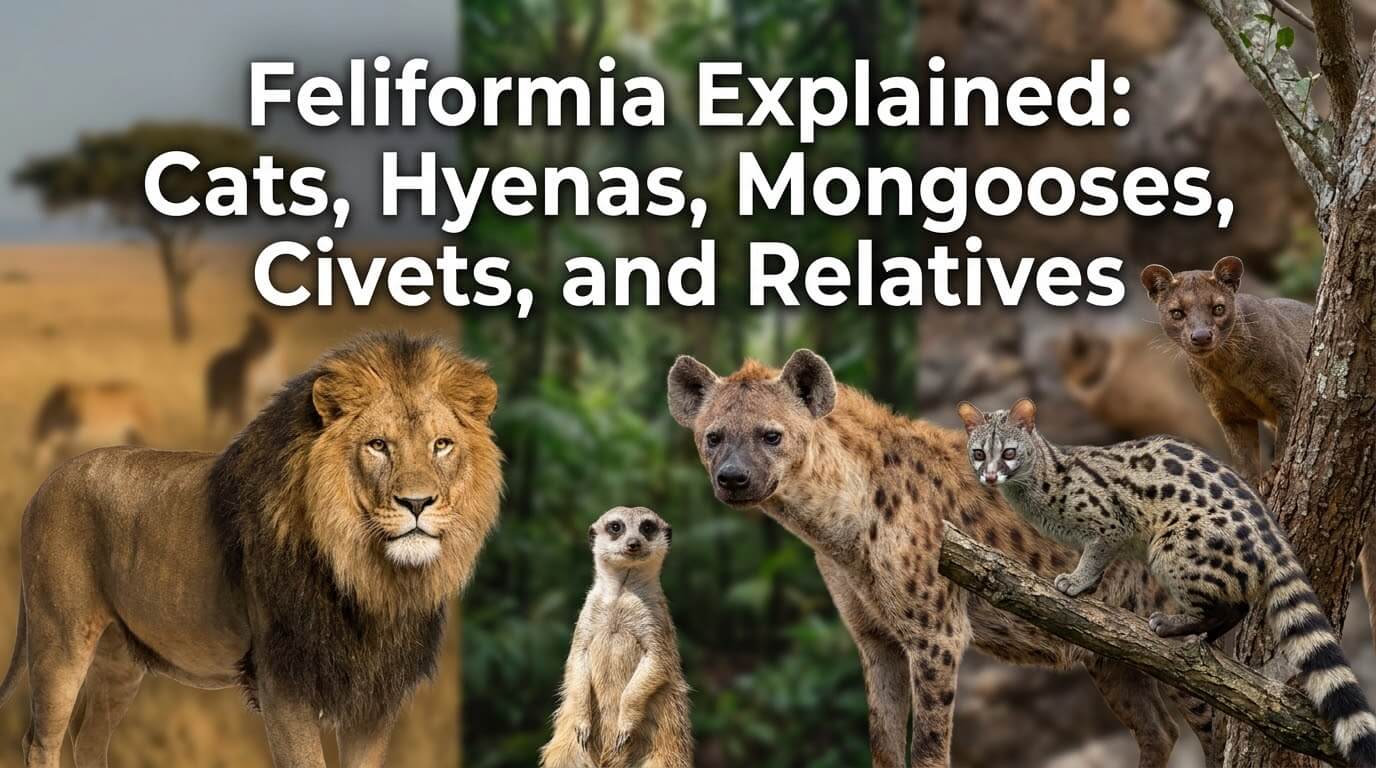
Feliformia is one of the two major living branches of the mammalian order Carnivora. It includes the cat family, but it also includes hyenas, mongooses, Malagasy carnivorans, civets, genets, Asian linsangs, and the African palm civet. That makes Feliformia much broader than the familiar phrase “cat-like carnivorans” can suggest.
The members of this branch share evolutionary ancestry, not one body shape, one hunting style, or one diet. A lion, meerkat, spotted hyena, fossa, binturong, and African palm civet can all be feliforms while differing sharply in size, locomotion, social behavior, habitat, and feeding ecology. Understanding Feliformia therefore works best as a classification framework rather than as a checklist of supposedly “cat-like” traits.
Quick Answer
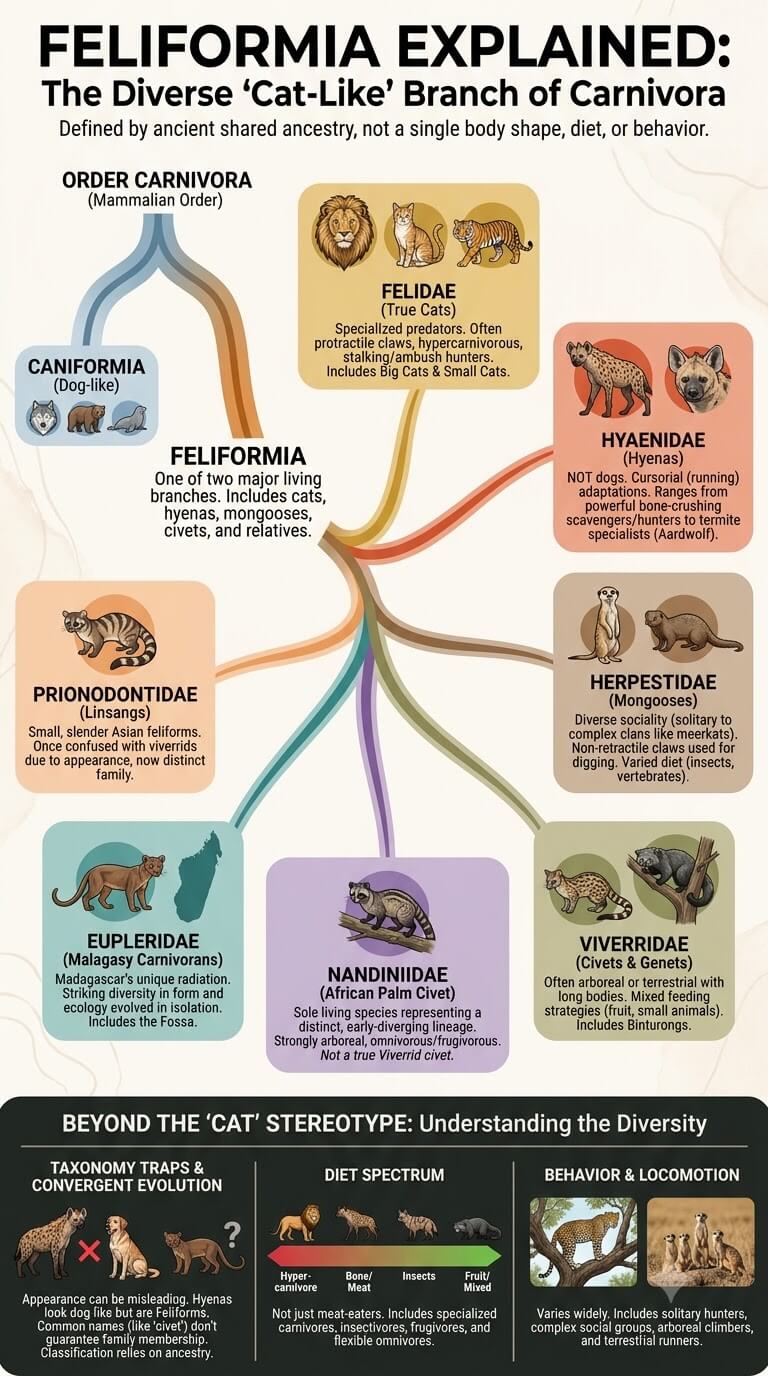
Feliformia is a suborder within Carnivora. In the current Mammal Diversity Database framework, the living feliform families are Felidae, Prionodontidae, Eupleridae, Herpestidae, Hyaenidae, Viverridae, and Nandiniidae. The other major living branch of Carnivora is Caniformia, which includes dogs, bears, mustelids, raccoons, skunks, red pandas, seals, sea lions, and walruses.
“Feliform” does not mean “member of the cat family.” Cats belong specifically to Felidae. A hyena is a feliform in Hyaenidae, a mongoose is a feliform in Herpestidae, and the fossa is a feliform in Eupleridae. These families are relatives within the same evolutionary branch, but they remain distinct lineages.
Why Feliformia Is More Than Cats
The everyday label “cat-like carnivorans” is useful as a rough memory aid, but it becomes misleading if it is treated as a body-shape rule. Feliformia contains sleek ambush hunters such as many cats, long-bodied civets and genets, sturdy bone-processing hyenas, small social mongooses, arboreal species, terrestrial runners, insect specialists, fruit-eating omnivores, and animals found only on Madagascar.
This diversity also shows why taxonomic names and ecological terms should not be confused. Feliformia is a branch defined by ancestry. It is not a diet category. Many feliforms rely heavily on animal prey, but the amount and type of animal food vary, and some species regularly eat fruit or other plant material. Even within a single family, closely related species can occupy different ecological roles.
Familiar cats tend to dominate public ideas about Feliformia because lions, tigers, leopards, and domestic cats are so recognizable. Yet using Felidae as the template for the whole branch hides some of its most informative biology. Hyenas demonstrate that a feliform can evolve a body plan suited to sustained terrestrial movement. Mongooses demonstrate major variation in sociality. Viverrids and the African palm civet show how strongly arboreal and mixed-feeding lifestyles can occur within the same broad branch.
Where Feliformia Fits Within Carnivora
Its position inside Carnivora explains both the shared ancestry of feliform families and why outward resemblance can be misleading.
Feliformia as One of the Two Major Living Branches
Carnivora is a formal mammalian order, and its living members are commonly divided into Feliformia and Caniformia. These names describe evolutionary relationships among carnivoran mammals. They do not mean that every feliform resembles a modern cat or that every caniform resembles a modern dog.
The split is especially useful because it organizes a very diverse order into two deep lineages. Scientists compare many kinds of evidence when reconstructing these relationships, including skull anatomy and molecular data. Certain structures of the middle-ear region, including the auditory bulla that encloses parts of the ear, have long been important in carnivoran systematics. Those anatomical tendencies are more informative than superficial resemblance alone, but even they should not be turned into simplistic one-feature identification rules.
Why Feliform Does Not Mean Member of the Cat Family
Felidae is only one family inside Feliformia. The distinction is similar to the difference between saying an animal is a primate and saying it is an ape. One term identifies a broader branch; the other identifies a narrower group within it.
This matters because convergent evolution can make unrelated or more distantly related mammals look alike. Hyenas can appear dog-like because of features such as their relatively long limbs and sloping back, yet they are firmly within Feliformia. Conversely, a small, slender feliform may resemble a cat without belonging to Felidae. Classification depends on ancestry and diagnostic evidence, not on a quick visual impression.
Living Feliform Families in a Current Taxonomy Framework
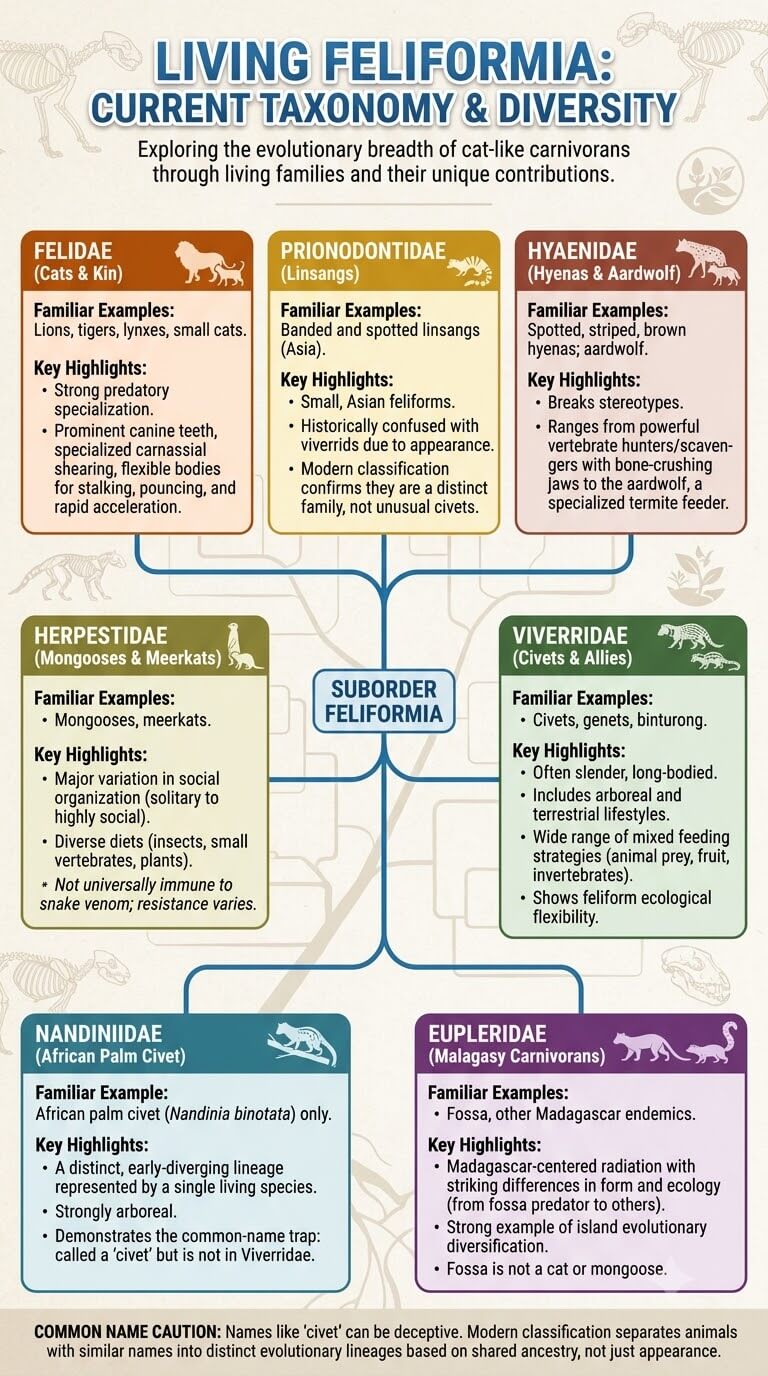
A useful way to understand Feliformia is to learn the families first, then use representative animals to see how each family broadens the picture.
| Family | Familiar examples | What it adds to Feliform diversity |
|---|---|---|
| Felidae | Cats, including lions, tigers, lynxes, and small cats | Strong predatory specialization, stalking, pouncing, and highly developed carnassial shearing in many species |
| Prionodontidae | Banded and spotted linsangs | Small Asian feliforms whose external resemblance once contributed to taxonomic confusion with viverrids |
| Hyaenidae | Spotted, striped, and brown hyenas; aardwolf | Ranges from powerful vertebrate hunters and scavengers to a termite specialist |
| Herpestidae | Mongooses and meerkats | Shows major variation in diet and social organization, including solitary and highly social species |
| Viverridae | Civets, genets, binturong, related forms | Includes arboreal and terrestrial lifestyles and a wide range of mixed feeding strategies |
| Nandiniidae | African palm civet | A distinct early-diverging feliform lineage represented today by a single living species |
| Eupleridae | Fossa and other Malagasy carnivorans | A Madagascar-centered radiation with striking differences in body form and ecology |
Felidae and Prionodontidae
Felidae contains the true cats. Across the family, predatory anatomy is often strongly developed: relatively short faces, prominent canine teeth, specialized carnassials, flexible bodies, and limb mechanics that support stalking, rapid acceleration, grappling, or pouncing in different combinations. Those tendencies are powerful, but they do not make every cat identical in prey choice, habitat, activity pattern, or social behavior.
Prionodontidae is much smaller and contains the Asian linsangs of the genus Prionodon. Their placement is a good example of why appearance and old common-name associations can be deceptive. The Mammal Diversity Database entry for the banded linsang places it in Prionodontidae and notes its historical movement from Viverridae. Modern classification therefore treats these linsangs as their own feliform family rather than simply as unusual civets.
Hyaenidae and Herpestidae
Hyaenidae contains hyenas and the aardwolf. This family alone breaks several stereotypes about feliforms. Some hyenas are formidable hunters as well as scavengers, and their skulls and jaws can be adapted for processing resistant foods such as bone. The aardwolf takes the family in a very different direction because it specializes heavily on termites rather than on large vertebrate prey. The Animal Diversity Web profile of Hyaenidae highlights this contrast within the family.
Herpestidae includes mongooses and meerkats. Many have elongated bodies, relatively short legs, pointed faces, and terrestrial habits, but the family is behaviorally diverse. Some species live largely alone, while others form stable social groups and coordinate activities such as vigilance or care of young. Their diets can include insects, reptiles, small vertebrates, eggs, crustaceans, and plant material depending on species and habitat.
Mongooses are also a useful case for myth correction. They are not universally immune to snake venom. Speed, agility, behavior, and species-specific physiological traits can all affect encounters with venomous snakes. The Animal Diversity Web overview of mongooses specifically cautions against the simple immunity story.
Viverridae and Nandiniidae
Viverridae includes many animals called civets as well as genets and the binturong. These mammals are often slender and long-bodied, and several species are comfortable in trees. Diets vary widely. Some take substantial animal prey, while others combine small animals, invertebrates, fruit, and other foods. Their ecological flexibility makes them especially useful for seeing why Feliformia cannot be reduced to “cat-shaped meat eaters.”
The African palm civet, Nandinia binotata, illustrates a major common-name trap. Despite being called a civet, it is not placed in Viverridae in current classification. It belongs to Nandiniidae. The Animal Diversity Web account for Nandiniidae treats the African palm civet as the sole living species in that family and describes its strongly arboreal forest lifestyle.
This is why common names work best as everyday labels, not as guarantees of family membership. “Civet” can point readers toward a general kind of animal, but scientific classification may separate animals with similar names into distinct evolutionary lineages.
Eupleridae and Madagascar’s Endemic Carnivorans
Eupleridae contains the native carnivoran radiation of Madagascar. The best-known member is the fossa, a long-bodied predator with climbing ability and a superficial resemblance to both cats and mongooses. Other euplerids look and live differently, which makes the family a strong example of evolutionary diversification on an island.
Euplerids are restricted to Madagascar, and their habitats range from humid forests to drier environments and wetlands depending on species. The Animal Diversity Web profile of Eupleridae emphasizes both their endemism and their broad ecological variety. The important classification point is that the fossa and its Malagasy relatives belong to Eupleridae, not to Felidae and not to Herpestidae.
Body Forms, Skulls, Claws, and Locomotion
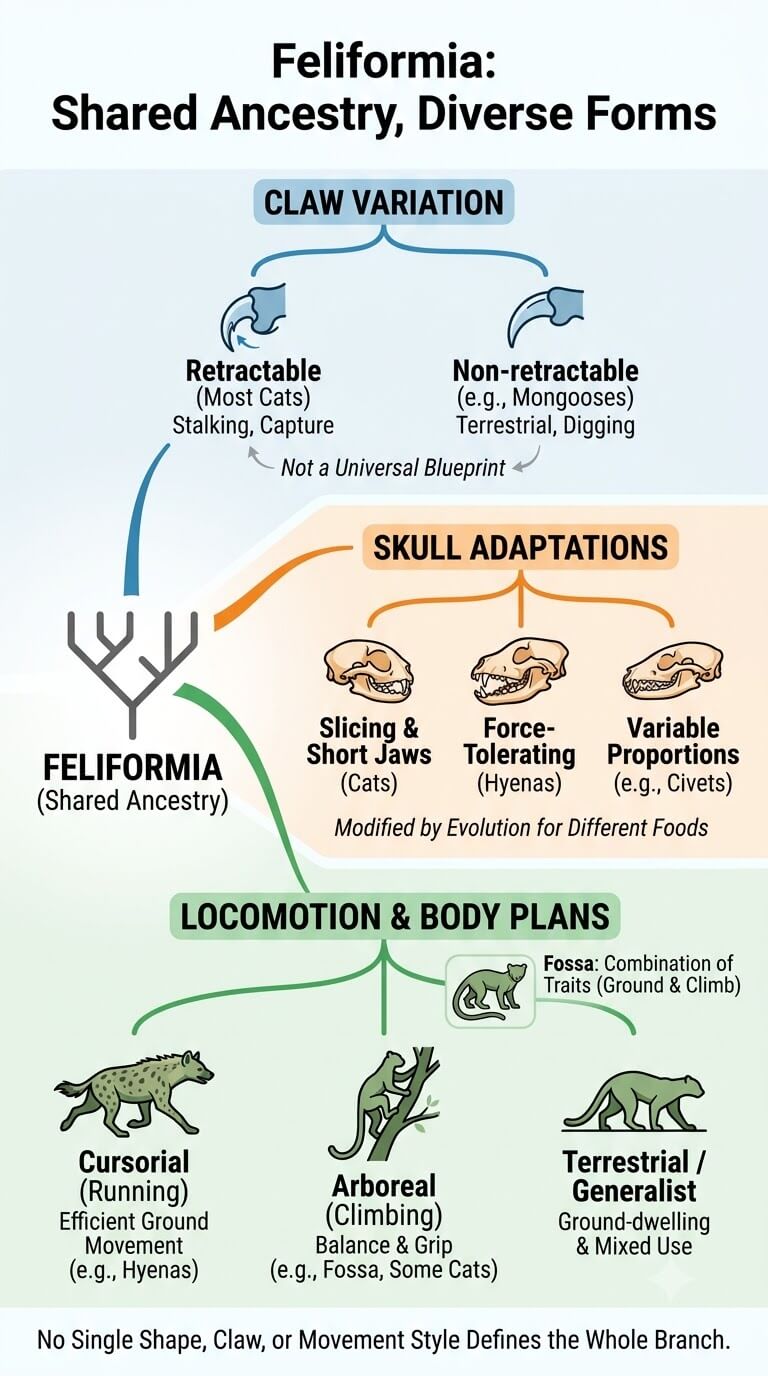
Feliform bodies reflect different mechanical demands, so no single skull shape, claw type, or style of movement defines the whole branch.
Cat-Like Specializations and Their Limits
Many felids provide the classic image of a feliform predator: a flexible spine, strong forelimbs, sharp claws, forward-facing eyes, and teeth suited to seizing and slicing animal tissue. These features can support stalking and close-range capture, but they are not a universal blueprint for Feliformia.
Claws are a good example. Most cats can retract their claws to a substantial degree, although the degree and mechanics vary among felids. Other feliform families do not simply repeat that arrangement. Mongooses generally have nonretractile claws useful for terrestrial movement and digging. Hyenas also differ from typical cats in foot structure and locomotion. Building a definition around claw retraction would therefore exclude obvious feliforms and oversimplify variation even within Felidae.
Skull form varies just as strongly. A cat skull often emphasizes short jaws and powerful slicing mechanics, while a hyena skull may be built to tolerate high forces during feeding. Long-snouted mongooses and civet-like feliforms show yet other proportions. The shared ancestry is real, but evolution has modified that basic inheritance to suit different foods and ways of moving.
Cursorial, Arboreal, Terrestrial, and Generalist Body Plans
Some feliforms spend much of their time on the ground. Others climb readily, forage in trees, or move between the canopy and forest floor. The term cursorial refers to adaptations associated with efficient running, especially over the ground. Certain hyenas show strong cursorial tendencies, while many cats emphasize stealth and acceleration rather than prolonged pursuit.
Arboreal species face different mechanical problems. Balance, grip, flexible joints, and controlled movement become especially important when branches replace flat ground. Long tails can aid balance in several tree-using feliforms, but tail length alone does not identify an arboreal lifestyle. Body size, foot anatomy, branch diameter, climbing technique, and behavior all matter.
The fossa provides another useful reminder that combinations of traits matter more than familiar labels. It can move on the ground and climb effectively, producing an overall form that may look “cat-like” to one observer and “mongoose-like” to another. Neither resemblance determines its family.
Diet Diversity Within Feliformia
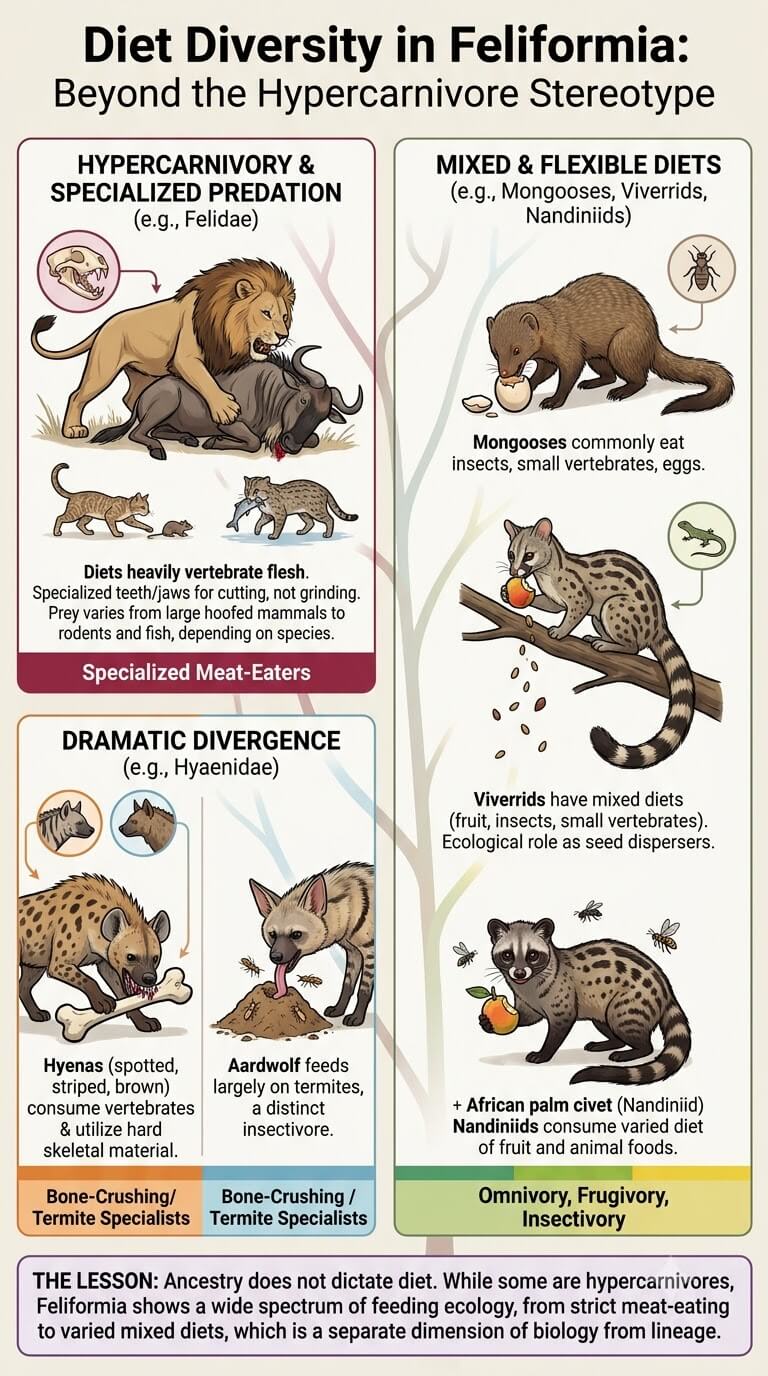
Feeding ecology ranges from strong specialization on vertebrate prey to termites, invertebrates, fruit, and flexible mixed diets.
Hypercarnivorous Cats and Specialized Meat-Eaters
Hypercarnivory describes a diet in which vertebrate flesh makes up a very large proportion of food intake. Many felids are strongly specialized toward animal prey, with carnassial teeth and jaw mechanics that favor cutting flesh rather than prolonged grinding of fibrous plant material. This pattern is important in Feliformia, but it should not be projected onto every family.
Predatory specialization also varies among cats. A small cat catching rodents and birds, a fishing cat taking aquatic prey, and a lion tackling large hoofed mammals all belong to Felidae, yet their prey environments and hunting problems differ. Even within a family famous for carnivory, ecological details matter.
Bone Processing, Insects, Vertebrates, Fruit, and Mixed Diets
Hyaenids show dramatic dietary divergence. Spotted, striped, and brown hyenas can consume vertebrate tissues and, to different degrees, make use of hard skeletal material. The aardwolf instead feeds largely on termites. That contrast is especially valuable because it occurs within one family and cannot be explained by simply calling Hyaenidae a group of “bone-crushing scavengers.”
Mongooses commonly eat animal foods such as insects, small vertebrates, eggs, and other invertebrates, but species differ in the proportions they take. Viverrids add even more mixed feeding. Fruit can be important for some species, sometimes alongside insects and small vertebrates. Such animals may also move seeds after eating fruit, giving them ecological effects that look very different from those of a large cat hunting ungulates.
Nandiniids provide another example of a feliform that does not fit a strict meat-eater stereotype. African palm civets consume a varied diet that can include fruit as well as animal foods. The lesson is not that Feliformia lacks predatory specialization. It is that ancestry and diet are separate dimensions of biology.
Social and Behavioral Diversity
Feliforms also differ sharply in how individuals space themselves, cooperate, raise young, defend resources, and communicate with neighbors.
Solitary Tendencies, Pairs, Clans, and Cooperative Groups
Feliform social systems span a wide range. Many cat species spend much of their adult lives alone outside mating and parental care, but lions form social prides. Spotted hyenas can live in large clans with complex relationships. Meerkats and some other mongooses form cooperative groups, while other herpestids are far less social.
Calling an animal “solitary” also requires care. A solitary foraging pattern does not mean an individual never communicates, mates, shares space, recognizes neighbors, cares for offspring, or gathers around concentrated resources. Social organization can change with season, age, sex, food distribution, breeding condition, and local ecology.
Likewise, group living does not make all social feliforms behaviorally equivalent. A lion pride, spotted hyena clan, and meerkat group differ in membership, dispersal, feeding ecology, reproductive structure, and cooperation. Broad labels such as “pack” can conceal those differences.
Habitats and Ecological Variety
The branch occupies many environments, and each lineage combines anatomy and behavior differently to use the resources available there.
Forests, Savannas, Deserts, Mountains, and Human-Modified Landscapes
Feliforms occupy tropical forests, open grasslands, savannas, dry scrub, deserts, mountains, wetlands, and landscapes altered by people. No single habitat defines the branch. Forest canopies favor climbing and balance in some species, while open country rewards endurance, vigilance, concealment, or rapid acceleration in others.
Even familiar families have broad habitat variation. Cats range from rainforest species to animals of deserts, high mountains, temperate forests, and open plains. Mongooses occur in dry regions as well as forests and wetlands. Euplerids occupy several habitat types within Madagascar. Viverrids include strongly arboreal species and species that spend more time on the ground.
Living near people adds another layer. Some civets, mongooses, and other medium-sized feliforms can use farms, plantations, villages, or fragmented habitats, but tolerance of human-modified landscapes varies greatly by species. Adaptability should not be mistaken for invulnerability to habitat loss or conflict.
Taxonomy Traps and Common-Name Confusion
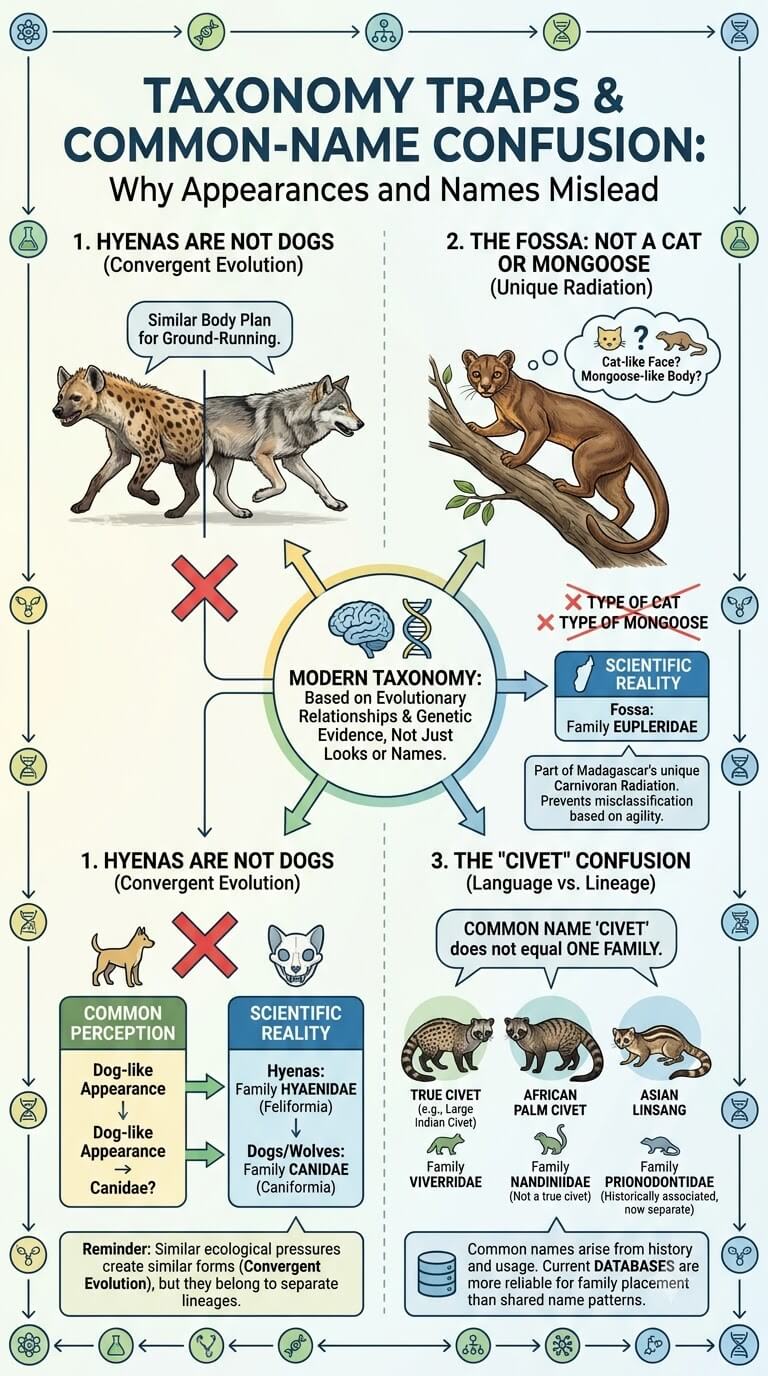
Several familiar names and body shapes encourage incorrect family assignments, making feliforms especially useful for learning how modern classification works.
Hyenas Are Not Dogs
Hyenas can look dog-like at a glance because several species have long legs, powerful shoulders, and a ground-running body plan. That resemblance does not place them in Canidae. Hyenas belong to Hyaenidae within Feliformia, while dogs, wolves, and foxes belong to Canidae within Caniformia.
The resemblance is a reminder that similar ecological pressures can favor similar external forms in separate lineages. Long legs can be useful for covering ground regardless of whether the animal’s closer relatives are cats, civets, or dogs. Evolutionary relationships have to be tested with broader anatomical and genetic evidence.
The Fossa Is a Euplerid, Not a Cat or Mongoose
The fossa is one of the easiest feliforms to misclassify from appearance. Its face can look somewhat cat-like, its body is elongated, and its climbing ability may call mongooses to mind. Current taxonomy places it in Eupleridae with Madagascar’s other native carnivorans.
That placement is more informative than choosing whichever familiar animal it most resembles. It tells readers that Madagascar’s native carnivorans represent their own evolutionary radiation. It also prevents the common mistake of describing the fossa as a “type of cat” simply because it is an agile predator.
Why Animals Called Civets Do Not All Belong to One Simple Common-Name Category
Many true civets are viverrids, but the word “civet” has been attached historically to animals outside Viverridae as well. The African palm civet is the clearest example in this article because it belongs to Nandiniidae. Common names arise from language, resemblance, history, and local usage, so they do not always track modern family boundaries.
Linsangs add another complication. Asian linsangs in Prionodon were historically associated with viverrids but are now placed in Prionodontidae. These cases are exactly why current databases are more reliable for family placement than assuming that animals sharing a common-name pattern must share the same family.
Common Myths and Oversimplifications
Most errors come from treating a trait common in cats as though it must also occur in every other feliform family.
Not All Feliforms Have Retractile Claws
Retractile claws are strongly associated with cats, but they are not a defining rule for Feliformia. Claw anatomy varies across the branch. Mongooses generally do not retract their claws in the cat-like way, and hyenas have a different foot design again. Even felids show variation in how far the claws can be withdrawn and how they are used.
A better way to think about claws is functionally. Claws can assist with gripping prey, climbing, traction, digging, defense, or manipulating surfaces. Different feliform lineages place different mechanical demands on them.
Not All Feliforms Are Solitary or Strict Carnivores
The branch includes both largely solitary species and highly social ones. It also includes animals with meat-dominated diets, insect specialists, and species that eat substantial fruit or other plant material. Neither sociality nor diet provides a universal diagnostic shortcut.
These misconceptions often come from starting with a familiar cat and extending its traits to all feliforms. Reversing the approach works better: start with the family tree, then ask how each lineage has modified body form and behavior for its own ecological problems.
Feliform Diversity in the Larger Carnivoran Picture
Comparing the branch with other carnivorans shows how shared ancestry and ecological specialization can produce very different living mammals.
How Feliforms Differ From Caniforms
Feliformia and Caniformia are sister branches within Carnivora, but their differences are evolutionary patterns rather than a simple cat-versus-dog checklist. Skull anatomy, especially features around the auditory region, has historically helped distinguish the branches, and molecular evidence has refined how families are arranged. Body shape, claws, and diet can provide clues, but none should be used alone as an absolute rule.
This helps explain apparent exceptions. Hyenas remain feliforms despite looking somewhat dog-like. Bears are caniforms despite not resembling dogs closely. The branches describe ancestry, while natural selection can reshape bodies in response to running, climbing, digging, swimming, prey capture, or other ecological demands.
Why Diet, Hunting, Communication, Senses, and Sociality Vary
Once Feliformia is understood as an evolutionary branch rather than a lifestyle category, its internal diversity becomes easier to predict. A solitary ambush hunter faces different sensory and communication demands from a social mongoose. A termite-feeding aardwolf solves a different feeding problem from a bone-processing hyena. An arboreal fruit-eating civet interacts with its habitat differently from a large terrestrial cat.
Those differences arise because related animals can specialize in different resources and environments over evolutionary time. Shared ancestry sets part of the anatomical starting point, but it does not force descendants into one ecological role.
FAQ
These questions address the classification mix-ups readers most often encounter when comparing cats with other feliform mammals.
Is a hyena a cat?
No. A hyena is not a member of the cat family Felidae. Hyenas belong to their own family, Hyaenidae. However, both Hyaenidae and Felidae are part of Feliformia, so hyenas are evolutionarily on the feliform side of Carnivora rather than the caniform side that contains dogs and their relatives.
This is why the phrases “hyenas are cats” and “hyenas are dogs” are both inaccurate. Their dog-like appearance reflects body-form evolution, not family membership.
Is a fossa a cat or a mongoose?
Neither. The fossa belongs to Eupleridae, the family that contains Madagascar’s native carnivoran radiation. Its combination of an elongated body, agile climbing, and predatory habits can make it look superficially similar to cats or mongooses, but resemblance is not enough to determine taxonomy.
Calling the fossa a euplerid is the most precise short answer. It is also a feliform and therefore a member of Carnivora.
Are all animals called civets members of Viverridae?
No. Many animals commonly called civets do belong to Viverridae, but common names do not map perfectly onto modern family boundaries. The African palm civet belongs to Nandiniidae, not Viverridae. Some historical classifications and common-name traditions also blur relationships among civets and linsangs.
For that reason, family-level identification should rely on a current taxonomic authority rather than on the common name alone.
Final Thoughts
Feliformia is best understood as a diverse evolutionary branch of Carnivora, not as a collection of mammals that all behave or look like cats. Its seven living families include true cats, Asian linsangs, hyenas, mongooses, viverrids, the African palm civet, and Madagascar’s euplerids. Together they range from specialized vertebrate predators to termite feeders and mixed-diet fruit eaters, and from solitary hunters to complex social groups.
The most useful takeaway is simple: classification follows ancestry, while body form, diet, and behavior can change dramatically within that ancestry. Remembering that principle makes apparent oddities such as dog-like hyenas, non-viverrid “civets,” and the fossa’s unusual appearance much easier to understand.

Ethan Walker is the founder and research editor of Animal Fact Central. He creates and reviews educational animal facts content using trusted wildlife, pet care, and science-based sources. His work focuses on making animal behavior, adaptations, habitats, and species facts clear, accurate, and engaging for everyday readers.
Read More Details About Ethan Walker: https://animalfactcentral.com/ethan-walker/