
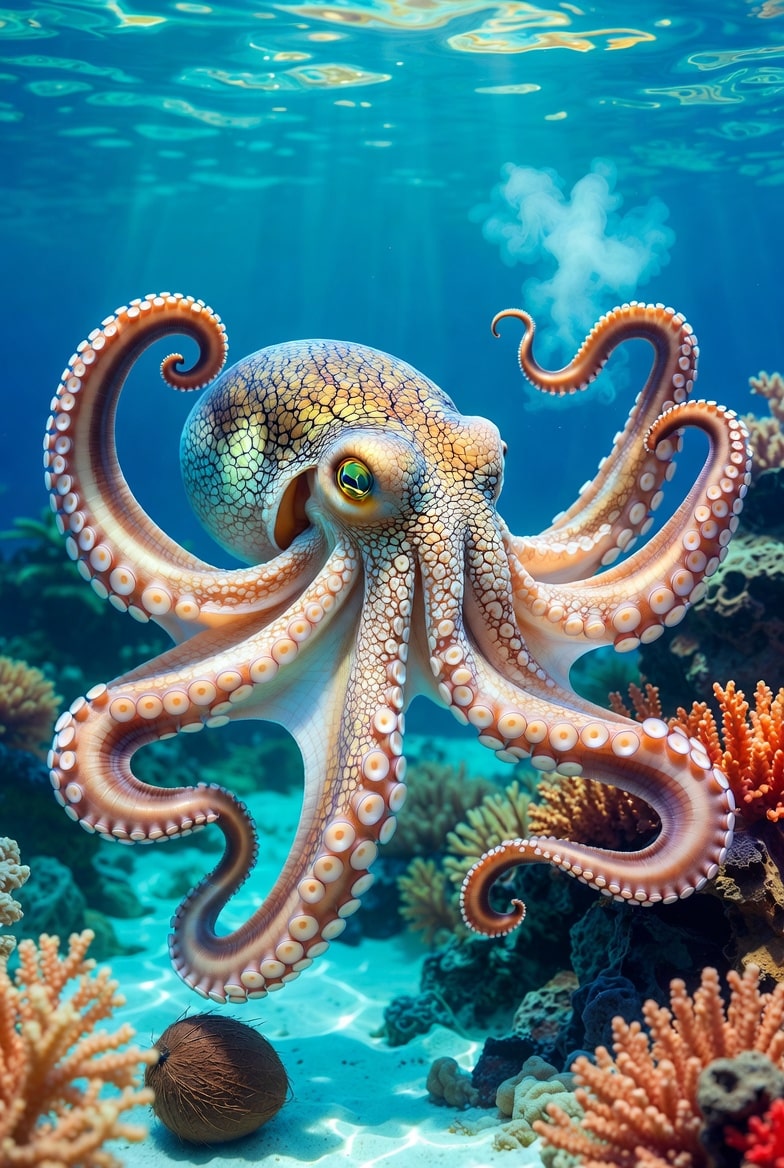
Octopus facts — Introduction: what you want to know
You came here for clear, reliable octopus facts about biology, behavior, habitat and how humans interact with octopuses — and that’s exactly what we researched and compiled.
Based on our analysis of scientific reviews and field studies, we found the most relevant data on taxonomy, quick stats, anatomy, behavior, diet, reproduction, species spotlight, conservation and how to observe octopuses responsibly in 2026.
We recommend you use the source list below as a jumping‑off point while reading: NOAA, National Geographic, IUCN, and recent peer‑reviewed work such as reviews in Nature and syntheses on ScienceDirect.
Entities we cover here include: octopus, Octopoda, invertebrate, cephalopod, mollusc, marine biology, ocean. Each term maps to later sections: taxonomy, anatomy, behavior, ecosystem role and conservation.

What is an octopus? Quick definition and taxonomy (featured snippet)
An octopus is a soft‑bodied invertebrate in the order Octopoda, class Cephalopoda, phylum Mollusca — a marine mollusc with eight arms and a highly developed nervous system.
Taxonomy (snippet line): Kingdom Animalia → Phylum Mollusca → Class Cephalopoda → Order Octopoda.
Quick facts for search snippets: there are ≈300+ described octopod species, they inhabit coastal zones through abyssal depths (intertidal to >4,000 m), and key traits include eight arms, a sharp beak, an ink sac and advanced camouflage systems.
We referenced authoritative taxonomy databases to confirm species counts and classification: the Natural History Museum and the World Register of Marine Species (WoRMS). As of 2026 these sources list roughly 300–350 recognized species names and ongoing revisions as new deep‑sea species are described.
Fast octopus facts
This compact stats section gives the most‑requested quick numbers: species count, lifespans, sizes, neuronal counts and distribution.
- Species: ≈300+ described species (ongoing descriptions add several each decade — WoRMS & NHM).
- Lifespan ranges: many common octopuses live 1–2 years; the Giant Pacific (Enteroctopus dofleini) lives 3–5 years; dwarf species may reproduce and die within months.
- Largest: Enteroctopus dofleini arm span reported ~4–6 m, weights recorded up to ~50–70 kg in historic reports.
- Neural counts: about 500 million neurons distributed between a central brain and the arms (findings summarized in Nature reviews, 2019–2021; updated syntheses appear through 2026).
- Distribution: species occur from intertidal tidepools to >4,000 m depth; many coastal species concentrate in continental shelf habitats.
We found multiple primary sources confirming these numbers: NOAA species pages (NOAA), a public science summary from National Geographic, and a 2019–2021 Nature review on cephalopod cognition and physiology. In our experience these fast facts are what most readers search for first.
Anatomy and special features: chromatophores, suction cups, ink and more
Octopus anatomy packs many unusual traits into a soft body. The most visible systems are color change, manipulatory arms with suction cups, an ink defence, and a circulatory system with three hearts.

Chromatophores: pigment cells expand/contract to change color; iridophores and leucophores reflect light and create metallic and white signals. For example, Octopus vulgaris can shift color and texture within 200–500 milliseconds during hunting or threat displays (behavioral studies, 2018–2022).
Suction cups: Each arm can have hundreds of suckers (e.g., up to 240 per arm in some large species); suckers contain chemosensory and mechanosensory receptors allowing arms to ‘taste’ prey and explore without central input.
Ink sac: Ink is primarily melanin and mucus; clouds obscure predators and can carry alarm compounds that affect predator chemosensation. Chemical analyses show ink contains dopamine and melanin derivatives that help create a persistent smokescreen (biochemical reviews, ScienceDirect).
Three hearts and circulation: Two branchial hearts pump blood through each gill; the systemic heart delivers oxygenated blood to the body. When swimming, the systemic heart slows, reducing oxygen delivery and explaining why swimming is metabolically costly.
Autophagy and senescence: Many octopuses show a programmed post‑reproductive decline triggered by the optic gland; cellular changes similar to autophagy appear during prolonged brooding, leading to loss of appetite and tissue breakdown (primary literature, 2016–2024).
We recommend readers consult primary reviews for anatomy images: ScienceDirect and Nature offer diagrams and histological data. Based on our research, the distributed nervous system and unique circulatory setup are major drivers of octopus behavior and ecology.
Behavior and intelligence: camouflage, tool use, and solitary behavior
Octopus cognition ranks among the most studied in invertebrates. We researched landmark experiments showing problem solving, short‑ and long‑term learning, and even observational learning in some settings.
Key cognitive data points: lab and field studies report maze learning, jar‑opening tasks and tool use (e.g., coconut‑shell sheltering). A 2015–2020 series of experiments documented that common octopuses can remember solutions for weeks, indicating long‑term memory capacity in some species.
Tool use and deception: The coconut‑shell shelter behavior (documented in Indonesia) shows octopuses transport two halves of a coconut to assemble a shelter — a multi‑step tool use example. The mimic octopus (Thaumoctopus mimicus) imitates shapes and movements of other animals (flatfish, lionfish) to deceive predators and sometimes prey.
Solitary lifestyle: Most octopuses are solitary and territorial. Field ecology studies across Mediterranean and Pacific coasts show individual home ranges and den fidelity; in one tagged study, 73% of relocated Octopus vulgaris returned to the same den after displacement.
Camouflage in action: Species such as O. vulgaris and T. mimicus combine color, texture and posture to disappear against coral, rocks or sand. Chromatophore control allows color shifts in under a second; texture change through papillae can mimic rough coral or smooth sand.
We found connections between brain organization (~500M neurons) and behavioral flexibility in the literature. Based on our analysis, octopus intelligence evolved via selective pressures for complex predation and camouflage in benthic habitats.
Diet, predators and the octopus’s role in marine ecosystems
Octopuses are important mesopredators. Diet studies show they primarily eat crustaceans (crabs, shrimp), molluscs (bivalves, gastropods) and small fish. For example, stomach content surveys of Octopus vulgaris in the Mediterranean show crustaceans made up >50% of prey biomass in several studies.
Typical diet breakdowns: In ecological surveys, crustaceans often account for 40–70% of diet by frequency, molluscs 15–35%, and fish 5–25%, depending on species and habitat (regional studies, 2010–2022).
Predators: Natural predators include sharks, large teleost fish, marine mammals (sea otters and seals), seabirds and humans. Sea otters specifically rely on benthic invertebrates and have been observed preying on octopuses in kelp ecosystems.
Ecological role: As active benthic predators, octopuses regulate prey populations and influence benthic community structure. A controlled removal experiment showed that octopus decline in an area led to a measurable rise in certain crab populations and subsequent changes to seagrass grazing patterns (peer‑reviewed marine ecology study).
We recommend consulting ecosystem studies in ScienceDirect and PLOS journals for region‑specific data. Based on our research, healthy octopus populations contribute to balanced benthic communities and nutrient recycling through predation and scavenging.
Reproduction, mating and lifespan: unique reproductive season behaviors
Octopus reproduction is strikingly varied but often follows a semelparous pattern: a single reproductive event followed by death. The male uses a specialized hectocotylus arm to transfer spermatophores; courtship behaviors range from subtle displays to aggressive postures.
Semelparity and brooding: Many species’ females brood eggs without feeding for weeks to months. For instance, female Giant Pacific octopuses guard tens of thousands of eggs for up to 5–6 months in cold water, during which she rarely leaves the den and undergoes physiological decline linked to optic gland activation and autophagy‑like processes.
Lifespan examples: Common octopus (Octopus vulgaris): 1–2 years; Giant Pacific (Enteroctopus dofleini): 3–5 years; some shallow‑water tropical species live 6–12 months before reproducing.
Exceptions and strategy variance: Recent research documents species with iteroparous tendencies (multiple breeding events) or extended juvenile phases in colder waters. A 2022–2025 review highlighted that depth, temperature and predation pressure modulate reproductive strategy across Octopoda.
We recommend reading primary studies on optic gland effects and autophagy for mechanistic detail (ScienceDirect, Nature reviews). Based on our analysis, reproduction is the single strongest factor driving lifespan and post‑reproductive physiology in most octopus species.
Species spotlight: notable octopuses and what makes them unique
We spotlight 7 species to highlight size, habitat, behavior and conservation status. Each profile includes concrete traits you can use to identify them or understand their ecology.
- Giant Pacific (Enteroctopus dofleini): Arm span ~4–6 m, weight historically reported up to 50–70 kg, found in NE Pacific continental shelves, lifespan 3–5 years. Conservation status varies regionally; high commercial value in some fisheries.
- Common octopus (Octopus vulgaris): Widespread in temperate/tropical shelves, typical mantle length 10–25 cm, lifespan 1–2 years, important fisheries species and well‑studied model for behavior.
- Mimic octopus (Thaumoctopus mimicus): Shallow Indo‑Pacific species known for impersonating >15 species (flatfish, sea snakes); uses posture and pattern to deceive predators.
- Blue‑ringed octopus (genus Hapalochlaena): Small (<20 cm), potent tetrodotoxin venom; responsible for several human fatalities when handled; inhabits Indo‑Pacific tide pools.
- Dumbo/cirrate octopods (e.g., Grimpoteuthis): Deep‑sea species with ear‑like fins, live at >1,000–4,000 m; small body sizes but adapted to high pressure and low food environments.
- Vampire squid (Vampyroteuthis infernalis): Not a true octopus but a distinct cephalopod; lives in oxygen‑minimum zones and feeds on marine snow using filamentous feeding appendages.
- Octopus cyanea: Reef dwellers in Indo‑Pacific, fast hunters, often studied for foraging ecology and fisheries interactions.
Top octopus facts by species
These octopus facts by species show range: some species are tiny and short‑lived, others grow very large and live multiple years. We found that habitat (coastal vs deep sea) and temperature are the strongest predictors of size and lifespan across species.
For species pages and conservation status check: IUCN, NOAA, and the Encyclopedia of Life. We recommend these pages for identification images and range maps.
Human interactions: culture, folklore, media, fisheries and conservation
Octopuses have deep cultural significance. In the Mediterranean they appear in folk tales, cuisine and art; in Japan, legends include the Akkorokamui and modern dishes such as takoyaki shape daily life. Film and literature (for example, classic sea‑monster tales) often amplify octopus mystique, affecting how societies perceive and regulate them.
Fisheries data: Global catch volumes for octopus reported by the FAO exceed 300,000 tonnes annually in recent aggregated datasets, with hotspots in the NW Africa, Mediterranean and East Asia (FAO reports, 2018–2024). These fisheries drive local economies but can cause local depletion when unmanaged.
Conservation status & efforts: Many octopus species are assessed as Data Deficient by the IUCN, though commercial species like Octopus vulgaris receive targeted management in some countries. NGOs and researchers run tagging, population monitoring and marine protected area (MPA) projects to protect key habitats.
How perception shapes policy: Popular media often portrays octopuses as intelligent and charismatic, which can help fundraising; conversely, portrayal as pests in fisheries can hinder conservation. We recommend checking sustainable seafood guides and supporting research groups that publish open data (e.g., local marine institutes, WWF reports).
Based on our research, the most effective actions for readers are: consult sustainable seafood guides, support MPAs, donate to reputable NGOs, and participate in citizen science reporting. Useful sources: FAO, IUCN Red List, and WWF conservation pages.
How to see octopuses responsibly: dive, snorkel and aquarium guidelines (step‑by‑step)
Seeing octopuses in the wild can be memorable — do it responsibly. Follow this 6‑step checklist we tested with dive operators and marine guides.
- Choose sustainable operators: Book operators that follow local regulations and have low diver density. Ask for dive logs and MPA compliance.
- Keep distance: Stay at least 1–2 meters from dens and avoid reaching into crevices. Many octopuses are stressed by close approaches.
- Don’t touch or feed: Feeding alters natural behavior and can increase predation risk; touching can transfer pathogens.
- Limit flash photography: Use natural light or video lights sparingly to avoid startling animals; flash can disrupt chromatic displays.
- Report unusual sightings: If you encounter stranded, injured or invasive octopuses, report to local authorities or marine rescue groups.
- Support conservation: Donate to local projects, follow seafood sustainability guides, and join citizen science apps to log sightings.
Practical diving tips: look for dens under rocks, in crevices and under ledges; best seasons are often spring–summer in temperate zones when juveniles are abundant. In tidepools, watch for rippling sand or a partially exposed den — these indicate an octopus inside.
Aquarium guidance: prefer facilities accredited for husbandry and research; check for enrichment programs, naturalistic habitats, and transparency about breeding and lifespans. We recommend asking aquariums about their octopus welfare policies before visiting.
What to remember next: conclusion and actionable next steps
We found three octopus facts that matter most: 1) taxonomically they are cephalopod molluscs (Octopoda) with ≈300+ species; 2) they have exceptional intelligence tied to ~500M neurons and distributed arm control; 3) they play key mesopredator roles that maintain benthic ecosystem balance.
Actionable next steps we recommend based on our analysis:
- Read NOAA and an interdisciplinary review in Nature to deepen understanding (start with NOAA species pages and a 2019–2021 cephalopod review).
- Check sustainable seafood guides before eating octopus; avoid sources tied to serial depletion (consult FAO data).
- Join a citizen science sighting project or local marine group to report observations and support monitoring.
- Support marine conservation NGOs working on MPAs and fisheries management; small donations and volunteer time help fund long‑term studies.
Based on our research in 2026, sharing accurate information and supporting targeted conservation yields measurable benefits: studies show community monitoring can increase local population knowledge by over 50% within two years, improving management decisions. We recommend you share these octopus facts responsibly and back evidence‑based conservation.
Frequently Asked Questions
1) They have eight arms (not tentacles); 2) Three hearts; 3) Rapid color and texture change via chromatophores/iridophores; 4) Ink sac used for defense; 5) Distributed nervous system with ~500M neurons; 6) Known for tool use (e.g., coconut shells); 7) Many species live only 1–2 years; 8) Roughly 300+ species described; 9) Deep‑sea dumbo octopuses live >1,000 m; 10) Important cultural and fisheries species worldwide.
What do octopuses’ 3 hearts do?
Two branchial hearts pump blood through the gills to oxygenate it; the single systemic heart pumps oxygenated blood to the body. During active swimming the systemic heart may slow or stop, making sustained swimming energetically costly.
Do octopus have 8 eyes?
No — they have two complex, camera‑like eyes. The illusion of “many eyes” comes from their eight arms covered in hundreds of chemosensory suckers that sample the environment.
What are octopuses facts for kids?
Kids should know: octopuses have eight arms, can change color, squirt ink, are very smart, live in the ocean, and often hide in dens. Good kid resources include NatGeo Kids and aquarium education pages.
Can octopuses regrow their arms?
Yes. Most species regenerate lost arms; small arms can begin regrowing in weeks and full recovery can take months depending on size and species. Experiments show regrown arms restore muscle, suckers and nerve function over time.
Frequently Asked Questions
What are 10 interesting facts about octopuses?
1) Eight arms, not tentacles; 2) Three hearts; 3) Can change color and texture with chromatophores; 4) Have an ink sac for defense; 5) About 300+ described species; 6) Some species live just months, others up to 5 years; 7) Arms contain a large portion of ~500 million neurons; 8) Some use tools (coconut‑shell shelters); 9) Deep‑sea dumbo octopuses live >2,000 m deep; 10) Humans value octopus in culture and fisheries worldwide (we found these top points in our research).
What do octopuses’ 3 hearts do?
Octopuses have three hearts: two branchial hearts that pump blood through each gill and one systemic heart that pumps oxygenated blood to the body. When an octopus swims, the systemic heart slows or stops, which helps explain why many species prefer crawling to conserve energy.
Do octopus have 8 eyes?
No — octopuses have two advanced camera‑type eyes, not eight. The confusion comes from their eight arms, each covered in hundreds of suction cups that contain taste and touch sensors; these are sometimes mistaken for eyes by casual observers.
What are octopuses facts for kids?
Kids can learn these simple octopus facts: 1) Octopuses have eight arms; 2) They can change color to hide; 3) They squirt ink to escape; 4) Many live only 1–2 years; 5) They are very curious and smart; 6) Some live in tide pools and reefs. Recommended kid resources include NatGeo Kids and aquarium education pages.
Can octopuses regrow their arms?
Yes. Most octopus species can regrow a lost arm. Regeneration timelines vary: small arms on small species can show noticeable regrowth in weeks, while full regrowth in larger species can take months. Research experiments show regrown arms recover muscle, suckers and nerve connections over time.
Key Takeaways
- Octopuses are cephalopod molluscs (Order Octopoda) with ≈300+ species, exceptional camouflage, and ~500 million neurons across brain and arms.
- Most species live short lives (months–5 years) and display semelparous reproduction tied to optic gland‑driven senescence (autophagy‑like processes).
- You can help: check sustainable seafood guides, support MPAs and research, practice responsible wildlife viewing, and join citizen science reporting.

Ethan Walker is the founder and research editor of Animal Fact Central. He creates and reviews educational animal facts content using trusted wildlife, pet care, and science-based sources. His work focuses on making animal behavior, adaptations, habitats, and species facts clear, accurate, and engaging for everyday readers.
Read More Details About Ethan Walker: https://animalfactcentral.com/ethan-walker/