

Primate hands and feet are not built around one universal grip. Instead, the order shows a flexible anatomical pattern that lets different species cling, climb, leap, walk along branches, hang below supports, move on the ground, or manipulate food. Mobile digits, sensitive pads, nails on many digits, flexible wrists and ankles, and opposable digits where they occur can all help an animal maintain secure contact with uneven surfaces.
The details vary sharply. A gibbon uses long arms and hook-like hands during brachiation. A spider monkey combines long limbs with a prehensile tail. A macaque often loads the hands during quadrupedal walking. A gorilla supports substantial body weight through the knuckles on the ground. Many lemurs rely heavily on hind-limb power for leaping. Humans, although primates, have feet specialized for habitual bipedal walking rather than branch grasping.
Quick Answer
Grasping anatomy is common but highly variable
Many nonhuman primates can wrap fingers or toes around branches, and a grasping foot with a mobile big toe is an important part of the ancestral primate pattern. Research comparing primate hand and foot representation notes the long evolutionary importance of a grasping foot with an opposable hallux, especially for body support and propulsion on arboreal surfaces.
That does not mean every living primate has the same grasp. Some lineages have reduced thumbs. Some small New World monkeys have claw-like nails that improve clinging to trunks. Humans have lost the opposable big toe typical of many nonhuman primates. The underlying pattern is versatility, not anatomical uniformity.
Why opposable thumbs alone do not explain primate climbing
An opposable thumb can help a hand close around a branch or object, but climbing also depends on the wrist, forearm, shoulder, foot, ankle, limb proportions, body mass, balance, and the surface being used. In many arboreal primates, the feet contribute as much as the hands to secure movement.
A primate with a modest thumb can still be an excellent climber if other structures compensate. Gibbons, for example, use elongated fingers and hook-like grips during suspension, while spider monkeys add a powerful prehensile tail to the locomotor system. Looking only at the thumb misses most of the biomechanics.
The Basic Primate Grasping Toolkit
Mobile digits
Primate fingers and toes are generally capable of considerable independent positioning compared with the more rigid paws or hooves of many mammals. Mobile digits allow the hand or foot to conform to branches of different diameters and approach supports from changing angles.
This is especially valuable in a tree canopy because branches are rarely flat or evenly spaced. A hand may contact a horizontal branch during one step and a steeply angled support during the next. The ability to adjust finger placement spreads force and reduces dependence on one fixed limb position.
Nails and tactile pads
Early primate evolution is associated with grasping extremities, nails on many digits, and enlarged tactile surfaces at the fingertips and toe tips. A scientific review of grasping and nail evolution in primates describes these features as part of the branch-grasping history of the order.
Flat nails do not project as far beyond the fingertip as typical claws. This leaves a broad pad available for direct contact with a surface. The pad can deform slightly around an object, increasing the area of contact while sensory receptors provide information about pressure, texture, and movement.
The nail pattern is not universal. Marmosets and tamarins have claw-like structures on most digits, an adaptation associated with clinging to trunks and other vertical supports. Several primates also retain specialized grooming claws on particular toes.
Flexible wrists and ankles
A secure grip is useful only if the joints can position that grip appropriately. Primate wrists and ankles vary in mobility according to locomotor style, balancing the need for flexibility against the need to support body weight.
Arboreal movement often rewards a wider range of joint positions because supports approach from multiple directions. Terrestrial quadrupedal movement places more repeated loading through the hand and can favor stability. These are trade-offs rather than strict categories.
Opposability where it occurs
Opposability means that one digit can rotate toward the others, increasing the ability to surround a support or object. Many primates have an opposable or partly opposable thumb, big toe, or both. The degree of opposition varies among species.
For climbing, an opposable big toe can be particularly important because the foot becomes a grasping organ rather than simply a platform. In humans, the big toe is aligned with the other toes, improving stability and push-off during habitual bipedal walking but reducing the foot’s ability to grasp branches.
Hands Built for Different Kinds of Grip
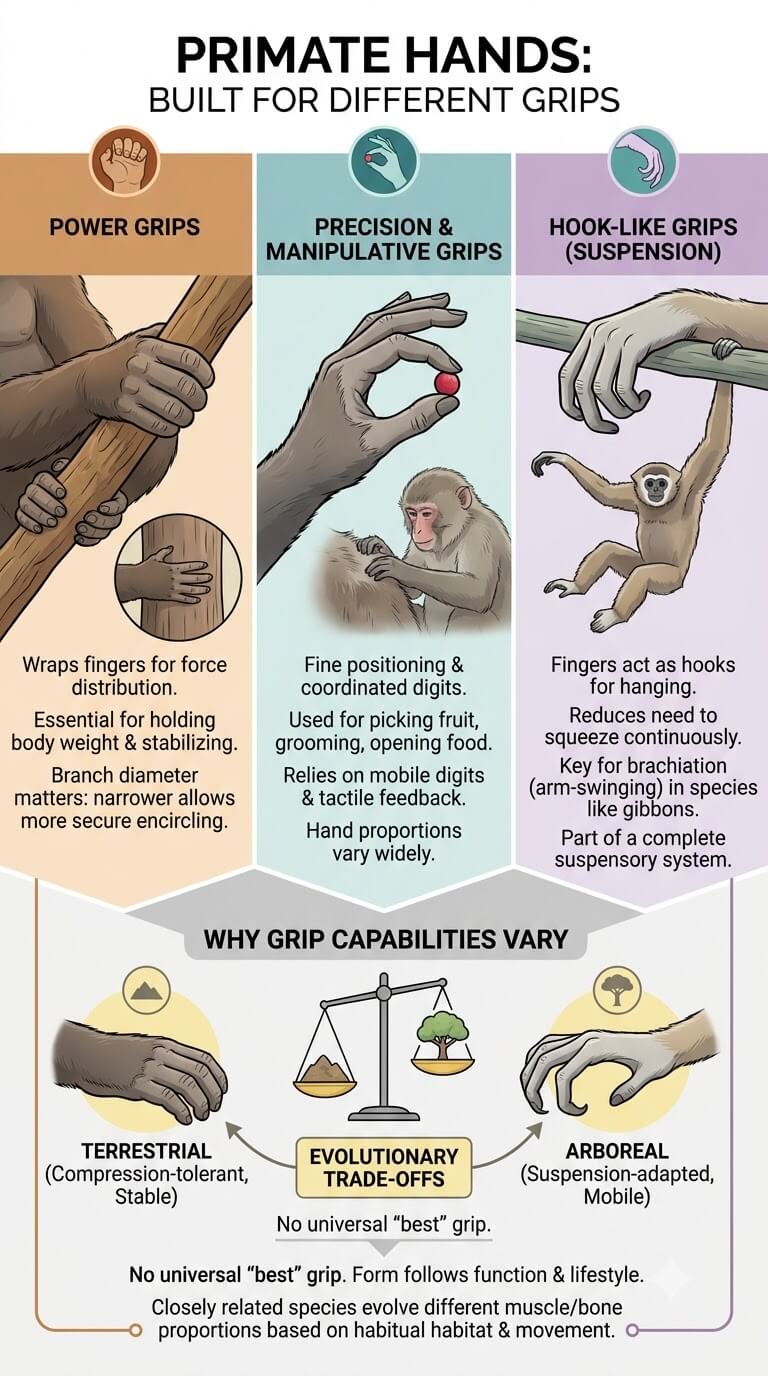
Power grips
A power grip wraps the fingers around a support so force is distributed through much of the hand. This is useful when an animal must hold body weight, stabilize itself against a trunk, or maintain a secure grasp while another limb searches for the next support.
Branch diameter matters. A support that is narrow enough to be enclosed by the fingers can allow a more secure encircling grip than a trunk too wide to surround. Small-bodied primates can therefore exploit supports that large apes cannot use in the same way.
Precision and manipulative grips
Primates also use the hands for tasks that demand fine positioning rather than full-body support. Picking small fruit, removing insects, grooming fur, opening food, or probing into narrow spaces can require coordinated movement of individual digits.
Not every species has human-like precision grip abilities. Hand proportions and thumb mobility differ widely. Still, the combination of mobile digits and tactile feedback gives many primates impressive control over small objects and food items.
Hook-like grips during suspension
Suspensory primates can use the fingers like hooks over a branch. This reduces the need to squeeze continuously with a powerful thumb opposition grip. Gibbons are a particularly clear example because their elongated fingers and forelimbs are closely tied to brachiation.
A detailed study of gibbon forelimb functional anatomy shows how muscle architecture and limb proportions support rapid, controlled arm-swinging. The hand is part of a complete suspensory system that also includes the shoulder, elbow, trunk, and body mass.
Why grip capabilities vary among primates
No grip is universally best. A hook-like hand is useful beneath branches, while a stable hand that tolerates repeated compression is useful during terrestrial quadrupedal travel. A highly mobile hand can adjust to irregular supports but may require different stabilization than a hand repeatedly loaded in a predictable direction.
Evolution therefore produces trade-offs. Closely related primates can share the same basic bones yet differ in muscle proportions, joint shape, digit length, and habitual hand posture.
Feet and Arboreal Stability

Grasping feet in many nonhuman primates
Many nonhuman primates use the foot almost like a second pair of hands during climbing. Long toes can wrap around branches, and the big toe may oppose the other digits to form a strong grip. This allows the hind limb to support the body while the hands reach, feed, or reposition.
The foot can also provide stability during slow climbing or hanging postures. An orangutan may distribute its weight among multiple hands and feet, while a smaller monkey may use the feet to maintain contact as it walks above a branch.
Divergent or mobile first toes
When the big toe, or hallux, angles away from the other toes and can rotate toward them, the foot can clamp around a support. Great apes such as chimpanzees retain a grasping hallux, and many monkeys and strepsirrhines also use a mobile first toe during arboreal locomotion.
The precise range of movement differs by lineage. Foot structure needs to be understood together with ankle mobility, toe length, body size, and the typical diameter and orientation of supports.
Foot adaptations in more terrestrial primates
Primates that spend more time on the ground still retain many features of a grasping ancestry, but repeated terrestrial travel can shift the balance toward stability and weight-bearing. Some macaques and baboons use relatively predictable hand and foot postures during quadrupedal walking while remaining capable climbers.
Terrestrial adaptation is therefore not the complete loss of climbing ability. It is often a change in how frequently particular joints, grips, and muscles are used and loaded.
Human feet as a specialized exception
Human feet illustrate how strongly the basic primate pattern can be remodeled. The human big toe is aligned with the other toes rather than functioning as a grasping hallux. The foot also has arches and other structures that support repeated bipedal walking and running.
Research on human foot mechanics shows how this specialization differs from the grasping feet of other primates. Humans remain primates, but their feet demonstrate that a characteristic ancestral trait can be transformed when locomotor demands change.
Shoulders, Arms, and Flexible Joints

Shoulder mobility
Climbing requires the forelimb to reach in many directions. A mobile shoulder allows an animal to raise the arm overhead, reach outward, pull the body toward a support, or hang beneath a branch. Apes show especially extensive upper-limb mobility.
Shoulder mobility is not independent of stability. Muscles surrounding the joint must control the humeral head while forces change direction. A gibbon swinging below a branch and a macaque supporting weight above a branch place very different demands on the same general joint region.
Limb rotation and reach
Forearm rotation lets the palm change orientation without requiring the entire body to move. Flexible elbows and wrists further increase the number of positions available for grasping a support.
Longer limbs can increase reach and bridge gaps, but they also change leverage and loading. The best limb proportions depend on body mass, movement style, and habitat structure rather than following one ideal primate design.
How arm length affects suspension and climbing
Gibbons have exceptionally long forelimbs relative to their bodies, which increases reach during brachiation. Orangutans also have long arms, but their greater body mass favors slower, more cautious climbing and suspension. Gorilla proportions support both climbing and a heavily terrestrial lifestyle.
Arm length therefore has meaning only in context. Two primates can both have long arms while using them in very different ways.
Major Primate Locomotor Strategies

Arboreal quadrupedalism
Many monkeys move above branches on all four limbs. Hands and feet contact a sequence of supports, while the tail may contribute to balance. Flexible joints let the animal adapt to branches that bend or change direction.
Arboreal quadrupedalism differs from walking on flat ground because the supporting surface can be narrow, unstable, and interrupted by gaps. Secure grasping and careful foot placement reduce the chance of slipping.
Vertical clinging and leaping
Several primates use vertical trunks or stems as major supports. Powerful hind limbs can propel the animal from one vertical surface to another, while hands and feet must secure the landing.
Research on primate leaping shows that vertical clinging and leaping is associated with specialized hind-limb proportions in several lineages. Sifakas and other leaping lemurs provide familiar examples, as do tarsiers and galagos outside the lemur radiation.
Brachiation
Brachiation is arm-swinging beneath supports. Gibbons are the classic specialists, using long arms, mobile shoulders, and hook-like hands to transfer body weight from one hand to the other.
Other primates may swing, hang, or move suspensorily without relying on specialized brachiation as their dominant locomotor mode. The term should therefore be used more narrowly than simply “moving with the arms.”
Climbing and suspension
Climbing can involve pulling, pushing, bridging, hugging trunks, or using multiple limbs at once. Suspension places the body below the support, which changes the forces acting on the shoulders, elbows, wrists, and fingers.
Orangutans and spider monkeys both use extensive suspension, but their solutions differ. Orangutans are large apes using long limbs and multiple supports, while spider monkeys combine long limbs with a prehensile tail that can take part in body support.
Terrestrial quadrupedalism and knuckle-walking
Ground travel places different demands on the hands. Macaques and baboons often use palmigrade or digitigrade quadrupedal postures, depending on species and speed. Their hands must tolerate repeated loading while still retaining enough mobility for climbing and manipulation.
Chimpanzees and gorillas commonly use knuckle-walking on the ground, placing weight through the middle phalanges rather than flattening the palm. Their hands therefore combine climbing and manipulation with specialized weight-bearing postures.
How Different Primates Solve the Same Movement Problem

Gibbons and specialized brachiation
For a gibbon, crossing a canopy gap often means using momentum and arm length. Long fingers form secure hooks around branches, and the shoulder provides a broad range of motion. Low body mass makes rapid suspension mechanically practical.
The feet are still useful for climbing, landing, and moving on larger supports. Gibbon locomotion is not “arms only,” even though brachiation is its most recognizable specialization.
Spider monkeys and suspensory movement
Spider monkeys solve similar canopy problems differently. Their long arms help during climbing and suspension, but the prehensile tail adds another strong contact point. Some New World monkeys can use a specialized tail to support body weight, yet prehensile tails in primates are limited to particular lineages rather than being a general primate feature.
With the tail anchored, a spider monkey can stabilize the body while reaching with the limbs. This can be especially useful during feeding or when moving among flexible branches. Among apes, these locomotor patterns become especially clear when comparing great apes with lesser apes.
Macaques and flexible quadrupedalism
Macaques provide a useful contrast because many species combine terrestrial and arboreal movement. A study comparing macaque hand musculature and locomotion shows how a semi-terrestrial primate hand balances grasping, manipulation, and repeated support during quadrupedal travel.
Macaques still climb effectively, but their habitual hand use includes more weight-bearing than that of a highly suspensory gibbon. Similar bones can therefore operate under very different daily loading patterns.
Gorillas and terrestrial weight-bearing
Adult gorillas spend substantial time on the ground and commonly knuckle-walk. Their robust hands and fingers must tolerate large forces while the wrists remain positioned for stable support.
Gorillas can still climb, especially younger individuals, but body mass changes which branches are practical and how frequently arboreal movement is used. The locomotor system reflects both ape climbing ancestry and the demands of supporting a very large body terrestrially.
Lemurs and leaping diversity
Lemurs show a broad range of solutions. Sifakas emphasize vertical clinging and powerful hind-limb leaping, while other lemurs move quadrupedally along branches or spend more time on the ground.
The contrast demonstrates why long legs or grasping feet cannot be interpreted without knowing how the animal actually moves. Limb proportions and joint mechanics are tuned to recurring locomotor demands.
Trade-Offs in Hand and Foot Design

Stability versus mobility
A highly mobile joint can reach more positions but may require greater muscular control. A more stable joint can tolerate repeated loading efficiently but may not move through the same range. Primate hands, wrists, feet, and ankles occupy different points along this continuum.
Suspensory species benefit from mobility because they encounter supports from many directions. Terrestrial quadrupeds benefit from predictable weight-bearing positions. Mixed-strategy species must compromise between both demands.
Grasping versus efficient terrestrial support
A strongly divergent big toe is excellent for encircling a branch but less suited to acting as part of a rigid forward-propelling platform. Humans show the extreme terrestrial-bipedal end of this trade-off, with an aligned big toe and arched foot.
Nonhuman terrestrial primates generally retain more grasping ability because they still climb or because their evolutionary history has not eliminated those features. Their feet can therefore remain more versatile than the human foot.
Body size, substrate size, and movement choices
Body size changes the meaning of every support. A thin branch may safely carry a small monkey but bend dangerously under a great ape. Larger primates often use thicker supports, distribute weight among several contacts, or move more slowly.
Small primates can exploit narrow terminal branches where fruit or insects may be available. Large apes may bend branches toward themselves rather than travel to the tip. Locomotion is therefore partly a problem of matching body size to the mechanical properties of the habitat.
Balance, Tails, and the Rest of the Body
How balance works with limb placement
Hands and feet do not act alone. The trunk, head, tail where present, and the position of every limb determine the body’s center of mass. During climbing, an animal continually shifts that center relative to its supports.
A long tail can help control rotation or maintain balance during quadrupedal movement. In tailless apes, the trunk and limbs must manage those same stability problems without an external tail.
Prehensile tails in some New World monkeys
In spider monkeys and several relatives, the tail goes beyond balance and becomes a grasping organ capable of supporting body weight. This creates an additional point of contact that can free a hand or foot during movement and feeding. Hand, foot, and shoulder anatomy also helps explain several important differences between monkeys and apes.
That specialization is powerful but taxonomically limited. Capuchins, macaques, gibbons, gorillas, and lemurs do not share the same weight-bearing tail system.
Why tails are not part of every climbing solution
Apes demonstrate that sophisticated arboreal movement can evolve without an external tail. Gibbons use extreme forelimb specialization, and orangutans distribute weight through long, flexible limbs.
Lorises rely on secure hand and foot grips, while many leaping primates use the tail mainly for balance rather than grasping. Climbing performance emerges from the entire body rather than one appendage.
Common Mistakes and Myths
All primates have fully opposable thumbs
False. Opposability varies, and some primates have reduced thumbs or hand designs in which the thumb plays a smaller role. A primate can climb effectively through other combinations of digit shape, wrist mobility, foot grasping, and body position.
All primates have grasping feet
False. Grasping feet are widespread among nonhuman primates and are important to primate evolutionary history, but humans are a clear exception. The human foot is specialized for habitual bipedal locomotion rather than branch grasping.
All apes brachiate
False. Gibbons are the specialized brachiators. Orangutans climb and suspend extensively, while gorillas and chimpanzees combine climbing with substantial terrestrial locomotion. Humans do not use brachiation as a habitual travel mode.
Primates are adapted only for life in trees
False. Arboreal ancestry shaped many primate features, but baboons, geladas, gorillas, humans, and several macaques show major terrestrial adaptations. Many species move between trees and ground depending on food, safety, travel, and life stage.
Terrestrial Adaptations and Important Exceptions
Baboons and other ground-using primates
Baboons spend large amounts of time traveling and foraging on the ground, yet they remain capable climbers. Their hands and feet function during repeated quadrupedal loading rather than serving only as grasping organs.
This mixed heritage helps explain why terrestrial primate limbs differ from the paws of specialized running mammals. They retain considerable mobility because climbing, manipulation, and social grooming still matter.
Humans and specialized bipedal feet
The human foot represents one of the strongest departures from the typical nonhuman primate grasping pattern. An aligned big toe, longitudinal and transverse arches, and a stiffened lever during push-off support economical bipedal walking.
Human hands, meanwhile, are largely freed from locomotor support and can emphasize manipulation. This division of labor is unusual within Primates and should not be treated as the standard ape condition.
Primates that switch among multiple locomotor modes
Many primates cannot be placed neatly into one locomotor box. A macaque may walk on the ground, climb a trunk, leap a gap, and sit on a branch within the same day. A chimpanzee can knuckle-walk, climb, hang, and occasionally move bipedally.
Flexibility is itself an adaptation. Hands and feet that can tolerate several kinds of loading may allow an animal to exploit changing food distributions, avoid danger, or move through habitats with mixed ground and canopy routes.
Why Primate Limbs Differ So Much
Defining primate traits provide the starting point
Mobile digits, grasping ability, nails and tactile pads on many digits, flexible joints, and visually guided movement provide a shared anatomical foundation. Evolution then modifies that foundation according to the locomotor challenges faced by each lineage.
This is why primate hands and feet look related without being identical. Shared ancestry explains the common pattern, while habitat and movement explain much of the variation.
Habitat structure changes the value of each grip
A dense canopy of thin flexible branches rewards different movements from a forest floor or rocky hillside. Support diameter, angle, spacing, and stiffness determine whether an animal benefits most from encircling grips, suspension, leaping, cautious climbing, or repeated weight-bearing.
The habitat is therefore part of the mechanical system. A hand or foot can only be called well adapted relative to the surfaces it normally encounters.
Monkey and ape body forms reflect different movement histories
Many monkeys retain body plans strongly associated with quadrupedal movement, whether above branches or on the ground. Apes generally show broader upper-body mobility and a greater history of climbing and suspension, though individual ape lineages have diverged substantially.
Comparing a macaque, spider monkey, gibbon, orangutan, and gorilla reveals how the primate limb plan can be reshaped without losing its basic evolutionary identity.
FAQ
Do all primates have opposable thumbs?
No. Many primates have opposable or partly opposable thumbs, but the degree varies, and some have reduced thumbs. Feet may also provide opposition through a mobile big toe. Opposability is an important primate tendency, not a universal defining feature.
Which primates are best adapted for brachiation?
Gibbons and siamangs are the most specialized living brachiators. Their very long arms, mobile shoulders, hook-like hands, and relatively light bodies allow efficient arm-swinging beneath branches. Other primates may hang or swing without relying on specialized brachiation as their main travel method.
Can primates climb without grasping feet?
Yes. Humans can climb despite having nonprehensile feet, and some primates rely more heavily on hands, claws, tail support, limb friction, or other strategies than on a strongly opposable big toe. Climbing ability depends on the entire locomotor system.
Why do some primates spend so much time on the ground?
Ground use can provide access to widely distributed foods, efficient travel routes, open habitats, or resources unavailable in the canopy. Larger body size can also make some branches less usable. Terrestrial primates retain different amounts of climbing ability depending on their evolutionary history and ecology.
Final Thoughts
Primate hands and feet are best understood as adaptable contact systems rather than one standard climbing design. Mobile digits, tactile pads, flexible joints, and opposable digits where present allow many species to maintain control on irregular supports, but those features have been reshaped for very different jobs.
Gibbons emphasize hook-like hands and long arms for brachiation, spider monkeys add a prehensile tail, macaques balance grasping with quadrupedal loading, gorillas combine climbing anatomy with terrestrial knuckle-walking, and leaping lemurs place greater emphasis on the hind limbs. Human feet show how far the pattern can shift toward terrestrial bipedalism. The diversity of primate movement comes from trade-offs among grip, mobility, stability, body size, and the structure of the habitat.

Ethan Walker is the founder and research editor of Animal Fact Central. He creates and reviews educational animal facts content using trusted wildlife, pet care, and science-based sources. His work focuses on making animal behavior, adaptations, habitats, and species facts clear, accurate, and engaging for everyday readers.
Read More Details About Ethan Walker: https://animalfactcentral.com/ethan-walker/