

Primates communicate through far more than vocal calls. Depending on the species and situation, they may use facial expressions, gaze, body posture, hand or arm gestures, touch, grooming, scent, and combinations of several signals at once. A call may attract attention before a gesture is given, a facial expression may change how rough play is interpreted, or grooming may communicate tolerance and affiliation while also removing debris and parasites.
No single communication system represents the entire order. Lemurs can rely heavily on scent, gibbons use powerful vocal displays, monkeys produce calls linked to predators and social situations, and apes use rich combinations of gestures, faces, vocalizations, and touch. These signals can influence what another animal does, but describing them as “language” requires much stronger evidence than simply showing that a call or gesture has a recognizable effect.
Quick Answer

Primates use multiple communication channels
Primate communication can be vocal, visual, tactile, or chemical. Vocal signals include alarm calls, contact calls, food-associated calls, infant calls, and group or pair displays. Visual signals include facial movements, gaze direction, posture, and gestures. Touch includes grooming, embracing, play contact, and other close-range interactions. Chemical communication includes scent marks and odors carried on the body.
Species differ in how strongly they use each channel. A nocturnal lemur may gain more from scent and sound than from a subtle facial signal visible only in bright light. A diurnal monkey living in a social group may combine calls, faces, and postures. An ape at close range may use a hand gesture that depends on whether the recipient is looking.
Signals work in context
A signal rarely means the same thing in every possible setting. The identity of the caller, its arousal level, nearby animals, predator presence, social relationship, distance, and what happened immediately before the signal can all affect how a receiver responds.
This is why communication research often tests both production and response. Scientists ask not only what sound or gesture was made, but who produced it, who received it, what the animals could see or hear, and what changed afterward.
What Counts as Communication?

Signals can change a receiver’s behavior
In a biological sense, communication involves information or influence passing from a signaler to a receiver through a signal that has a communicative function. A call can cause group members to look toward a threat. A gesture can prompt another ape to approach, play, groom, or move away. A scent mark can alter how another individual investigates an area.
That does not mean every movement is a signal. An animal scratching because its skin itches may accidentally provide information about its state, but the scratch is not automatically a communicative gesture. Researchers distinguish signals from incidental cues by studying how behaviors are produced and how receivers respond.
Intentional signaling requires stronger evidence
Some primate signals show features consistent with intentional communication. A signaler may direct a gesture toward a particular recipient, wait for a response, repeat or elaborate when the first attempt fails, or change the signal depending on whether the receiver is attending.
Chimpanzee alarm-call research has found evidence that callers can take the knowledge or attention of nearby animals into account. In one field experiment on chimpanzee alarm-call production, calling patterns met several criteria used to evaluate intentional signaling. This supports flexible communication, but it does not by itself demonstrate human-like language.
Communication is not the same as language
Human language combines learned symbols, open-ended vocabulary, complex syntax, displaced reference, and highly productive combinations. Some nonhuman primate signals show impressive flexibility or can be linked to particular events, but the evidence does not justify treating every call sequence or gesture system as equivalent to human language.
Careful wording matters. Researchers may discuss referential signals, intentional gestures, call combinations, or audience effects without claiming that a monkey is speaking in sentences or that an ape gesture functions exactly like a human word.
Vocal Communication

Alarm calls
Alarm calls are among the most studied primate signals because they allow researchers to compare a specific event with a specific receiver response. Vervet monkeys became famous for producing acoustically different alarm calls in encounters with different predator types and for responding in predator-appropriate ways.
Later work has shown that the system is more complex than a simple one-call-one-predator dictionary. A quantitative study of vervet monkey alarm-call structure found graded acoustic variation linked to context, helping correct the overly neat idea that each call is simply a spoken label for one predator.
Contact calls
Contact calls help animals maintain awareness of one another when visual contact is difficult. Dense forest, long travel distances, canopy layers, or group spread can make sound more useful than facial or gestural signals.
The exact function differs by species. A call may advertise location, help coordinate travel, identify the caller, or maintain contact between a parent and offspring. Because sound travels beyond the signaler’s immediate reach, vocal communication can connect individuals that are not close enough to touch or see one another clearly.
Food-associated calls
Some primates vocalize in feeding situations. The structure and use of these calls can vary with food quality, excitement, social circumstances, or the presence of other group members. A receiver may use the call together with knowledge of the caller and local conditions rather than responding to the sound as a fixed food label.
Food calls are therefore useful examples of contextual communication. The signal may carry information about a feeding event while also reflecting motivation or social circumstances.
Infant and caregiver calls
Young primates and caregivers use vocal signals to maintain contact, respond to separation, and regulate close interactions. Infant calls can attract a mother’s attention, while maternal responses may change with distance, danger, or the infant’s behavior.
These exchanges develop within a social relationship. Young animals learn when calls are effective, how nearby individuals respond, and which sounds commonly occur in different situations.
Long-distance displays and duets
Some primates are especially well known for loud long-distance vocalizations. Gibbons and siamangs produce elaborate calls that can carry through forests and are often used in territorial or pair-associated contexts. Howler monkeys produce powerful calls that can advertise presence over long distances.
Long-distance calls do not require the receiver to see the caller. They can reduce the need for close confrontation, help maintain spacing, or keep partners aware of one another across dense vegetation.
Facial Expressions and Gaze

Faces can modify the meaning of an interaction
Primate faces can signal arousal, playfulness, threat, submission, fear, interest, or other social states depending on species and context. Open-mouth play faces, lip movements, brow changes, and exposure of the teeth can all be meaningful, but similar-looking expressions should not automatically be translated into human emotions.
A study of facial expressions in hylobatids found that small apes use facial displays in distinct social contexts. The work shows how facial behavior can be communicative even in primates that are less frequently discussed than chimpanzees or macaques.
Gaze direction matters
Where another primate is looking can provide information about attention, food, threat, or social focus. In close-range interactions, gaze can also determine whether a visual gesture is likely to be noticed.
Some apes adjust visual gestures depending on whether a recipient is facing them. If the recipient is not looking, the signaler may use a tactile or audible signal instead. Such audience-sensitive behavior is one reason researchers test attention rather than assuming every gesture is produced automatically.
Teeth displays do not have one universal meaning
Humans often interpret exposed teeth as a smile, but primate tooth displays differ in form and function. A silent bared-teeth display can occur in affiliative, submissive, or tension-related contexts depending on the species. An open-mouth threat can have a very different meaning.
Reading facial signals requires species-specific context. A visually similar movement can have different effects in two primate lineages because its evolutionary and social history differs.
Play faces help regulate rough interactions
Play can include chasing, wrestling, biting motions, and grabbing that might resemble aggression if viewed without context. Relaxed open-mouth expressions and other play signals can help partners maintain the interaction as play.
Receivers use multiple clues, including posture, movement style, facial signals, and what happened before the interaction. A play face works as part of a broader package rather than as an isolated symbol.
Gestures and Body Posture

What primatologists call a gesture
A gesture is a visible or tactile movement used to influence another individual’s behavior. Gestures can involve the hand, arm, head, body, or locomotor movement. Examples include reaching, presenting a body part, extending a hand, pushing, touching, slapping a surface, or moving into another animal’s visual field.
Researchers usually avoid labeling every repeated movement a gesture. They look for evidence that it is directed toward a recipient and that it reliably occurs in communicative interactions.
Gestures can be flexible
Great apes have been studied extensively for flexible gesture use. They may alter a gesture depending on whether the recipient is watching, continue signaling when no response occurs, or switch to another signal type. Intentional signaling and flexible responses also overlap with questions studied in primate cognition.
Gesture research is not limited to apes. A recent field study of gestural communication in wild spider monkeys documented a varied repertoire used in different social settings, showing that complex gestural systems also occur in New World monkeys.
Body posture changes how signals are read
Posture can amplify or soften another signal. An animal may crouch, present its side or rear, stand tall, turn away, lean toward another individual, or make itself more visible. These body positions can affect how a facial expression, vocalization, or gesture is interpreted.
Posture also reveals whether an animal is prepared to approach, flee, play, groom, or threaten. The receiver reads the whole body, not just one hand movement.
Receiver attention can shape signal choice
Visual signals work best when the recipient can see them. Audible signals work when the recipient is turned away or separated by vegetation. Touch works only at close range but can be highly direct.
Some primates choose among these channels in ways that fit the receiver’s attention. This flexibility is one reason multimodal communication is so important to understanding primate behavior.
Touch and Grooming as Communication

Grooming is both practical and social
Grooming can remove dirt, loose skin, and ectoparasites, but in many primates it also functions as a close-range social interaction. An individual must tolerate physical contact, remain near a partner, and often adopt a posture that allows access to the fur.
The behavior can communicate willingness to interact and can help maintain affiliation. That does not mean every grooming bout is the equivalent of human friendship. Its significance depends on who is grooming whom, what happened before, and the species’ social system.
Touch can coordinate an ongoing interaction
Tactile signals are especially useful when animals are already close together. A touch can request grooming, initiate play, guide an infant, or redirect a partner’s attention. Physical contact can also be combined with facial or vocal signals.
Chimpanzee research found that lip-smacking during social grooming was associated with longer and more reciprocal grooming interactions. The finding illustrates how a sound or mouth movement can coordinate a tactile exchange without implying that grooming is governed by spoken-like rules.
Mother-infant touch
Infants depend heavily on contact with caregivers. Holding, carrying, retrieving, grooming, and physical reassurance can regulate proximity and provide information before a young animal can move independently.
As juveniles grow, touch continues to occur in play, grooming, resting contact, and other interactions. The balance changes by species because some primates carry infants continuously while others place or park young during certain periods.
Why grooming belongs partly to communication
Grooming is also important in social relationships, but its communicative role can be described without turning this into a full account of hierarchy, alliance formation, or conflict management. At the communication level, grooming is a tactile exchange through which animals maintain contact, signal tolerance, request or continue interaction, and respond to partners.
The broader consequences of grooming depend on the social system. Communication research focuses on how the interaction is signaled and coordinated rather than treating grooming as proof of one fixed social bond.
Scent and Chemical Communication

Scent is especially important in many strepsirrhines
Lemurs and other strepsirrhines often use scent marks extensively. Specialized glands can deposit chemical signals on branches or other surfaces, and receivers investigate those marks through sniffing and close contact.
A study of scent marking in crowned lemurs found sex differences in marking behavior and emphasized the complexity of olfactory communication in a primate group often overshadowed by visual and vocal research.
Scent can carry several kinds of social information
Chemical signals may provide information related to species identity, sex, reproductive condition, individual identity, or social context, depending on the species and the gland involved. A scent mark can also persist after the signaler has left, giving chemical communication a different time scale from a fleeting face or gesture.
The receiver’s response is not determined by chemistry alone. Location, freshness, familiarity, reproductive state, and prior experience can all influence investigation.
Monkeys and apes also use smell
Primates are sometimes described as visually oriented mammals with weak smell, but that generalization is too broad. Monkeys and apes use olfactory information as well, even if scent marking is less conspicuous in many species than it is in lemurs.
Research on olfactory recognition in chimpanzees has found evidence that individuals can distinguish social information through odor. Smell should therefore be treated as one part of primate communication rather than a sense that disappeared with the evolution of forward-facing eyes.
Multimodal Communication
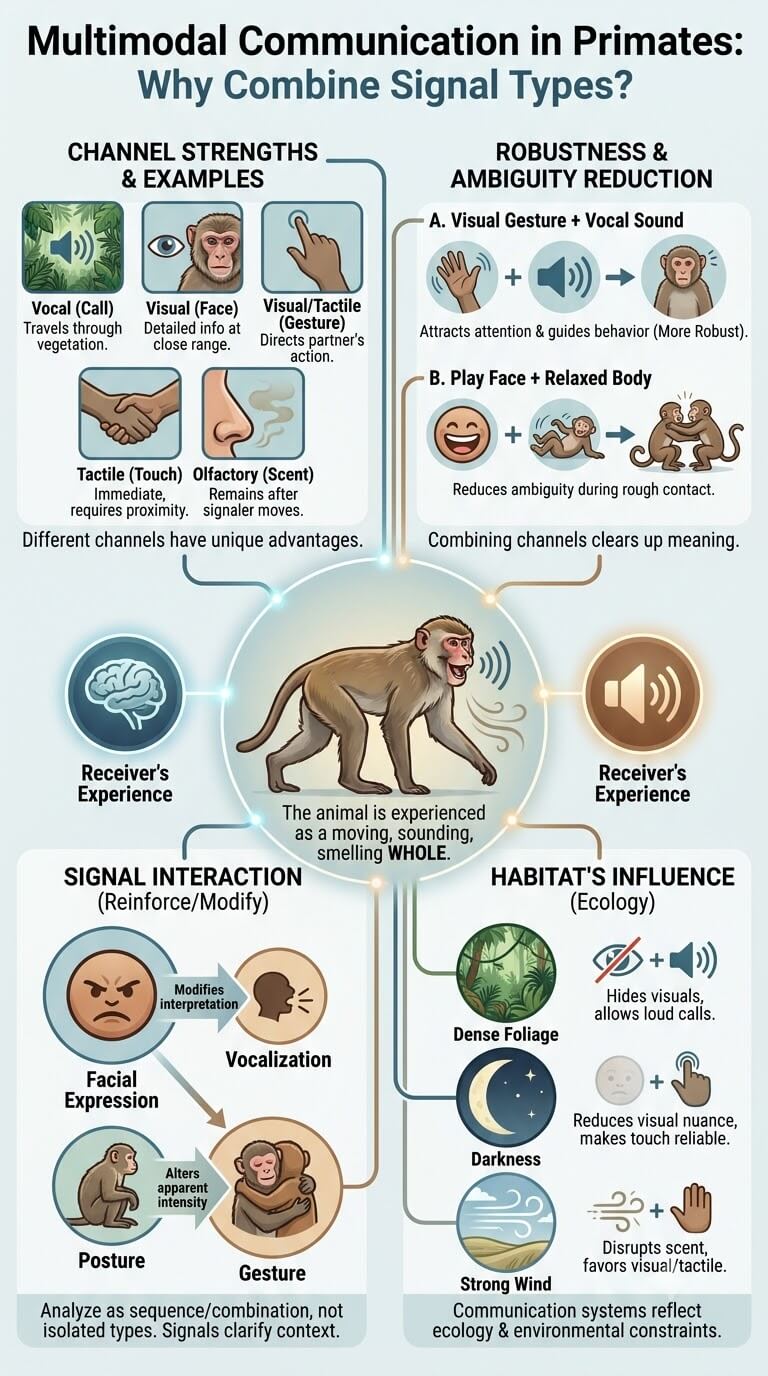
Why primates combine signal types
Different channels have different strengths. A call travels through vegetation. A face gives detailed information at close range. A gesture can direct a partner’s action. Touch is immediate but requires proximity. Scent can remain after the signaler has moved away.
Combining channels can make communication more robust. A visual gesture paired with a vocal sound may attract attention and then guide behavior. A play face paired with relaxed body movement may reduce ambiguity during rough contact.
Signals can reinforce or modify one another
Two signals do not necessarily carry identical information. One may draw attention while another clarifies context. A facial expression can change how a vocalization is interpreted, and posture can alter the apparent intensity of a gesture.
This is why researchers increasingly analyze communication as a sequence or combination rather than counting isolated signal types. The receiver experiences the animal as a moving, sounding, smelling whole.
Habitat affects which channels work best
Dense foliage can hide visual signals but still allow loud calls to travel. Darkness reduces the value of subtle facial expressions. Strong wind can disrupt scent trails, while close physical contact makes touch especially reliable.
Communication systems therefore reflect ecology. A nocturnal forest primate, a terrestrial savanna monkey, and an arboreal ape face different constraints on which signals reach a receiver.
Alarm and Contact Signals in Real Social Settings
Callers can respond to who is nearby
Some primates alter calling according to the audience. A signal may be more likely when particular group members have not yet detected a danger or when a nearby individual is socially important.
These audience effects show that communication is not always a fixed reflex to an external event. At least in some contexts, the signaler’s behavior is influenced by what other individuals appear to know, see, or do.
Receivers use more than the acoustic signal
A receiver may combine a call with knowledge of the caller, recent events, location, and the reactions of other group members. The same broad call type can therefore produce different behavior depending on context.
This flexibility is one reason simple translations such as “this sound means eagle” are scientifically risky. A call can be strongly associated with a threat category without functioning exactly like a human noun.
Communication can reduce uncertainty
Signals often help animals decide what to do when information is incomplete. A contact call can reveal where a partner is. An alarm call can prompt scanning or escape. A gesture can clarify whether another individual wants to play, groom, travel, or gain access to something.
Communication does not eliminate uncertainty. It changes the information available to the receiver, who still makes decisions using the surrounding situation.
Species Differ in Communication Style
Gibbons and long-distance vocal communication
Gibbons rely heavily on powerful calls that carry through forests. Their songs can be produced by individuals or coordinated between pair members depending on species and context. These vocal displays are useful where dense vegetation makes long-range visual signaling difficult.
Close-range gibbon communication also includes facial expressions, posture, and touch. Loud songs are prominent, not exclusive.
Chimpanzees and flexible multimodal signaling
Chimpanzees use vocalizations, gestures, facial expressions, gaze, posture, touch, and grooming. Their communication has been studied in detail because researchers can compare signaling across feeding, travel, play, aggression, grooming, mating, and alarm situations.
That research reveals flexibility but also cautions against human translation. A gesture’s likely outcome can depend on the recipient, context, and sequence in which it appears.
Lemurs and chemical communication
Many lemurs make chemical signals particularly obvious through scent glands and scent-marking behavior. Vocalizations and visible displays remain important, but smell can carry information over time and after the signaler leaves.
This sensory emphasis illustrates why ape communication should never be used as the template for every primate.
Monkeys and context-sensitive calls and gestures
Monkeys use a wide variety of calls, facial signals, postures, gestures, and tactile interactions. Vervet alarm calls are a famous example, while macaques, baboons, capuchins, spider monkeys, and other groups show their own communication patterns.
Differences in group size, habitat, predation, diet, and social relationships help shape which signals are useful and how often they are produced.
Common Mistakes and Myths
Primate calls are words
Some calls are strongly associated with particular events and can trigger predictable responses, but calling them words can imply symbolic and linguistic properties that have not been demonstrated. It is safer to describe the evidence directly: what causes the call, how it varies, and how receivers respond.
All primates communicate mainly with sound
False. Vocal communication is important, but primates also rely on faces, gaze, posture, gestures, touch, grooming, and scent. The balance varies by lineage, habitat, and activity pattern.
Grooming always means friendship
False. Grooming can be affiliative, practical, requested, exchanged, or shaped by the immediate social setting. Human labels such as friendship can obscure the behavior unless they are defined carefully and supported by long-term relationship data.
Facial expressions mean the same thing as human expressions
False. Similar facial movements can have different functions across species. Teeth exposure, open-mouth displays, lip movements, and gaze need to be interpreted from species-specific observations rather than from human intuition.
Complex signaling proves human-like language
No. Complex communication is not the same as human language. Evidence for flexible gesture use, referential calls, call combinations, or audience-sensitive signaling is scientifically important on its own. It does not need to be exaggerated into a claim that nonhuman primates speak a language equivalent to ours.
How Researchers Study Primate Communication
Field observation
Long-term observation lets researchers record which signals occur before feeding, play, travel, aggression, grooming, mating, predator encounters, or reunions. Repeated observations help separate a reliable pattern from a memorable one-time event.
Field work also preserves natural audience relationships and ecological conditions that can be difficult to reproduce in captivity.
Playback experiments
In a playback experiment, researchers record a vocalization and later play it to an animal under controlled conditions. They can compare responses to different call types, callers, or contexts while reducing some of the uncertainty present during spontaneous events.
A response to playback shows what information the receiver can extract from the sound under those conditions. It does not automatically prove that the caller produced the signal with the same conceptual interpretation.
Gesture and attention tests
Researchers studying gestures often record whether the signaler faces a recipient, waits for a response, persists after failure, or changes behavior when the recipient is not looking. These criteria help distinguish goal-directed signaling from movements that happen to affect another animal.
Because different species vary in vision, posture, hand use, and social tolerance, methods need to be adapted rather than copied blindly from humans or great apes.
Chemical sampling and scent tests
Primate scent communication can be studied by observing where animals mark, collecting chemical samples, and presenting odors to receivers under controlled conditions. Researchers may test whether animals distinguish familiar from unfamiliar scents or respond differently to reproductive and social information.
This work has helped correct the old assumption that primate communication is mainly visual and vocal.
FAQ
Do primates have a language?
Nonhuman primates have complex communication systems, but scientists generally distinguish those systems from human language. Some primates use flexible gestures, context-linked calls, call combinations, and audience-sensitive signaling. Human language adds highly productive symbolic vocabulary and syntax on a scale not demonstrated in other primates.
Why do primates groom each other?
Grooming can clean fur and remove ectoparasites, but it also provides structured close contact between individuals. It can maintain affiliation, continue an interaction, or communicate tolerance. Its social meaning depends on the species, partners, and context rather than always representing one human-like relationship.
Do primates understand alarm calls?
Many primates respond selectively to alarm calls, and some systems provide detailed information about threats. Receivers can use the acoustic signal together with context and prior knowledge. Scientists therefore study what animals discriminate and how they respond rather than assuming the calls function exactly like spoken words.
Do primates use scent to communicate?
Yes. Scent communication is especially conspicuous in many strepsirrhines such as lemurs, but monkeys and apes can also use olfactory information. Depending on the species, odors may provide information related to identity, sex, reproductive condition, familiarity, or social context. Scent communication is especially useful for understanding differences among lemurs, lorises, and tarsiers.
Final Thoughts
Primates communicate through a flexible mixture of calls, faces, gaze, gestures, posture, touch, grooming, and scent. The most useful channel depends on distance, light, habitat, attention, social setting, and the sensory abilities of the species. A gibbon song, a vervet alarm call, a chimpanzee gesture, and a lemur scent mark are all communication, but they solve different problems. The effectiveness of calls, gestures, and scent also depends on the habitat in which a primate lives.
The strongest interpretation stays close to the evidence. Signals can influence behavior, carry context-dependent information, and sometimes show intentional or audience-sensitive use without being equivalent to human words or sentences. Understanding primate communication means asking how signals are produced, combined, received, and used in real situations rather than forcing every species into a human language model.

Ethan Walker is the founder and research editor of Animal Fact Central. He creates and reviews educational animal facts content using trusted wildlife, pet care, and science-based sources. His work focuses on making animal behavior, adaptations, habitats, and species facts clear, accurate, and engaging for everyday readers.
Read More Details About Ethan Walker: https://animalfactcentral.com/ethan-walker/