
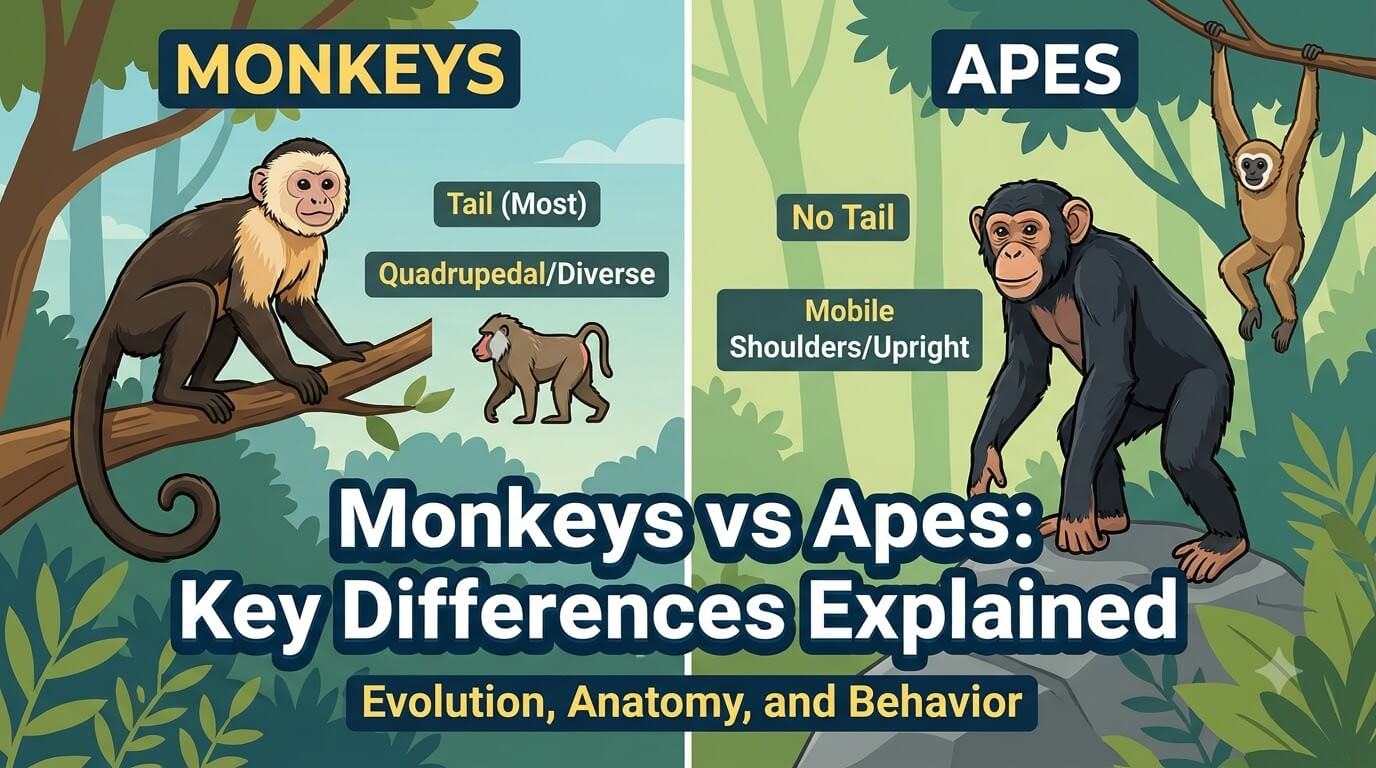
Monkeys and apes are both primates, but they are not the same kind of primate. In modern classification, monkeys belong to New World or Old World monkey lineages, while apes belong to the superfamily Hominoidea. The most familiar visible clue is the tail: living apes do not have an external tail, while most monkeys do. That clue is useful, but it is not a complete definition because some monkeys have extremely short or vestigial tails.
The deeper differences involve body structure and evolutionary history. Apes generally have a broader upper body, highly mobile shoulders, and locomotor patterns that can include climbing, suspension, brachiation, knuckle-walking, or habitual bipedalism. Monkeys are even more varied as a group, but many use quadrupedal movement with a body plan that differs from the more upright trunk and mobile shoulder arrangement typical of apes. Many locomotor differences between monkeys and apes are tied to how primate hands, feet, shoulders, and limbs are built.
Quick Difference Between Monkeys and Apes

The simplest accurate distinction
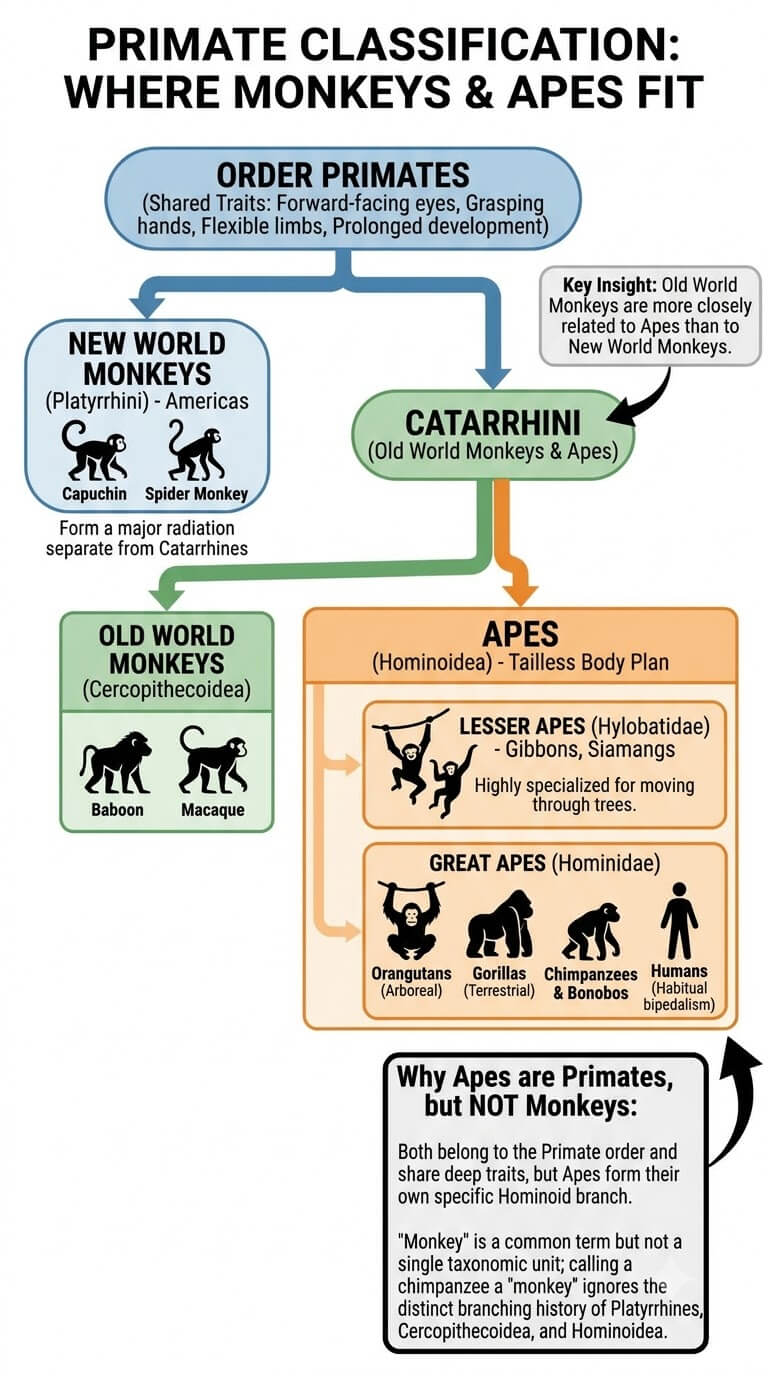
The clearest biological distinction is taxonomic. The Mammal Diversity Database classification of Primates places New World monkeys in Platyrrhini, while Old World monkeys and apes are within Catarrhini. Old World monkeys are in the superfamily Cercopithecoidea. Apes are in Hominoidea, which contains the families Hominidae and Hylobatidae.
So an ape is a primate, but it is not classified as a monkey in the usual modern zoological sense. Gorillas, chimpanzees, bonobos, orangutans, gibbons, siamangs, and humans are apes. Baboons, macaques, colobus monkeys, capuchins, howler monkeys, spider monkeys, and marmosets are monkeys.
Why tail presence is useful but incomplete
Living apes do not have an externally visible tail. Most monkeys have one, which makes the tail a helpful field clue. Smithsonian’s discussion of gibbon anatomy and classification makes the same distinction while also noting that some monkeys have only a reduced or vestigial tail.
That exception matters. A Barbary macaque, for example, has such a reduced external tail that it can look tailless at a glance. It is still a monkey because its evolutionary relationships and anatomy place it among Old World monkeys. Tail presence helps identify many animals, but classification does not depend on that feature alone.
Where Monkeys and Apes Fit in Primate Classification
New World and Old World monkeys
Monkeys are not one single branch that sits opposite apes. New World monkeys, or platyrrhines, form a major radiation in the Americas. Old World monkeys belong to Catarrhini, the same broader catarrhine branch that also includes apes.
This means an Old World monkey is more closely related to an ape than it is to a New World monkey in terms of the branching pattern of primate evolution. The word “monkey” is convenient in everyday language, but it does not describe one simple taxonomic unit containing every monkey and excluding every ape.
Apes within Hominoidea
Hominoidea includes the gibbons and siamangs in Hylobatidae and the great apes in Hominidae. Great apes include orangutans, gorillas, chimpanzees, bonobos, and humans. The term “lesser ape” has traditionally been used for gibbons and siamangs, although “small apes” or simply “gibbons” can avoid the mistaken impression that they are biologically inferior. Within the apes, the next major comparison is between great apes and lesser apes.
All living apes share a tailless body plan, but they do not all look alike or move alike. Gibbons are lightweight and highly specialized for moving through trees. Gorillas are much heavier and substantially terrestrial. Orangutans are strongly arboreal. Humans are specialized for habitual bipedalism.
Why apes are primates but not monkeys
Both monkeys and apes belong to the primate order, so they share deeper traits such as forward-facing eyes, grasping hands, relatively flexible limbs, and prolonged development. Those similarities reflect common ancestry.
The monkey-ape distinction appears farther down the family tree. Apes form their own hominoid branch, while Old World monkeys form Cercopithecoidea and New World monkeys are platyrrhines. Calling a chimpanzee a monkey ignores that branching history even though the two animals share many primate features.
Monkeys vs Apes Comparison Table
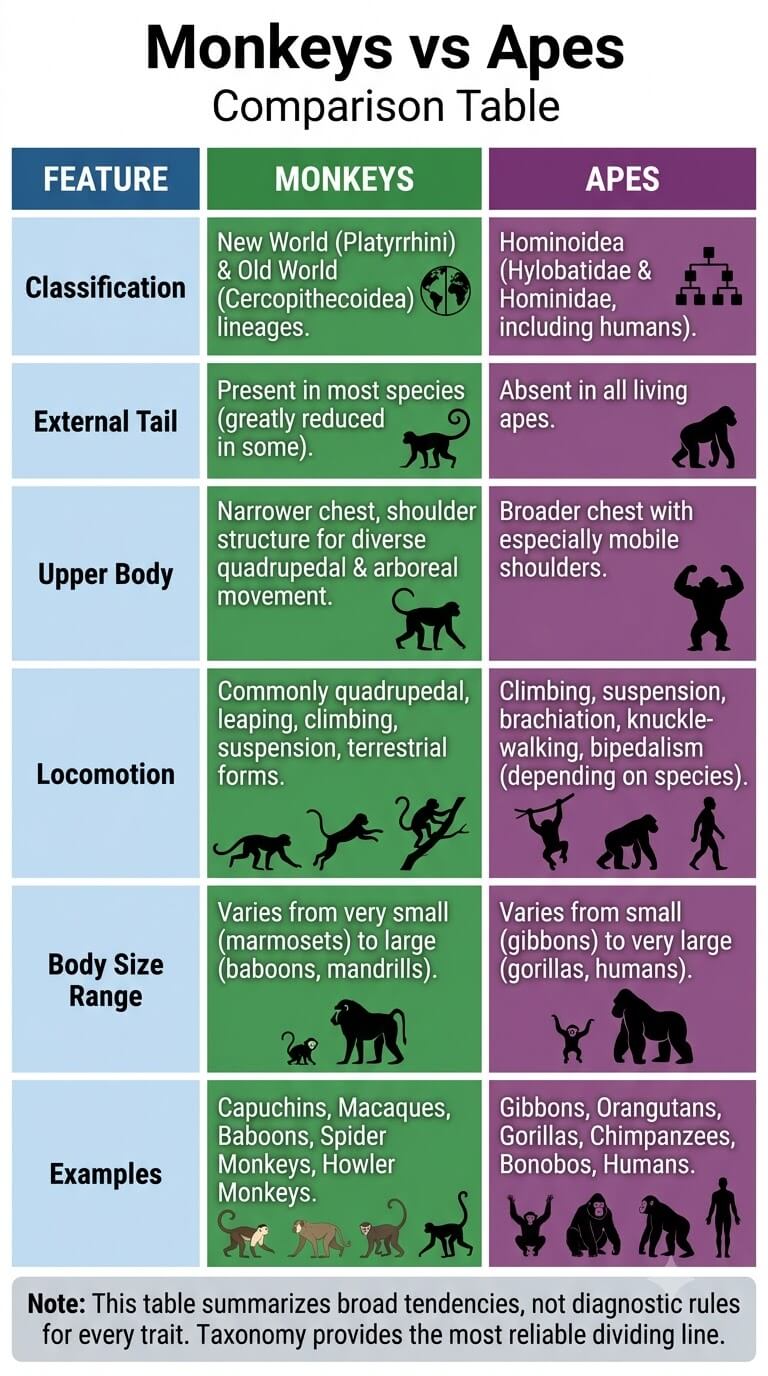
| Feature | Monkeys | Apes |
|---|---|---|
| Classification | New World lineages in Platyrrhini and Old World monkeys in Cercopithecoidea | Hominoidea, including Hylobatidae and Hominidae |
| External tail | Present in most species, but greatly reduced in some | Absent in all living apes |
| Upper body | Often narrower through the chest, with shoulder structure suited to diverse quadrupedal and arboreal movement | Generally broader through the chest with especially mobile shoulders |
| Locomotion | Commonly quadrupedal, with leaping, climbing, suspension, and terrestrial forms also present | Climbing, suspension, brachiation, knuckle-walking, careful arboreal clambering, and bipedalism depending on species |
| Body size | Ranges from very small marmosets to large baboons and mandrills | Ranges from small gibbons to very large gorillas |
| Examples | Capuchins, macaques, baboons, colobus monkeys, spider monkeys, howler monkeys | Gibbons, orangutans, gorillas, chimpanzees, bonobos, humans |
The table summarizes broad tendencies, not diagnostic rules for every individual trait. A gibbon can be smaller than many monkeys, a tailless-looking macaque is still a monkey, and some monkeys use highly suspensory movement. Taxonomy provides the most reliable dividing line.
Tails and Body Shape

Why living apes lack external tails
All living apes lack an external tail. The human coccyx and comparable structures in other apes are remnants of the vertebral region associated with the tail in more distant ancestors, but they do not form the long external tail seen in many monkeys.
Tail loss is therefore a genuine hominoid feature, but it should be understood alongside the rest of ape anatomy rather than as a stand-alone explanation of what an ape is.
Tail diversity among monkeys
Monkey tails vary from long balancing structures to powerful prehensile organs and extremely reduced vestiges. Some New World monkeys, especially certain spider monkeys and howler monkeys, can wrap a prehensile tail around branches and use it to support the body. Other New World monkeys have long tails that cannot grip.
Old World monkey tails are also variable. Baboons and many macaques have visible tails of different lengths, while some macaques have very short ones. None of these differences changes whether the animal belongs to the monkey side of the primate family tree.
Why tails alone cannot identify every primate category
A tail is most useful when combined with other evidence. A long-tailed animal that clearly has monkey-like facial anatomy and locomotion is unlikely to be an ape, because living apes lack external tails. But an animal without an obvious tail is not automatically an ape.
Other primates outside monkeys and apes complicate the shortcut further. Lemurs and tarsiers may have long tails, while some lorises have very short tails. The tail clue works best for a focused monkey-versus-ape comparison, not as a universal key to all primates.
Shoulders, Arms, and Upper-Body Mobility

Ape shoulder mobility
One of the most important structural differences lies in the shoulder and chest. Apes generally have a broad, relatively shallow thorax with shoulder blades positioned more toward the back, creating an upper-body arrangement that permits extensive arm movement. A scientific review of ape body form and locomotor evolution contrasts this pattern with the deeper, narrower thorax typical of monkeys.
Greater shoulder mobility is useful in climbing and suspension, where an arm may need to reach overhead, outward, or behind the body. The same general hominoid architecture has been modified differently in gibbons, orangutans, African apes, and humans.
Monkey limb proportions and movement diversity
Many monkeys have a trunk and shoulder arrangement well suited to quadrupedal movement along branches or on the ground. Their limbs usually function in a more consistently weight-bearing pattern than the highly suspensory arms of gibbons.
Still, monkeys are not mechanically uniform. Spider monkeys use long limbs and suspension extensively. Howler monkeys combine quadrupedal movement with a grasping tail. Baboons are adapted for substantial terrestrial travel. Langurs and other monkeys can leap impressively between supports.
How anatomy relates to climbing and suspension
Movement reflects an entire body, not just arm length. Shoulder orientation, chest shape, elbow mobility, wrist structure, hand form, body mass, limb proportions, and the presence or absence of a functional tail all affect what an animal can do.
Apes are especially notable for upper-body mobility, while monkey locomotion includes an enormous range of quadrupedal, leaping, climbing, and suspensory strategies. The contrast is real, but it is better described as a difference in overall anatomical emphasis than as “apes swing and monkeys walk.”
Locomotion and Posture

Quadrupedal movement in many monkeys
Many monkeys travel on four limbs. Arboreal quadrupeds move above branches, adjusting hand and foot placement to irregular supports. Terrestrial quadrupeds use the ground more extensively and often show limb proportions and joint mechanics suited to repeated forward travel.
Monkeys can shift between these modes. Macaques are a good example because different species and populations use trees and ground in different proportions. Baboons are strongly associated with terrestrial travel but still retain climbing ability.
Climbing, suspension, brachiation, and knuckle-walking in apes
Apes display several locomotor patterns. Gibbons are the classic brachiators, moving beneath branches with alternating arm swings. Orangutans climb and clamber through the canopy, often distributing their weight carefully across flexible supports. Chimpanzees and gorillas use knuckle-walking on the ground while retaining substantial climbing ability.
The Smithsonian’s orangutan overview illustrates how long arms and strong grasping extremities support an arboreal ape whose movement differs greatly from both a gibbon and a gorilla.
Why neither group has one universal locomotor pattern
“Monkey movement” and “ape movement” are useful only at a broad level. A capuchin and a baboon do not travel the same way, just as a gibbon and a gorilla do not. Habitat, body size, feeding height, branch diameter, and evolutionary history all influence locomotion.
The strongest comparison is therefore anatomical and phylogenetic. Apes share a body plan with especially mobile shoulders and no external tail, while monkeys retain a different range of body plans that usually includes a tail and often emphasizes quadrupedal movement.
Posture and Trunk Position
Why apes often look more upright
Apes often hold the trunk more upright during sitting, climbing, reaching, and some forms of locomotion. Their broader thorax and shoulder placement support arm positions above and around the body without requiring the trunk to remain in the more horizontal orientation common during monkey quadrupedalism.
This does not mean every ape routinely walks upright. Gibbons may walk bipedally on branches or the ground, but brachiation is central to their locomotion. Chimpanzees and gorillas can stand or walk bipedally for short periods but usually use other forms of locomotion. Humans are the living ape specialized for habitual bipedal walking.
Monkey posture varies with ecology
Monkeys can also sit upright, stand bipedally, hang beneath branches, or rear during social behavior. A monkey’s posture changes with feeding, locomotion, vigilance, display, and substrate use.
The useful distinction is not “apes upright, monkeys horizontal.” Instead, apes generally possess a trunk and shoulder configuration that makes upright and suspensory positions especially important, while many monkeys retain anatomy strongly associated with quadrupedal support.
Body Size, Growth, and Life History
General size tendencies and major exceptions
Great apes include some of the largest living primates, especially gorillas, but apes are not universally large. Gibbons are smaller than many baboons and mandrills. Monkeys also span a huge size range, from tiny marmosets to large-bodied Old World species.
Body size can help explain locomotion and ecology, but it cannot define the groups. A small ape remains an ape, and a large monkey remains a monkey.
Development and reproductive pace
Primates as a whole tend to grow slowly and invest heavily in relatively few young compared with many mammals of similar body size. Within Primates, great apes are among the lineages with especially slow development. A review of long and slow primate life histories emphasizes late maturation, long lifespan, and substantial parental investment as recurring primate patterns.
Apes often have long juvenile periods that allow extended learning before adulthood. Monkeys also provide prolonged care and learning opportunities, but many monkey species mature and reproduce faster than great apes. Exact schedules differ by species, sex, environment, and population.
Why broad tendencies should not become strict rules
Life history is influenced by body size, ecology, mortality risk, and evolutionary lineage. It would be inaccurate to say that every ape develops more slowly than every monkey without checking the specific species being compared.
The useful generalization is that great apes tend toward the slow end of an already slow primate life-history spectrum. It is a tendency with biological meaning, not a shortcut for identifying an unknown animal.
Intelligence and Behavior Without Ranking the Groups
Cognitive diversity in monkeys
Monkeys show sophisticated learning, memory, social knowledge, communication, and problem-solving in many contexts. Capuchins are well known for flexible object manipulation and tool-related behavior. Macaques can learn complex social relationships and adapt to changing environments. Other monkeys specialize in different cognitive challenges.
These abilities should be evaluated in relation to each species’ ecology and sensory world. A task designed around hand manipulation may favor one species, while a spatial or social task may reveal strengths in another.
Cognitive diversity in apes
Great apes have received extensive attention in studies of tool use, social learning, memory, communication, planning, and self-recognition. Gibbons have historically received less cognitive research than great apes, which makes broad comparisons among all apes uneven.
Research effort itself can influence public impressions. A species studied for decades in laboratories and long-term field sites will accumulate more documented examples than a less-studied species even if the comparison does not reflect a simple difference in general intelligence.
Why monkey-versus-ape intelligence rankings are misleading
There is no scientifically useful single scale that ranks every monkey and ape from smartest to least smart. Cognition includes many abilities, and species differ in motivation, perception, social tolerance, motor skills, and experience.
Apes often attract attention because of their close evolutionary relationship to humans and because some species show striking tool and social behaviors. That does not justify the claim that every ape is cognitively superior to every monkey in every task.
Representative Examples
Baboons, macaques, and colobus monkeys
Baboons illustrate terrestrial Old World monkey adaptations, with strong quadrupedal travel and social lives that can involve large groups. Macaques show remarkable ecological flexibility and occur in habitats ranging from tropical forests to temperate regions. Colobus monkeys represent a different Old World strategy, with strong arboreal habits and digestive adaptations for leaf-rich diets.
These examples alone show why “monkey” cannot mean one body shape, one diet, or one lifestyle.
Capuchins, spider monkeys, and howler monkeys
New World monkeys add a different set of contrasts. Capuchins are dexterous generalists. Spider monkeys are highly suspensory and use long limbs plus a prehensile tail in the canopy. Howler monkeys move more slowly and also use prehensile tails, while their enlarged hyoid apparatus supports powerful vocalizations.
A monkey can therefore be more suspensory than some apes in particular movements, another reason locomotion by itself cannot define the boundary.
Gibbons, orangutans, gorillas, chimpanzees, and bonobos
Gibbons are small-bodied apes specialized for brachiation. Orangutans are large, long-armed arboreal apes. Gorillas are the largest living primates and use the ground extensively. Chimpanzees and bonobos combine terrestrial and arboreal movement with flexible social and foraging behavior.
These apes share hominoid ancestry and key aspects of body structure, yet their locomotion, ecology, and social organization differ enough that no single species should represent the entire group.
Common Mistakes and Myths
Every monkey has a tail
Most monkeys have an external tail, but some have a greatly reduced or vestigial one. Tail absence in living apes is a consistent contrast, but lack of an obvious tail does not automatically turn a primate into an ape.
Every ape is large
Great apes include very large species, but gibbons and siamangs are smaller-bodied apes. Some large monkeys can outweigh smaller apes. Size is a tendency within parts of the group, not a taxonomic definition.
Apes are simply more evolved monkeys
This is incorrect. Evolution is a branching process, not a ladder. Modern monkeys and modern apes both descend from earlier primate ancestors and have continued evolving along separate lineages.
Apes are not a superior stage that monkeys are trying to reach. Monkey adaptations are successful in their own ecological settings, just as ape adaptations are.
Humans descended from modern apes
Humans are apes, but humans did not descend from chimpanzees, gorillas, or any other ape species alive today. Humans and other living apes share common ancestors farther back in evolutionary history.
The same principle applies to monkeys. Modern monkeys are evolutionary relatives, not living snapshots of a human or ape ancestor.
Why the Monkey-Ape Difference Matters
Old World and New World monkeys have their own important differences
Once monkeys are separated from apes, another major distinction becomes important. Old World and New World monkeys differ in evolutionary history, geographic range, nose anatomy, dental patterns, tail specialization, and several other features.
Those differences explain why a capuchin should not be treated as a smaller version of a macaque. The word monkey contains multiple evolutionary radiations with their own characteristic anatomy.
Great apes and gibbons also differ substantially
Apes likewise contain major divisions. Gibbons and siamangs belong to Hylobatidae, while great apes belong to Hominidae. Their differences in body size, locomotion, social organization, and life history are large enough that “ape” should not be imagined as shorthand for a gorilla or chimpanzee body plan.
Movement reveals how anatomy has been modified
Comparing movement helps make the anatomical distinction visible. A macaque traveling quadrupedally, a spider monkey hanging with a prehensile tail, a gibbon brachiating, and a gorilla knuckle-walking are all using primate limbs, but in very different mechanical ways.
The monkey-versus-ape comparison is therefore most useful when it combines classification with anatomy and locomotion. No single shortcut captures the full difference.
FAQ
Are apes monkeys?
No, not in the usual modern zoological classification. Apes are primates in Hominoidea, while Old World monkeys are in Cercopithecoidea and New World monkeys are platyrrhines. Apes and monkeys share common primate ancestry but belong to different branches.
Do all monkeys have tails?
No. Most monkeys have external tails, but a few have extremely short or vestigial tails. The Barbary macaque is a well-known example. In contrast, no living ape has an external tail.
Are gibbons monkeys or apes?
Gibbons are apes. They belong to the family Hylobatidae and are often called small apes or, traditionally, lesser apes. Their long arms, mobile shoulders, lack of an external tail, and specialized brachiation fit the hominoid body plan.
Which primates count as apes?
Living apes include gibbons, siamangs, orangutans, gorillas, chimpanzees, bonobos, and humans. Gibbons and siamangs belong to Hylobatidae, while the great apes belong to Hominidae.
Final Thoughts
The key difference between monkeys and apes is evolutionary classification, supported by a recognizable set of anatomical patterns. Living apes have no external tail, generally broader upper bodies and highly mobile shoulders, and locomotor systems that often emphasize climbing, suspension, upright trunk positions, or specialized terrestrial movement. Monkeys usually retain tails and many are strongly quadrupedal, but their anatomy and movement are highly diverse.
Tail presence, size, posture, and intelligence can all provide clues, but none should replace taxonomy. A gibbon can be smaller than a monkey, a macaque can appear nearly tailless, and a spider monkey can be highly suspensory. Looking at classification, body structure, and locomotion together gives a much more accurate answer to the monkey-versus-ape question.

Ethan Walker is the founder and research editor of Animal Fact Central. He creates and reviews educational animal facts content using trusted wildlife, pet care, and science-based sources. His work focuses on making animal behavior, adaptations, habitats, and species facts clear, accurate, and engaging for everyday readers.
Read More Details About Ethan Walker: https://animalfactcentral.com/ethan-walker/