

Living nonhuman primates are concentrated mainly in tropical and subtropical parts of Africa, Asia, Madagascar, Central America, and South America. Forests contain much of this diversity, but primates are not limited to tropical rainforest and they do not all live high in trees. Depending on the species, primates occupy dry forests, woodlands, savannas, montane forests, bamboo zones, mangroves, highland grasslands, rocky cliffs, and human-modified landscapes as well as humid rainforest.
Habitat use also varies within a species. Some primates spend most of their lives in the canopy, others travel mainly on the ground, and many switch between trees and terrestrial routes. Body size, food distribution, predation, sleeping sites, branch structure, temperature, rainfall, and competition all influence where a primate can live and which part of a habitat it uses.
Quick Answer

Most nonhuman primates live in warmer regions
The broad geographic pattern is strongly tropical and subtropical. The Animal Diversity Web overview of Primates describes most primates as tropical or subtropical mammals with a strong evolutionary association with arboreal habitats. Modern primate diversity is especially concentrated in Central and South America, sub-Saharan Africa, Madagascar, South and Southeast Asia, and parts of East Asia.
That pattern has important exceptions. Some macaques live in temperate climates, and geladas occupy cool, high-elevation grasslands in Ethiopia. Humans are primates biologically and have a global distribution, but this article focuses on nonhuman primates.
Trees are important, but not universal
Many primates are strongly arboreal because trees provide food, sleeping sites, escape routes, and a three-dimensional network for movement. Spider monkeys, gibbons, many lemurs, colobus monkeys, and orangutans are obvious examples of species that depend heavily on arboreal space.
Other primates are substantially terrestrial. Baboons can spend most daylight hours on the ground, geladas forage extensively in grasslands, and gorillas often travel terrestrially. Several macaques combine ground travel with frequent climbing. “Primate habitat” therefore includes both canopy and ground.
Where Primates Live Around the World

Central and South America
New World monkeys are native to the Americas. Their greatest diversity occurs in tropical Central and South America, particularly across the Amazon Basin and other forest regions. Capuchins, howler monkeys, spider monkeys, squirrel monkeys, marmosets, tamarins, sakis, uakaris, and night monkeys occupy different parts of this broad region.
Not every New World monkey uses the same forest. Some live in wet lowland rainforest, while others occur in dry forest, seasonal woodland, flooded forest, montane forest, or mangrove-associated habitats. Their ranges can be narrow or extensive depending on the lineage.
Continental Africa
Africa supports great apes, Old World monkeys, lorises, and galagos. Chimpanzees and gorillas occupy forested regions, but chimpanzee habitat can include forest-savanna mosaics. Baboons extend into open woodlands, grasslands, scrub, and semi-arid settings where sufficient food, water, and secure sleeping places are available.
African primates therefore span a major environmental gradient. A colobus monkey feeding in forest canopy and a baboon traveling across open ground are both Old World monkeys, yet the mechanical and ecological demands of their habitats are very different. The global pattern is especially clear when comparing the ranges of Old World and New World monkeys.
Madagascar
Madagascar is the native home of living lemurs. The island contains humid eastern rainforests, western dry deciduous forests, southern dry and spiny habitats, montane environments, bamboo-rich areas, and other ecosystems that support very different lemur communities.
Lemurs are not all canopy specialists. Many are strongly arboreal, but ring-tailed lemurs use the ground extensively, while sifakas combine vertical clinging and leaping with terrestrial movement when crossing gaps. Madagascar shows how one primate radiation can diversify across contrasting habitats without native monkeys or apes.
South and Southeast Asia
Asian primates include macaques, langurs, snub-nosed monkeys, proboscis monkeys, gibbons, orangutans, lorises, and tarsiers. Their habitats range from tropical lowland forests and peat-swamp forests to mangroves, limestone forests, montane zones, and seasonally dry woodland.
Orangutans are among the most arboreal large mammals, while some macaques make extensive use of the ground. Gibbons depend heavily on connected forest canopy for efficient travel. Asian primate habitat cannot be represented by one generic rainforest scene.
Temperate and high-elevation exceptions
Primates are often associated with heat and humidity, but some lineages tolerate cold winters or high elevations. Japanese macaques occur farther north than any other living nonhuman primate and occupy climates with substantial seasonal cold. Several other Asian macaques live in montane or subtropical environments.
Geladas provide a very different high-elevation example. Research on the large-scale distribution of geladas describes them as endemic to Ethiopian highland grassland plateaus. Their ecology is strongly terrestrial and tied to open highland landscapes rather than forest canopy.
Forests Are Important, but Forests Are Not All the Same

Tropical lowland rainforest
Lowland rainforest supports high plant productivity, complex canopy structure, and numerous fruiting tree species. These conditions can support many arboreal primates, but even within one rainforest, species divide space by height, food type, activity period, body size, and locomotor style.
A small marmoset can exploit trunks and fine branches that cannot support a large monkey. A spider monkey may travel through upper canopy using suspension, while another species uses lower levels and more quadrupedal movement.
Dry and seasonal forests
Dry forests experience stronger seasonal shortages of leaves, fruit, or surface water. Primates living there may change diets, travel routes, activity timing, and home-range use as resources shift.
Seasonal forest does not necessarily mean poor primate habitat. It means animals face a different timing problem. Knowledge of water, fallback foods, sleeping sites, and seasonal fruiting can become especially important.
Montane forests
Mountain forests can be cooler, steeper, and structurally different from lowland forest. Cloud cover, elevation, bamboo, mossy vegetation, and changing plant communities alter the foods and supports available to primates.
Some macaques, langurs, gorillas, lemurs, and other primates use montane habitats. Locomotion may involve more terrestrial routes where canopy continuity is low, but the pattern depends on the species and local forest.
Mangroves and flooded forests
Some primates exploit forests influenced by tides, rivers, or seasonal flooding. Proboscis monkeys are strongly associated with riverine, mangrove, and swamp habitats in Borneo. Other monkeys also use mangroves where food and safe arboreal routes are available.
Flooded habitats change how animals move. Water can interrupt terrestrial travel, concentrate routes through trees, and alter the seasonal distribution of fruit and leaves.
What Arboreal Life Means
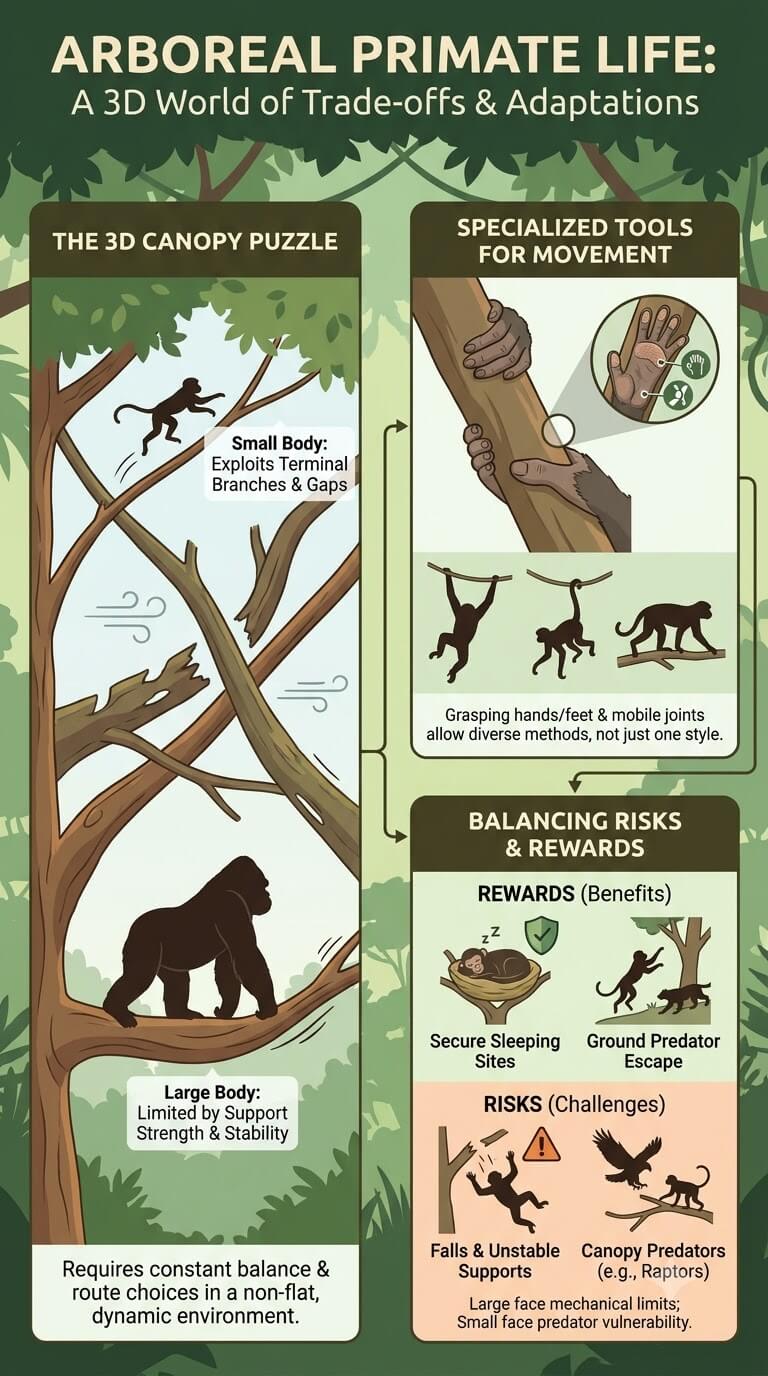
Canopy living is three-dimensional
A tree canopy is not a flat surface. Branches vary in diameter, slope, stiffness, spacing, and height. Gaps can require leaping, suspension, bridging, or detours. Wind changes the stability of small supports.
Arboreal primates must continuously choose where to place hands and feet while controlling the body’s center of mass. A route that is easy for a small monkey may be impossible for a gorilla or orangutan because the branch cannot support the same load.
Hands and feet secure irregular supports
Many nonhuman primates have grasping hands and feet that allow digits to wrap around branches. Mobile joints help the limbs approach supports from different angles, while tactile pads improve contact and sensory feedback.
These traits do not produce one locomotor method. Gibbons emphasize arm-swinging, spider monkeys combine suspension with a prehensile tail, orangutans climb and bridge, and many monkeys walk quadrupedally along branches.
Arboreal travel can reduce some risks and create others
Trees can provide escape routes from certain ground predators and secure elevated sleeping sites. They can also expose primates to falls, unstable branches, canopy predators, and gaps that demand precise movement.
Large-bodied primates face particular mechanical limits because narrow supports bend under their weight. Small primates can reach terminal branches, but their size may increase vulnerability to raptors and other predators.
Terrestrial and Mixed Primate Lifestyles
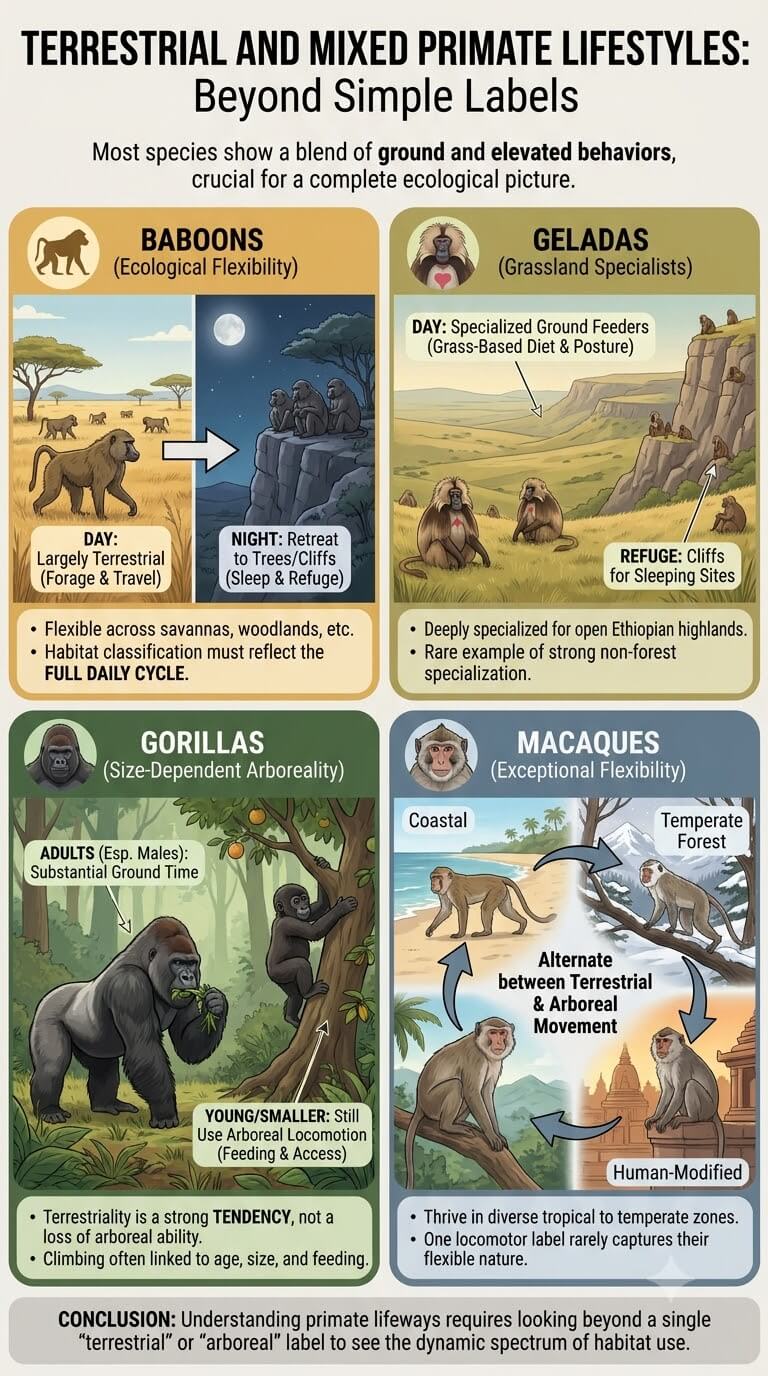
Baboons are highly terrestrial but still use trees and cliffs
Baboons are among the most ecologically flexible terrestrial primates. A review of baboon ecology and social systems notes that baboons are largely terrestrial during the day but commonly retreat to trees or cliffs for sleeping. Different species occupy savannas, woodland, scrub, semi-arid landscapes, and forest-edge environments.
This mixed use is important. A primate can be terrestrial during travel and foraging while still depending on arboreal or rocky refuges at night. Habitat classification should reflect the full daily cycle.
Geladas are grassland specialists
Geladas are unusual among living primates because their ecology is strongly centered on Ethiopian highland grasslands. They spend much of the day on the ground feeding and moving through open habitat, while cliffs provide important sleeping and refuge sites.
Their hands and posture are adapted to terrestrial feeding, and their diet is unusually grass-based for a primate. Geladas demonstrate that a primate lineage can become deeply specialized for open landscapes rather than forest.
Gorillas combine terrestriality with arboreal behavior
Gorillas are large-bodied apes that spend substantial time on the ground, especially adult males. Recent research on the locomotor ecology of wild western lowland gorillas shows that western gorillas still use arboreal locomotion and that age, sex, activity, and ecological context affect how often they climb.
Young and smaller gorillas can use branches unavailable to very large adults. Feeding opportunities can also draw gorillas into trees. Terrestriality is therefore a strong tendency, not the disappearance of arboreal ability.
Macaques show exceptional flexibility
Macaques include tropical forest species, temperate species, mountain populations, and monkeys that use coasts, woodland, grassland edges, and human-modified environments. Many alternate between terrestrial and arboreal movement.
A study of wild Tibetan macaques found extensive ground use alongside climbing behavior linked to feeding in scrub vegetation. This kind of flexible terrestrial and arboreal habitat use makes macaques useful examples of why one locomotor label rarely captures an entire species.
Sleeping Sites Matter
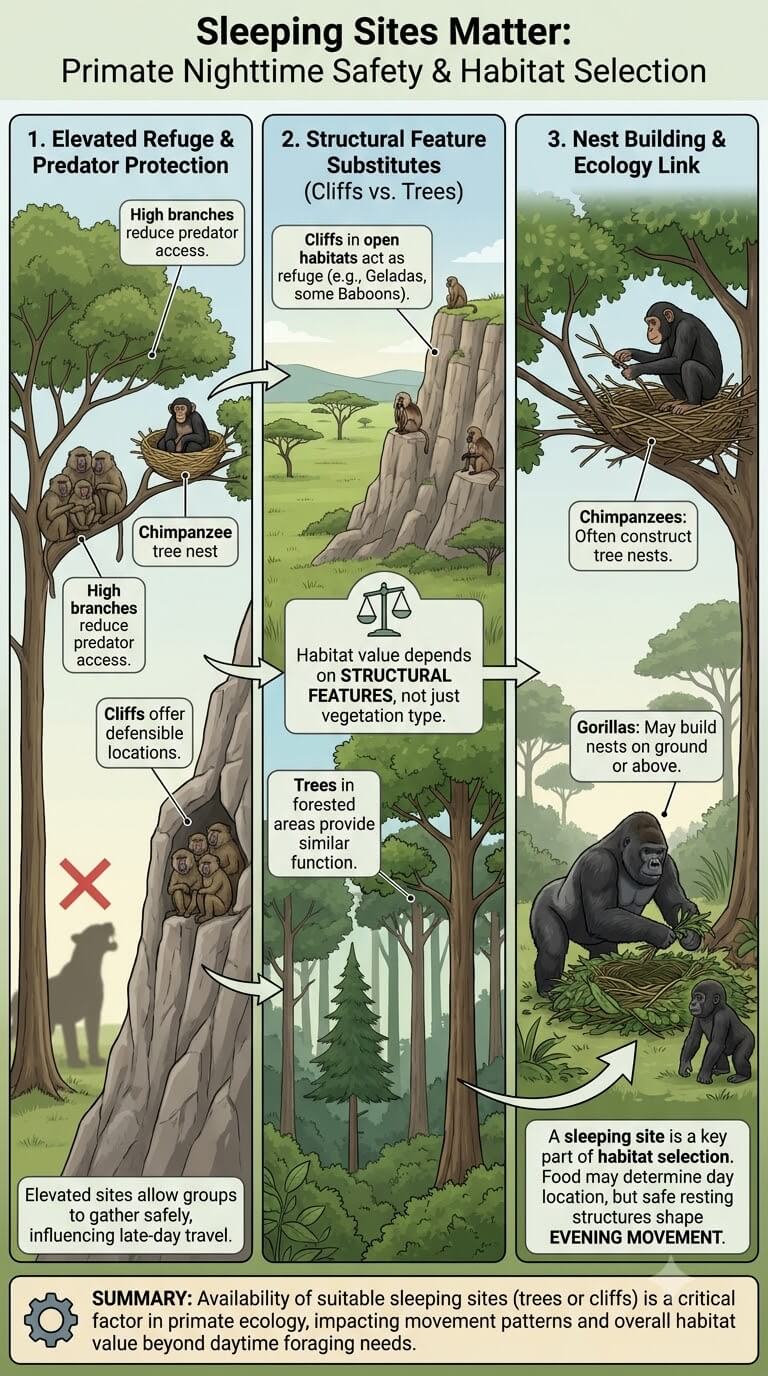
Trees can provide nighttime safety
Even strongly terrestrial primates may climb to sleep. Elevated sites can reduce access for some predators and allow groups to gather in defensible locations.
Baboons often use tall trees or cliffs, while chimpanzees construct sleeping nests in trees in many populations. The availability of suitable sleeping sites can therefore influence where primates travel late in the day.
Cliffs can substitute for trees
In open or highland habitats, rocky cliffs can provide the same general refuge function as a large sleeping tree. Geladas are closely associated with cliffs that provide nighttime sleeping sites near grassland feeding areas.
Baboons in some regions also use cliffs. This reveals that habitat value depends on structural features, not simply vegetation type.
Nest building links trees with ape ecology
Chimpanzees and gorillas construct nests from vegetation for resting and sleeping. Nest location varies by species, population, age, and local conditions. Chimpanzees often nest in trees, while gorillas may build on the ground or above it.
A sleeping site is therefore part of habitat selection. Food may determine where an ape spends the day, but safe and comfortable resting structures can shape evening movement.
Food Distribution Shapes Habitat Use
Fruit trees create temporary feeding patches
Fruit is often patchy in space and time. A tree can become highly valuable for a short period and then provide little food for months. Frugivorous primates must move among changing patches rather than occupy every part of a home range equally.
Large fruit crops may allow several animals to feed together. Small patches can increase competition or encourage animals to spread out.
Leaves can support different ranging patterns
Leaves are often more broadly available than ripe fruit, although high-quality young leaves can still be patchy. Leaf-oriented primates may travel differently from specialized fruit eaters because their food renews on another schedule and may occur in greater abundance.
Digestive constraints also matter. A leaf-eating primate may need long resting periods for fermentation, influencing daily movement and choice of feeding areas.
Ground foods can pull arboreal primates downward
Fallen fruit, grasses, insects, mineral sources, crops, or other ground resources can draw otherwise arboreal primates to terrestrial feeding sites. Ground use may increase when benefits outweigh predation and travel risks.
Habitat use is therefore dynamic. An animal classified as arboreal can still descend regularly under particular ecological conditions.
Body Size Changes How Primates Use Space

Small primates can use narrow supports
Small-bodied primates can move on thin branches and terminal foliage that would not safely carry large animals. These outer canopy areas can contain fruit, flowers, nectar, and insects.
Low body mass can also make rapid leaping practical, although small size brings its own balance and predator challenges.
Large apes must manage flexible branches carefully
Orangutans solve the problem of large body size in trees by using multiple supports, careful climbing, suspension, and controlled movement. Research on orangutan movement on flexible branches shows how they can alter posture and movement to manage compliant supports and reach terminal-branch foods.
Instead of simply avoiding every thin branch, a large ape can bend supports, distribute weight, or use several limbs simultaneously. Arboreal locomotion is therefore a problem of mechanics as well as anatomy.
Large body size can favor greater ground use
Ground surfaces remove many of the weight limits created by branches. Large primates can travel without continually testing whether a support will bend or break.
This helps explain why gorillas are more terrestrial than smaller gibbons, although body size is not the only factor. Food, evolutionary history, predation, and anatomy also matter.
Canopy Layers and Vertical Space
Different species can use different forest levels
When several primate species share a forest, they do not necessarily occupy identical routes. One may feed mainly high in the canopy, another in the understory, and another on the ground. When these habitats are lost or fragmented, conservation risk can rise sharply for species that depend on them.
This vertical separation can reduce competition while matching each species’ food preferences and locomotor abilities.
The understory creates different movement challenges
Understory vegetation can be dense, with thin stems, tangled branches, vines, and limited long-distance visibility. Small monkeys, lemurs, lorises, and tarsiers can exploit these structures in different ways.
Calls may become important where visual contact is restricted, while vertical supports favor clinging or leaping in some species.
The forest floor is part of forest habitat
Calling an animal a forest primate does not mean it stays in trees. Gorillas, chimpanzees, macaques, baboons living near forest, and several lemurs use the forest floor extensively.
Forest habitat should therefore be understood as a connected vertical system extending from soil and understory to upper canopy.
Climate and Season Change Habitat Use

Rain changes foods and travel conditions
Rainfall affects fruiting, leaf production, insect activity, water availability, and ground conditions. Seasonal rainfall can shift where primates feed and how far they travel.
Flooding may close terrestrial routes, while drought can concentrate animals around remaining water or fallback foods.
Temperature changes activity
Primates in cool mountains or temperate regions face different energetic constraints from tropical lowland species. Cold can increase the value of sun-exposed resting sites, sheltered sleeping areas, huddling, or seasonal changes in activity.
Heat can produce the opposite problem, favoring shade, reduced midday movement, or access to water.
Habitat use can change without the species changing habitat type
A monkey may remain within the same forest yet shift from one canopy layer to another, alter daily travel distance, or increase ground use across seasons. Habitat selection occurs at multiple scales.
This flexibility helps explain why short observations can give an incomplete impression of whether a species is arboreal or terrestrial.
Human-Modified Landscapes
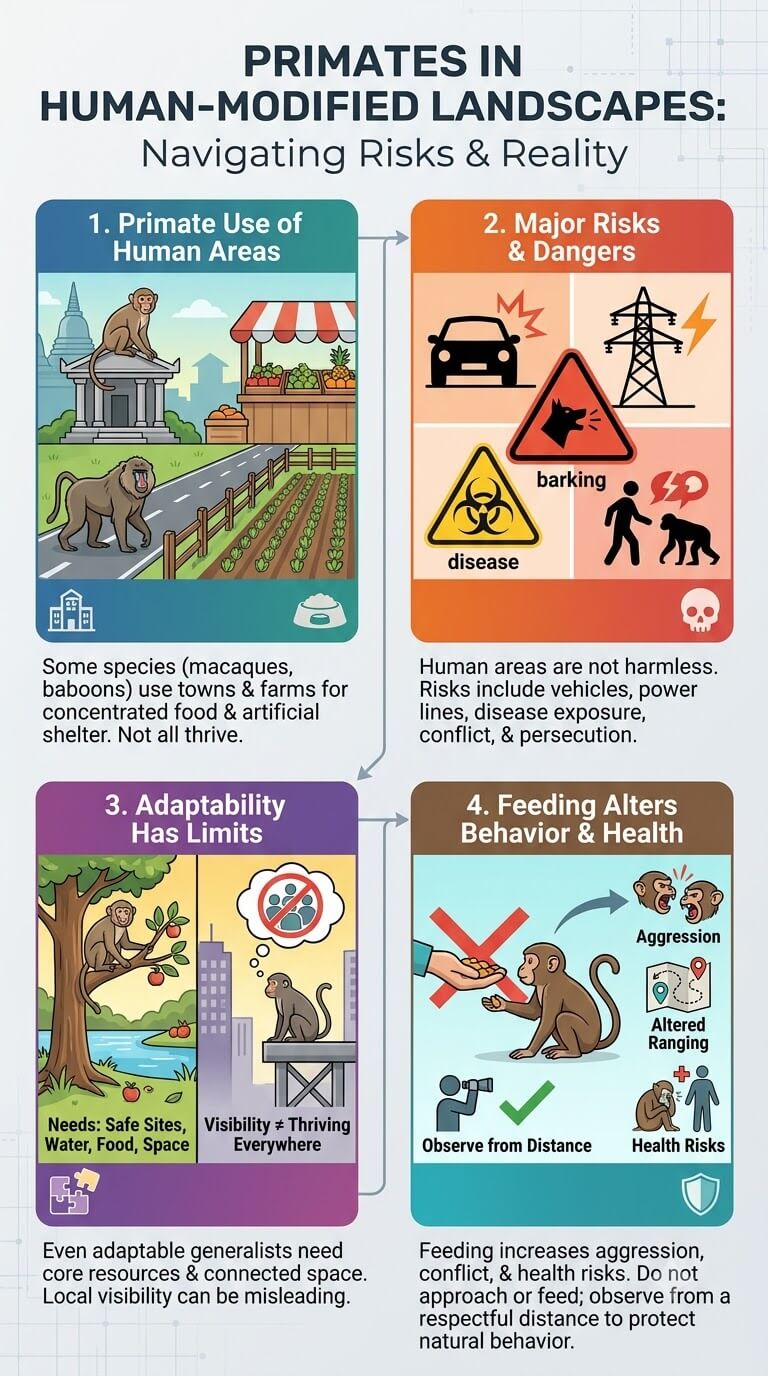
Some primates can use farms and towns
Macaques, baboons, vervet monkeys, and some other primates can enter farms, roadsides, parks, temples, villages, or cities. These environments may provide concentrated food and artificial structures for travel or shelter.
Ability to use a human-modified landscape does not mean the habitat is harmless. Vehicles, power lines, dogs, persecution, poor-quality food, disease exposure, and conflict can create major risks.
Adaptability has limits
Some generalist primates tolerate disturbance better than specialists that depend on continuous canopy, particular food trees, or restricted climates. Even adaptable species still require safe sleeping sites, water, appropriate foods, and enough connected space.
Visible primates near people can create the false impression that the species is thriving everywhere. Local abundance in one town does not describe populations across the entire natural range.
Feeding wild primates changes their behavior
Human feeding can concentrate animals, alter ranging, increase aggression and conflict, and expose both primates and people to health risks. Wild primates should not be approached, touched, or fed.
Observing from a respectful distance protects natural behavior and reduces the chance that animals learn to associate people with food.
Common Mistakes and Myths
All primates live in tropical rainforest
False. Rainforest is extremely important, but primates also inhabit dry forest, woodland, savanna, scrub, highland grassland, montane forest, mangroves, and temperate environments.
All monkeys live in trees
False. Many monkeys are arboreal, but baboons and geladas are strongly terrestrial, and several macaques use the ground extensively. Ground-using monkeys may still climb for feeding, safety, or sleeping.
All apes are forest-canopy animals
False. Gibbons and orangutans are strongly arboreal, but gorillas and chimpanzees spend substantial time on the ground. Ape habitat use varies with body size, food, forest structure, and lineage.
A primate seen in a city has adapted perfectly to urban life
Not necessarily. Urban or agricultural food can support local groups while exposing them to new hazards. Behavioral flexibility should not be confused with absence of ecological cost.
Terrestrial primates no longer need trees
False. Many terrestrial primates still use trees for sleeping, escape, feeding, shade, or social activity. Others substitute cliffs or rocky refuges for some of those functions.
Why Habitat Diversity Matters
Habitat determines which movements are useful
Continuous canopy favors grasping, climbing, suspension, and leaping. Open ground favors efficient quadrupedal or bipedal travel. Cliffs reward secure climbing and access to protected ledges.
Primate locomotion makes sense only when the physical structure of the habitat is considered.
Habitat determines which foods can be found
Fruit-rich rainforest, seasonal woodland, bamboo forest, mangrove, and grassland offer very different feeding opportunities. Diet and habitat therefore evolve together.
A primate cannot simply transfer a specialized feeding strategy to any landscape if the necessary plants, insects, or substrates are absent. Habitat determines which fruits, leaves, insects, gums, and other foods primates can find.
Habitat connection can matter as much as habitat area
For highly arboreal primates, a break in canopy can interrupt travel even if forest remains on both sides. Terrestrial primates may cross some gaps more easily, although roads, farms, and settlements can still create danger.
Connected habitat allows animals to reach seasonal foods, mates, sleeping sites, and suitable microhabitats. Detailed threats and conservation responses vary by species and require current assessment.
FAQ
What continents do nonhuman primates live on?
Native nonhuman primates occur in Africa, Asia, Central America, and South America, with lemurs on Madagascar and monkeys extending into southern parts of North America through Mexico. Their natural distributions are concentrated mainly in tropical and subtropical regions, with notable temperate and high-elevation exceptions.
Do any primates live outside rainforests?
Yes. Baboons live in habitats including savannas, woodlands, scrub, and semi-arid areas. Geladas inhabit Ethiopian highland grasslands. Some macaques live in temperate or montane environments, and several primates occupy dry forests and mangroves.
Are gorillas terrestrial or arboreal?
Gorillas use both. Adults, especially large males, are strongly terrestrial, but gorillas also climb for feeding, resting, and other activities. Smaller and younger individuals generally use trees more readily than very large adults.
Why do primates sleep in trees?
Elevated sleeping sites can reduce access for some predators and provide stable resting locations. Trees also keep groups near arboreal feeding routes. Strongly terrestrial primates may still sleep in trees, while others use cliffs that provide similar protection.
Final Thoughts
Most nonhuman primates live in tropical and subtropical regions, but their habitats extend far beyond a single rainforest stereotype. Primates occupy humid forests, dry forests, woodlands, mangroves, mountains, savannas, highland grasslands, and temperate environments. Some remain strongly arboreal, others are mainly terrestrial, and many move between trees and ground according to food, safety, season, age, and local habitat structure.
That diversity explains why primate anatomy and behavior vary so widely. Gibbons depend on connected canopy, orangutans solve the mechanical problems of moving a large body through trees, baboons combine terrestrial foraging with elevated sleeping sites, geladas specialize in open highlands, macaques shift flexibly between substrates, and gorillas blend terrestrial travel with climbing. Where primates live is ultimately a question of geography, food, climate, body design, and the physical routes a habitat makes possible.

Ethan Walker is the founder and research editor of Animal Fact Central. He creates and reviews educational animal facts content using trusted wildlife, pet care, and science-based sources. His work focuses on making animal behavior, adaptations, habitats, and species facts clear, accurate, and engaging for everyday readers.
Read More Details About Ethan Walker: https://animalfactcentral.com/ethan-walker/