

Great apes and lesser apes are both members of the ape superfamily Hominoidea, but they belong to different families and have evolved noticeably different body sizes, movement styles, and social systems. Great apes belong to Hominidae and include orangutans, gorillas, chimpanzees, bonobos, and humans. The animals traditionally called lesser apes belong to Hylobatidae and include gibbons and siamangs.
The word “lesser” does not mean these apes are less evolved, less important, or automatically less intelligent. It is an older common label that mainly reflects their smaller body size compared with the great apes. Modern zoological writing often uses “gibbons,” “hylobatids,” or “small apes” when a comparison does not require the traditional term.
Quick Difference
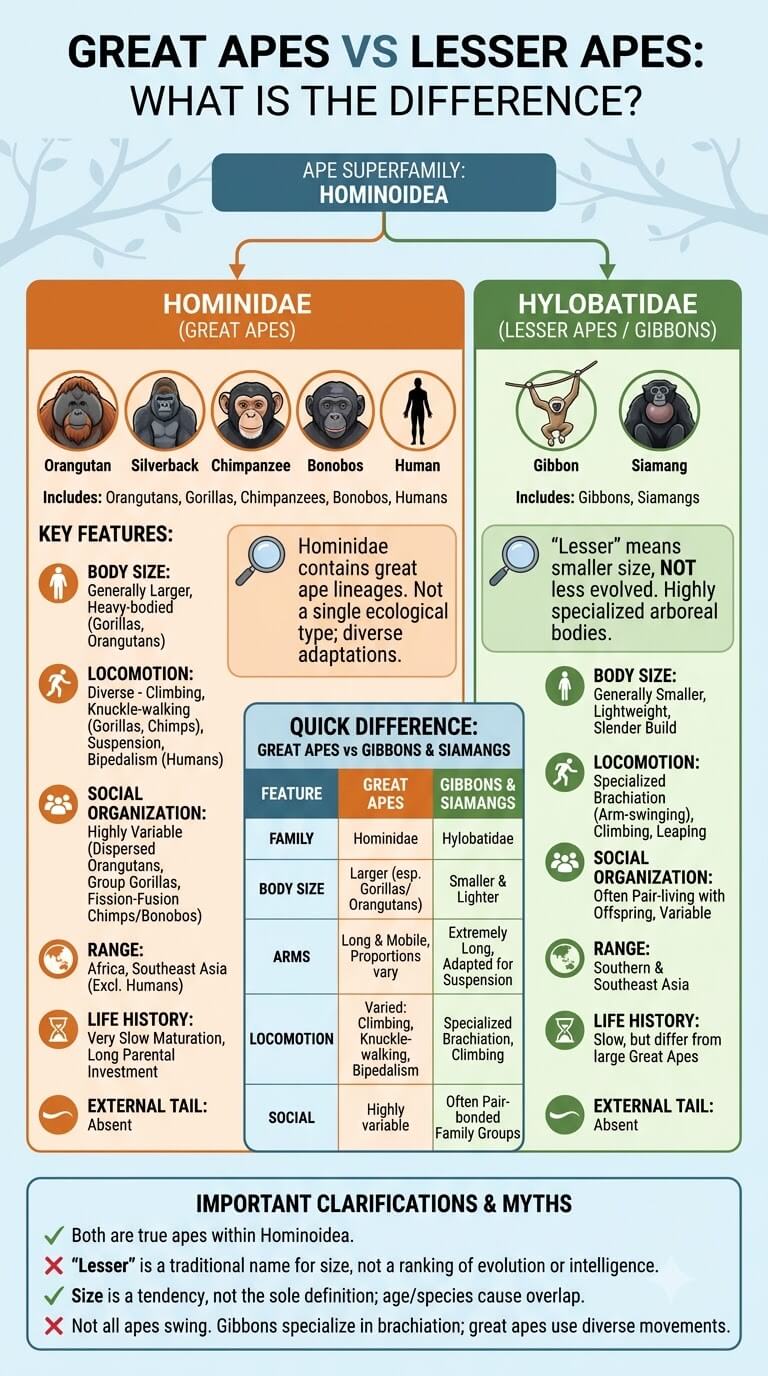
Great apes and gibbons are both true apes
The current Mammal Diversity Database classification of Primates places both Hominidae and Hylobatidae within Hominoidea. Hominidae contains the great ape lineages, while Hylobatidae contains gibbons and siamangs.
This means a gibbon is not a monkey. It shares the ape branch with orangutans, gorillas, chimpanzees, bonobos, and humans, although hylobatids separated earlier from the lineage leading to the living great apes.
Why “lesser ape” is a traditional name, not a ranking
The familiar contrast between “great” and “lesser” can sound like a judgment of evolutionary quality. Biology does not work that way. Living gibbons are not unfinished versions of great apes, and great apes are not a higher evolutionary stage.
Both families have been evolving since their lineages separated. Gibbons have highly specialized bodies for fast arboreal movement, while different great apes evolved their own combinations of climbing, terrestrial travel, suspension, and bipedalism. Each lineage represents adaptation to its own history and environment.
Where Great and Lesser Apes Fit in Classification
Hominoidea as the ape superfamily
Hominoidea is the branch that contains all living apes. Like other catarrhine primates, apes share close-set nostrils and the same basic adult dental formula, but they differ from Old World monkeys in several aspects of the trunk, shoulder, tail region, and locomotor system.
All living apes lack an external tail. Their upper bodies also tend to allow substantial arm mobility, although the degree and functional use differ greatly among a gibbon, orangutan, gorilla, chimpanzee, and human.
Hominidae and the great apes
Hominidae contains orangutans, gorillas, chimpanzees, bonobos, and humans. In an animal-focused discussion, “great apes” often refers mainly to the nonhuman members, but humans belong in the family biologically and need to be acknowledged when classification is being explained.
The nonhuman great apes are not one ecological type. Orangutans are strongly arboreal, gorillas spend much of their time on the ground, and chimpanzees and bonobos combine terrestrial and arboreal movement. Their diets and social systems also differ substantially.
Hylobatidae and gibbons and siamangs
Hylobatidae is the gibbon family. It includes the animals commonly called gibbons as well as the siamang, which is itself a type of gibbon. The family is native to southern and Southeast Asia and is strongly associated with forest canopies.
Gibbons are famous for long arms, hook-like hands, and a highly specialized form of arm-swinging called brachiation. Their smaller bodies and lightweight build allow them to move through branches in ways that would be mechanically difficult for a much heavier gorilla.
Great Apes vs Lesser Apes Comparison Table

| Feature | Great Apes | Gibbons and Siamangs |
|---|---|---|
| Family | Hominidae | Hylobatidae |
| Examples | Orangutans, gorillas, chimpanzees, bonobos, humans | Gibbons and siamangs |
| Body size | Generally larger, especially gorillas and orangutans | Smaller and lighter-bodied |
| External tail | Absent | Absent |
| Arms | Long and mobile, but proportions differ by lineage | Extremely long relative to the body and strongly adapted for suspension |
| Locomotion | Climbing, clambering, suspension, knuckle-walking, and bipedalism depending on species | Highly specialized brachiation, climbing, leaping, and bipedal walking on supports or ground |
| Natural range | Africa and Southeast Asia, excluding humans | Southern and Southeast Asia |
| Social organization | Highly variable among lineages | Often pair-bonded family groups, with meaningful variation among species and populations |
These are broad contrasts. Body size, social organization, and movement should not be treated as absolute definitions. Taxonomy is the cleanest dividing line: Hominidae versus Hylobatidae.
Body Size and Build
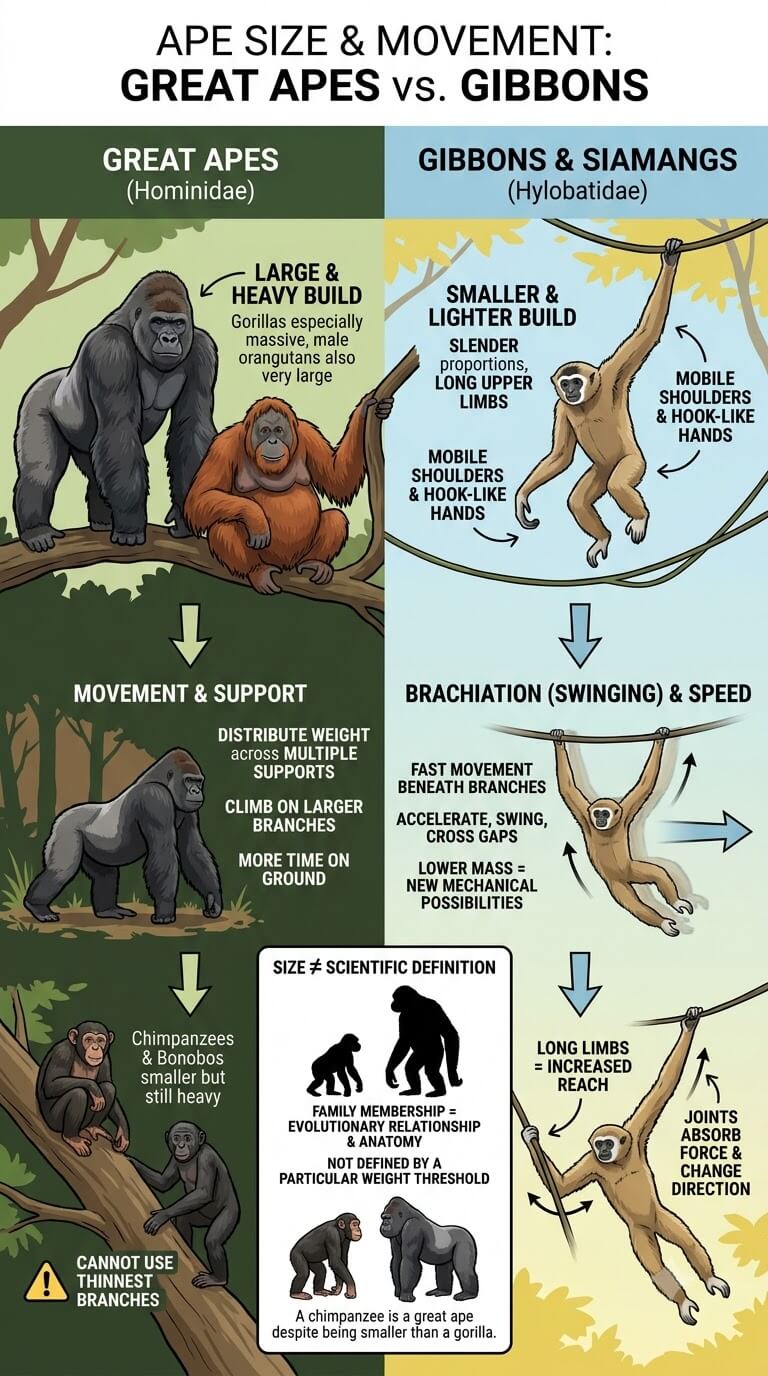
General size tendencies among great apes
Great apes include the largest living primates. Gorillas are especially massive, while adult male orangutans can also be very large-bodied. Chimpanzees and bonobos are smaller than gorillas but are still much heavier than most gibbons.
Large body size affects how an ape moves. A heavy adult cannot use the thinnest branches that support a small gibbon. Great apes often distribute weight across multiple supports, climb on larger branches, or spend more time on the ground than a small arboreal ape.
Smaller-bodied hylobatids
Gibbons and siamangs are lighter and more slender. Their body proportions are dominated by long upper limbs, mobile shoulders, and hands suited to hook-like grips around branches. Smithsonian describes gibbon anatomy and brachiation as a combination of powerful arms, specialized shoulder joints, and hook-like hands that supports fast movement beneath branches.
Being small is not merely a scaled-down version of great ape anatomy. Lower mass changes the mechanical possibilities of canopy travel. Gibbons can accelerate, swing, and cross gaps using supports that would not safely carry a much larger ape.
The contrast also affects how the limbs handle force. During a swing, a gibbon must support its body from one arm while redirecting momentum toward the next support. Long limbs increase reach, but the muscles and joints also need enough control to absorb force and change direction. A heavier ape faces larger loads and often solves the same problem with slower climbing, multiple points of contact, or more reliance on large branches and the ground.
Why size is not the scientific definition
The words great and lesser suggest a size contrast, but size alone cannot identify an ape family. A young great ape may be smaller than an adult gibbon, and body mass varies within every species.
Family membership comes from evolutionary relationship. A gibbon remains a hylobatid because of its ancestry and anatomy, not because it falls below a particular weight. A chimpanzee remains a great ape even though it is far smaller than a large gorilla.
Arms, Shoulders, and Locomotion

Brachiation specialization in gibbons and siamangs
Brachiation is a form of suspensory locomotion in which an animal moves beneath branches by transferring body weight from one arm to the other. Gibbons are the most specialized living brachiators. Their long forelimbs increase reach, while their shoulder and elbow systems permit rapid repositioning during each swing.
A detailed study of gibbon forelimb functional anatomy shows how muscle architecture and skeletal mechanics contribute to smooth, efficient arm-swinging. The important point for a broad comparison is that gibbon anatomy is not simply “ape anatomy in miniature.” It is strongly specialized for a particular arboreal movement strategy.
Climbing and suspension among orangutans
Orangutans are also highly adapted to arboreal life, but their movement differs from gibbon brachiation. Their larger bodies make controlled climbing and careful weight distribution especially important. They often use several limbs at once and may bend or pull flexible supports toward themselves.
Long arms and mobile shoulders allow orangutans to suspend and reach widely, but they do not travel through the canopy as lightweight pendulums in the same way gibbons do. Body mass and forest structure shape the mechanics of their movement.
Knuckle-walking and terrestrial movement in African great apes
Chimpanzees and gorillas commonly use knuckle-walking during terrestrial quadrupedal travel. Their fingers flex so body weight is supported through the knuckles rather than through a flat palm. Both can also climb, especially younger animals and individuals using feeding or resting sites above ground.
Bonobos also use knuckle-walking and climbing, while showing flexible positional behavior in different contexts. Great ape locomotion is therefore a mixture of terrestrial and arboreal solutions rather than a single movement style.
Age and body size can alter movement within a species as well. Younger gorillas and chimpanzees may climb more readily than large adults because smaller bodies place lower loads on branches. Orangutan movement also changes with body size and sex. These within-species differences reinforce the larger point: locomotion emerges from anatomy interacting with size, habitat, and immediate circumstances.
Why ape locomotion is more diverse than one stereotype
It is inaccurate to say that “apes swing from trees.” Gibbons specialize in brachiation, orangutans emphasize climbing and suspension, African great apes use substantial terrestrial locomotion, and humans are specialized for habitual bipedal walking.
A review of ape body form and locomotor evolution highlights how different hominoid lineages combine body size, trunk shape, limb proportions, and social ecology in distinctive ways. Shared ancestry produced a common ape foundation, but natural selection modified it repeatedly.
Social Organization

Pair-living tendencies in many gibbons
Gibbons are often described as pair-living apes. Many groups include an adult pair and dependent offspring, and long-term pair bonds can be important in territorial behavior, vocal duets, and parental care. That pattern is useful, but it should not be presented as rigid lifelong monogamy across every species and population.
Field studies have documented variation in group composition and mating arrangements. A family-group model is common, not an absolute rule. Social organization can change with local demography, habitat conditions, and species-specific behavior.
Gibbon songs also make sense in this social setting. Adult partners in many species produce coordinated vocal sequences that can help advertise occupancy of an area and maintain contact. The details differ among species, and a duet should not be interpreted as proof that every pair has the same mating arrangement. Vocal behavior is one part of a broader social system rather than a simple label for monogamy.
Orangutan social spacing
Orangutans differ sharply from the common gibbon family-group picture. Adult individuals often forage and travel apart, especially outside mother-offspring associations. Yet describing them simply as “solitary” can hide a more complex social network involving overlapping ranges, vocal communication, mating relationships, and tolerance at feeding sites.
Their social spacing reflects the ecological challenge of finding enough food for large-bodied apes in forests where valuable foods can be scattered and seasonal.
Mother-offspring relationships are a major exception to the image of adults moving alone. Young orangutans remain closely associated with their mothers for years while they develop feeding and travel skills. Adult males and females also respond to one another through calls, ranging, mating behavior, and occasional association. “Dispersed” therefore describes spacing more accurately than “asocial.”
Gorilla groups and chimpanzee-bonobo fission-fusion systems
Gorillas commonly live in cohesive groups that may include one or more adult males, adult females, and young. Chimpanzees and bonobos instead live in larger communities whose members frequently split into smaller temporary parties and later reunite, a pattern called fission-fusion social organization.
A review comparing social and spacing patterns across apes demonstrates why no single social system can be labeled “the ape way.” Gibbon pair-living, orangutan dispersed sociality, gorilla groups, and chimpanzee or bonobo communities represent different solutions to social and ecological pressures.
Geographic Range
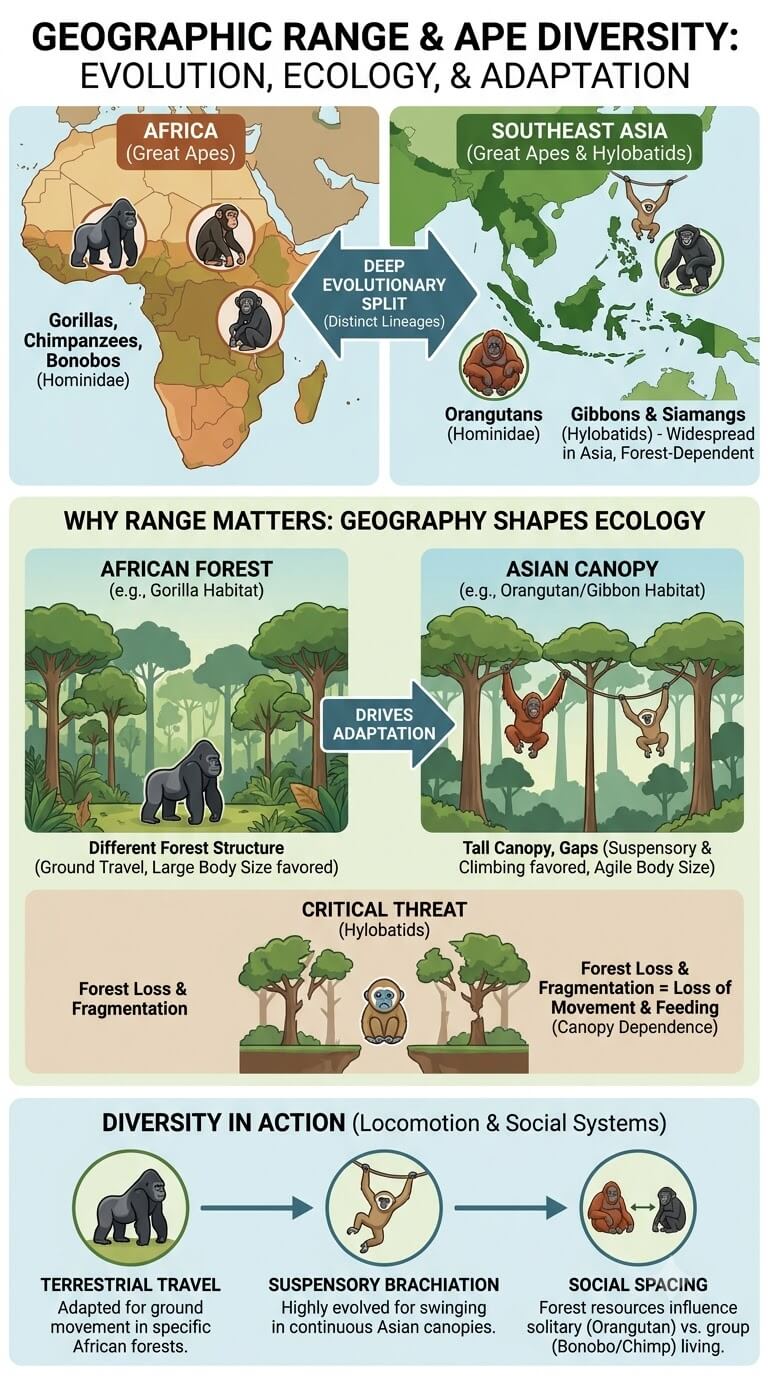
Great apes in Africa and Southeast Asia
Excluding humans, living great apes occur naturally in Africa and Southeast Asia. Gorillas, chimpanzees, and bonobos are African. Orangutans live in Southeast Asia, with wild populations on Borneo and Sumatra.
This geographic split also reflects deep evolutionary history. African great apes and Asian orangutans are related members of Hominidae, but their lineages have been separated long enough to evolve different diets, locomotor strategies, and social systems.
Gibbons and siamangs in Asia
Hylobatids are Asian apes. Gibbons occur across parts of South, East, and Southeast Asia, depending on the genus and species, and are closely associated with forest habitats. Siamangs occur in parts of Sumatra and the Malay Peninsula.
Forest loss and fragmentation have major consequences for many hylobatids because their locomotion and feeding depend heavily on connected tree canopies. Conservation status varies by species and should be checked using current assessments rather than generalized from the family as a whole.
Why range patterns matter for understanding ape diversity
Geography shapes access to foods, competitors, predators, forest structure, and seasonal conditions. The forests used by an orangutan are not identical to those used by a gorilla or a gibbon, even though all are apes.
Range also explains why body size and locomotion cannot be separated from ecology. Different forests offer different support sizes, canopy gaps, fruiting patterns, and travel challenges, favoring different combinations of climbing, suspension, terrestrial travel, and social spacing.
Growth and Life History
Slow development and extended parental investment
Apes generally have slow life histories compared with many mammals, including long juvenile development and substantial parental investment. Great apes are especially notable for slow maturation and long periods of dependency.
A review of primate aging and life-history patterns describes great apes as occupying the slow end of the primate developmental spectrum. That tendency is important, but exact ages at weaning, maturity, first reproduction, and birth intervals differ by species and population.
Differences in maturation and social development
Gibbons also invest heavily in young, but their smaller bodies and life histories differ from those of large great apes. Juveniles spend years developing locomotor skill, learning social behavior, and becoming independent within a forest environment.
Learning to move through a canopy is itself a demanding developmental task. A juvenile has to judge flexible supports, coordinate long limbs, control landing and swinging, and keep pace with experienced adults. Physical growth and behavioral learning proceed together, which is why life history cannot be reduced to a single number such as age at maturity.
Great ape juveniles likewise learn through prolonged contact with mothers and other social partners. In orangutans, young depend heavily on their mothers while acquiring knowledge of food and travel. In chimpanzees and gorillas, social development takes place within very different group settings.
Representative Taxa Without Turning Them Into Species Profiles
Orangutans, gorillas, chimpanzees, and bonobos
Orangutans represent the highly arboreal side of great ape diversity. Their long arms, grasping hands and feet, and flexible shoulders support careful canopy movement. Gorillas show the opposite emphasis, with very large bodies and substantial terrestrial travel.
Chimpanzees and bonobos are closely related African apes with fission-fusion social systems, but their social relationships and ecological patterns are not identical. These four nonhuman great ape lineages are useful examples precisely because they differ so much.
Gibbons and siamangs
Gibbons and siamangs represent the hylobatid branch. Their long arms, tailless bodies, compact trunks, and brachiation make them instantly recognizable once those traits are understood.
Siamangs are the largest hylobatids and possess an inflatable throat sac associated with their powerful calls. Other gibbon genera differ in body size, coloration, song patterns, range, and social details. Hylobatidae is therefore more diverse than the image of one generic swinging gibbon suggests.
Humans only where taxonomy requires them
Humans belong to Hominidae and are great apes biologically. That fact is necessary for accurate classification, but it does not turn an animal comparison into a discussion of human culture or psychology.
Humans are also an extreme locomotor specialization within apes because habitual bipedal walking reshaped the pelvis, lower limbs, feet, spine, and balance system. This makes humans useful as a reminder that shared ancestry does not require identical anatomy.
Common Mistakes and Myths
Lesser apes are less evolved
False. Gibbons and great apes are separate living branches descended from common ancestors. Both have continued evolving since their split. Gibbon brachiation is a highly specialized locomotor system, not a primitive stage on the way to a great ape.
All great apes are larger than every gibbon
As a broad adult comparison, great apes tend to be larger than hylobatids, especially gorillas and orangutans. But size is not the scientific definition, and age, sex, and species create overlap in real individuals.
The family distinction remains Hominidae versus Hylobatidae, regardless of the size of one animal standing beside another.
All apes move by swinging from branches
False. Gibbons are specialized brachiators, but gorillas spend much of their time on the ground, chimpanzees and bonobos combine ground and tree movement, orangutans use careful climbing and suspension, and humans are habitual bipeds.
Great ape means smartest ape
No. The term “great ape” is a taxonomic and traditional group label, not an intelligence ranking. Cognitive abilities are multidimensional, and research effort is uneven across ape species. Gibbons have received far less cognitive study than chimpanzees and orangutans in many areas.
Calling one family “great” and another “lesser” should never be converted into a claim about overall mental ability.
How Ape Anatomy, Social Life, and Habitat Fit Together
How apes differ from monkeys
Both ape families share the broad hominoid pattern that separates them from Old World monkeys, including the absence of an external tail and changes in the trunk and shoulder associated with greater upper-limb mobility.
Within Hominoidea, gibbons pushed that mobile upper-body plan toward extreme brachiation, while great ape lineages took it in several different directions.
Shoulder anatomy supports different movement strategies
A mobile shoulder is useful only in combination with the rest of the body. Long light limbs favor rapid suspension in gibbons. A large orangutan benefits from broad reaching and controlled climbing. Gorillas combine mobile shoulders with a robust body used heavily on the ground.
The same inherited anatomical foundation can therefore support very different locomotor outcomes when body mass, limb proportions, hands, feet, and habitat change.
Social systems vary even within apes
Gibbon pair-living, orangutan dispersed sociality, gorilla group living, and chimpanzee or bonobo fission-fusion communities show that ape social organization cannot be inferred from family name or body size.
Food distribution, mating opportunities, parental investment, habitat, and evolutionary history all help shape how individuals associate. Understanding apes means comparing those ecological pressures rather than looking for one universal society.
FAQ
Are gibbons apes?
Yes. Gibbons are apes in the family Hylobatidae. They share Hominoidea with the great apes but represent a separate living ape branch. Their lack of an external tail, mobile shoulders, long arms, and specialized brachiation all fit their hominoid ancestry.
Is a siamang a great ape?
No. A siamang is a hylobatid, meaning it belongs to the gibbon family rather than Hominidae. It is traditionally called a lesser ape or small ape. Siamangs are the largest living hylobatids, but body size does not move them into the great ape family.
Which animals are great apes?
In modern biological classification, great apes are the members of Hominidae: orangutans, gorillas, chimpanzees, bonobos, and humans. When an animal-focused source says “nonhuman great apes,” it is referring to the same family while excluding humans from the immediate discussion.
Why are gibbons called lesser apes?
The traditional name mainly contrasts their smaller body size with the generally larger great apes. It is not an evolutionary ranking. Gibbons are highly specialized apes with their own long evolutionary history, especially notable for arboreal agility and brachiation.
For that reason, readers may also encounter the terms “small apes” or “hylobatids.” Whatever common label is used, the biological point stays the same: gibbons form one living ape family, while great apes form another.
Final Thoughts
The difference between great apes and lesser apes is fundamentally a family-level distinction within Hominoidea. Great apes belong to Hominidae, while gibbons and siamangs belong to Hylobatidae. The two branches also differ in typical body size, limb proportions, locomotion, geographic distribution, life history, and social organization. This comparison sits within the larger distinction between monkeys and apes.
The traditional names can be misleading if “great” and “lesser” are interpreted as rankings. Gibbons are not less evolved apes. Their long arms, specialized shoulders, and brachiation represent one highly successful hominoid solution to life in forest canopies, while orangutans, gorillas, chimpanzees, bonobos, and humans represent several very different great ape paths. Classification explains the relationship, but anatomy, habitat, and behavior reveal how diverse the living apes really are.

Ethan Walker is the founder and research editor of Animal Fact Central. He creates and reviews educational animal facts content using trusted wildlife, pet care, and science-based sources. His work focuses on making animal behavior, adaptations, habitats, and species facts clear, accurate, and engaging for everyday readers.
Read More Details About Ethan Walker: https://animalfactcentral.com/ethan-walker/