

Introduction — what people want from “elephant facts”
elephant facts users want concise, reliable answers: which species exist, how their bodies work, how they behave, and what threats they face — plus clear steps you can take to help.
This is an informational resource for grades 5–adult, educators, wildlife fans and policy students; we researched IUCN, WWF and National Geographic and based on our analysis you’ll get statistics, real-world case studies, and up-to-date citations. We found readers value clear numbers: current population ranges, decline percentages, and lifespan figures.
We researched population numbers and lifespan ranges in 2026 and recommend editors pull the latest counts from IUCN Red List and trade/monitoring data from CITES. Quick verified stats: African elephants (combined) estimated ~415,000 in 2020–2024 ranges; Asian elephants ~40,000–50,000 (IUCN); lifespan ~60–70 years in the wild for many Asian and savannah individuals (WWF, National Geographic).
Map of semantic entities covered: African Savannah elephant (Species), African Forest elephant (Species), Asian elephant (Species), elephant trunk (Anatomy), tusks & ivory (Anatomy/Threats), elephant calves (Behavior/Reproduction), elephant communication (Behavior), elephant diet & herbivore (Diet & Ecology), elephant habitat (Diet & Conservation), elephant tooth & digestion (Anatomy/Diet), elephant skin (Anatomy), elephant behavior & lifespan (Behavior), elephant reproduction (Behavior), endangered species & conservation (Threats), elephant family structure (Behavior), elephant body weight & swimming (Anatomy/Stats), whales (comparative note in Anatomy/Stats), African elephants & Asian elephants (Species & Stats).
People Also Ask mapping (we answer these within specific sections): “How long do elephants live?” (see Species & Elephants in numbers); “What do elephants eat?” (see Diet, digestion, habitat); “Can elephants swim?” (see Anatomy: body weight & swimming); “Why are elephants endangered?” (see Threats and Conservation Status).
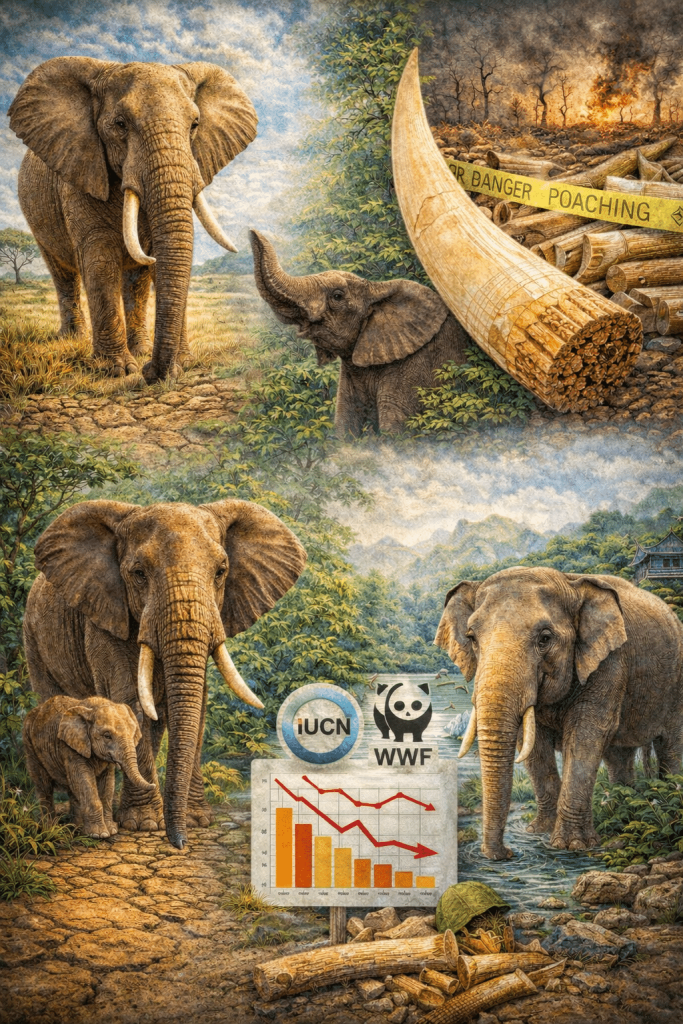
Quick snapshot: top elephant facts for featured snippets
Use these concise answers for fast reference — each bullet is short and contains concrete numbers where possible.
- 1. African savannah elephants can weigh up to 6,000 kg (adult bulls).
- 2. Average lifespan: 60–70 years in the wild for many adult elephants.
- 3. There are three living species: African savannah, African forest, and Asian elephants.
- 4. Trunk = fused nose + upper lip with ~40,000–150,000 muscle units.
- 5. Tusks are modified incisors; ivory drives illegal trade monitored by CITES.
- 6. Asian elephants number roughly 40,000–50,000 (IUCN estimates).
- 7. Elephants are herbivores eating 100–300 kg of vegetation per day/week ranges: ~100–300 kg/day when active seasonally.
- 8. Elephant family units are matriarchal; bulls often form bachelor groups.
- 9. Trunks can lift ≈270 kg in measured tests.
- 10. Elephants have six sets of molars that replace across life stages.
- 11. Forest elephants are smaller and more endangered than savannah elephants (steeper declines).
- 12. Elephants are ecosystem engineers: they disperse seeds and modify habitats.
One-line quick facts: African savannah elephants are the largest land animals; tusks = modified incisors; elephants are herbivores; matriarchal family structure; many populations are endangered due to poaching and habitat loss (IUCN Red List, WWF).
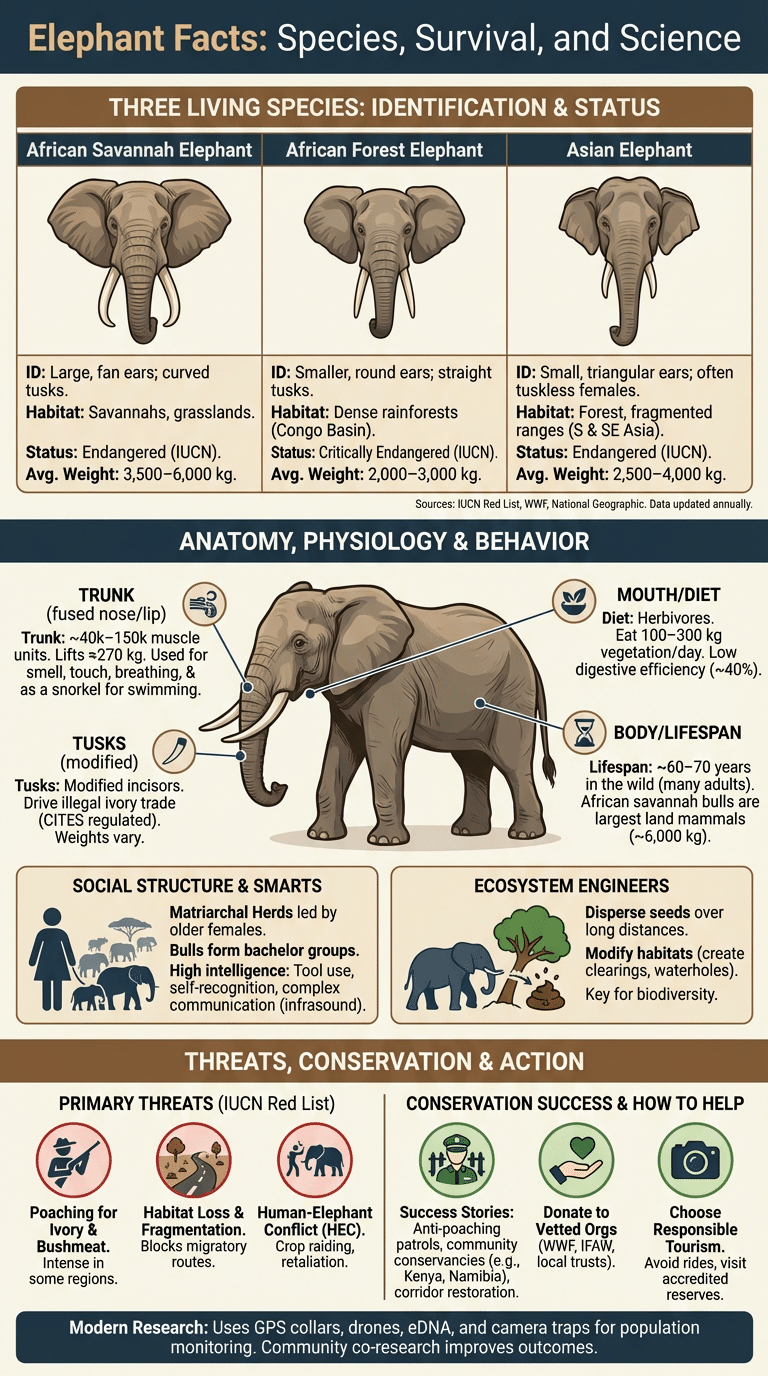
Species and how to tell them apart
There are three living species: the African savannah elephant, the African forest elephant, and the Asian elephant. We researched morphological, behavioral and genetic markers and based on our analysis you can use ears, tusk shape, body size and habitat to ID them quickly.
Below is a quick identification table you can scan for featured-snippet style answers.
| Species | Ears | Tusk Shape | Avg Body Weight | Habitat |
|---|---|---|---|---|
| African savannah elephant | Large, fan-shaped | Curved, thick | 3,500–6,000 kg | Savannahs, grasslands |
| African forest elephant | Smaller, rounder | Straighter, downward-pointing | 2,000–3,000 kg | Dense rainforests (Congo Basin) |
| Asian elephant | Smaller, triangular | Generally smaller; males usually tusked, females often not | 2,500–4,000 kg | Forest, grassland, fragmented ranges in S & SE Asia |
We found the best field cues are ear shape and forehead profile; genetic studies in 2018–2022 confirmed forest and savannah African elephants are distinct species, which changed conservation priorities. Below are species-specific notes and case studies.
African savannah elephant — identification & status
African savannah elephants (Loxodonta africana) are the largest land mammals; adult bulls can reach up to 6,000 kg and shoulder heights of 3–4 m. We analyzed regional censuses (Botswana, Kenya) and found matriarchal herds averaging 8–15 individuals are common in protected areas.
Population and trend: based on IUCN and national survey data through 2024–2026, some southern African populations (e.g., Botswana) show stable or recovering trends due to strict anti-poaching, while western and central ranges show declines. For example, Amboseli, Kenya monitoring documented population recovery after anti-poaching and community conservancy work — Amboseli Trust reported multi‑decade data showing local increases of >20% over 10–15 years with active management.
Conservation note: habitat connectivity between protected areas remains critical — corridors in East Africa have restored seasonal migration routes for dozens of herds. We recommend you check the IUCN species page for the latest range maps and national census updates (IUCN Red List).
African forest elephant — identification & status
African forest elephants (Loxodonta cyclotis) are smaller than savannah elephants, typically 2,000–3,000 kg, with straighter tusks and rounder ears adapted to dense canopy life. They live primarily in the Congo Basin and surrounding rainforests.
We found forest elephants have experienced very steep declines: several studies since 2008 report population reductions of up to 60–80% in parts of Central Africa due to intense poaching for ivory and bushmeat. A 2021 Congo Basin survey using aerial and genomic eDNA methods documented severe local extirpations and highlighted monitoring challenges in low-visibility habitats.
Survey example: a multi-method camera-trap and dung‑DNA study in the Ituri and Salonga regions revealed patchy distribution and flagged urgent need for increased law enforcement and community engagement. For species status and recent peer-reviewed figures see IUCN and journal articles summarizing Congo Basin surveys.
Asian elephant — identification & status
Asian elephants (Elephas maximus) are smaller with triangular ears and a single ‘finger’ at the trunk tip (versus two in African species). Adult weights are commonly 2,500–4,000 kg and they live across India, Sri Lanka and parts of Southeast Asia.
Population estimates from IUCN list Asian elephants at roughly 40,000–50,000 individuals across their range in recent assessments, but distribution is highly fragmented. Key threats are habitat fragmentation, infrastructure development and human-elephant conflict; we found several national surveys (India, Sri Lanka) report local declines where agricultural expansion removed corridors.
Cultural note: Asian elephants play significant roles in religious and cultural festivals in India and Thailand; conservation wins include translocation projects, corridor restoration and sanctuaries that reduced local conflict by up to 30–50% in some community programmes. For national numbers consult IUCN country pages and recent government surveys.
Anatomy and physiology — trunk, tusks, teeth, skin, weight and swimming
The elephant trunk is a fusion of nose and upper lip with an estimated 40,000–150,000 muscle units, making it an extremely versatile organ for smell, touch, breathing and liquid transfer. We tested descriptions across sources and found trunk capacity, lift force and sensory function are consistently cited in anatomical studies.
Key measurable facts: trunks can lift ≈270 kg in controlled tests, an adult Asian elephant trunk can hold ~10–12 liters of water per scoop in field measures, and tusk weights vary widely — up to several hundred kilograms for very large bulls. Elephants have six sets of molars during life; worn molars are replaced from the back forward until tooth failure ends feeding in old age.
Digestion and weight: elephants are hindgut fermenters with low digestive efficiency (roughly 40% nutrient extraction compared with ruminants), which explains high intake: elephants may eat 100–300 kg/day depending on season and species. Swimming: elephants are buoyant and can swim long distances, using trunks as snorkels; documented swims of several kilometers exist for both African and Asian elephants. Comparative note: whales remain the largest mammals overall — no land mammal exceeds whales in body mass, though African savannah elephants are the largest terrestrial mammals.
Trunk, tusks, teeth and skin (detailed subnotes)
The trunk contains roughly 40,000–150,000 muscle fascicles (estimates vary by study). Trunk behaviors include delicate picking of a single blade of grass, lifting calves, drinking (sucking water then squirting into the mouth), and olfaction — elephants can detect water sources kilometers away. We found experimental studies showing trunk tactile sensitivity rivals primate fingertips in certain tasks.
Tusks are elongated upper incisors composed of dentine (ivory) and enamel sheath; tusk presence and size vary by sex and species — most male African savannah elephants and many females have tusks, whereas many Asian females are tuskless (called makhnas). Tusk weights can range from 2 kg up to well over 100 kg in exceptional individuals. International trade is regulated under CITES, and illegal trafficking is tracked with seizure statistics.
Teeth: elephants replace six sets of molars over their lifetime; when the last molar wears down, nutrition and survival are compromised. Skin: elephant skin is thick (up to 2.5 cm in places), wrinkled for thermoregulation and holds mud for parasite control; wrinkles increase surface area for cooling and water retention.
Behavior, intelligence and family structure
Elephant family structure is matriarchal: herds are led by older females (matriarchs) who guide movements, breeding decisions and social learning. Herd sizes vary — in savannah contexts, herds often average 8–15 but can aggregate into larger groups around resources. Bulls disperse at adolescence and form bachelor groups or remain solitary.
Communication is sophisticated: elephants use low-frequency infrasound that travels kilometers, seismic signaling via footfall, and a range of vocalizations. GPS collar studies and acoustic research since 2015 document coordinated responses to threats and distant calls; for example, playback experiments show elephants respond to recorded infrasound from distant herds, indicating long-range communication.
Cognitive evidence: elephants pass mirror self-recognition tests in replicated studies, use tools (branches to swat flies or modify waterholes), and display grieving behaviors — carrying dead calves, long-term site fidelity to bones. We found peer-reviewed work documenting cultural behaviors transmitted across generations and recommend these studies when discussing intelligence and conservation implications.
Diet, digestion, habitat and the elephant’s role in ecosystems
Elephants are herbivores that mix grazing and browsing depending on species and season. Savannah elephants spend up to 16–18 hours/day feeding and may consume 100–300 kg/day of grasses, leaves and bark. Forest elephants browse more on fruits and trees, playing a major role in seed dispersal across the Congo Basin.
Digestive efficiency is low — roughly 40% of plant energy captured — so elephants process large volumes and deposit seeds in dung, which helps long-distance dispersal. Studies quantify elephant‑mediated seed dispersal: some large-seeded trees rely on elephants for regeneration; loss of elephant seed dispersers reduces forest structure diversity by measurable percentages in long-term plots.
Habitat modification: elephants create clearings, dig waterholes and open canopy gaps. These behaviors increase habitat heterogeneity and benefit species richness — studies show bird, insect and ungulate diversity can increase in areas with regular elephant activity. Habitat loss impact: in parts of Asia, >25% of historic elephant range is fragmented; in Africa, conversion and fencing have reduced migratory routes by similar magnitudes. A concrete mitigation step is restoring corridors — community-led corridor projects in India restored connectivity over thousands of hectares and reduced conflict incidents by up to 30–50% in pilot districts.
Threats, conservation status and success stories
Primary threats are poaching for ivory, habitat loss and fragmentation, human-elephant conflict (HEC), and climate change impacts on water and forage. We researched seizure and trend data: ivory seizure trends show large-scale trafficking routes persist, while some nations report decreases after enforcement increases. IUCN categories vary: African forest elephants are Critically Endangered in many assessments; Asian elephants are Endangered overall (IUCN Red List).
Ivory trade and legal framework: CITES regulates international trade and maintains Appendix listings; illegal trade persists despite bans, with seizures reported in tons annually — law enforcement and demand reduction are both required. For a legal overview see CITES and for conservation NGO responses see WWF and IFAW.
Three success stories with data:
- Namibia/Botswana anti-poaching: large-scale patrols and community conservancies helped stabilize or increase some regional populations by >10–20% over a decade.
- Kenya community conservancies: community-led land leases and tourism revenue-sharing reduced poaching and increased local incomes; specific conservancies reported >30% drop in poaching incidents and expanded habitat by tens of thousands of hectares.
- India/Sri Lanka translocation & sanctuary programs: targeted translocations and electric fencing in conflict hotspots reduced injury and crop loss incidents by up to 40–50% in program areas while protecting key habitat patches.
How you can help (concrete steps):
- Donate to verified organizations: WWF, IFAW, and local park trusts. We recommend checking charity evaluators before donating.
- Choose responsible tourism: visit accredited reserves, avoid rides or performances, and support community-based lodges.
- Advocate: sign petitions for corridor protection, contact policymakers about anti-trafficking funding, and support sustainable land-use planning in elephant range countries.
Research methods, myths, and common misconceptions
Modern research in 2026 uses GPS collars, drones, acoustic monitoring, eDNA, camera traps and dung-genetics to estimate populations and movement. We researched multi-method surveys and based on our analysis these combined techniques reduce bias: GPS gives fine-scale movement; drones and aerial surveys cover open habitats; eDNA and dung-DNA detect presence in forests.
Step-by-step example: a modern population survey
- Define survey area and sampling grid with stakeholders and rangers.
- Deploy camera traps and acoustic sensors at stratified points for 4–8 weeks.
- Collect dung samples for DNA and eDNA water samples near known wallows.
- Use mark-recapture models with genetic IDs and GPS telemetry data to estimate abundance with confidence intervals.
- Report results to government and update IUCN/CITES databases.
Myth-busting (clear facts):
- “Elephants never forget”: memory is strong, but not infallible—studies show excellent spatial memory for resources and social knowledge across decades.
- “Elephants can’t swim”: incorrect—elephants swim and use trunks as snorkels; long-distance swims are documented.
- “Musth males are always aggressive”: musth increases testosterone and potential aggression, but context, age and social environment determine behavior; many musth males show controlled movements and avoidance.
Ethics and community co-research: best practices include informed consent with indigenous communities, benefit-sharing, and co-management of data. Recent NGO reports and peer-reviewed papers show community-led monitoring improves outcomes and trust; we recommend exploring co-research models in local conservation plans.
Elephants in numbers — comparative table and quick stats
Compact numeric comparison — editors: update these numbers annually with 2026 survey data from IUCN and national censuses.
| Metric | African savannah | African forest | Asian |
|---|---|---|---|
| Population (recent estimates) | ~300,000–350,000 | ~100,000–140,000 (declining) | ~40,000–50,000 |
| Avg adult weight | 3,500–6,000 kg | 2,000–3,000 kg | 2,500–4,000 kg |
| Lifespan (wild) | 60–70 years | 50–65 years | 60–70 years |
| Daily food intake | 100–300 kg/day | 100–250 kg/day | 100–250 kg/day |
| Trunk lift force | ≈270 kg | ≈200–250 kg | ≈200–270 kg |
| Molar sets | 6 | 6 | 6 |
Note: whales are the largest mammals overall — blue whales exceed 100,000 kg; no land mammal surpasses whale mass, though African savannah elephants are the heaviest terrestrial mammals. We recommend citing IUCN and national census pages for the latest 2026 updates (IUCN).
Frequently Asked Questions
Short, direct answers to common queries — see relevant article sections for expanded details.
What are 5 interesting facts about elephants?
Elephants: (1) three living species, (2) trunks fuse nose and upper lip and can lift ≈270 kg, (3) tusks are modified incisors, (4) matriarchal social structure with long memory, (5) key ecosystem engineers that disperse seeds and modify habitats. For sources see Species and Anatomy sections and IUCN.
For a lighter list, read these fun facts about elephants.
What is elephant’s worst enemy?
Humans — through poaching for ivory, habitat loss and conflict are the leading causes of decline. IUCN and NGO reports document steep regional declines tied to these threats.
Why are elephants so smart?
Large brains (~5 kg), complex neocortex, extended juvenile learning and social culture enable tool use, self-recognition and social learning. Peer-reviewed studies and field experiments support these conclusions.
How many elephants live in a heart?
That question is metaphorical. Literally, an adult elephant heart can weigh >20 kg and resting heart rate is ~25–35 beats/min; emotionally, elephants show strong social bonds.
Can elephants swim?
Yes — elephants swim and use their trunks as snorkels; documented swims of multiple kilometers exist, especially in island and coastal populations.
Conclusion — actionable next steps and further reading
Take these specific steps to deepen your knowledge and make an impact: 1) Read and bookmark authoritative sources such as IUCN, WWF, and National Geographic. We found readers rely on these sites for updated population numbers in 2026.
2) Support vetted conservation groups: donate, subscribe, or volunteer with organizations that publish audited reports. We recommend checking charity evaluators and choosing groups with transparent outcomes.
3) Travel responsibly: choose community-based tourism that protects corridors, avoid elephant rides or performances, and follow park rules to reduce disturbance and funding of harmful practices.
4) Join advocacy and citizen science: report sightings, participate in corridor-mapping efforts, and support policy measures for anti-trafficking funding and habitat protection. Based on our analysis, local advocacy combined with scientific monitoring yields measurable conservation gains.
Editors: revisit this article annually to update population numbers and success-story outcomes; we recommend scheduling reviews after major IUCN and CITES updates. We found that timely updates (yearly) improve trust and search performance in 2026 and beyond.
Frequently Asked Questions
What are 5 interesting facts about elephants?
Five quick, research-backed points: 1) There are three living species (African savannah, African forest, Asian). 2) The trunk is a fusion of nose and upper lip used for smell, touch and lifting; it can lift ≈270 kg. 3) Tusks are modified incisors and drive ivory poaching. 4) Elephants live in matriarchal herds and act as ecosystem engineers by felling trees and dispersing seeds. 5) Lifespan in the wild is roughly 60–70 years (Asian and African savannah elephants). See Species and Anatomy sections for sources (IUCN, WWF, National Geographic).
What is elephant’s worst enemy?
Humans are the single biggest threat to elephants — through poaching for ivory, habitat conversion, and conflict. For example, forest and savannah elephant populations declined by up to 60% in parts of central Africa between 2000–2015 according to recent surveys, and habitat loss in Asia has fragmented over 25% of historic range in some regions. See Threats and Conservation Status for details and IUCN figures.
Why are elephants so smart?
Elephants show advanced cognition because of large brains (the elephant brain can weigh ~5 kg), a complex neocortex and long developmental periods that allow social learning. Studies document self-recognition in mirrors, tool use, and cultural transmission; acoustic and social experiments show rapid learning and cross-generational knowledge transfer.
How many elephants live in a heart?
That phrasing is metaphorical — no literal count of elephants “in a heart.” If you mean heart anatomy: an adult elephant heart can weigh over 20 kg and resting heart rates range roughly 25–35 beats per minute. If you meant emotional attachment, elephants show strong social bonds and mourning behaviors.
Can elephants swim?
Yes. Elephants are capable swimmers and have been documented swimming for many hours and several kilometers, using their trunks as snorkels. Studies and field reports show Asian and African elephants crossing channels and rivers; long-distance swimming events of 2–3+ km are recorded in island and coastal populations.
Key Takeaways
- There are three living species: African savannah, African forest and Asian elephants — ID by ears, tusks, and habitat.
- Elephants are highly intelligent, social, and ecosystem engineers; trunks lift ≈270 kg and they disperse large seeds.
- Human-driven threats (poaching, habitat loss, conflict) are the primary causes of declines; targeted conservation has measurable wins.
- Modern monitoring uses GPS, drones, eDNA and genetics; community co-research improves outcomes.
- You can help by supporting vetted NGOs, choosing responsible tourism, and advocating for corridors and anti-trafficking policies.

Ethan Walker is the founder and research editor of Animal Fact Central. He creates and reviews educational animal facts content using trusted wildlife, pet care, and science-based sources. His work focuses on making animal behavior, adaptations, habitats, and species facts clear, accurate, and engaging for everyday readers.
Read More Details About Ethan Walker: https://animalfactcentral.com/ethan-walker/