

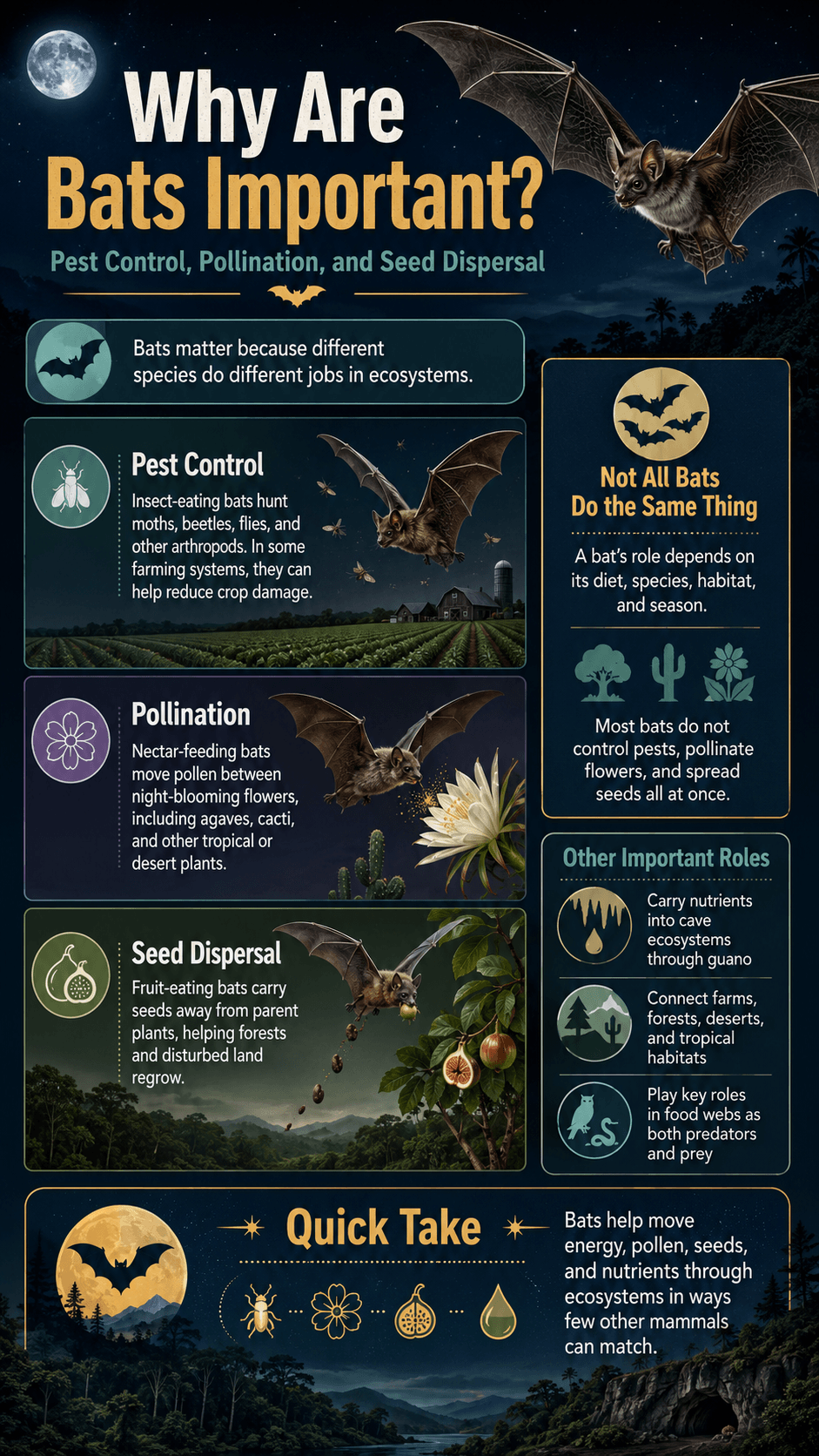
Bats are important because different species perform several kinds of ecological work. Insect-eating bats hunt moths, beetles, flies, and other arthropods. Nectar-feeding bats move pollen between flowers. Fruit-eating bats carry seeds away from parent plants. Cave-roosting colonies also transport nutrients from outside feeding areas into dark underground ecosystems.
Those benefits are real, but they are not identical everywhere. A bat hunting over a cornfield has a different role from a nectar bat visiting desert agaves or a fruit bat moving seeds across a tropical clearing. Even within one region, the effect of bats changes with species, season, habitat, prey abundance, plant flowering, colony size, and the way researchers measure the interaction.
The clearest answer to why bats are important is therefore not that every bat does everything. Bats matter because the order Chiroptera contains many feeding guilds, and each guild connects parts of an ecosystem that might otherwise remain separate. The U.S. Geological Survey’s North American bat research summarizes three especially visible roles: suppressing pest insects, pollinating plants, and spreading seeds.
Quick Answer
Different bat species support ecosystems in different ways
Most bats do not pollinate flowers, disperse seeds, and control crop pests at the same time. Their contribution follows their diet and behavior. Many temperate bats are insectivores. Numerous tropical bats eat fruit or nectar. Other species take fish, frogs, small vertebrates, or blood, and those diets create still different food-web relationships.
Thinking in terms of feeding guilds gives a more accurate picture than treating bats as one ecological unit. A guild is a group of species that use similar resources in broadly similar ways. Insectivorous, nectar-feeding, and fruit-eating bats can overlap in habitat, yet their effects on plants, prey, and nutrient movement are distinct.
No single benefit applies to every bat or every landscape
A bat may consume an insect that damages a crop, an insect that pollinates a wildflower, or an insect with no obvious economic effect. A fruit bat may deliver a seed to a good germination site, drop it where it cannot survive, or eat a fruit without moving the seed far. A nectar bat may transfer useful pollen between plants, but only when its route and the flower’s structure allow contact with the right reproductive parts.
Ecological importance is about patterns across many interactions, not a promise that every feeding event produces a measurable human benefit. This distinction protects the science from exaggerated claims while still showing why diverse bat communities can influence farms, forests, deserts, caves, and tropical landscapes.
How Scientists Describe Bat Ecosystem Roles
Ecosystem function, ecosystem service, and food-web interaction
An ecosystem function is a biological process, such as predation, pollination, seed movement, or nutrient transfer. An ecosystem service is a benefit people receive from such a process, such as reduced crop damage or pollination of a useful plant. A food-web interaction describes who consumes whom and how energy moves among organisms.
The same event can fit more than one description. When a bat catches a moth, predation is the function. If that moth is a crop pest and damage falls, pest suppression can become a service. At the same time, the bat and moth remain part of a food web that also includes plants, parasites, birds, spiders, and other predators.
Species, place, season, and study scale change the result
Bat activity over one field during a warm month cannot automatically be applied to another crop, region, or year. Prey populations fluctuate. Bats change feeding areas. Weather affects flight. Farming practices alter vegetation and insect communities. Researchers may also be measuring different outcomes, such as prey DNA in guano, bat calls over fields, crop damage, fruit removal, pollen transfer, or seedling survival.
A strong conclusion matches the scale of the evidence. Detecting pest DNA in droppings shows that a bat consumed the pest. It does not by itself prove that crop loss declined. Recording calls over a field shows activity, but not exactly how many insects were eaten. Exclusion experiments can test effects more directly, yet their findings still belong to the crop, location, season, and experimental design studied.
Insect Consumption and Pest Control

Aerial hawkers and gleaners hunt different prey
Aerial hawkers catch insects while flying through open air, forest gaps, or above water and vegetation. Depending on the species and habitat, their prey may include moths, beetles, flies, true bugs, caddisflies, or other flying arthropods. Their wing shape, echolocation calls, flight speed, and preferred height all influence what they can capture.
Gleaning bats take prey from surfaces such as leaves, bark, soil, or water. Some listen for rustling sounds made by insects. Others use echolocation to inspect vegetation. This means bat predation is not limited to insects flying high above fields. It can occur along forest edges, within cluttered vegetation, around streams, and near the ground.
Bat diets include agricultural pests and ordinary wild insects
DNA metabarcoding has made bat diet studies much more detailed. Researchers extract mixed prey DNA from guano and compare genetic sequences with reference libraries. The method can reveal soft-bodied insects and fragmented prey that would be difficult to identify by eye. It also shows that most insectivorous bats eat a broad and changing menu rather than targeting only one pest.
That variety matters. Generalist predators may consume a crop pest when it is abundant, then switch toward other prey as conditions change. Such flexibility can help bats remain in a landscape outside a pest outbreak. It also means their diet includes many insects that are neutral or beneficial from a human perspective, so “insect control” should not be confused with indiscriminate removal of insects.
Field experiments show that bats can reduce crop damage
One influential experiment placed large night-time enclosures over sections of corn so bats could not forage there while birds retained daytime access. The researchers found more corn earworm larvae, more kernel damage, and more pest-associated fungal growth where bats were excluded. The PNAS corn-field experiment demonstrated a causal effect in that farming system rather than relying only on evidence that bats had eaten pest insects.
The lesson is not that bats protect every cornfield by the same amount. It is that under suitable conditions, nocturnal predation can affect pest abundance and damage strongly enough to influence crop outcomes. The strength of that effect depends on local bat activity, landscape structure, pest timing, weather, crop management, and the presence of other predators.
Mosquito-control claims need special caution
Many bats can eat mosquitoes, but laboratory feeding capacity is not the same as a measured reduction in outdoor mosquito populations. Mosquitoes may be only a small part of a bat’s diet when larger moths or beetles are available. Different mosquito species also live and fly in different places, while bats select feeding areas according to their own sensory and energetic needs.
It is reasonable to say that some bats consume mosquitoes and other flies. It is not reasonable to promise that attracting bats to a yard will eliminate mosquitoes or prevent disease. Mosquito abundance is shaped by breeding water, weather, vegetation, predators, and public-health control programs, not by bats alone.
Researchers combine several kinds of evidence
- Guano analysis: insect fragments or DNA identify prey that bats consumed.
- Acoustic surveys: ultrasonic recordings reveal where and when bats are active, although calls do not directly count prey eaten.
- Radar and tracking: movement data show how bats use farms, forests, waterways, and seasonal feeding areas.
- Exclusion experiments: barriers or controlled comparisons test what changes when bats cannot reach a site.
- Crop and insect sampling: researchers measure pest abundance, plant damage, yield, fungal infection, or pesticide use.
The strongest pest-control conclusions usually come from multiple methods. Diet evidence identifies the interaction, activity data place it in the landscape, and field experiments test whether the interaction changes insects or plants.
Pollination by Bats

Night-blooming flowers offer cues and rewards
Bat-pollinated flowers often open or produce their strongest scent at night. Many are sturdy enough for a mammal visitor, expose pollen where it can brush against the bat’s head or body, and offer abundant nectar. Pale coloration can improve visibility in dim light, but appearance varies widely and no single flower checklist identifies every bat-pollinated plant.
Nectar bats use smell, vision, spatial memory, and in many species echolocation as they move among flowers. Their long muzzles or tongues can reach nectar that other visitors may not access efficiently. Pollen sticks to fur and is carried to another flower, where some grains may contact a receptive stigma.
Agaves, cacti, and tropical plants use bat pollinators
Bat pollination is especially important in parts of the tropics and subtropics. Nectar-feeding bats visit agaves, columnar cacti, and many tropical trees, shrubs, and vines. Some plant-bat relationships are broad, with several visitors sharing the work. Others are more specialized and depend strongly on the seasonal movements or anatomy of particular bats.
The U.S. Forest Service overview of bat pollination highlights agaves and saguaros among North American examples. These relationships connect flowering schedules, desert resources, bat migration, and plant reproduction across large landscapes.
Pollen transfer is not guaranteed by every flower visit
A bat can take nectar without moving much useful pollen, just as a flower can receive pollen that does not fertilize it. Effective pollination depends on where pollen touches the bat, whether the next flower is compatible, how far the animal travels, and whether the plant produces viable fruit and seeds afterward.
Researchers may measure pollen on bats, visitation rates, pollen deposition, fruit set, seed set, or genetic movement between plants. These are related but not interchangeable. A study showing frequent visits supports a plant-bat interaction, while a study showing increased fruit or seed production gives stronger evidence of reproductive benefit.
People benefit in specific plant systems
Bat pollination can support wild plant populations, landscape stability, and the reproduction of plants used for food, fiber, or beverages. The human benefit is strongest when a crop or harvested wild plant depends substantially on bat-mediated pollen transfer. It should be stated for the particular plant and region rather than turned into a claim that bats pollinate most crops.
Protecting pollination also requires more than protecting a flower patch. Bats need suitable roosts, water, feeding corridors, and a sequence of blooming plants across the season. A landscape can contain the right flowers yet still fail to support pollinators if shelter or safe movement routes disappear.
Seed Dispersal and Forest Regeneration
Fruit-eating bats move seeds away from parent plants
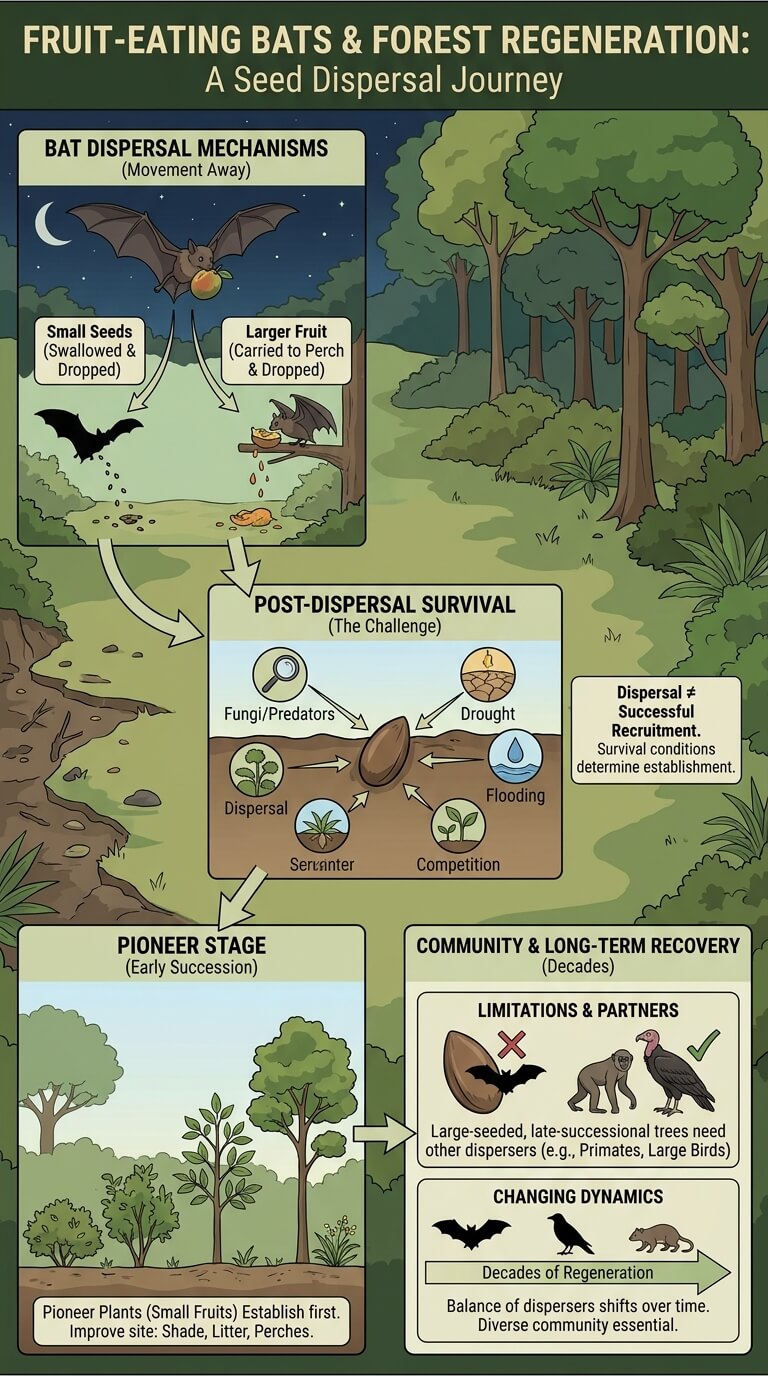
Frugivorous bats may swallow small seeds and later pass them in droppings, or carry larger fruits to feeding perches and drop seeds or pulp below. Either route can move seeds beyond the parent plant. Distance can reduce competition with the parent and may help seeds reach light gaps, forest edges, secondary growth, or other sites where establishment is possible.
Some bats repeatedly visit fruiting plants and move through open areas that less mobile animals avoid. Their night-time flights can connect forest fragments, remnant trees, pastures, and regrowing vegetation. The pattern varies by bat species, fruit size, roosting behavior, and landscape structure.
Dispersal is only the first stage of plant recruitment
A deposited seed still has to survive predators, fungi, drought, flooding, fire, competition, and unsuitable soil. It must germinate and persist as a seedling. For this reason, seed dispersal is not the same as successful forest restoration. Bats can deliver the biological starting material, but conditions after arrival decide whether a new plant becomes established.
A Costa Rican study of two tent-roosting fruit bats found that their feeding behavior moved seeds and influenced seed and seedling patterns beneath roosts. The Journal of Mammalogy seed-dispersal study also illustrates why the effect must be described by species and site rather than generalized to all fruit bats.
Pioneer plants can help begin succession
Early-successional plants are species able to establish in disturbed or open conditions. Many produce small fruits used by bats and birds. When their seeds arrive in a clearing, the resulting shrubs and young trees can add shade, litter, perches, and new food. Those changes may make the site more suitable for other plants and animals.
However, bats do not carry every type of forest seed equally. Large-seeded, late-successional trees may depend more on primates, large birds, ground mammals, gravity, or other dispersers. A recovering forest needs a community of animals and plants, not a single “reforestation species.”
Animal dispersal changes as forests recover
Long-term forest research in Panama has shown that the balance among animal dispersers changes over decades of regeneration. Bats, birds, and nonflying mammals do not contribute the same proportion at every stage. The Smithsonian Tropical Research Institute’s forest-recovery research emphasizes that restoring tree cover and restoring animal-plant interactions are connected but separate challenges.
This is an important corrective to simple claims. Bats can be valuable seed movers in disturbed tropical landscapes, yet their relative contribution depends on the plant community, nearby forest, hunting pressure, and which other dispersers remain.
Cave Nutrient Cycles

Guano carries outside energy into dark caves
Most deep cave zones receive little sunlight and cannot support ordinary green-plant food chains. Bats feed outside, then return to caves and deposit guano, urine, shed material, or carcasses. These inputs move carbon, nitrogen, phosphorus, and other nutrients from surface ecosystems underground.
Guano can support bacteria, fungi, mites, beetles, fly larvae, springtails, and other detritivores. Predators then feed on those organisms. In some caves, this chain is a major part of the available energy. A USGS guide to southwestern cave life notes that guano can be a critical component of cave food webs.
Cave effects depend on colony and site conditions
The importance of guano varies with colony size, length of occupation, bat diet, moisture, cave airflow, flooding, and other organic matter entering the system. A huge seasonal colony can create a concentrated nutrient patch. A small or temporary roost may contribute much less. Some caves receive substantial debris from water or entrances, while others rely more heavily on animals that commute to the surface.
Guano should not be romanticized as a harmless material for people to collect. Active roosts should not be disturbed, and accumulated droppings can contain irritating dust, ammonia, fungi, or other hazards. Cave nutrient ecology is a reason to protect undisturbed systems, not an invitation to enter colonies or handle waste without appropriate guidance.
Bats in Food Webs
Bats are predators as well as plant partners
Insectivorous bats place pressure on arthropod populations. Carnivorous bats may take frogs, rodents, birds, fish, or other bats, depending on species. These feeding relationships move energy from prey into mobile mammal predators and can influence when and where prey are active.
Predation effects do not always produce a simple decline in one prey species. Bats may switch among prey, compete with other predators, or affect prey behavior. Moths with ears sensitive to ultrasound, for example, can perform evasive maneuvers when they detect bat calls. That interaction is both feeding ecology and an evolutionary contest between predator sensing and prey defense. “These ecosystem roles are one part of the broader picture of bat biology and differ greatly among feeding guilds.”
Bats are also prey
Owls, hawks, falcons, snakes, carnivorous mammals, large spiders, and other predators may take bats. Risk often rises near cave mouths, water surfaces, feeding trees, or predictable flight routes. Juveniles, grounded animals, and bats leaving dense colonies can be especially exposed.
Being prey means bats transfer energy upward as well as downward in a food web. Their colonies can create reliable feeding opportunities for local predators, though the number taken may be small relative to the colony. The ecological role is therefore not only what bats remove from an ecosystem, but also what their bodies provide to other consumers.
Nocturnal animals divide resources
Bats share night landscapes with owls, nightjars, frogs, spiders, and predatory insects. Species reduce direct competition by hunting at different heights, using different call frequencies, choosing different prey sizes, or feeding at different times and places. Waterways, forest edges, canopy gaps, and open fields can each favor a different set of hunters.
Resource partitioning helps explain why conserving several bat species can preserve more ecological functions than focusing on one abundant species. A fast open-air hunter may not replace a slow gleaner that searches leaves, and neither substitutes for a nectar bat visiting flowers.
How Bats Can Affect Farms and Forests
Landscape structure influences pest suppression
Bat activity often depends on nearby shelter, water, tree cover, hedgerows, woodland edges, and low-light travel routes. Large uniform fields may contain prey but offer fewer navigational features or safe roosts. A farm’s surrounding landscape can therefore influence whether bats forage over the crop and which species are present.
Natural pest suppression should be treated as one part of integrated management, not a replacement for monitoring or evidence-based farm decisions. Bats may reduce pressure from some insects, while weather, crop rotation, resistant varieties, soil management, other predators, and targeted control measures also shape outcomes.
Pollination and seed movement connect working lands with wild habitat
Nectar bats can move between native vegetation and cultivated plants when flowering resources overlap. Fruit bats can cross pastures or farm mosaics while carrying seeds. These movements link production areas with surrounding forests, scrub, desert vegetation, and riparian corridors.
Economic estimates need boundaries
Dollar values can help people recognize benefits, but they are model outputs rather than universal properties of bats. An estimate depends on the crop, market price, pest pressure, pesticide assumptions, bat population, geographic area, year, and how researchers translate ecological effects into money.
A figure calculated for one crop should not be copied as the value of bats everywhere. The more defensible approach is to state where the estimate came from, what it measured, and what it did not include. In many places, ecological importance is clear even when no reliable monetary value has been calculated.
What Happens When Bat Populations Decline
Ecological changes are possible, but not always immediate
If insect-eating bats decline, some prey may experience less nocturnal predation. If a specialized nectar bat disappears, plants with few alternative pollinators may receive less pollen. Loss of fruit bats can reduce seed movement, and loss of cave colonies can shrink nutrient inputs. These are plausible pathways, but the magnitude must be measured rather than assumed.
Some ecosystems contain functional redundancy, meaning several species perform partly similar roles. Other systems depend on a small number of specialized partners. Surviving animals may compensate for a decline, or they may not be able to match the timing, distance, prey type, or flower structure handled by the lost species.
Correlation is not the same as a measured cause
A rise in crop pests after bats decline could also reflect weather, pesticide resistance, land-use change, or loss of other predators. A forest recovering slowly may be limited by soil, fire, seed availability, grazing, or drought. Researchers need comparisons, experiments, long-term monitoring, or multiple lines of evidence to isolate the contribution of bats.
Representative Bat Guilds and Their Roles
Insectivorous bats in temperate and agricultural landscapes
Many North American bats feed primarily on arthropods. Open-air species may pursue moths and beetles over fields or above the canopy, while forest-adapted bats search edges and cluttered vegetation. Their value lies in a broad predatory community whose members operate in different airspaces and seasons.
Nectar bats in arid and tropical plant communities
Nectar-feeding bats link distant flowering plants during nightly movements and, in some cases, seasonal migration. Their bodies pick up pollen while they drink. They are especially important where large night-blooming flowers offer abundant nectar and where other pollinators do not provide the same pattern of long-distance movement.
Fruit bats in tropical forests and recovering landscapes
Fruit-eating bats can move seeds while commuting between feeding sites and roosts. Small-seeded pioneer plants often feature prominently in their diets, making some species effective early visitors to disturbed land. Larger fruit bats and tent-roosting species may transport larger fruits or create concentrated seed deposits beneath feeding sites.
Common Myths About the Benefits of Bats
Myth: Every bat mainly eats mosquitoes
Some bats eat mosquitoes, but many favor larger or more abundant insects, and numerous bats do not eat insects at all. Mosquito consumption should be described by species, habitat, and diet evidence, not used as a universal reason bats matter.
Myth: All bats pollinate plants and disperse seeds
Pollination and seed dispersal are mainly associated with nectar-feeding and fruit-eating bats. Insectivorous bats contribute through predation and other food-web interactions. The diversity of roles is more impressive, and more accurate, than assigning every role to every species.
Myth: One large dollar estimate applies everywhere
Economic estimates are tied to assumptions and a defined area. They can illustrate potential value, but they should not be repeated without the crop, place, date, and method. Ecological importance also includes wild plants, cave communities, food webs, and functions that may never receive a market price.
How Bat Ecology Fits Together
Diet determines the first ecological connection
What a bat eats shapes its teeth, tongue, senses, flight behavior, and role. Insect hunters connect with arthropod communities. Nectar feeders connect flowering plants. Fruit eaters connect plant reproduction with movement across landscapes. Understanding diet is therefore the starting point for understanding ecological importance.
Habitat determines where the role can occur
A bat needs a route from shelter to food. Forest edges, wetlands, caves, deserts, farms, and cities offer different combinations of prey, flowers, fruit, water, and safe roosts. When one part of that network disappears, a bat may remain present but perform less of the ecological function people expect.
Protecting bats can protect ecological processes
Conserving bats is not only about keeping species from disappearing. It can also maintain nocturnal predation, pollen movement, seed transport, and nutrient transfer. The best actions depend on the species and region, so habitat protection, cave management, farm practices, and public education need local evidence rather than a single global prescription. “When populations decline, those ecological interactions may also weaken, which is one reason bat conservation matters beyond the animals themselves.”
FAQ
Do bats really control mosquitoes?
Some bats eat mosquitoes, but the effect on outdoor mosquito populations is difficult to predict and varies by species, habitat, and available prey. Evidence that mosquito DNA appears in guano confirms consumption, not guaranteed population control. Reducing standing water and following local public-health advice remain more reliable household mosquito measures than trying to attract bats for that purpose.
Which plants depend on bat pollination?
Bat pollination occurs in many tropical and subtropical plants, including certain agaves, columnar cacti, trees, shrubs, and vines. Dependence varies. Some plants have several pollinators, while others rely more heavily on bats in a particular region or season. A species-specific botanical or ecological study is needed before calling a plant fully dependent on bats.
How do bats help forests regrow?
Fruit-eating bats carry seeds away from parent plants and can deposit them in clearings, pastures, forest edges, and secondary vegetation. Seeds of early-successional plants may establish and change the site in ways that help later species. Seed arrival is only one step, however, because soil, moisture, fire, competition, and seed predators determine whether seedlings survive.
Is bat guano important to cave ecosystems?
It can be. In caves with regular bat colonies and limited outside food, guano supplies organic matter used by microbes and invertebrates, which in turn support predators. Its importance varies with colony size, diet, moisture, flooding, and other nutrient inputs. People should not disturb active roosts or collect guano without appropriate safety and wildlife guidance.
Final Thoughts
Bats are important not because every species provides one identical benefit, but because their diversity creates many ecological connections. Insectivorous bats can suppress arthropods and, in some farming systems, reduce crop damage. Nectar bats move pollen among night-blooming plants. Fruit bats transport seeds, while cave colonies carry surface nutrients underground. Bats also act as predators, prey, competitors, and partners in complex food webs.
The most trustworthy way to describe these roles is with context. Species, habitat, season, and research method determine what can be claimed. When those limits are respected, the evidence gives a strong answer to why bats are important: they help move energy, pollen, seeds, and nutrients through ecosystems in ways that few other mammals can duplicate.

Ethan Walker is the founder and research editor of Animal Fact Central. He creates and reviews educational animal facts content using trusted wildlife, pet care, and science-based sources. His work focuses on making animal behavior, adaptations, habitats, and species facts clear, accurate, and engaging for everyday readers.
Read More Details About Ethan Walker: https://animalfactcentral.com/ethan-walker/