

Where do bats live? Bats occupy forests, deserts, grasslands, wetlands, farms, cities, mountains, coasts, and tropical islands, but they do not simply live wherever there is open air. Each species needs a suitable combination of food, water, flight space, seasonal conditions, and safe places to rest.
The place a bat spends the day is called a roost. A roost may be a tree hollow, loose bark, folded leaf, cave chamber, rock crack, mine, bridge joint, barn, attic space, or another protected site. Habitat is the wider landscape that supplies those shelters along with feeding areas and travel routes. Keeping those two ideas separate makes bat distribution much easier to understand.
Quick Answer

Bats occupy many regions, but every species has limits
Bats have a worldwide distribution. They occur through tropical and temperate regions and use an extraordinary variety of land-based environments. They are absent from the polar regions and some isolated islands, and their diversity is much greater in tropical forests than in cold climates. The Animal Diversity Web account for Chiroptera summarizes this broad range while emphasizing that food and appropriate resting sites still set local limits.
A range map shows where a species has been recorded or is expected to occur. It does not mean the bat is equally common throughout that area. Elevation, climate, vegetation, water, prey, shelter, land use, disease, and survey effort can all affect where it is actually found.
Habitat and roost are related, but they are not the same place
A habitat is the larger environment in which a bat feeds, drinks, travels, mates, and shelters. A roost is a particular resting place inside that environment. A bat may roost in a tree cavity, fly along a wooded stream to reach a pond, and hunt insects above the water. The tree cavity is the roost, while the surrounding forest, corridor, and pond are parts of its habitat. “When those connected habitats or roosts disappear, the result can become one of the major reasons some bats are endangered.”
This distinction also explains why protecting one visible shelter may not be enough. A roost can lose its value if nearby feeding grounds disappear, a commuting path becomes brightly lit, or water becomes inaccessible. Conversely, good feeding habitat cannot support a species that lacks safe places to rest and raise young.
Where Bats Occur Around the World
Tropical regions support the greatest variety
Warm regions often provide long feeding seasons and a wide range of insects, fruit, flowers, and vertebrate prey. Tropical forests can support many bat species in the same area because different species divide the landscape by food, height above the ground, flight style, and shelter type. Some feed in the canopy, others in the understory, and others over streams, clearings, or forest edges.
Tropical bats also use mangroves, dry forests, savannas, plantations, caves, gardens, and cities. A fruit-eating bat may depend on flowering and fruiting trees, while a small insect hunter in the same region may depend more on water, forest gaps, and sheltered crevices.
Temperate bats face stronger seasonal changes
In temperate regions, cold weather reduces insect activity and changes the value of summer shelters. Many species respond by entering prolonged torpor in protected winter sites, moving to milder areas, or switching between several shelter types. Females may gather in warm maternity sites, while males use cooler or more solitary sites.
Mountains add another layer of variation. Temperature, vegetation, and insect availability change with elevation. Some bats move uphill or downhill seasonally, while others remain tied to caves, forests, cliffs, or valleys with the conditions they need.
Islands, deserts, and high latitudes create special limits
Reaching an island requires crossing water, surviving storms, and finding suitable food and shelter after arrival. Some islands support native bats even when they have few or no other native land mammals. Other isolated islands lack bats because the distance, climate, or available resources create barriers.
Deserts can support diverse bat communities where caves, cliffs, mines, trees, and dependable water occur. The landscape may look empty during the day, yet insects emerge at night and flowering desert plants supply seasonal nectar. At very high latitudes, long winters and short feeding seasons restrict the number of species that can persist.
Species records and maps change as knowledge improves
Bat distribution is not fixed on a single permanent map. Taxonomic revisions may split one named species into several, surveys may reveal overlooked populations, and changing climate or land use may alter local occurrence. Acoustic detectors can identify activity, but similar calls may be difficult to separate. Captures, genetics, museum specimens, and roost surveys may be needed for confident records.
For that reason, statements about where a bat lives should name the species, region, and time period whenever precision matters. A broad statement about bats as a whole cannot replace a current species-level assessment.
Major Bat Habitats
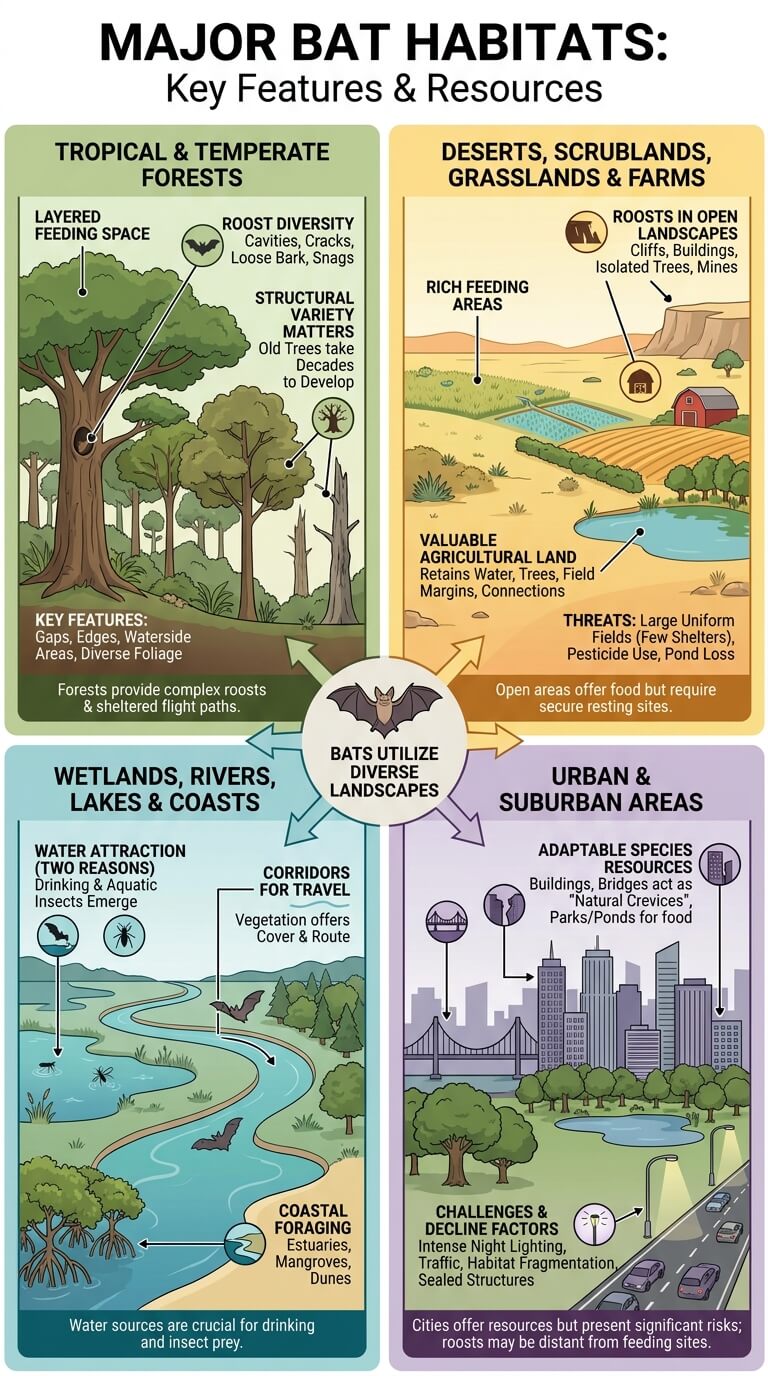
Tropical and temperate forests
Forests provide layered feeding space, sheltered flight paths, insects, fruit, flowers, and many kinds of roosts. Bats may use cavities made by decay or woodpeckers, cracks in trunks and branches, loose bark, broken limbs, foliage, and dead standing trees called snags. Large old trees can be especially valuable because they contain structures that take decades to develop.
Forest structure matters at more than one scale. The U.S. Forest Service review of canopy use by bats notes that cavities, crevices, foliage, microclimate, bark, canopy form, forest gaps, edges, and waterside areas can all influence roosting and feeding. A forest with trees but little structural variety may not provide the same opportunities as a forest containing old trees, snags, gaps, streams, and several vegetation layers.
Deserts, scrublands, grasslands, and farms
Open landscapes may offer rich feeding areas even when they contain fewer obvious shelters. Bats hunt above grasslands, along hedgerows, around livestock areas, over irrigated fields, and near ponds or canals. Cliffs, rocky slopes, isolated trees, farm buildings, caves, and abandoned mines can provide resting places.
Agricultural land is most useful when it retains water, trees, field margins, wooded strips, and connections to natural areas. A large uniform field may provide a temporary pulse of insects but few secure shelters. Pesticide use, removal of old trees, and loss of ponds can change how bats use the landscape.
Wetlands, rivers, lakes, and coasts
Water attracts bats for two major reasons. Bats need to drink, and aquatic insects often emerge from ponds, marshes, lakes, and streams. Smooth water can also create open hunting space. Many species fly along river corridors where vegetation offers cover and a recognizable route between a roost and feeding grounds.
Not every bat depends on water in the same way. Desert species may travel to scarce drinking sites, while bats in humid forests may encounter water more frequently. Coastal bats may forage around estuaries, mangroves, dunes, or shoreline vegetation, but exposure to wind and salt can limit suitable resting sites.
Urban and suburban areas
Cities can contain insects, ornamental flowers and fruit, ponds, parks, mature trees, bridges, and buildings that resemble natural crevices. Some adaptable species use these resources successfully. Others decline when development removes mature trees, seals old structures, fragments feeding areas, increases traffic, or adds intense nighttime lighting.
A bat seen over a street may live in a tree, bridge, roof space, cliff, or another site some distance away. Nighttime feeding activity alone does not reveal the location of its daytime shelter.
What Is a Bat Roost?
Day roosts, night roosts, and temporary resting places
A day roost is where a bat spends daylight hours, when it needs protection from weather, predators, and disturbance. A night roost is a place used between feeding bouts. It may allow a bat to rest, digest, groom, socialize, or handle prey without returning all the way to the daytime site.
Some bats also use feeding perches, where they carry large insects or fruit before eating. A temporary shelter can be occupied for a few hours or a few days. The term roost therefore describes a function, not one permanent home.
Solitary bats and colonies use space differently
Some bats rest alone or in small groups. Others form maternity groups, winter aggregations, or enormous seasonal colonies. Group size can change within the same species as weather, reproduction, food, and shelter conditions change.
A large colony is not the normal pattern for every bat. Tree-roosting species may split into small groups that repeatedly merge and separate. A solitary male and a nursery group can have different temperature needs even when they belong to the same species.
Roost fidelity does not mean permanent occupancy
Many bats remember and return to useful shelters, sometimes across years. Yet fidelity can exist alongside frequent switching. A forest bat may move among several trees while remaining loyal to the same general area. Switching can help it follow favorable temperatures, respond to disturbance, avoid a deteriorating tree, manage parasites, or stay with familiar companions.
Some social bats also exchange information about shelter locations. This gives a group access to several known options rather than forcing every individual to discover a new site alone. These patterns have been studied in only part of bat diversity, so they should not be treated as universal.
Tree Roosts

Cavities, hollows, cracks, bark, and dead trees
Tree cavities can form through decay, broken branches, fire scars, lightning damage, or excavation by birds. Cracks may occur where wood splits, while loose bark creates a narrow protected chamber. Some bats use the spaces beneath slabs of bark on dead or dying trees. Others choose hollows inside living trees.
These sites differ in temperature, humidity, entrance size, internal texture, and protection from rain. A cavity that suits one species may be too large, too exposed, too cool, or too dry for another. Old trees and snags are therefore not interchangeable with young smooth-barked trees.
Leaves, tents, foliage, and exposed branches
Not all tree-roosting bats hide inside wood. Some hang among dense leaves or from branches. Certain tropical species modify large leaves by biting veins so the leaf folds into a tent-like shelter. Others use furled leaves, palm fronds, epiphytes, or clumps of dead foliage.
Foliage shelters can be temporary. Leaves grow, dry, tear, and fall, so a bat may need a network of alternatives. Color and body posture may help some foliage-roosting bats blend into leaves or dead vegetation, but camouflage is species-specific rather than a general feature of all bats. “Roost structure also influences resting posture, helping explain why many bats hang upside down in some shelters while other species use different orientations.”
Sun, wind, rain, predators, and forest management
Solar exposure can warm a roost and reduce the energy a bat must spend maintaining body temperature. Too much heat can be dangerous, especially during hot weather. Wind and rain can cool or expose a site, while dense vegetation may offer concealment but make flight access more difficult.
Removing dead trees, peeling bark, clearing old growth, or simplifying forest edges can eliminate resting places that are not obvious from the ground. Good forest conditions often involve a variety of tree ages, sizes, decay stages, gaps, and waterside vegetation rather than one preferred tree type.
Caves, Mines, Tunnels, and Rock Shelters
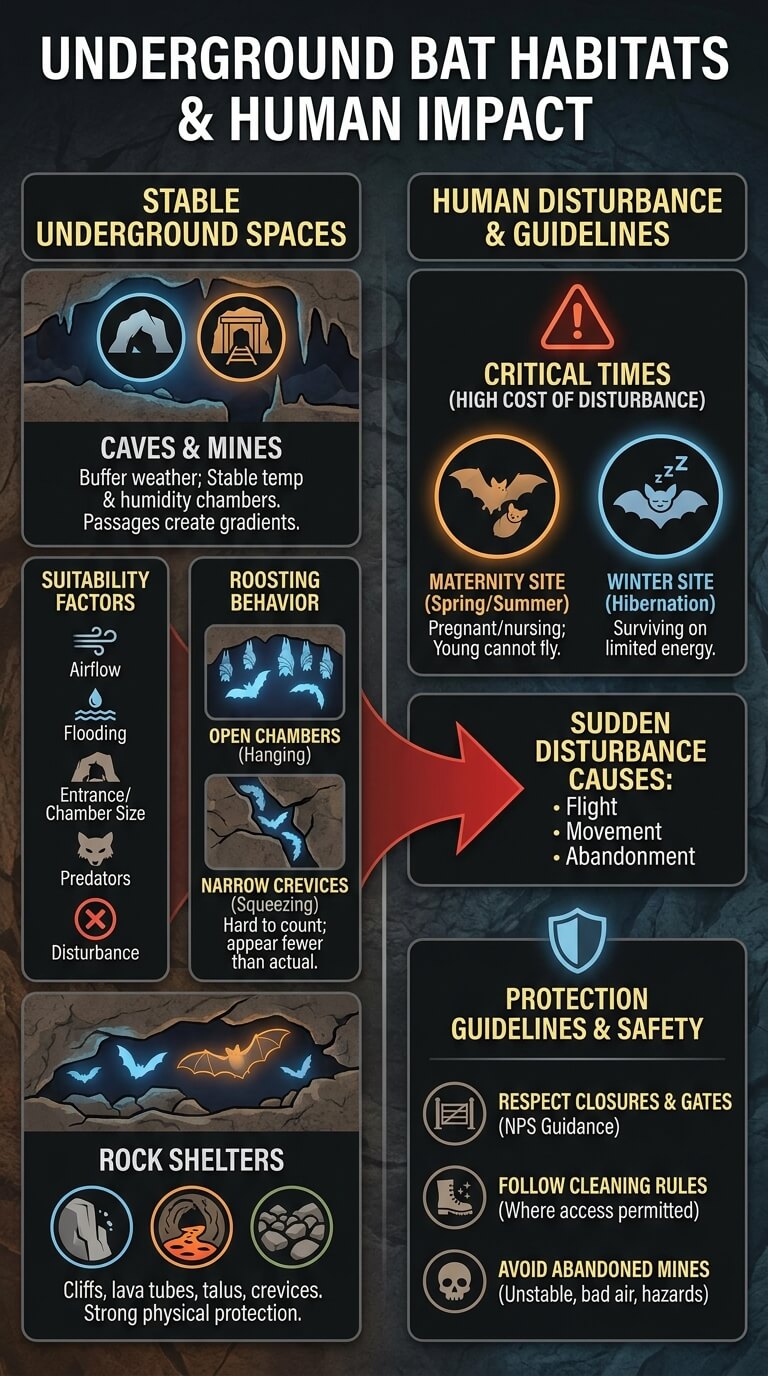
Underground spaces provide stable conditions
Caves and mines can buffer bats from daily weather. Deep chambers may maintain relatively stable temperatures and humidity, while entrances and passages create gradients. Bats can select different positions as outside conditions change.
Stability does not make every cave suitable. Airflow, flooding, entrance shape, chamber size, rock temperature, humidity, predators, and human disturbance all matter. Some species hang in open chambers, while others squeeze into cracks that are nearly invisible to visitors.
Cliffs, lava tubes, talus, and narrow rock crevices
Rock shelters extend beyond familiar limestone caves. Bats may use cracks in cliffs, lava tubes, boulder fields, talus slopes, canyon walls, sea cliffs, and spaces behind exfoliating rock. Narrow crevices can provide strong physical protection and create favorable temperatures.
Crevice-roosting bats can be difficult to count because they remain hidden. An area that appears to contain only a few bats may hold more individuals inside deep cracks, while a dramatic open chamber may be used only seasonally.
Disturbance can be most harmful at sensitive times
A maternity site supports pregnant females, nursing mothers, and young that cannot yet fly. A winter site supports animals surviving on limited stored energy. Sudden disturbance can cause flight, movement, or abandonment at a time when the cost is unusually high.
The National Park Service guidance on protecting bat sites explains why some caves are closed seasonally or year-round. Visitors should respect signs and gates, avoid entering abandoned mines, and follow cleaning rules where cave access is permitted. Old mines can also contain unstable ceilings, bad air, deep shafts, and flooding hazards for people.
Buildings, Bridges, and Other Human-Made Shelters

Attics, walls, barns, roofs, culverts, and bridge joints
Narrow spaces in buildings and transportation structures can resemble tree cracks, bark chambers, or rock crevices. Bats may use gaps beneath roofing, spaces behind siding, barns, attics, wall cavities, expansion joints, drainage structures, and concrete seams.
Some structures become warm during the day and can serve as maternity sites. Others provide cooler solitary refuges or temporary night roosts. The Bat Conservation International overview of bats in buildings notes that preferences vary by species, season, region, climate, and activity.
Structures can imitate natural shelter without replacing the whole landscape
A bridge joint may imitate a rock crack, and an attic may imitate a warm tree cavity. That physical resemblance helps explain why bats enter structures. It does not mean a building supplies everything they need. Bats still require feeding areas, water, safe emergence space, and routes through the surrounding landscape.
Human-made shelter can sometimes become important where hollow trees or natural crevices have declined. It can also create conflict when a resting site overlaps with occupied rooms, repairs, or bridge work. The biological value of a site and the needs of people must both be considered.
A building encounter requires local professional guidance
This is not a removal guide. Do not touch bats, block an active opening, use poison, or make structural changes that could trap adults or flightless young. Timing and legal requirements vary by place and species.
A person dealing with bats inside a home should contact the local health department when exposure may have occurred and consult a state wildlife agency, qualified wildlife professional, or bat rehabilitator for the next step. Direct handling is unsafe for both people and bats.
Seasonal Roost Needs
Maternity sites support birth and pup development
Female bats of many temperate species gather in maternity groups during pregnancy, birth, nursing, and early pup development. Warm conditions can support growth, but overheating remains a risk. A useful maternity site may contain temperature choices that allow females to move within the shelter.
Young bats cannot fly immediately after birth. That makes an occupied maternity shelter especially sensitive to obstruction or disturbance. The timing of birth and first flight varies among species, regions, and weather conditions, so fixed calendar rules can be misleading.
Mating sites, stopovers, bachelor sites, and swarming areas
Males may use separate shelters during part of the year. Migratory bats may pause at stopover sites, while cave-associated species can gather near underground entrances during autumn swarming. Swarming can involve mating, exploration, and social activity before winter, but its exact function and timing differ among species.
A site used briefly can still be important. A bridge, tree grove, cliff, or cave entrance may support bats during only one stage of an annual cycle. Surveys conducted in another season may miss that use.
Hibernacula provide winter microclimates
A hibernaculum is a site where bats spend the winter in prolonged torpor interrupted by occasional arousals. Caves, mines, rock cracks, and some structures can supply the cool, humid, sheltered conditions needed by certain species. Other bats migrate or winter in trees rather than underground.
The National Park Service explanation of hibernation and migration emphasizes that bats select winter sites by temperature and humidity and that many species move between summer and winter areas. Winter strategy must therefore be described by species, not assigned to bats as a single group.
What Makes a Good Bat Roost?
Temperature, humidity, darkness, airflow, and texture
A useful roost protects a bat while keeping its body within a workable range of temperature and water balance. Warmth can reduce energy costs for reproductive females and growing young. Cooler conditions can promote energy savings through torpor. Humidity may reduce water loss, but the best level varies by species and season.
Many bats need rough surfaces that their claws can grip. Entrance size affects access, predators, light, and airflow. Darkness can reduce exposure, although some foliage-roosting bats rest in relatively open sites. No single checklist describes an ideal shelter for every species.
Food, water, commuting routes, and emergence space
A secure shelter can still be poor habitat if it is too far from food or water. Flight costs matter, especially for pregnant or nursing females and for small bats with limited energy reserves. Wooded edges, streams, hedgerows, and other linear features may guide travel between shelter and feeding areas.
An emergence opening must also be usable. Dense clutter may help maneuverable forest bats but hinder fast open-air species. Bright light, heavy traffic, or a sudden open crossing can increase the difficulty of leaving and returning.
Every choice involves trade-offs
Warm shelters can speed pup growth but increase overheating. Grouping can conserve heat and provide social benefits but may increase competition, parasites, or disease transmission. A deep cave can provide stable conditions but require a long commute. A tree cavity may be close to food but disappear when the tree breaks.
Bats respond to these trade-offs through behavior. They may change position within a shelter, enter daily torpor, switch among sites, alter group size, or move seasonally. A roost is best understood as one choice within a changing landscape.
Examples of Different Shelter Strategies
Foliage and tree-cavity bats
Red bats and hoary bats are familiar North American examples of species that often rest in foliage. Silver-haired bats frequently use tree crevices, cavities, and loose bark. Northern long-eared bats use cavities, cracks, and bark in forested settings during summer.
These examples should not be turned into rigid labels. Individuals may use alternative structures, and populations in different regions may behave differently. Tree condition, weather, season, sex, and reproductive state all influence site choice.
Cave-dependent and rock-crevice bats
Some bats depend heavily on caves or mines during part of the year. Townsend’s big-eared bats may use spacious underground rooms and can be sensitive to disturbance. Canyon bats often use rock cracks in arid country, while other species occupy narrow crevices in cliffs or lava formations.
Cave dependence can refer to wintering, maternity use, daily shelter, or several functions. A bat described as cave-associated may still feed over forests, deserts, farms, or water far outside the cave.
Urban-adapted and bridge-roosting bats
Big brown bats and some free-tailed bats commonly use buildings or bridges in parts of North America. Yuma myotis may use structures near water. Mexican free-tailed bats can form conspicuous colonies beneath certain bridges, but those famous examples should not be treated as the standard for every urban bat.
Urban tolerance also does not mean complete dependence on concrete. Many structure-roosting bats still rely on rivers, parks, wetlands, farms, or natural vegetation for food. Their nightly life extends well beyond the shelter visible to people.
Common Myths About Bat Homes
Myth: All bats live in caves
Caves are important, but many bats spend much or all of the year in trees, foliage, rock cracks, buildings, bridges, culverts, or other shelters. Even a species that hibernates underground may use trees or structures in summer. The National Park Service summary of where bats live highlights trees, caves, mines, talus slopes, rock crevices, bridges, and other structures.
Myth: A bat flying near a house must live inside it
Bats often feed around homes because porch lights attract insects, trees offer cover, and ponds or drainage areas supply water. The daytime shelter may be nearby or several miles away, depending on the species and landscape. Repeated emergence from a specific opening is more informative than a bat merely flying through a yard.
Myth: One shelter design works for every bat
Bat houses can provide useful shelter in some settings, but occupancy is not guaranteed. Size, chamber design, temperature, sun exposure, mounting height, surrounding habitat, and local species all matter. A box cannot replace every cavity, snag, cave, wetland, or feeding corridor a bat population uses.
Artificial shelters should not be used as justification for destroying occupied natural sites. They are one possible management tool, not a universal substitute for habitat.
How Food, Movement, and Seasons Shape Where Bats Stay
Diet determines which feeding areas are valuable
An insect hunter may benefit from streams, wetlands, forest gaps, and field edges. A fruit eater needs landscapes that produce suitable fruit across the year. Nectar feeders track flowering plants, while fishing bats need accessible water surfaces. Shelter and feeding habitat must work together.
This is why two bats using the same cave can travel in different directions after sunset. Their bodies, senses, and diets lead them toward different parts of the landscape.
Flight connects resting places with nightly resources
Bats may commute along rivers, tree lines, canyons, streets, or forest edges. Wing shape and flight style affect how easily a species crosses open ground or moves through clutter. A fast open-air hunter may cover long distances, while a maneuverable forest species may stay closer to dense vegetation.
Removing a corridor can isolate a shelter from food even when the shelter itself remains intact. Resting places, travel routes, and feeding areas function as a connected system.
Seasonal survival requires more than one place
A bat may need a warm nursery area in summer, a mating or stopover site in fall, and a cool winter shelter months later. Migratory species may depend on a chain of landscapes separated by hundreds of miles. Others move only between nearby elevations or between a building and a cave.
Protecting bats therefore requires attention to the full annual cycle. A site that appears empty in one month may be essential at another time.
FAQ
Where do bats sleep during the day?
Bats usually rest in sheltered sites that protect them from weather, predators, and disturbance. Depending on the species, these can include tree cavities, loose bark, foliage, caves, mines, rock cracks, bridges, barns, attics, and narrow spaces in other structures. Many bats use more than one daytime site during a season.
Do bats return to the same roost?
Many bats show loyalty to a useful shelter or general area, but return patterns vary. Some colonies occupy the same building, cave, or tree network in successive years. Other bats switch frequently among several shelters while remembering and revisiting them. Damage, temperature, predators, disturbance, or seasonal movement may cause a bat to change sites.
Do bats live in trees?
Yes. Tree-roosting bats may use hollows, woodpecker cavities, trunk cracks, loose bark, dead trees, leaves, branches, palms, and folded foliage. Some rest alone, while others form groups. Tree use can be seasonal, and an individual may move among several trees rather than occupy one permanent hollow.
Why do bats sometimes roost in buildings?
Buildings can provide dark, protected crevices and stable or warm temperatures similar to natural tree or rock shelters. Availability differs by region and species. A structure may be used by one bat, a temporary group, or a maternity colony. People should not handle bats or seal an active opening without appropriate local guidance. “Habitat and roost choice are part of the broader bat biology picture, alongside flight, diet, senses, reproduction, and seasonal behavior.”
Final Thoughts
Where bats live depends on much more than the nearest cave. Their wider habitat supplies food, water, flight routes, and seasonal conditions, while a roost provides a specific place to rest, raise young, mate, pause during feeding, or survive winter. Trees, foliage, caves, mines, cliffs, bridges, and buildings can all serve these functions for different species.
The most accurate way to understand a bat’s home is to ask which species is present, what season it is, what the site provides, and how that shelter connects with the surrounding landscape. Respecting occupied sites, avoiding direct handling, and preserving natural shelter diversity help bats use the places their lives depend on.

Ethan Walker is the founder and research editor of Animal Fact Central. He creates and reviews educational animal facts content using trusted wildlife, pet care, and science-based sources. His work focuses on making animal behavior, adaptations, habitats, and species facts clear, accurate, and engaging for everyday readers.
Read More Details About Ethan Walker: https://animalfactcentral.com/ethan-walker/