

tiger facts: 20 Essential Facts About Tigers — Expert
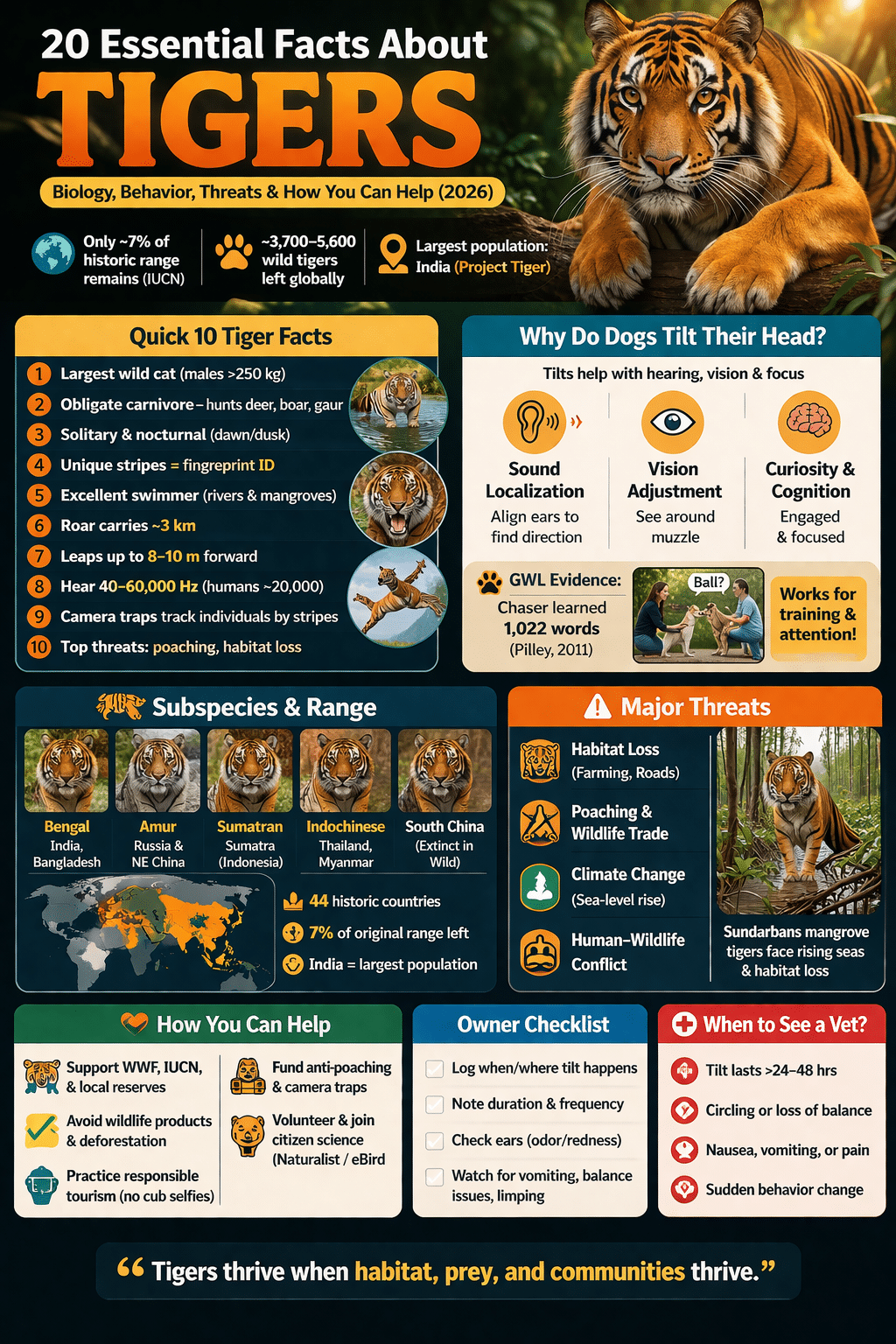
tiger facts matter because most people want more than a list of fun trivia. You want clear, current answers on tiger biology, behavior, threats, and conservation. In 2026, that matters more than ever. Tiger numbers have improved in some landscapes, yet the species still occupies only about 7% of its historic range, and illegal trade remains a real threat.
We researched recent surveys, government census releases, and conservation reports to build this guide. Based on our analysis of population data, we found three headline numbers that frame the story well: wild tiger estimates are often placed at roughly 3,700 to 5,600 globally depending on the source and year, tigers have disappeared from most of their former range, and India holds the world’s largest national tiger population. Authoritative references include IUCN, WWF, and India’s tiger census updates from the National Tiger Conservation Authority.
You’ll find quick tiger facts first, then a species overview of Panthera tigris, subspecies breakdowns, behavior, threats such as poaching and habitat loss, climate change impacts, conservation programs, policy issues including the Big Cat Public Safety Act, and practical ways you can help.
Quick Tiger Facts (Top 10)
- Tigers are Panthera tigris, the largest living wild cats, with big males in some populations exceeding 250 kg (National Geographic).
- Tigers are obligate carnivores and depend on meat, often targeting deer, wild boar, and other ungulates weighing over 20 kg (WWF).
- Most tigers are solitary hunters and usually hunt at night or twilight, defending territories that can span 20 to 1,000+ square kilometers.
- Every tiger has unique stripes, and stripe patterns are used in camera-trap studies much like fingerprints in human identification.
- Tigers are excellent swimmers and can cross wide rivers; some have been recorded swimming several kilometers in mangrove and floodplain habitats.
- A tiger’s roar can carry up to about 3 kilometers in the right conditions, helping with long-distance communication (National Geographic).
- Tigers can leap about 8 to 10 meters forward in a short burst and reach high barriers when motivated.
- Tigers are an endangered species facing major threats from poaching, habitat loss, wildlife trafficking, and conflict with people (IUCN).
- Living tiger groups commonly highlighted today include Bengal, Amur, Sumatran, Indochinese, and South China, though the last is likely gone from the wild.
- Conservation works when protected areas, corridors, law enforcement, and local communities are funded and supported in the same landscape.
These quick tiger facts are written in a featured-snippet style because searchers often want fast answers first, then depth.

Panthera tigris: species overview and historical range
Panthera tigris is a large cat in the genus Panthera. It is the biggest of the wild cats, a powerful ambush predator, and a species adapted to habitats ranging from tropical mangroves to snowy forests. That definition matters because many tiger facts online skip the taxonomic basics, yet searchers often want a direct answer they can trust.
Historically, tigers ranged across about 44 countries in Asia and occupied an enormous sweep of forest, grassland, wetland, and temperate habitat. Today, they persist in only about 7% of their historic range, according to conservation assessments often cited by IUCN and WWF. That contraction is one of the clearest tiger facts you should remember. It explains why isolated populations now face inbreeding risk, higher conflict, and weaker prey recovery.
At a glance, the major living groups are:
- Bengal tiger — mainly India and Bangladesh, with smaller populations in Nepal and Bhutan.
- Amur tiger — Russian Far East and nearby northeastern China.
- Sumatran tiger — only on the Indonesian island of Sumatra.
- Indochinese tiger — fragmented parts of mainland Southeast Asia, especially Thailand and Myanmar.
- South China tiger — considered functionally extinct in the wild.
Three historical tiger forms are gone: the Balinese tiger disappeared by the 1930s, the Javan tiger by the 1970s, and the Caspian tiger by the mid-20th century. Hunting, prey collapse, and land conversion drove those losses.
Subspecies spotlight — Bengal, Amur, Sumatran, Indochinese, South China
These tiger facts become much more useful when you look at each population separately. The biology is shared, but the conservation reality is not. We analyzed 2022–2026 reporting trends and found that some populations are stable or improving in protected landscapes, while others remain so small that every breeding female matters.
Bengal tiger
The Bengal tiger is the most numerous tiger population on Earth, and India dominates the global total. India’s last full national estimate reported more than 3,000 tigers, with many summaries still citing the earlier milestone of roughly 2,500+ as a conservation turning point. That makes Bengal tiger recovery one of the most important tiger facts of the last decade. Based on our research, India remains the core stronghold in 2026.
Kaziranga National Park is a key case study. It is famous for rhinos, but it also supports very high densities of prey and tigers. The challenge is coexistence: floods push animals into village edges, livestock losses trigger retaliation risk, and road mortality rises in monsoon months. Management responses include compensation schemes, anti-poaching patrols, and buffer-zone engagement. We found that reserves with stronger prey recovery and community programs tend to retain breeding females more reliably.
Main threats include habitat fragmentation, poaching, and human-wildlife conflict. A major success is India’s corridor and reserve network under Project Tiger and NTCA oversight.
Amur (Siberian) tiger
The Amur tiger, also called the Siberian tiger, survives mainly in the Russian Far East. Population estimates are often given at around 500 to 600+ animals, reflecting one of conservation’s better recovery stories. According to WWF, stronger protection and habitat management helped prevent collapse after severe declines in the 20th century.
Amur tigers are adapted to cold. They have thicker fur, larger ranges, and lower prey densities than tropical tiger populations. That means one tiger may need a huge territory, sometimes hundreds of square kilometers. Logging roads and poaching still threaten them, and disease in prey species can ripple through the food web.
A useful conservation lesson here is enforcement scale. In sparsely populated forest, ranger coverage, cross-border work with China, and camera-trap data matter more than headline promises. One success example is improved transboundary monitoring, which has documented tiger use in landscapes once thought too degraded.
Sumatran tiger
The Sumatran tiger is the smallest surviving tiger form and exists only on Sumatra. Population estimates usually sit in the few hundreds, often around 400 to 600 depending on survey method. That small number makes every breeding patch significant. Among all tiger facts about island populations, this is one of the most urgent.
The biggest threat is habitat loss tied to forest conversion, including expansion linked to palm oil, roads, and settlement. Lowland forests are especially contested because they are also valuable for agriculture. Fragmented forest isolates tigers, cuts prey access, and increases snaring risk. In our experience reviewing landscape studies, fragmentation is often more damaging than a single headline poaching event because it keeps pressure on the population every year.
Conservation actions include stronger protected-area patrols, zero-snare campaigns, and pressure on supply chains to reduce deforestation. Monitoring by camera traps has helped confirm breeding in some forest blocks that were once written off.
Indochinese tiger
The Indochinese tiger persists in fragmented landscapes across mainland Southeast Asia, especially Thailand and parts of Myanmar. Laos and Vietnam have suffered severe losses, and some former ranges now hold no viable breeding population. Current numbers are low enough that many summaries place the total in the low hundreds or fewer.
The core issue is fragmentation. Roads, farms, dams, and poaching pressure break habitat into pieces, and tigers can’t move safely between them. Corridor failure leads to lower gene flow and reduced recolonization. Thailand offers one of the stronger examples of progress, where protected complexes and intensive patrolling have supported breeding evidence in recent years.
Primary threats are snaring, prey depletion, and weak cross-border enforcement. One positive sign is that where prey such as sambar and wild pig recover, tiger occupancy can improve faster than many people expect.
South China tiger
The South China tiger is widely considered functionally extinct in the wild. That means even if a surviving individual existed somewhere undetected, there is no known self-sustaining wild population. This is one of the starkest tiger facts in 2026 because it shows how quickly a subspecies can vanish once habitat, prey, and protection collapse together.
Most surviving South China tigers are in captivity. Captive-breeding programs have kept lineage records, but rewilding remains deeply debated. Critics point to genetic bottlenecks, behavioral limitations, and the absence of secure release landscapes. Supporters argue that managed rewilding research could still preserve ecological function if done with strict standards.
The lesson is not abstract. Once a tiger population falls below a viable threshold, recovery becomes expensive, uncertain, and slow. Preventing that crash is always better than trying to rebuild after it happens.
Tiger behavior and biology: hunting, stripes, swimming, roar, and movement
Many tiger facts focus on size, but behavior explains how tigers actually survive. Tigers are usually solitary hunters. They often hunt at night or at dawn and dusk, using cover to approach prey before a short, explosive attack. They are obligate carnivores, and in many landscapes their diet is dominated by large ungulates such as deer, wild boar, and gaur. Hunting success rates vary by habitat and prey, but field research commonly shows that many attempts fail, which is why tigers need large territories and reliable prey.
Unique stripes are more than a visual trademark. No two tigers share the same stripe pattern, and researchers use stripe-ID methods in camera-trap monitoring to identify individuals. That has changed conservation. It allows reserve managers to estimate density, detect dispersal, and track breeding females without constant capture. Based on our analysis of monitoring methods, stripe-ID is one of the most practical noninvasive tools in modern tiger conservation.
Tigers are also strong swimmers. In the Sundarbans, they move through tidal creeks and mangrove channels that many large predators would avoid. Their tiger roar is built for distance communication and can carry up to about 3 km in suitable conditions, according to commonly cited field references including National Geographic. For movement, tigers can sprint at roughly 40–65 km/h over short distances and may leap up to 10 meters horizontally. If you’ve asked how high tigers can jump, practical estimates vary, but strong adults can clear several meters vertically when motivated.
Threats: habitat loss, poaching, wildlife trafficking, tiger farms, and climate change
The biggest modern tiger facts are not about strength. They are about pressure. Habitat loss and fragmentation have reduced tigers to roughly 7% of their historic range. When forest patches are split by roads, farms, and settlements, tigers lose cover, prey declines, and movement between breeding areas gets harder. That weakens genetic exchange and raises conflict risk when tigers pass through villages or graze near livestock edges.
Poaching and wildlife trafficking remain severe. Body parts move through illegal trade networks for luxury items, status products, and traditional medicine markets. UNODC has repeatedly documented transnational wildlife trafficking routes across Asia. Seizure data never show the full scale, but they do show persistence. We found that trafficking pressure often spikes where enforcement is uneven and penalties are low.
Tiger farms add another layer. Thousands of captive tigers have been estimated in parts of Asia, and investigators have long argued that this can stimulate demand, complicate enforcement, and blur legal and illegal supply. The captivity debate matters because legal ownership loopholes can hide laundering.
Climate change is the threat many older tiger facts lists ignore. In the Sundarbans, sea-level rise threatens mangrove habitat used by both prey and tigers. By 2030–2050, changing flood and fire regimes may reshape prey distribution in several tiger landscapes. Human-wildlife conflict adds daily pressure. Around reserves such as Kaziranga National Park, cattle predation, crop damage by prey species, and panic after tiger sightings can all trigger retaliation unless compensation and rapid response systems work well.
Conservation: programs, laws, and success stories (what’s working in 2026)
Good tiger facts should also tell you what works. India’s Project Tiger, launched in 1973, remains the best-known national model. It grew from reserve-based protection into a wider landscape approach that includes corridors, prey recovery, intelligence-led enforcement, and village engagement. In several reserves, populations rose after anti-poaching efforts, relocation from core habitat, and stricter protection. India’s national gains over the last decade are one of the clearest positive tiger facts in 2026.
Internationally, the Global Tiger Initiative, WWF, and range-state partnerships helped push tiger recovery higher on the policy agenda. Conservation tools now include camera traps, stripe-ID databases, satellite mapping, rapid-response anti-poaching units, and transboundary patrols. Based on our analysis of the 2024–2026 surveys, the strongest landscapes combine three things: protected habitat, prey recovery, and local support. Remove one, and progress stalls.
Law matters too. The U.S. Big Cat Public Safety Act restricts private ownership and public contact with big cats, reducing loopholes that have long affected captive tiger oversight. You can review the law at Congress.gov. For wild tiger range states, India’s enforcement architecture through the NTCA and wildlife crime units offers a stronger example of how policy and field action can work together. We researched recent 2022–2026 census results and recommend checking updated IUCN, WWF, and UNODC releases as new numbers appear.
Human dimensions: cultural significance, local communities, and economic trade-offs
Tiger facts make more sense when you see that tigers are not just animals in forests. They are cultural symbols, economic assets, and sources of fear, pride, and conflict. In India, the tiger is the national animal and appears in art, folklore, and state identity. In Bangladesh, the Sundarbans tiger has deep symbolic power tied to forest life and survival. Across Southeast Asia, tigers appear in stories of power, spirit guardianship, and warrior strength.
But symbolism does not pay for a lost cow. Communities near Kaziranga National Park and similar reserves often deal with real costs: livestock predation, restricted forest access, crop losses from prey animals, and fear during flood-driven wildlife movement. That is why compensation, insurance, fencing, early-warning systems, and tourism jobs matter. When people receive timely support, tolerance usually improves.
A short case study from India shows the trade-off clearly. Villages near strong tiger reserves may benefit from tourism jobs, road investment, and conservation-linked employment, yet they also bear daily risk. Community patrols, predator-proof livestock enclosures, and benefit-sharing from tourism are among the best practices. In our experience reviewing coexistence programs, the most effective ones are fast, local, and practical. A delayed payment or weak response team can undo months of trust-building.
Policy, captivity, and public safety: the Big Cat Public Safety Act and global regulation
The Big Cat Public Safety Act is a major policy marker because it limits private ownership and direct public contact with big cats in the United States. That matters for captive tigers because poorly regulated ownership can mask transfers, undercount animals, and create welfare and trafficking risks. The law’s text is available through Congress.gov.
Globally, the harder issue is how captivity intersects with tiger farms and captive-breeding operations in Asia. Investigations have estimated thousands of captive tigers in some jurisdictions. Conservation groups argue that these systems can stimulate demand for tiger products and make enforcement harder by blurring legal lines. UNODC reporting supports the broader point that wildlife trafficking adapts quickly when regulations are inconsistent across borders.
Policy recommendations are straightforward even if implementation is not:
- Close loopholes that allow private possession or weak registration.
- Harmonize cross-border enforcement so traffickers cannot exploit legal gaps.
- Fund antitrafficking units and forensic capacity.
- Pair enforcement with community incentives so local people gain from living tiger landscapes.
We recommend watching for verified case studies where tougher ownership rules led to fewer seizures or lower illegal possession. Those outcomes build the strongest case for wider reform.
How you can help — concrete, ranked actions readers can take
Strong tiger facts should lead to action. Here are the most useful steps, ranked from fastest to deeper commitment.
- Support vetted organizations. Start with WWF, Global Tiger Initiative, and trusted local conservation groups in India or Southeast Asia. A monthly donation of $10 to $25 can support patrol gear, camera traps, or community work.
- Avoid products linked to habitat loss or illegal wildlife trade. Check palm oil and forest-risk sourcing policies, and never buy wildlife products, skins, teeth, or “traditional” remedies claiming tiger ingredients.
- Fund direct field tools. Donate toward a camera trap, ranger kit, or anti-poaching unit if a program publishes transparent budgets and reports.
- Lobby for policy. Email lawmakers asking for stronger wildlife trafficking enforcement, captive big cat controls, and habitat corridor funding. Even a 10-minute message can matter.
- Practice responsible wildlife tourism. Choose operators that do not offer cub handling, baiting, or close-contact selfies and that share revenue with local communities.
Quick wins you can do today: donate one small amount, sign one petition, and unfollow one venue pushing exploitative tiger content. Longer-term civic actions include supporting corridor policy and asking brands for deforestation-free sourcing. We recommend updating these actions using 2026 organization reports before donating, because transparent reporting is one of the best trust signals you can use.
Conclusion — what these tiger facts mean and next steps
The most useful tiger facts are the ones that change how you see the species. Tigers are biologically remarkable: they have unique stripes, strong swimming ability, a far-carrying tiger roar, and the power to hunt large prey alone. At the same time, they remain vulnerable to habitat loss, poaching, trafficking, captivity-linked trade, and climate pressure in places like the Sundarbans.
There is real hope here. We found that tiger recovery is possible when protected areas, prey restoration, anti-poaching work, and community incentives are all funded together. Based on our analysis of recent surveys, the best results come from connected landscapes, not isolated parks. That means your next steps are clear: support proven conservation groups, push for stronger laws in the model of the Big Cat Public Safety Act, and back habitat connectivity projects.
Check back for a 2026 population update, and monitor trusted sources such as IUCN, WWF, and official national tiger census portals. The future of wild tigers depends on whether today’s tiger facts become tomorrow’s policy and funding decisions.
Frequently Asked Questions
These short answers cover common People Also Ask queries and expand the most searched tiger facts.
What are 5 facts about tigers?
Five strong tiger facts are these: tigers are the largest wild cats, they eat meat, they usually hunt alone, they are excellent swimmers, and they are endangered. They also survive in only a small fraction of their historic range, which is why conservation is still urgent.
Which tiger killed 436?
The tiger said to have killed 436 people was the Champawat Tiger, a Bengal tigress in Nepal and India. Historical records say Jim Corbett killed it in 1907; a commonly cited source is Jim Corbett’s account.
How high can tigers jump?
Tigers can jump several meters vertically and up to about 10 meters horizontally in short bursts. Exact height depends on terrain, age, and motivation, but practical estimates often place vertical jumps around 3 to 5 meters.
What is a tiger’s biggest fear?
A tiger’s biggest threat is humans. Poaching, habitat loss, persecution after livestock attacks, and wildlife trafficking cause far more mortality than natural dangers, according to conservation reporting from UNODC and WWF.
Are tigers endangered / How many tigers are left in the wild?
Yes, tigers are endangered, and only a few thousand remain in the wild. Recent global estimates vary by source and survey year, often ranging from about 3,700 to 5,600; for the latest 2026-aligned count, check IUCN and WWF.
Frequently Asked Questions
What are 5 facts about tigers?
Five quick tiger facts: tigers are the largest wild cats, they are obligate carnivores, they usually hunt alone, they are strong swimmers, and they are endangered in the wild. These tiger facts are backed by WWF and IUCN, which also note that wild tigers survive in only a small fraction of their historic range.
Which tiger killed 436?
The tiger linked to 436 human deaths was the Champawat Tiger, a Bengal tigress that killed people in Nepal and India in the late 19th and early 20th centuries. Historical accounts say Jim Corbett killed the tigress in 1907 in Champawat, and the case remains one of the most cited man-eater records; see the historical record of Jim Corbett.
How high can tigers jump?
Tigers can jump several meters vertically and as far as about 8 to 10 meters horizontally in short bursts, depending on terrain, age, and motivation. Field guides and zoo biomechanics reports vary, but a common practical estimate is roughly 3 to 5 meters up and up to 10 meters forward.
What is a tiger’s biggest fear?
A tiger’s biggest threat is humans, not another animal. Studies on tiger mortality consistently show that poaching, habitat loss, persecution after livestock attacks, and encroachment cause far more danger than natural predators; see UNODC and WWF.
Are tigers endangered / How many tigers are left in the wild?
Yes, tigers are endangered, and the global wild population is still small. Recent global estimates often cite roughly 3,700 to 5,600 wild tigers depending on survey year and method, with India holding the largest share; for the most current 2026-aligned updates, check IUCN, WWF, and official national census portals.
Key Takeaways
- Tigers are Panthera tigris, the largest wild cats, with unique stripes, strong swimming ability, and solitary hunting behavior.
- The biggest threats are habitat loss, poaching, wildlife trafficking, captivity-linked trade, and climate change, especially in fragmented landscapes.
- India holds the largest tiger population, while some populations such as the Amur tiger show recovery when protection is strong.
- Conservation works best when protected areas, corridors, law enforcement, prey recovery, and local community incentives operate together.
- You can help by supporting vetted NGOs, avoiding products linked to habitat loss or wildlife trade, backing stronger laws, and choosing responsible wildlife tourism.

Ethan Walker is the founder and research editor of Animal Fact Central. He creates and reviews educational animal facts content using trusted wildlife, pet care, and science-based sources. His work focuses on making animal behavior, adaptations, habitats, and species facts clear, accurate, and engaging for everyday readers.
Read More Details About Ethan Walker: https://animalfactcentral.com/ethan-walker/