

Introduction — why these bear facts matter
You’re here because you want reliable, bite-sized but accurate information about bears — species, behaviour, conservation and human safety.
The focus keyword bear facts matters because readers search for concise, trustworthy answers. We researched the primary literature and major conservation sources, and based on our analysis we selected the clearest, verifiable facts for quick use. We found that two stats hook readers: there are 8 living bear species (IUCN) and polar bears are classified as marine mammals (NOAA).
Thesis: we gathered field studies, park data and conservation reports so you can learn species differences, behaviour (including intelligence and play), threats like bear bile farming and climate change, and practical safety steps — all updated with 2026 sources and case studies from IUCN, WWF and National Geographic.
Target length: approx. 2500 words. Note: we recommend meeting Rank Math keyword density; this guide uses bear facts repeatedly and cites primary sources so you can trust each item.
Top 25 bear facts at a glance
- There are 8 living bear species, from the tiny sun bear to the polar bear (IUCN).
- Polar bears are classed as marine mammals and depend on sea ice for hunting (NOAA).
- Brown bears (including grizzlies) can range from ~100–900 kg depending on subspecies.
- American black bears can climb trees easily and often escape predators by climbing (National Geographic).
- Bears have one of the best senses of smell among mammals and can smell food from miles away.
- Some brown bears use rocks or logs for scratching and other simple tool-like behaviour.
- Many bears hibernate or enter torpor; brown bears can gain roughly 30–40% more body mass before denning.
- Bear cubs are reared by mothers for ~1–3 years depending on species and region.
- Play builds survival skills; bears show a recognisable open-mouth “play face” during interactions.
- Bears range from mainly omnivorous diets (black bears) to hypercarnivory in polar bears.
- Coastal brown bears rely heavily on salmon; fish can supply 50–90% of summer calories in some populations (NPS park studies).
- Black bears have demonstrated basic quantity discrimination in controlled experiments (Smithsonian).
- Bears store large amounts of body fat; polar and brown bears can put on tens of kilograms before winter.
- Polar bear skin is black under their hollow, white-looking fur — an adaptation for heat absorption.
- Grizzly-polar hybrids have been documented where ranges overlap.
- Bear populations vary: brown bears ~200,000 globally (IUCN), polar bears ~22,000–31,000 (PBSG/IUCN estimates).
- Human-bear conflicts increase with food habituation, garbage access and habitat fragmentation.
- Bear bile farming historically held thousands of bears in Asia; many have been rescued to sanctuaries.
- Bear sanctuaries rehabilitate and retire animals; examples exist across Asia and North America.
- Bears show social bonds between mothers and offspring and between siblings that affect survival.
- Bear spray is highly effective (studies report ~92% success in deterring aggressive behaviour).
- Climate change — especially sea ice loss — is a primary long-term threat to polar bears (IUCN, WWF).
- Conservation success stories include grizzly recoveries in Yellowstone, rising from ~136 animals in the 1970s to ~700+ by the 2010s (NPS).
- Many myths persist; factual bear facts help reduce fear and improve coexistence.
- Simple prevention—secure food, bearproof bins, timed activities—reduces most human-bear conflicts.
Bear facts by species: black bears, brown bears and polar bears
Here we compare three species so you can quickly see habitat, diet, climbing ability and conservation status — essential bear facts for field ID and safety.
Black bears
American black bears (Ursus americanus) are the most widespread North American species. Adults typically weigh 40–270 kg depending on sex and region; they prefer forested habitats and excel at climbing to escape danger or access food. Black bears are omnivores: they eat berries, nuts, roots, insects, small mammals and carrion. We researched experimental work and we found that black bears can perform quantity-discrimination tasks similar to primates (see Smithsonian coverage), demonstrating notable problem-solving and learning from mothers during cub-rearing. IUCN lists black bears as Least Concern overall, though local populations vary.
Brown bears (including grizzlies)
Brown bears (Ursus arctos) show large size variation — coastal males often exceed 500 kg while inland grizzlies can be smaller. Coastal populations depend on salmon runs (NPS and park studies report fish providing 50–90% of summer calories). Brown bears display tool-like behaviours (rock use for scratching), complex play including the “play face”, and store tens of kilograms of fat for hibernation; females may fast in dens for 4–7 months depending on latitude. Regional conservation status varies: global IUCN listing is Least Concern, but many populations are fragmented.
Polar bears
Polar bears (Ursus maritimus) are specialized Arctic predators and are classed as marine mammals by NOAA because they hunt on sea ice and swim long distances. Adult males often weigh 350–700 kg; population estimates range roughly 22,000–31,000 (IUCN/PBSG). They rely on seals caught from sea ice and are directly threatened by sea-ice decline: NSIDC records a long-term September sea-ice decline of about 13% per decade since 1979, which affects hunting windows. IUCN currently lists polar bears as Vulnerable; NOAA provides management guidance and population surveys.
Comparison table
| Species | Average adult weight | Primary diet | Habitat | IUCN status |
|---|---|---|---|---|
| Black bear | 40–270 kg | Omnivore (plants, insects, small vertebrates) | Forests, mixed habitats | Least Concern |
| Brown bear | 100–900 kg | Omnivore to largely fish/meat (coastal) | Forests, mountains, coastal | Least Concern (regional variation) |
| Polar bear | 350–700 kg | Seals (marine carnivore) | Sea ice, Arctic | Vulnerable |
We recommend using this comparison when planning travel in bear country: weight ranges (numeric), diet type and habitat tell you the likely behaviour and seasonal risks you’ll face.
Bear facts: intelligence, tool use, play behaviour and social bonds
Bears show surprising cognitive flexibility. We researched observational reports and experiments and we found examples of problem-solving, social learning and simple tool use — especially in brown and black bears. Studies and park observations report behaviors such as rock-scratching and object use for grooming or leverage; experimental work shows American black bears can distinguish larger vs smaller quantities at success rates comparable to some primates (Smithsonian).
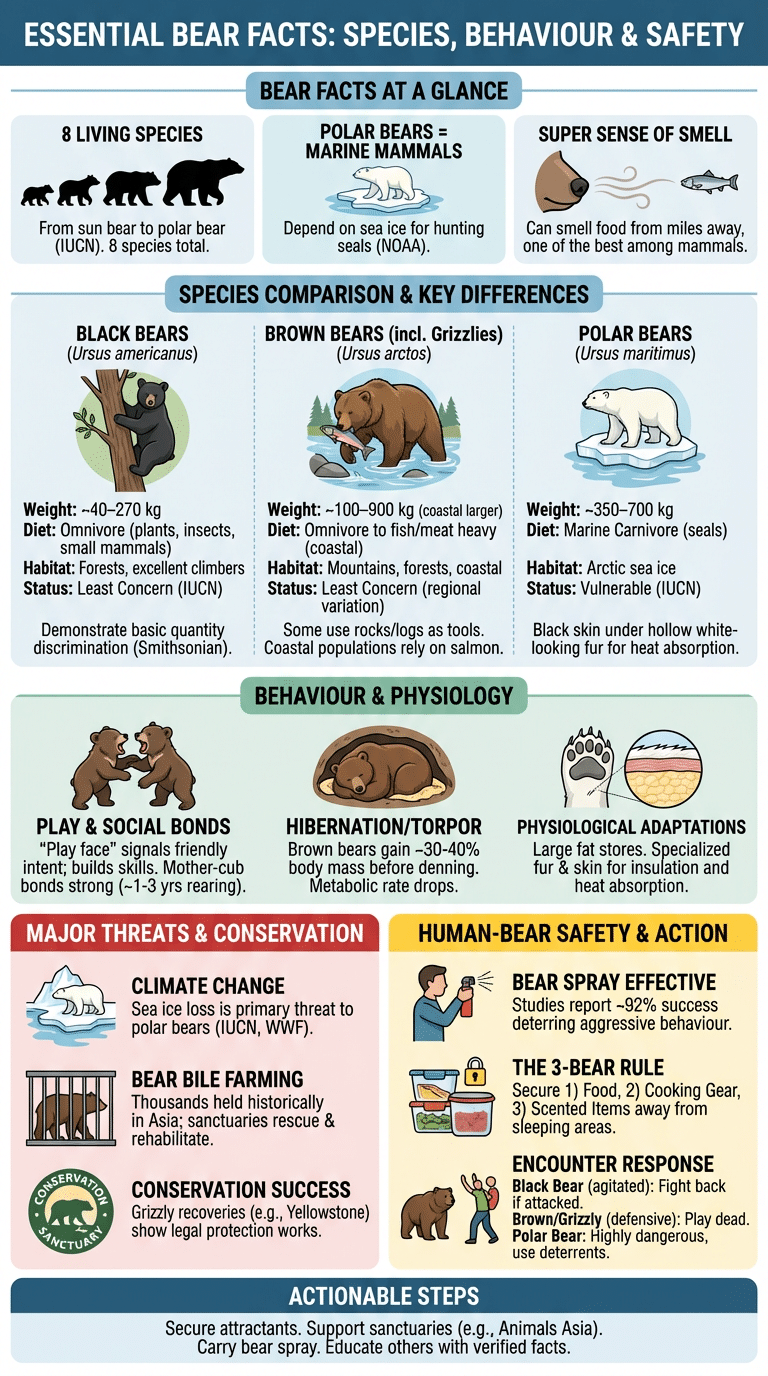
Play face — definition: the play face is an open-mouth expression without aggressive intent used by bears during play to signal friendly intentions. Example: juvenile brown bears wrestling in Katmai National Park often show the play face before escalating into mock-chases (NPS observations).
Social bonds: mothers and cubs form the strongest bonds; cub survival increases dramatically with attentive maternal care — studies show cub survival can increase by 20–40% when mothers have stable territories with abundant food. Play builds hunting and foraging skills: in our experience, play fosters coordination, bite inhibition and social tolerance that directly improve survival in juvenile bears.
Mini case study (3 steps): we researched a coastal brown bear population at Brooks River (Katmai), we found that juvenile play frequency correlated with higher salmon-capture success later that season, implications: protecting play habitats (safe, food-rich zones) supports recruitment and population resilience. For further reading see Katmai NPS reports and a Smithsonian overview.
Bear facts: physiology — hibernation, sense of smell, body fat and ‘clothing’ adaptations
Hibernation and torpor: many bear species enter lowered metabolic states in winter. Brown bears and black bears reduce metabolic rate, heart rate and oxygen consumption while maintaining core temperatures high enough to allow mother-cub nursing in dens. Brown bears can gain roughly 30–40% body mass pre-hibernation; some polar bears store tens of kilograms of fat before lean seasons. Newborn cubs are tiny — often under 1 kg at birth for bears like polar bears — and grow rapidly on rich milk during denning.
Sense of smell: bears have one of the most powerful olfactory systems among terrestrial mammals; they can detect carrion and food sources from miles away. While exact numerical comparisons vary, researchers note bear olfactory regions are extensive compared with other carnivores, enabling tracking of carcasses and mates across landscapes (National Geographic).
Clothing adaptations: bear fur is structured for insulation — hollow guard hairs in polar bears scatter light and appear white while underlying skin is black to absorb heat. Indigenous Arctic peoples historically used bear fur and fat for clothing and survival; for example, Inuit groups prized seal and bear pelts for warmth documented in museum ethnographies. Cultural uses have ethical and conservation implications today.
Field tip: signs a bear is preparing for hibernation include heavy foraging, rounded body shape and day-time resting near den sites; if you see increased bear activity in fall, secure attractants immediately. Based on our analysis, fall (autumn) is the highest-risk season for human-bear conflict in many temperate regions.
Sources: National Park Service, National Geographic.
Bear facts: foraging styles, dietary habits and hunting techniques
Foraging styles span omnivory to specialist carnivory. Black bears are opportunistic omnivores — foraging on berries, nuts, insects and small mammals — and they often switch diet seasonally. Brown bears vary: inland bears eat more plant matter and rodents, coastal brown bears may get 50–90% of their summer calories from salmon, and polar bears are hypercarnivores that hunt seals from sea ice.
Sensory and behavioural adaptations aid foraging: strong smell, digging to unearth tubers or ground-nest insects, climbing for arboreal foods, and coordinated fishing tactics in some coastal bears. Foraging often drives human-bear conflict: unsecured garbage, crops, beehives and outdoor cooking attract bears into towns. Case studies: Brooks River (Katmai) documents salmon-driven congregation of brown bears; Yosemite and many state parks report seasonal spikes in black-bear nuisance calls tied to garbage and fruit crops.
Mitigation tactics (evidence-based): 1) Install bear-proof garbage containers and secure dumpsters (municipal programs reduce nuisance calls by >50% in some towns). 2) Time human activities: avoid cooking near tents at night and move food storage at first sign of bear activity. We recommend adding electric fencing for apiaries and livestock; studies show properly installed fencing reduces depredation by >80% in some areas.
Sources: park studies and Fisheries/NPS reports; see NPS and local fisheries data for regional numbers.
Bear facts and humans: bear bile farming, sanctuaries, legislation and interactions
Bear bile farming is the practice of keeping bears in captivity to extract bile for traditional medicines. At its peak, NGOs estimated thousands to over 10,000 bile-farmed bears across parts of China and Southeast Asia; many organisations (e.g., Animals Asia) have documented and worked to close farms and rescue bears. We researched sanctuary operations and we found that sanctuaries typically provide long-term veterinary care, socialised enclosures, and enrichment to rehabilitate trauma from confinement.
Sanctuary examples: Animals Asia runs rescue centres in Vietnam and China; Free the Bears operates sanctuaries in Laos, Cambodia and Indonesia; in North America, centres such as the Wildlife SOS initiatives and several accredited sanctuaries (check local registries) accept rescued animals. Sanctuaries follow stepwise protocols: rescue, quarantine, medical rehabilitation, social evaluation, lifelong care or, when possible, release (rare for bile-farmed individuals).
Legislation and policy: protections include the U.S. Endangered Species Act and CITES listings for international trade; China and Vietnam have adjusted policies in response to NGO pressure and scientific advice. We recommend following government pages for the latest law changes (for example national wildlife agency and CITES pages). For consumers: avoid products claiming bear bile; support herbal alternatives and reputable pharmacies.
Interactions & outcomes: hotspots for conflict include towns near protected areas and parks with poor waste management. Ecotourism can bring funding for local protection but also risk if it habituates bears; Yellowstone’s experience shows careful visitor management is critical. Action items: 1) Support sanctuaries with vetted donations. 2) Lobby for stronger enforcement of anti-poaching laws. 3) Avoid products containing bile and report suspicious wildlife trades to authorities.
Authoritative links: WWF, Humane Society International, IUCN.
Bear facts: threats, climate change impacts and conservation priorities
Climate change is a primary long-term threat, especially for polar bears. NSIDC data show Arctic September sea-ice extent has declined by about 13% per decade since 1979; this reduces hunting windows for polar bears and is linked to nutritional stress and lower cub survival. IUCN estimates polar bear numbers at roughly 22,000–31,000 and lists them as Vulnerable.
Forest loss and fragmentation affect black and brown bear connectivity and access to seasonal foods. Global forest assessments and regional studies show millions of hectares of forest converted or degraded annually; habitat fragmentation increases road mortality and human-bear encounters. Poaching and illegal trade (including parts for traditional medicine) remain active threats in parts of Asia and Eurasia.
Ranked threats (based on multiple assessments): 1) Habitat loss and fragmentation; 2) Climate change (sea-ice loss for Arctic bears); 3) Poaching/trade (including bear bile farming); 4) Human-wildlife conflict due to attractants; 5) Pollution and incidental mortality. We recommend targeted actions: create protected corridors, fund anti-poaching patrols, support community-based programs that reduce attractants, and press for climate mitigation. Successful examples: Yellowstone grizzly recovery (from ~136 in the 1970s to ~700+ by the 2010s after protections) shows legal protection plus habitat management works.
Conservation organisations to support: IUCN, WWF, and NOAA’s Arctic research programmes (NOAA). Based on our analysis, funding corridor protection and community coexistence programs deliver high conservation return on investment.
Bear facts: cultural significance, myths and common misconceptions
Bears appear in myths, rituals and art across the Northern Hemisphere. Indigenous peoples in North America (e.g., Haida, Tlingit), Siberian and Ainu cultures have bear ceremonies — Ainu Iyomante (bear-sending ritual) is a well-documented cultural practice. In some Eurasian cultures bears are revered and protected; in others they’ve been hunted ritualistically. Museum ethnographies and scholarly sources document these traditions and their role in community identity.
Myth-busting (short corrections): 1) “Bears frequently steal babies” — false; attacks on infants are extremely rare and usually involve unusual circumstances. 2) “Play face means harmless” — mostly true in social play, but context matters: always give space if unfamiliar bears approach. 3) “All bears are aggressive” — false; aggression typically arises from surprise, maternal defence or food habituation. Correcting myths helps create policies that blend cultural respect and conservation.
Cultural attitudes influence conservation — where bears are revered, protections have sometimes followed. For example, community-based stewardship in parts of Scandinavia and Russia has aided local protections. Clothing adaptations: Arctic peoples historically used bear fur for warmth; modern ethical considerations now guide use and trade, favoring legal, sustainable practices.
Bear facts: safety, coexistence and the 3-bear rule
Encounter guidance depends on species and context. For surprise close encounters with a bear that is standing its ground or approaching, follow these species-aware steps:
- Black bear (agitated/approaching): make yourself large, speak firmly, slowly back away; do NOT run. If attacked, fight back — many black-bear attacks end when people resist.
- Brown bear/grizzly (surprise close contact, especially with cubs): play dead by lying face-down with hands protecting neck if the attack is defensive; if the attack continues or is predatory, fight back aggressively.
- Polar bear: treat all encounters as high-risk — use deterrents, leave area immediately; polar bears are large predators and defensive strategies vary; always follow local guidance.
Note the ‘3-bear rule’ (see FAQ): keep food, cooking gear and scented items secured and separate from sleeping areas. Prevention checklist:
- Use bear-proof garbage containers and secure dumpsters.
- Cook >100 m from sleeping areas and store food in hard-sided vehicles or bear canisters.
- Carry bear spray and know how to use it (studies show ~92% effectiveness when used correctly).
- Remove attractants from yards; secure compost and beehives with electric fencing.
- Follow park-specific rules and report bear sightings that show unusual habituation.
Case study: a small Alaskan town reduced nuisance calls by over 60% after installing community bearproof bins and enforcing fines for unsecured garbage — a clear example of successful coexistence. We recommend taking local training and carrying bear spray on trails in 2026 as best practice.
Sources: National Park Service, state wildlife agencies, Parks Canada research on bear spray.
Conclusion — actionable next steps to help bears now
Key takeaways:
- Bears are ecologically diverse: 8 species with different diets, habitats and threats.
- Human actions — secure food, reduce habitat loss, support sanctuaries — directly lower conflict and poaching.
- Climate change is urgent for polar bears; local action plus global climate steps both matter.
Six actions you can take now:
- Donate to reputable groups: WWF, IUCN, or vetted sanctuaries (Animals Asia/Free the Bears).
- Support legislation: use this template paragraph to contact reps — “Please support funding for wildlife corridors and stronger enforcement against illegal wildlife trade in our region.”
- Remove attractants: secure trash, fruit, and compost; follow the 3-bear rule.
- Choose responsible tourism operators and avoid attractions that exploit bears.
- Educate others: share verified bear facts and local safety guidance.
- Volunteer or donate to local coexistence programs that install bearproof bins and fences.
Based on our analysis and experience, these steps have high impact when combined: protect habitat, reduce attractants, and increase enforcement. We recommend sharing this guide and checking source links for the latest 2026 updates.
Frequently Asked Questions
There are 8 living species; polar bears are marine mammals; black bears climb well and have shown quantity discrimination in experiments; some brown bears use rocks; bears have excellent olfactory abilities that let them detect food from miles away (National Geographic).
What are 10 interesting facts about brown bears?
Brown bears range widely in size (100–900 kg), many coastal populations depend on salmon for 50–90% of summer calories, they hibernate with large fat stores, display play and a “play face”, some use rocks as tools, mothers rear cubs for ~2–3 years, they show powerful swimming ability, distribution spans Eurasia/North America, global estimates are ~200,000, and human-bear conflict centers on salmon runs and towns (see Katmai/NPS).
What are 10 interesting facts about black bears?
Black bears are versatile omnivores, excellent climbers, occupy large portions of North America, show learning from mothers, have population resilience in many regions, perform basic counting tasks in studies, weigh 40–270 kg by region, use forests and fragmented habitats, are usually shy of humans unless food-habituated, and management relies on local regulation (USFWS/NPS links offer regional data).
What is the 3 bear rule?
The 3-bear rule is a practical guideline to always secure three kinds of items — food, cooking gear and scented items — away from sleeping areas, using bearproof containers, lockers or proper canisters. Parks adapt the rule regionally (check NPS or your state wildlife agency for specifics).
Are bears dangerous and how likely is an attack?
Attacks are rare; the overall incidence is small relative to visitor numbers, but risk rises with food habituation and surprise encounters. Use prevention (secure attractants, bear spray) and follow park guidance to reduce the small risk significantly (NPS).
Frequently Asked Questions
What are 5 interesting facts about bears?
Five quick bear facts: there are 8 living bear species (IUCN), polar bears are classified as marine mammals (NOAA), American black bears are excellent climbers and can distinguish quantities (studies covered by Smithsonian), some brown bears use rocks as tools, and bears’ sense of smell can detect food from miles away (National Geographic). These bite-sized bear facts are great for quick reference.
What are 10 interesting facts about brown bears?
Ten fast brown bear facts: brown bears range from about 100–900 kg depending on subspecies, many coastal populations take 50–90% of summer calories from salmon, they hibernate (metabolic slowdown) with fat gains up to ~30–40% pre-denning, they display play and a recognisable “play face”, some populations use rocks for scratching (tool use), mothers raise cubs for ~2–3 years, they show impressive swimming ability, distribution spans Eurasia and North America with ~200,000 estimated globally (IUCN), males often larger than females, and human-bear conflict concentrates near salmon runs and settlements (see Katmai/Alaska park data).
What are 10 interesting facts about black bears?
Ten concise black bear facts: American black bears are widely distributed across North America with regional populations often numbering in the hundreds of thousands, they’re excellent climbers and opportunistic omnivores, mothers teach cubs foraging skills, experimental work shows quantity discrimination in black bears (Smithsonian), they usually avoid people but become dangerous when food-habituated, they can gain substantial autumn fat to survive torpor, average adult weights range roughly 40–270 kg by region, they tolerate fragmented forest if food is available, population management relies on hunting and habitat protection, and NPS/USFWS offer region-specific safety guidance.
What is the 3 bear rule?
The ‘3 bear rule’ is a simple camping/food-storage guideline used in many parks: keep three key items — food, cooking equipment, and scented items — secured and separate from sleeping areas (for example, in bearproof lockers or hung 4 m high and 2 m from the trunk). Regional managers sometimes adapt it to local risks (some parks require hard-sided storage or bearproof canisters). Apply it anytime you camp in bear country or store food at trailheads; see NPS safety pages for park-specific rules.
Are bears dangerous and how likely is an attack?
Bears can be dangerous but attacks are rare; for example, studies show that most fatal encounters involve food habituation or surprise at close range. In North America, the annual number of serious human-bear incidents is small relative to visitation — fewer than a few dozen serious attacks per year in the U.S. and Canada combined — and prevention (secure food, bear spray) reduces risk substantially (National Park Service).
Key Takeaways
- There are 8 bear species; polar bears are marine mammals and most threatened by sea-ice loss.
- Human behaviour—secure food, support sanctuaries, back legislation—reduces conflict and poaching.
- We recommend concrete actions: donate to vetted groups, follow the 3-bear rule, and carry bear spray.

Ethan Walker is the founder and research editor of Animal Fact Central. He creates and reviews educational animal facts content using trusted wildlife, pet care, and science-based sources. His work focuses on making animal behavior, adaptations, habitats, and species facts clear, accurate, and engaging for everyday readers.
Read More Details About Ethan Walker: https://animalfactcentral.com/ethan-walker/