

Bats fly by sweeping flexible, skin-covered wings through the air. Each downstroke pushes air downward and backward, producing the upward and forward forces needed to stay aloft. Unlike a gliding squirrel, a bat keeps adding energy with repeated wingbeats, so it can climb, turn, slow down, accelerate, and remain airborne without simply losing height.
The basic idea sounds similar to bird flight, but the machinery is very different. A bat wing is a modified mammal forelimb with extremely long fingers supporting a living membrane. Its joints, muscles, skin, sensory receptors, hind limbs, and sometimes a tail membrane work together as a shape-changing flight system. That combination supports many different flight styles.
Quick Answer

How flapping wings create lift and forward force
A flying bat must generate enough aerodynamic force to balance its weight while also controlling speed and direction. During much of the downstroke, the wing meets the airflow at an angle and redirects air. The resulting force has an upward component that supports the bat and a forward component that can propel it. The upstroke resets the wing for the next cycle and may also contribute useful force, especially during slow or highly maneuverable flight.
Flight is not produced by one feature alone. Wing area, wingbeat speed, membrane curvature, body angle, airspeed, and muscle power all matter. A bat continuously adjusts these variables rather than holding its wings in a fixed airplane-like shape.
Why bats are the only living mammals capable of sustained powered flight
Several mammals glide, but living bats are the only mammals that use flapping wings for sustained powered flight. Their forelimbs have become wings capable of producing repeated thrust and lift, while gliders mainly stretch a membrane between their limbs and descend along a controlled path. The Animal Diversity Web overview of bat wings shows how the familiar bones of a mammal arm and hand were modified into the bat flight skeleton.
They can leave a roost below the canopy, climb above obstacles, pursue moving prey, commute between feeding areas, and return to elevated shelters without depending only on a downhill launch.
From Mammal Forelimb to Bat Wing
Upper arm, radius, ulna, wrist, and elongated fingers
The inner part of a bat wing begins with the humerus, or upper arm bone. Below it are the radius and a reduced ulna. The radius is the stronger forearm support, while much of the ulna is slender or reduced compared with the same bone in many walking mammals. The wrist connects this arm framework to the greatly lengthened hand.
Four elongated fingers spread through the outer wing. Their metacarpals and phalanges act like movable struts inside the membrane. Because the fingers can bend at multiple joints, the wing can fold tightly beside the body, expand into a broad surface, or twist and reshape during a wingbeat.
How the thumb remains free in many bats
The first digit, the thumb, usually lies along the leading edge rather than inside most of the flight surface. It commonly bears a claw. Bats may use this claw while climbing around a roost, repositioning themselves, or handling food, although thumb size and use vary among groups. Some fruit bats also retain a claw on the second digit.
The free thumb illustrates an important point: a bat wing is not merely a sheet of skin. It is also a functional hand that has been reorganized for flight while keeping some ability to grip and crawl.
Why a bat wing is more like a webbed hand than a feathered arm
The name Chiroptera is commonly translated as “hand-wing.” That description fits the anatomy. The outer wing is supported by fingers that spread through a continuous membrane, almost as though a hand had been stretched and webbed on a much larger scale.
Bird wings also evolved from forelimbs, but feathers form most of their aerodynamic surface. A bat instead flies on skin supported across the arm, fingers, body, and often the hind limbs. The Smithsonian’s bat anatomy summary describes the lengthened arm and finger bones and the usually free, clawed thumb.
The Parts of a Bat Wing Membrane

Propatagium along the leading edge
The propatagium is the membrane along the front of the wing between the shoulder region and the wrist. It helps create and stabilize the leading edge, which is the first part of the wing to meet the airflow. Its tension and shape can influence how air moves over the rest of the wing.
Dactylopatagium between the fingers
The dactylopatagium is the membrane divided into sections between the elongated digits. These outer panels make the hand portion of the wing especially adjustable. Small finger movements can alter local area, curvature, twist, and tip shape without requiring the entire wing to move as one rigid unit.
Plagiopatagium between the body and rear limb
The plagiopatagium is the large inner membrane extending from the body toward the fifth digit and hind limb. It contributes much of the wing’s surface area. Thin muscles embedded within this membrane can help regulate its tension and curvature, allowing the inner wing to become more or less cambered during different flight conditions.
Uropatagium between the hind limbs when present
Many bats have a uropatagium, or tail membrane, stretching between the hind limbs and associated with the tail. A cartilaginous spur called the calcar may help support it. The uropatagium can contribute to stability, turning, braking, and prey capture in some insect-eating bats.
Its size and structure vary widely. Free-tailed bats have a tail that projects beyond the membrane, while vampire bats have a reduced tail membrane. Some bats lack a substantial uropatagium, so it should not be treated as a universal bat feature.
Muscles and Joints That Power Flight
Chest and shoulder muscles drive the wingbeat
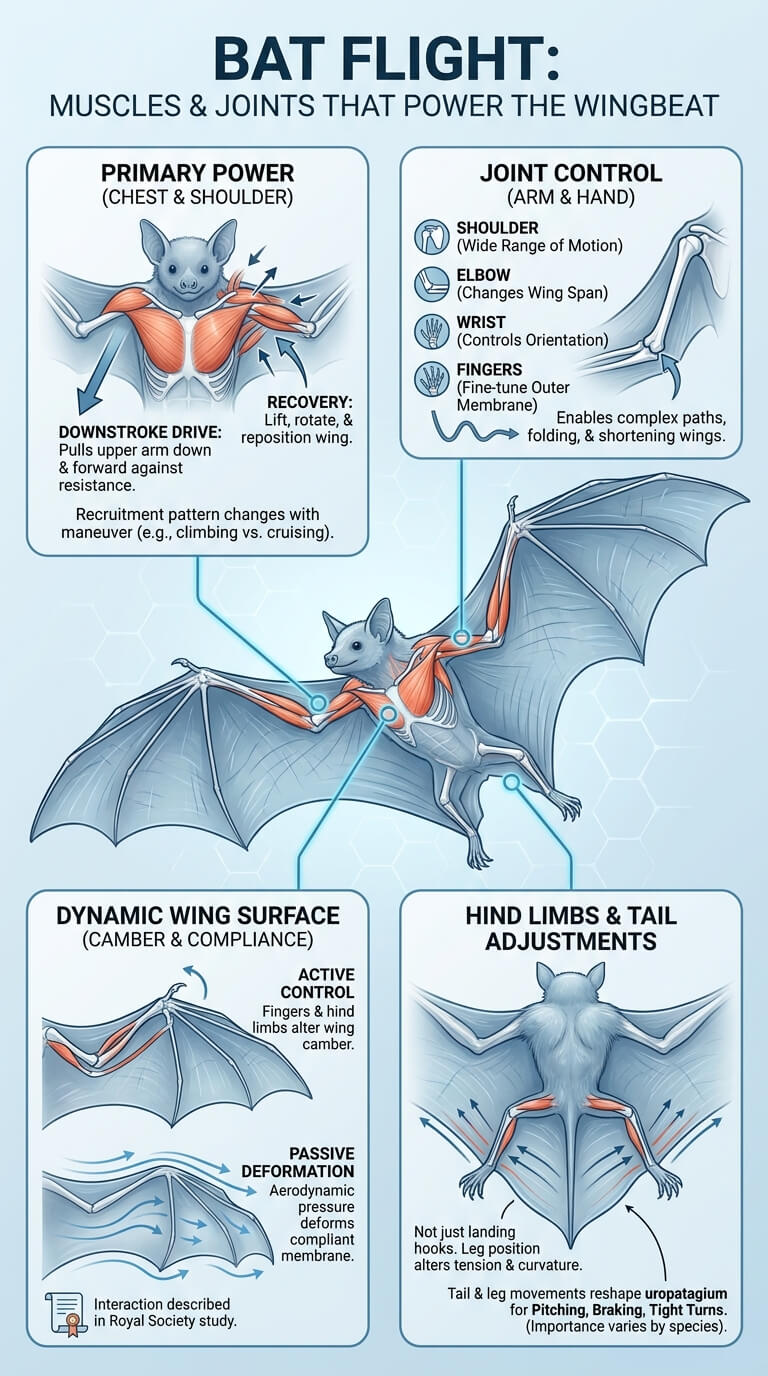
Large muscles around the chest and shoulder provide much of the power for the downstroke. These muscles pull the upper arm down and forward against aerodynamic resistance. Other muscles lift, rotate, and reposition the wing during the recovery portion of the cycle.
The exact recruitment pattern changes with speed and maneuver. A climbing bat needs to produce more upward force than one cruising steadily. A bat slowing near a roost may increase wing area and angle, then rapidly reconfigure the wings as it pitches and reaches for the landing surface.
Shoulder, elbow, wrist, and finger control
The shoulder provides a wide range of motion, while the elbow changes wing span and the wrist helps control the hand-wing’s orientation. Finger joints fine-tune the outer membrane. Together, these joints let the bat shorten one wing, extend the other, sweep both wings through different paths, or fold portions of the wing to reduce drag.
Research on bat-inspired wing design emphasizes that bats can actively alter wing camber through finger and hind-limb movement, while aerodynamic pressure also deforms the compliant membrane passively. The result is a surface that responds to both muscular control and airflow. This interaction is described in a Royal Society study of bat forelimb specialization.
How hind limbs and the tail membrane contribute
A bat’s hind limbs are not just landing hooks. By changing leg position, a bat can alter tension and curvature along the trailing part of the wing. Where a uropatagium is present, leg and tail movements can also reshape that surface.
These adjustments may help with pitching, braking, tight turns, and controlling airflow close to the body. Their importance differs among species because tail-membrane size, leg proportions, diet, and flight style are not the same across Chiroptera.
How Bat Wings Produce Lift, Thrust, and Control
Wing angle, camber, flapping motion, and airflow
Camber means the curved profile of a wing. A more strongly curved wing can generate substantial lift at low speed, but it can also create more drag. A flatter profile may be useful during faster forward flight. Bats can alter this curvature within a wingbeat, especially through the fingers, membrane muscles, and hind limbs.
The angle at which the wing meets the oncoming air also matters. Too little angle may produce insufficient force. Too much can cause airflow separation and loss of useful lift. A bat manages this balance dynamically, not by choosing one fixed setting.
Flexible membranes change shape during each wingbeat
Bat wing skin stretches under load and relaxes when that load changes. This compliance can smooth some disturbances, but it also makes control more complicated. The animal must manage a wing that bends, twists, and billows instead of behaving like a rigid board.
Muscles within the membrane help tune stiffness and camber. At lower speeds, increased curvature can support lift. At faster speeds, a flatter and more streamlined shape may reduce unnecessary drag. These patterns are useful principles, but different species and flight situations do not follow one identical script.
Vortices and unsteady aerodynamics
Flapping wings create swirling structures in the air called vortices. One important example is a leading-edge vortex that can remain attached over part of the wing and contribute to lift during slow flight or rapid maneuvers. Wingtip vortices and the wake behind the bat also reveal how force was produced during each stroke.
Scientists describe bat flight as unsteady aerodynamics because the wing’s speed, angle, span, and shape change throughout the cycle. No single vortex explanation accounts for every bat, every speed, and every maneuver. Body size, wing design, and motion all affect which mechanisms matter most.
How Bats Steer and Maneuver
Asymmetrical wing adjustments produce turns
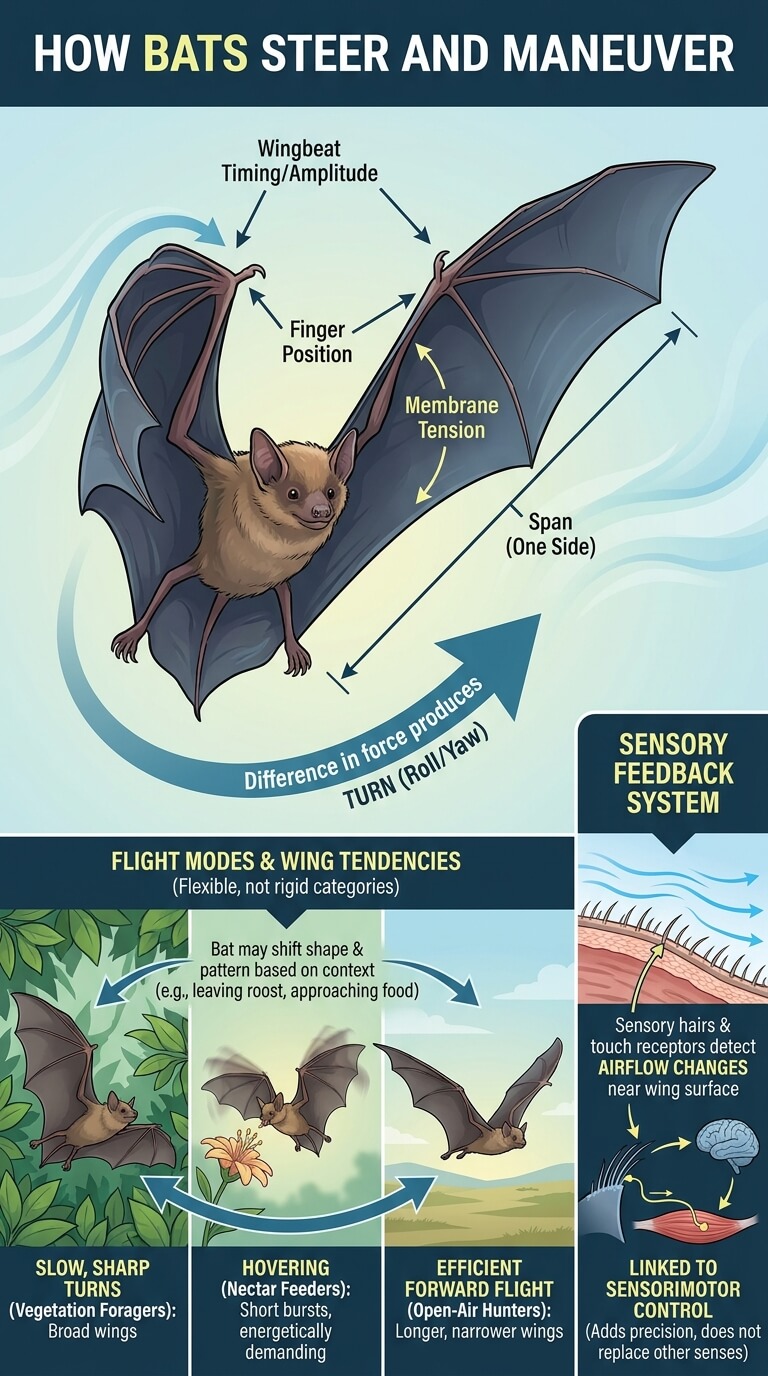
To turn, a bat can alter the force produced by the left and right wings. It may change wingbeat timing, stroke amplitude, finger position, membrane tension, or span on one side. A difference in force rolls or yaws the body, redirecting the overall flight path.
Because many adjustments can be made locally, the bat does not have to swing both wings in exactly the same way. This helps explain the quick directional changes seen when insect-eating bats pursue prey in cluttered airspace.
Tight turns, hovering, slow flight, and fast flight
Broad-winged bats that forage around vegetation often fly slowly and turn sharply. Nectar-feeding bats can hover for short periods near flowers, although hovering is energetically demanding and not typical of all bats. Open-air hunters often use longer, narrower wings suited to efficient forward flight.
These are tendencies rather than rigid categories. The same bat may shift its wing shape and stroke pattern as it leaves a roost, crosses open ground, enters vegetation, or approaches food.
Sensory hairs provide airflow feedback
The wing membrane carries touch receptors and tiny hairs that can respond to airflow. Experiments found that altering these hairs reduced the precision of some flight maneuvers, supporting the idea that they help bats detect changes near the wing surface. The original PNAS study on bat wing sensors linked this tactile system to sensorimotor flight control.
This feedback does not replace vision, hearing, balance, or echolocation. It adds another stream of information about the wing itself and the air moving across it. Sensory systems and motor control work together.
Wing Shape and Flight Style
Aspect ratio and wing loading
Aspect ratio describes how long and narrow a wing is relative to its area. Wing loading compares body weight with wing area. These measurements help researchers discuss likely flight performance, but they do not predict behavior perfectly on their own.
A long, narrow wing often favors efficient travel through open air. A broad wing with a relatively large area can support slower flight and tighter turns. Muscle capacity, wingtip shape, membrane flexibility, body size, and behavior also influence the final result.
Broad wings in clutter and narrow wings in open space
Forest bats that glean insects from leaves or maneuver among branches often have relatively broad wings and low wing loading. Those features can help at slow speeds where rapid turning and controlled approaches matter.
Many free-tailed bats hunt insects well above the ground. Their long, narrow wings are associated with faster, more efficient flight in open air, though they may need more room to turn and launch. Habitat structure therefore helps shape which wing designs are advantageous.
Trade-offs among speed, endurance, and maneuverability
No wing is best at every task. A design optimized for long-distance travel may not be ideal for hovering beside a flower. A wing suited to tight forest turns may create more drag during fast commuting. Bats balance these competing demands according to diet, roost placement, migration, and the spaces where they forage.
Individual bats also adjust within the limits of their anatomy. They can partially fold the wings at higher speed, spread them for braking, or change stroke timing during a chase. Wing shape sets a performance range, not a single fixed behavior.
How Bats Take Off
Dropping from a hanging roost
A hanging bat can release its feet, fall briefly, open its wings, and convert that downward motion into forward flight. This is an efficient launch from caves, trees, bridges, and other elevated roosts because gravity provides immediate airspeed.
The drop does not mean bats are incapable of producing lift from slow motion. It means a hanging launch can reduce the difficulty and energy cost of accelerating from rest, especially when space below the roost is clear.
Launching from walls, trees, caves, and the ground
Bats also launch from vertical and sloped surfaces by pushing away with their feet or thumbs while opening the wings. Some can take off from level ground, although ability and technique vary. Ground-adapted bats such as vampire bats are notably agile on all fours, while many other species appear awkward on a flat surface.
A grounded bat should not be tested, tossed into the air, or handled with bare hands. It may be exhausted, injured, young, or ill. People in the United States should keep pets and children away and contact a licensed wildlife rehabilitator or local wildlife authority for guidance.
Why takeoff varies by species and roost design
Body mass, leg strength, wing loading, wing length, and the space available for the first stroke all influence launch performance. A bat leaving a narrow crevice faces different constraints from a large fruit bat departing an exposed branch.
Roost architecture can favor particular movements. A ceiling roost provides a drop, a foliage roost may permit an outward push, and an opening crowded with other bats may require careful timing before acceleration.
How Bats Land
Slowing, pitching upward, and reaching with the feet
Approaching a roost, a bat spreads and angles its wings to reduce forward speed. It then pitches or rotates so the feet can reach the surface. The final maneuver may involve a controlled flip, rapid wing asymmetry, and a short period in which the body is moving upward toward the ceiling.
Landing studies show that species do not all use the same maneuver. Some make two-point contact with the hind feet, while others use both thumbs and feet. The Journal of Experimental Biology study of ceiling landings found distinct landing styles and impact forces among three bat species.
Landing on vertical and overhead surfaces
Vertical landings may require less body rotation than an overhead landing. A bat can approach a wall, brake, extend its feet, and cling. Landing upside down on a ceiling is more demanding because the animal must reverse body orientation while avoiding a hard collision.
Roost surface and ecology influence the approach. A bat landing among leaves may tolerate a different contact pattern from one repeatedly landing on solid cave rock. Claw arrangement, body size, and approach speed also matter.
The relationship between landing and upside-down hanging
Once the toes catch the surface, tendon mechanics help the bat maintain its hanging posture with relatively little continuous muscular effort. The landing maneuver and the hanging mechanism are separate stages: first the bat must arrive and grip safely, then its feet can support the resting position.
Not every bat spends every resting moment in an identical head-down pose. Some species use leaves, bark, crevices, or specialized surfaces in ways that produce different body angles. The familiar ceiling hang is widespread, not a rule without exceptions.
Bat Wings Versus Bird Wings
Skin supported by fingers versus feathers supported by the limb
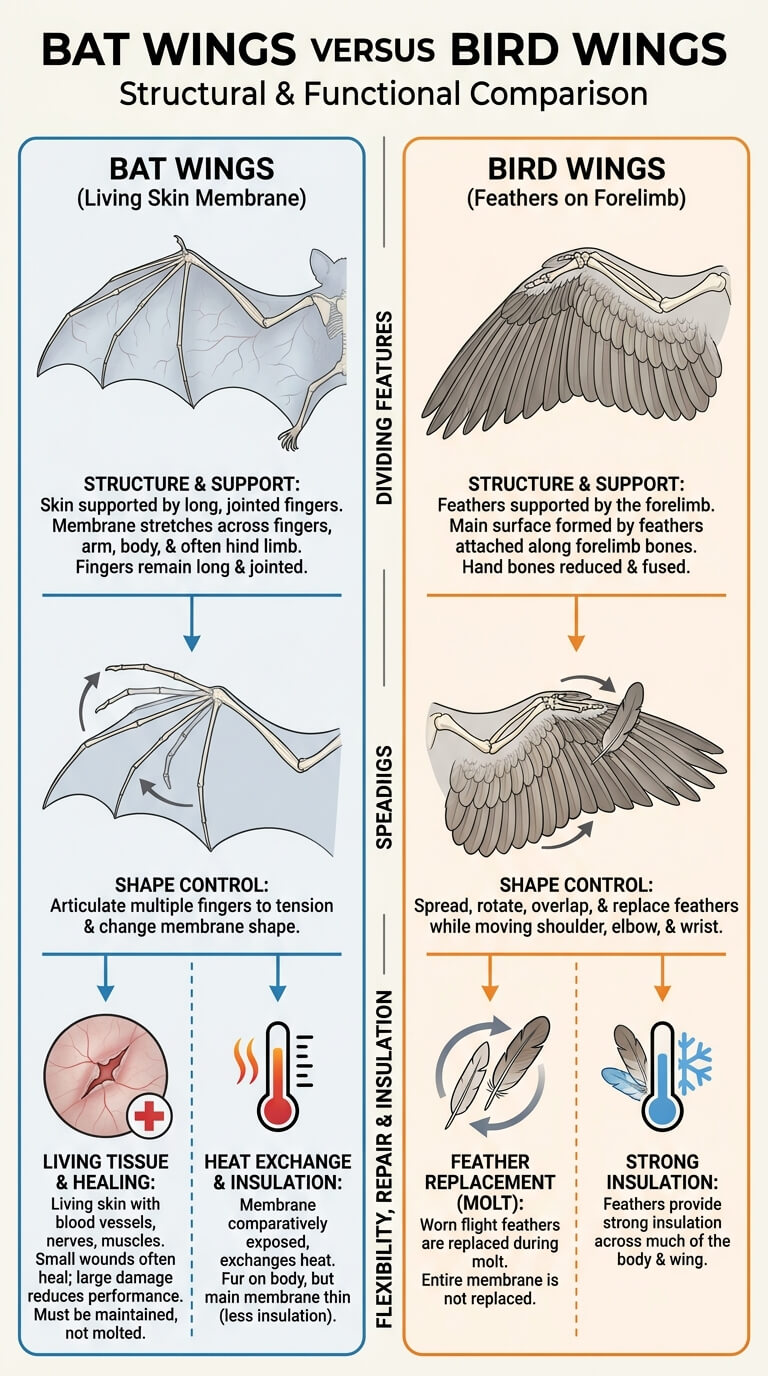
A bat’s flight surface stretches across long fingers, the arm, body, and often the hind limb. A bird’s main flight surface is formed by feathers attached along the forelimb. Bird hand bones are more reduced and fused, while bat fingers remain long, jointed supports within the wing.
Both groups can change wing shape, but they do it with different structures. Bats articulate multiple fingers and tension a membrane. Birds spread, rotate, overlap, and replace feathers while moving the shoulder, elbow, and wrist.
Flexibility, damage, repair, and insulation
Bat membranes are living skin with blood vessels, nerves, muscles, and connective tissue. Small wounds may close, but healing time and completeness depend on the injury and the bat’s condition. Large tears, disease-related damage, or injury to embedded muscles can reduce maneuverability and flight performance.
Birds replace worn flight feathers during molt. Bats do not molt away and replace the entire membrane, so the tissue must be maintained and repaired. A scientific review of wing damage and flight performance notes that small membrane wounds in healthy bats often heal, while more serious damage can change how they fly.
Feathers also provide strong insulation across much of a bird’s body and wing. Bat flight membranes are comparatively exposed and can exchange heat with the environment. Fur covers the body and may extend onto parts of the wing in some species, but the main membrane remains thin enough to bend and transmit airflow forces.
Examples of Bat Flight Specialists
Fast open-air free-tailed bats
Free-tailed bats often have long, narrow wings and relatively high wing loading. These traits suit sustained flight in open air, where the bats can travel quickly and pursue flying insects above vegetation. They may be less comfortable making extremely tight turns in dense foliage.
Reports of bat speed vary because researchers may measure ground speed, airspeed, level flight, dives, short bursts, or wind-assisted movement. It is safer to compare flight styles than to assign one universal maximum speed to all bats.
Maneuverable forest and foliage-gleaning bats
Bats that forage among branches, trunks, and leaves often depend on slow-speed control. Broad wings and lower wing loading can help them remain airborne at reduced speed and change direction within limited space.
Some gleaners take insects or other prey directly from surfaces instead of capturing everything in open flight. Their wings must support precise approaches and quick departures without striking nearby vegetation.
Hovering nectar feeders and low-flying fishing bats
Several nectar-feeding bats can hover briefly while extending the muzzle and tongue into flowers. This is true powered hovering, but it demands considerable energy and is usually used only long enough to feed.
Fishing and trawling bats fly close to water and may use enlarged feet or the tail membrane to seize prey from the surface. Low flight leaves little room for error, so controlled wingbeats, sensory guidance, and rapid changes in body position are especially important.
Common Mistakes and Myths
Myth: bats only glide
Bats can glide between wingbeats, but gliding is not their primary means of staying airborne. Repeated flapping supplies mechanical power, allowing them to climb and maintain height. That makes bat flight fundamentally different from the controlled descent of a flying squirrel or colugo.
Myth: every bat wing has the same shape and performance
Bat wings differ in span, area, tip shape, membrane attachment, tail-membrane structure, and loading. These differences affect speed, turning, hovering, commuting, and foraging. Even closely related species may use distinct spaces or hunting methods.
Myth: echolocation physically powers flight
Echolocation can guide movement by providing information about objects and prey, but sound does not create the aerodynamic force that holds a bat up. Muscles power the wings. Hearing, vision, touch, balance, and sometimes echolocation help control where those wings take the animal.
How Flight Shapes a Bat’s Way of Life
Hanging posture can simplify launch
Roosting overhead lets many bats release into open air and gain speed before the first full wingbeats. The same anatomy that supports hanging also creates the need for specialized ceiling landings. Flight, feet, tendons, and roost choice therefore function as parts of one locomotor system.
Nighttime senses guide a moving wing system
Many bats combine echolocation with hearing, vision, touch, and the balance organs of the inner ear. Sensory input identifies obstacles or prey, while the nervous system turns that information into changes in stroke timing, body angle, and wing shape.
Not every bat relies on echolocation in the same way. Sensory strategy varies among lineages and behaviors, but all flying bats must coordinate perception with rapid muscular control. “After dark, wing control works together with hearing, vision, touch, and memory as part of the broader set of nocturnal bat adaptations.”
Habitat, diet, and migration influence wing design
A bat that migrates long distances faces strong pressure for efficient travel. A bat hunting around leaves needs tight turning. A nectar feeder benefits from brief hovering, while an open-air insect hunter benefits from speed and endurance. These tasks help explain why wing proportions are so diverse.
Diet does not determine wing form by itself. Roost access, predator avoidance, body size, climate, and evolutionary history also shape what each species can do.
FAQ
Can bats take off from the ground?
Some bats can launch from level ground, but performance varies greatly. Species that move well on all fours can push upward and begin flapping, while others may struggle on a smooth, open surface. An elevated or vertical launch often makes takeoff easier by providing room to drop and accelerate.
Do not throw a grounded bat into the air or pick it up bare-handed. Keep people and pets away and seek guidance from a wildlife professional, especially if the bat is active in daylight, unable to fly, or found where human contact may have occurred.
How fast can bats fly?
There is no single speed for bats. Flight speed depends on species, wing shape, body mass, wind, behavior, and how researchers measure movement. Free-tailed bats are built for fast open-air travel, while broad-winged forest bats commonly trade maximum speed for slower, more maneuverable flight.
Claims about a record speed should specify whether they refer to airspeed or ground speed and whether the animal was flying level, descending, or receiving help from wind. Without that context, comparisons can be misleading.
Can bats hover like hummingbirds?
Some bats, especially nectar feeders, can hover briefly in front of flowers. They generate lift through rapid flapping at little or no forward speed. Hovering is energetically costly, so bats generally use it for short feeding visits rather than remaining stationary for long periods.
Hovering ability is not shared equally across bats. Wing shape, body size, muscle power, and feeding behavior determine whether it is practical.
Do torn bat wings heal?
Small holes and tears in a healthy bat’s wing membrane can close because the membrane is living tissue with blood vessels and repair processes. Healing may take weeks, and some injuries do not close completely. Large tears, repeated damage, infection, or injury involving membrane muscles can interfere with flight.
A person should not spread a bat’s wing to inspect it. Handling can worsen an injury and create bite or disease-exposure concerns. A grounded or visibly injured bat should be assessed by an authorized wildlife rehabilitator or wildlife agency.
Final Thoughts
How do bats fly? They combine the power of chest and shoulder muscles with a modified mammal hand, long jointed fingers, flexible skin membranes, sensory feedback, and precise control of the body and hind limbs. Their wings generate lift and forward force through repeated flapping, but they also twist, fold, stretch, and change curvature as conditions change.
There is no single model bat wing. Open-air hunters, forest maneuverers, nectar hoverers, and water-skimming species each emphasize different performance trade-offs. Understanding those differences reveals bat flight as more than a novelty. It is the central movement system around which bat anatomy, roosting, feeding, migration, and nighttime behavior are organized.

Ethan Walker is the founder and research editor of Animal Fact Central. He creates and reviews educational animal facts content using trusted wildlife, pet care, and science-based sources. His work focuses on making animal behavior, adaptations, habitats, and species facts clear, accurate, and engaging for everyday readers.
Read More Details About Ethan Walker: https://animalfactcentral.com/ethan-walker/