
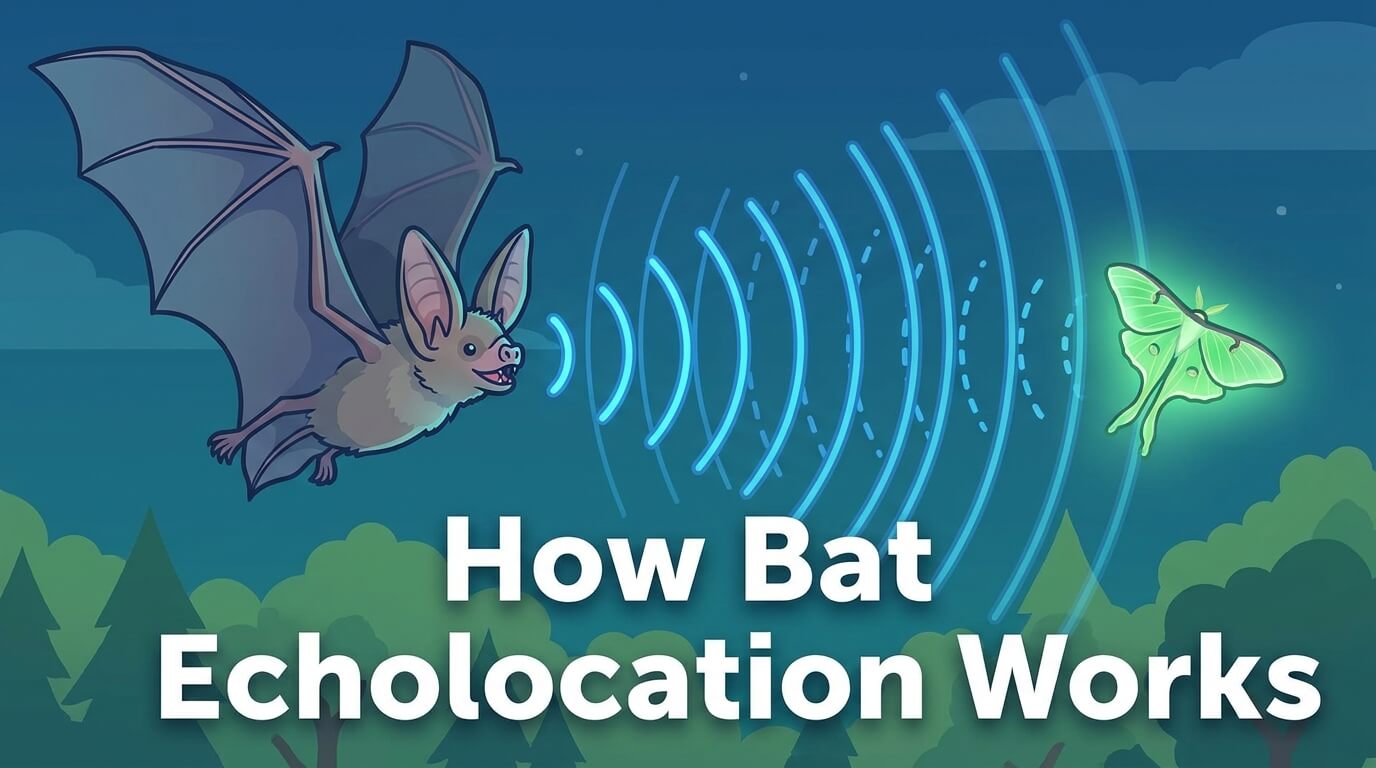
Bat echolocation is an active sensing system. A bat produces a brief sound, listens for the returning echoes, and uses tiny differences in echo timing, direction, frequency, and strength to guide its next movement. The process can help a bat avoid branches, recognize open flight paths, track insects, approach a landing surface, or inspect an object in darkness.
Echolocation is not a single fixed ability shared in exactly the same form by every bat. Calls differ among species and shift with habitat, prey, flight, noise, and target distance.
Quick Answer

Sound goes out, echoes return, and the brain builds a spatial picture
Most echolocating bats make short, high-frequency sounds with the larynx and send them through the mouth or nose. When the sound reaches an insect, wall, leaf, water surface, or other object, part of the sound reflects back. The ears collect those echoes, and the auditory system analyzes them quickly enough for the bat to adjust its wingbeats and call pattern while moving.
The basic loop can happen repeatedly during flight: call, echo, interpretation, movement, then another call. The National Park Service explanation of bat echolocation shows how these calls can be recorded as spectrograms, which display frequency over time and reveal changes during searching and feeding.
Why echolocation is active sensing rather than passive hearing
Passive hearing means listening to sounds that already exist, such as an insect rustling on a leaf. Echolocation is active because the bat creates the signal that will probe its surroundings. By changing that signal, the animal can change what information is most available in the returning echo.
A bat may shorten calls near an object, widen their frequency range for finer detail, or call faster as a target moves. Each new signal is adjusted using information from earlier echoes.
Why Bats Use Echolocation
Navigation, obstacle avoidance, prey detection, and object classification
Echolocation can solve several problems at once. Echo delay helps estimate distance. Differences between what reaches the left and right ears help locate direction. Changes in echo frequency can reveal movement. The pattern of sound energy across frequencies can also help distinguish a broad surface from a small object or separate prey echoes from vegetation.
These abilities guide fast decisions to turn, climb, slow down, continue, or attempt a capture. Echolocation also helps near roost entrances, landing surfaces, water, and obstacles.
Why echolocation complements rather than replaces vision, smell, and touch
Bats do not experience the world through one sense. Many use vision to judge large-scale features, celestial light, landmarks, or distant routes. Smell can help locate fruit, flowers, roost mates, or familiar places. Touch receptors in the wings and face provide additional feedback during flight and landing.
Some hunting bats also listen passively for prey-generated sounds. A frog call, an insect courtship song, or rustling in leaf litter may reveal food more effectively than echoes alone. The relative importance of each sense changes with the species, habitat, task, and weather.
How Bats Produce Echolocation Calls

Laryngeal sound production in most echolocating bats
Most echolocating bats generate calls in the larynx, or voice box. Air moving through the larynx causes tissues to vibrate, producing sound that is shaped by the vocal tract. The process is biologically related to mammalian vocalization, although many echolocation calls are far higher in frequency and much shorter than ordinary human speech sounds.
Call production is coordinated with breathing and flight. In many species, calls are timed with parts of the wingbeat cycle, which may reduce energetic costs. That coordination is flexible rather than mechanical. A hunting bat can change timing when it needs more rapid sensory updates.
Mouth emission, nose emission, and the role of nose leaves
Some bats direct echolocation sounds mainly through the open mouth. Others emit calls through the nostrils. In many nose-emitting species, folds of skin around the nose, often called nose leaves, help shape the outgoing sound beam. The exact form varies from simple ridges to elaborate structures.
A sound beam is directional, meaning it is stronger in some directions than others. By moving the head, changing the mouth opening, or using nasal structures, a bat can aim the beam toward the area it needs to inspect. Ear movements may also help coordinate where the animal sends sound and where it listens.
Tongue-click echolocation in certain fruit bats
The Egyptian fruit bat and other members of the genus Rousettus are important exceptions to the usual laryngeal pattern. They create very short clicks with the tongue and use the returning echoes for orientation. Research on young Egyptian fruit bats has found that this click-based system develops early and includes control of the outgoing beam.
A peer-reviewed study of echolocation development in Egyptian fruit bats describes rapid tongue movements that produce paired clicks. This is why old statements that divide bats into one group that echolocates and another that does not are too simple.
How Bats Receive Returning Echoes

External ears, tragus, head shape, and directional hearing
The outer ears, or pinnae, collect returning sound. Their size and shape differ greatly among bats. Large ears can be useful for detecting faint echoes or quiet prey sounds, while smaller ears may suit fast-flying species that use intense calls in open space. These are general patterns, not rules that identify every hunting style.
Many bats have a small projection inside the ear called the tragus. Together with the pinna, head, and other ear structures, it affects how sounds from different directions reach the ear canal. These directional changes help the auditory system estimate whether an echo came from above, below, left, right, or somewhere between.
Sound reaching the inner ear and auditory pathways
After sound enters the ear canal, vibrations pass through the middle ear to the cochlea in the inner ear. Sensory cells in the cochlea respond to particular frequency ranges. Signals then travel through auditory pathways in the brain, where timing, frequency, intensity, and patterns across both ears can be compared.
The bat does not need to consciously calculate each measurement. Neural circuits transform acoustic changes into useful information for behavior. Research summarized in a PNAS review of bat vocal and brain activity shows how closely call production and auditory processing are linked during active sensing.
Why ear shape and call design differ among ecological specialists
An open-air hunter faces a different acoustic problem from a bat flying among leaves. In open space, long and relatively narrowband calls may travel farther before returning. Near vegetation, short broadband calls can help separate a nearby target from echoes arriving from branches and foliage.
Gleaners may combine low-intensity echolocation with passive listening, while trawling bats use echoes near water. Call design, ears, wings, and hunting behavior work as interacting features.
What Information an Echo Can Reveal

Time delay and target distance
Distance is closely related to the time between an outgoing call and its returning echo. A nearby object produces a short delay. A farther object produces a longer delay. Because the bat knows when it called, its auditory system can compare call timing with echo arrival.
This measurement is often called ranging. It becomes harder when echoes from several objects overlap, when background surfaces produce strong clutter, or when the bat is so close to a target that calls and echoes occur almost together. Bats change call duration and spacing to reduce these problems.
Left-right and up-down cues for direction
An echo from one side reaches the nearer ear slightly earlier or more strongly than the farther ear. Comparing the two ears gives horizontal direction cues. Vertical direction is influenced by how the shape of the outer ear filters different frequencies depending on the angle of arrival.
Head movement adds more information. A bat can sweep its acoustic beam across a scene and compare echoes from successive viewpoints. This is similar to looking at an object from more than one angle, except the changing information arrives through sound.
Frequency changes and prey movement
When an object moves relative to the bat, the frequency of the returning sound can shift. This Doppler effect can reveal motion. Insects with beating wings may also produce rapid fluctuations in echo frequency and strength, sometimes called flutter information.
Certain bats that use long constant-frequency call components have highly specialized hearing for detecting these changes. Some adjust their outgoing call frequency during flight so that important echo information remains in a sensitive hearing range. Other bats rely more heavily on broadband sweeps and brief snapshots of distance.
Echo strength, spectrum, texture, surface, size, and identity
A large, hard surface generally returns a different echo from a small, soft, or irregular target, but echo strength alone does not reveal identity. Distance, angle, call direction, and the material of the object all affect the returned sound. A weak echo could come from a small target, a distant target, a poorly reflecting surface, or an object outside the strongest part of the beam.
The spectrum, or distribution of energy across frequencies, can add information about structure. Repeated echoes from changing angles may aid classification, but leaves and unusual surfaces can hide or distort targets.
How Calls Change During a Hunt
Search-phase calls
During search, a bat needs to cover space efficiently and detect possible prey before it is too late to respond. Search calls are usually spaced farther apart than capture calls. Their duration and frequency structure reflect the habitat. Open-space bats often use calls suited to longer-range detection, while bats near vegetation use shorter calls to reduce overlap with clutter echoes.
Search patterns are not rigid recordings. A bat can alter them when entering a narrow gap, approaching the ground, flying near other bats, or switching from travel to feeding. Biologists use these changes to study bat activity, although identifying a species from a recording can require regional knowledge and careful analysis.
Approach-phase calls
After detecting a target, the bat begins closing the distance. Calls usually become shorter and more frequent. Shorter intervals provide faster updates about the prey’s new position, while shorter call durations help prevent the outgoing signal from masking an echo returning from nearby.
The bat also adjusts flight. It may steer the beam toward the target, change speed, alter wingbeat timing, and prepare the tail membrane or mouth for capture. Echolocation and movement form one coordinated control loop rather than separate steps.
Terminal buzz and rapid updates near capture
Immediately before many aerial captures, the call rate rises sharply in a sequence called the terminal buzz or feeding buzz. The bat is then receiving very frequent updates as prey turns, drops, or accelerates at close range. Calls are brief because echoes return almost immediately.
The classic scientific review Echolocation by Insect-Eating Bats describes how search, approach, and terminal phases change with habitat and foraging mode. Not every feeding event follows one identical sequence, especially when prey is stationary or located by passive listening.
Constant-Frequency and Frequency-Modulated Strategies
Long constant-frequency components and Doppler-related information
A constant-frequency, or CF, component stays near one frequency for part of the call. Long CF signals are especially useful for detecting small frequency and amplitude changes caused by moving insect wings. Horseshoe bats and some other specialists combine these calls with refined auditory adaptations.
CF systems are often described in connection with cluttered habitats because fluttering prey can produce a distinctive pattern against echoes from stationary vegetation. Still, a species may use more than one component, and the behavior cannot be understood from a single label alone.
Sweeping frequency-modulated calls for precise ranging in clutter
A frequency-modulated, or FM, call sweeps across a range of frequencies. Broad bandwidth can sharpen distance and angle estimates because multiple frequency channels provide information about the target. Short FM calls are widely used by bats that must navigate close to vegetation or inspect objects near surfaces.
FM calls also change during a pursuit. The sweep may become shorter, the interval may decrease, and the emphasized frequencies may shift. These adjustments depend on the species and task rather than following one universal formula.
Mixed calls and why categories overlap
Many calls contain both narrowband and broadband portions. A call may begin with an FM sweep and include a near-constant component, or show a shallow frequency change rather than a perfectly flat tone. Scientists therefore use terms such as CF, FM, quasi-constant frequency, broadband, narrowband, high duty cycle, and low duty cycle to describe different features.
These categories are useful for comparing sensory strategies, but they do not divide all bats into two simple boxes. Comparative research on the evolution and adaptation of bat calls shows that similar ecological problems can favor similar call designs in distantly related bats.
Echolocation in Open Space, Forests, Water, and Clutter
Call intensity, duration, bandwidth, and repetition rate as habitat-linked traits
Sound that travels through open air faces different limits from sound used beside leaves. Lower frequencies generally lose less energy over distance than very high frequencies, while shorter wavelengths can improve sensitivity to small targets. Long calls can improve detection, but they also increase the risk that the outgoing signal overlaps a returning echo from a nearby object.
Bats balance these trade-offs by changing call intensity, frequency, duration, direction, and repetition rate. Each habitat produces a different mix of useful echoes and clutter.
Aerial hawking, gleaning, trawling, and listening for prey-generated sounds
Aerial hawkers chase insects in flight. Gleaners remove food from leaves, bark, branches, or the ground. Trawling bats take prey from or just above water. These labels describe feeding methods, not strict taxonomic groups, and some species use more than one method.
Gleaners often face strong clutter because prey echoes overlap echoes from the surface beneath the prey. Some solve part of this problem by listening for rustling, calls, or other sounds produced by the animal itself. Echolocation can then guide approach and obstacle avoidance even when passive hearing first revealed the meal.
Quiet echolocation and prey that can detect bat calls
Some bats use lower-intensity calls when hunting close to prey or surfaces. This may reduce the distance at which certain insects detect the approaching bat, though quiet calling also reduces the distance from which the bat receives useful echoes. The strategy works best when other senses or predictable feeding sites help locate prey.
Many moths and some other insects can hear ultrasound. They may turn away, dive, stop flying, or use acoustic defenses after detecting a bat. Some tiger moths produce clicks that can signal unprofitability, startle the attacker, or interfere with tracking. The result is an evolutionary contest between sensing prey and avoiding predators.
Do All Bats Echolocate the Same Way?

Variation among families, species, populations, tasks, and environments
Bat calls vary in dominant frequency, bandwidth, duration, loudness, directionality, rhythm, and harmonic structure. Even members of one species can sound different when flying in a room, forest, field, tunnel, or unfamiliar landscape. Age, sex, body size, behavior, and regional populations may also affect recordings.
This flexibility is one reason automatic bat identification is challenging. A detector does not record a permanent acoustic fingerprint in every situation. It records a behavior shaped by both the animal and the environment.
Flying foxes and other fruit bats as a caution against absolute statements
Many large flying foxes depend strongly on vision and smell and are not known to use the same laryngeal echolocation systems found in most smaller echolocating bats. Yet fruit bats are a diverse family, and Rousettus species use tongue clicks. Some other pteropodids have also produced sounds that researchers continue to investigate.
The safest statement is not that every fruit bat echolocates or that none do. It is that sensory systems differ among lineages, and the sound-production mechanism matters. Older terms such as megabat and microbat can hide these evolutionary and behavioral differences.
Flexible call adjustment during development and experience
Young bats must coordinate flight, vocal production, hearing, and target approach. Some components of echolocation appear early, while experience improves control and task performance. Adults also adjust calls with changing surroundings rather than relying on one fixed pattern learned once.
Flexibility does not mean unlimited ability. The bat still works within the physical range of its vocal system, ears, body size, and species-specific hearing. Learning refines a biological system rather than replacing it.
Echolocation Versus Bat Communication
Orientation calls can carry social information
An echolocation call is produced mainly to gather environmental information, but another bat may overhear it. Call patterns can reveal that a neighbor is nearby, searching, approaching prey, or feeding. Individual and species differences may also be audible to other bats.
Research reported by the Smithsonian Tropical Research Institute found that echolocation calls can contain socially useful information. That does not make every orientation call a deliberate message. Information can be available to a listener even when communication was not the caller’s main purpose.
Courtship, contact, territorial, distress, and mother-pup calls
Bats also produce dedicated social vocalizations. Depending on the species, these may help maintain contact, defend a roost, advertise during courtship, coordinate mothers and pups, or signal distress. Social calls are often longer or more complex than brief orientation calls, although both can include ultrasonic frequencies.
Separating the two systems matters. Echolocation asks, in effect, what is around me and where is it? Social communication concerns the behavior or identity of another animal. In real bat life, the systems can overlap because a call made for one purpose may still provide information for another.
Limits, Interference, and Counter-Adaptations
Background noise, call overlap, and group foraging
Rain, flowing water, insects, machinery, traffic, and other bats can add sound that competes with important echoes or prey noises. Leaves and walls create clutter even when the environment is quiet. A bat may respond by changing call timing, duration, frequency, intensity, flight path, or sensory strategy. “Echolocation is one part of the wider sensory and behavioral diversity found across bat biology.”
Researchers sometimes use the term jamming avoidance for adjustments that reduce interference. Evidence differs among species and experimental settings. Bats do not all shift frequency in one predictable way, and some apparent shifts can result from changes in recording angle or ordinary call flexibility. Directional beams, short calls, spatial separation, and individual differences may also help.
Moth hearing, evasive behavior, and acoustic defenses
Prey is not acoustically passive. An insect that hears an approaching bat may change speed or direction before the bat receives a strong echo. This can force the predator to update its path rapidly. At close range, some prey make sudden dives or unpredictable turns.
Acoustic defenses do not guarantee escape. Their effectiveness depends on distance, call intensity, the insect’s hearing range, habitat, and the bat’s hunting method. A moth resting on a surface faces a different problem from one flying in open air, and a bat using quiet calls may be detected later than one calling loudly.
Common Myths and Mistakes
Myth: Bats are blind
Bats can see. Vision varies among species and often works together with echolocation. Large fruit bats may rely heavily on vision, while many insect-hunting bats use both visual and acoustic information. Echolocation is an additional sensory tool, not evidence that the eyes do not function.
Myth: Echolocation maps everything perfectly
Echoes are affected by distance, angle, object size, surface material, air conditions, noise, and clutter. A smooth surface viewed at the wrong angle may reflect much of the sound away from the bat. A small target near vegetation may be hidden among stronger background echoes.
Bats are highly capable, but they make decisions with limited and changing information. Their success comes partly from rapid updating, flexible movement, memory, and combining senses, not from receiving a flawless three-dimensional scan.
Myth: Every fruit bat lacks echolocation
The genus Rousettus provides a clear counterexample because its members use tongue clicks. At the same time, it would be equally wrong to claim that every fruit bat uses click-based or laryngeal biosonar. Family names and older suborder labels do not replace species-level evidence.
How Echolocation Works With Flight, Night Senses, and Feeding
Flight control and obstacle avoidance
Echolocation helps guide flight, but it does not create lift or thrust. Wing muscles and aerodynamic forces keep the bat airborne. Echoes influence steering decisions by revealing walls, branches, prey, landing points, and open space ahead.
The timing of calls and wingbeats can be coordinated, and the bat may aim its head toward the next flight path. During a tight turn, sensory information and body control must be updated together.
Nocturnal sensory integration
Night activity is not simply a matter of replacing sight with sound. Bats combine vision, hearing, smell, touch, spatial memory, and balance. The combination changes with moonlight, habitat structure, weather, prey behavior, and the distance of important objects. “At night, echolocation works alongside vision, smell, touch, and memory rather than replacing them, a pattern central to nocturnal bat adaptations.”
At long distances, vision or remembered landmarks may be more useful than echoes from small objects. At short range in darkness, echolocation can provide detailed and rapidly updated information. Smell may dominate when locating ripe fruit or a familiar roost.
Diet and prey-capture strategies
A bat’s food shapes the sensory problem it must solve. Flying insects require rapid tracking. Nectar feeders must approach flowers without colliding. Fish-eating bats inspect water surfaces. Frog-eating bats may listen for calls. Fruit-eating bats can combine smell and vision with close-range acoustic orientation.
This variety is why there is no single best echolocation call. A signal that travels well in open air may perform poorly among leaves. A quiet gleaning call may help near a surface but fail to detect a distant insect. Each strategy involves trade-offs. “The way a bat uses echoes often reflects what it hunts or gathers, so bat diets and prey-capture strategies are closely connected with call design.”
FAQ
Can humans hear bat echolocation?
Most bat echolocation calls are ultrasonic, meaning their frequencies are above the usual upper limit of human hearing. Some species produce parts of calls at lower frequencies that certain people can faintly hear, especially in quiet conditions. Bat detectors convert ultrasound into audible sound or display it as a spectrogram.
What a detector plays is usually a transformed version rather than the sound exactly as the bat experiences it. Devices may slow the recording, divide the frequency, or translate selected frequencies into a range humans can hear.
How far can bat echolocation detect an object?
There is no one detection distance for bats. Range depends on the call’s intensity and frequency, the size and material of the object, atmospheric conditions, background noise, beam direction, and the bat’s hearing. A large wall can return a usable echo from farther away than a tiny insect.
Published distances depend on species, equipment, target, and the definition of detection, so one universal number is misleading.
Can bats echolocate in complete darkness?
Many echolocating bats can navigate and forage without visible light because the system depends on sound rather than illumination. Complete darkness does not remove acoustic obstacles, however. Clutter, noise, smooth reflective surfaces, and unfamiliar spaces can still make a task difficult.
Bats may also use memory, smell, touch, and other cues in darkness. Their ability is powerful but context-dependent.
Can bat calls interfere with one another?
Yes, overlapping calls and echoes can create interference, especially where many bats forage together. Bats can reduce the problem through timing, directionality, spacing, flight adjustments, call changes, and the ability to recognize useful echo patterns. The mix of strategies varies among species and situations.
Scientists continue to study how much interference occurs in the wild. Laboratory results do not always predict behavior in large outdoor spaces, where bats can separate themselves in three dimensions and aim narrow sound beams.
Final Thoughts
Understanding how bat echolocation works starts with a simple loop: a bat sends sound into the environment, receives echoes, and uses acoustic differences to guide behavior. The deeper story is one of flexibility. Calls change during search, approach, capture, landing, and travel. Ear shape, call design, habitat, prey, and other senses all influence what the bat can detect.
Echolocation is neither proof that bats are blind nor a perfect map of everything around them. It is an active, adjustable sensory system with many forms across the bat family tree. That diversity allows bats to hunt above water, weave through forests, inspect flowers, listen for hidden prey, and move through darkness without every species solving the problem in the same way.

Ethan Walker is the founder and research editor of Animal Fact Central. He creates and reviews educational animal facts content using trusted wildlife, pet care, and science-based sources. His work focuses on making animal behavior, adaptations, habitats, and species facts clear, accurate, and engaging for everyday readers.
Read More Details About Ethan Walker: https://animalfactcentral.com/ethan-walker/