
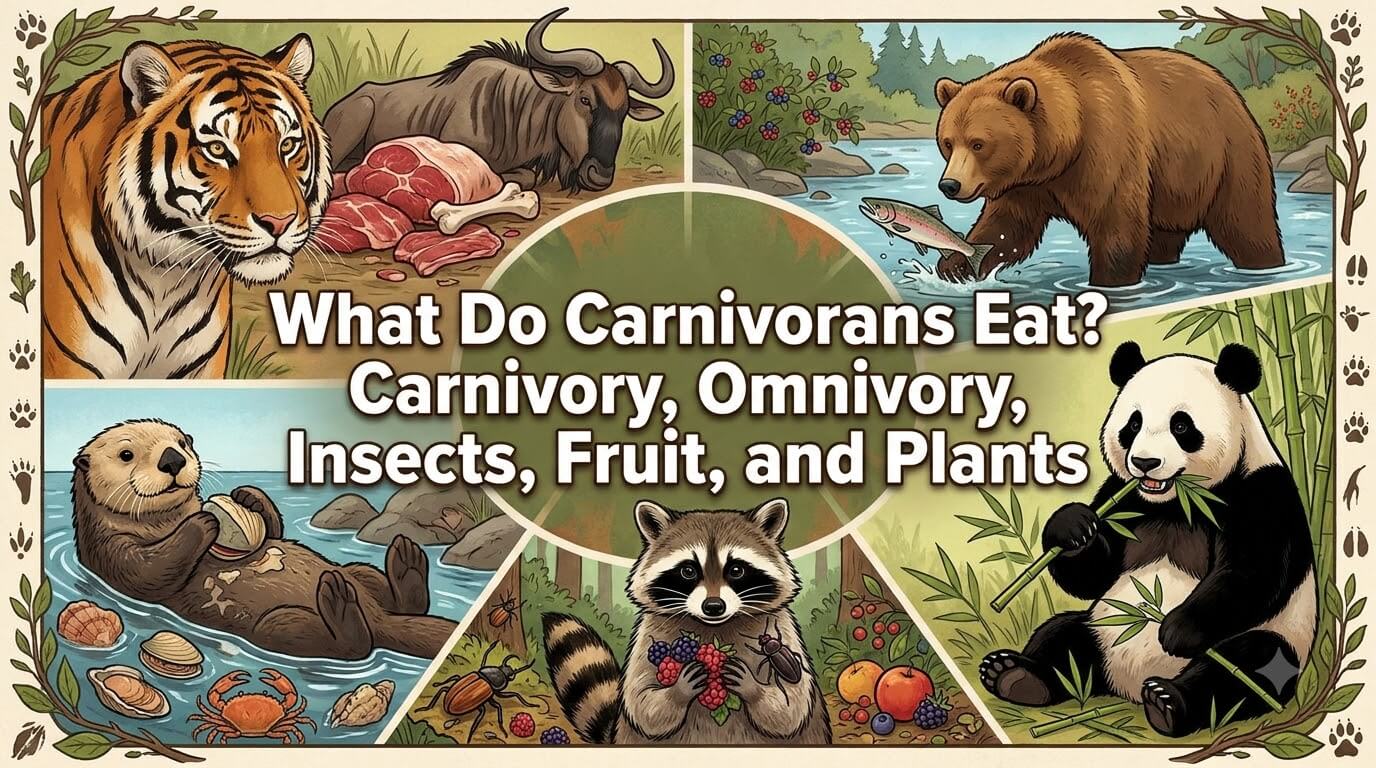
Carnivorans do not all eat the same kind of food. The mammalian order Carnivora includes strongly meat-specialized cats, flexible canids, bears that range from seal-eating polar bears to bamboo-specialized giant pandas, fruit-eating or omnivorous procyonids and viverrids, insect-eating mongooses, fish-catching otters, and marine pinnipeds that feed on many kinds of ocean prey.
That diversity is the main reason the words carnivoran and carnivore should not be treated as synonyms. A carnivoran is a member of the taxonomic order Carnivora. A carnivore is an animal whose feeding ecology is dominated by animal tissue. Many carnivorans are carnivores, but belonging to Carnivora does not lock every species into a meat-only menu.
Quick Answer
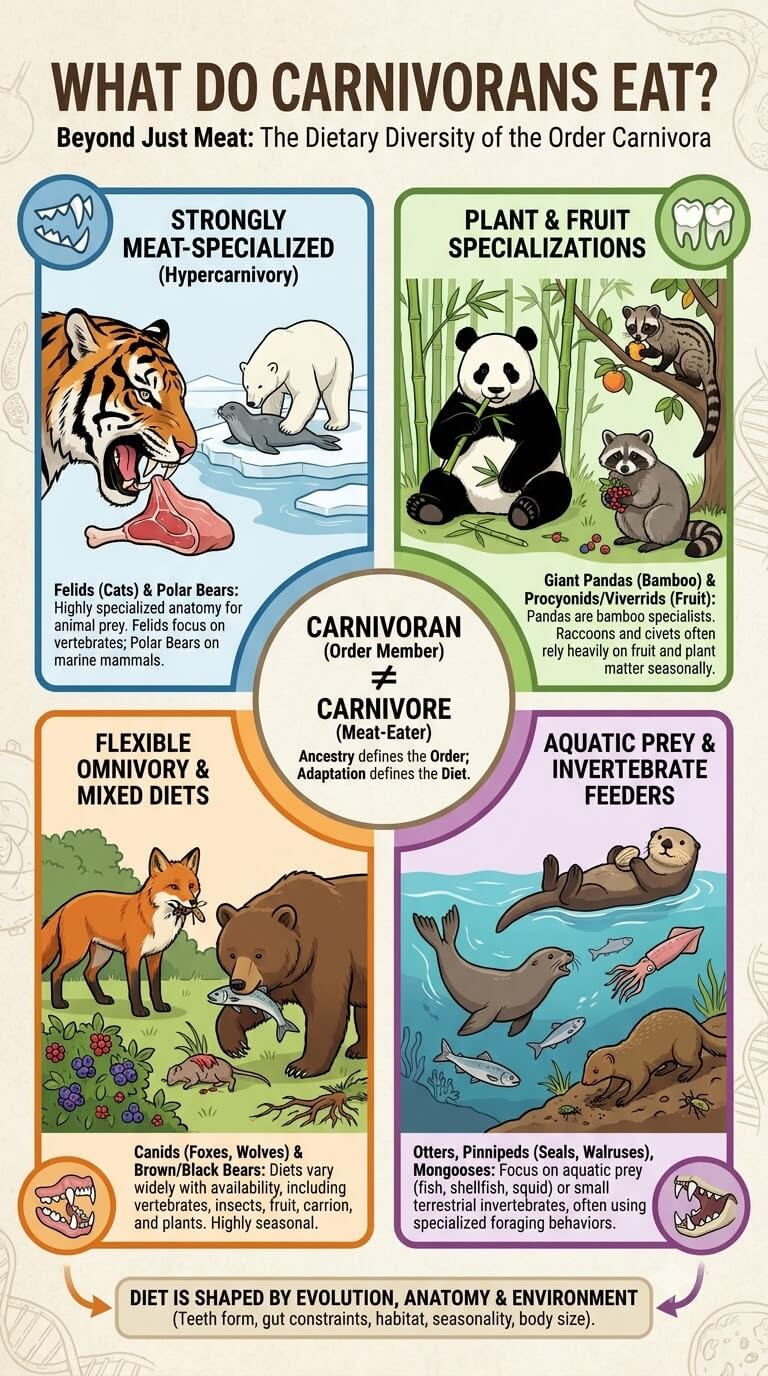
What do carnivorans eat? Depending on the species, they may eat mammals, birds, reptiles, amphibians, fish, squid, crustaceans, mollusks, insects, carrion, eggs, fruit, berries, roots, grasses, seeds, or other plant material. Some lineages are highly specialized, while others change foods as seasons and local conditions change.
The useful way to understand a carnivoran diet is not to ask what members of Carnivora are “supposed” to eat. Instead, look at ancestry, teeth and jaws, digestive constraints, habitat, available foods, body size, sensory abilities, and the cost of obtaining each food. Those factors can produce very different diets even among fairly close relatives.
Food quality matters as much as food category. Animal tissue, fruit, bamboo, insects, shellfish, and seeds differ in protein, fat, fiber, water, mineral content, digestibility, and handling cost. A food can be abundant but still be a poor choice if an animal cannot digest it efficiently or must spend too much time obtaining it. Carnivoran diets therefore reflect a balance between what is available and what a particular body can profitably process.
Why Diet Varies So Much Inside One Mammal Order
Taxonomy Does Not Dictate a Single Menu
Taxonomy groups organisms by evolutionary relationships, not by a single behavior or food choice. Carnivora is a branch of mammals whose living members share common ancestry and a suite of inherited anatomical features. Over time, different lineages adapted those inherited features to different ecological opportunities.
That is why a tiger, raccoon, giant panda, sea otter, and walrus can all belong to Carnivora while relying on very different foods. Their shared ancestry matters, but natural selection has modified teeth, skulls, limbs, senses, digestive function, behavior, and habitat use in different directions.
Diet Categories Describe Feeding Ecology, Not Order Membership
Terms such as carnivore, omnivore, insectivore, and frugivore describe what an animal eats or how strongly it depends on particular food types. They are ecological descriptions rather than formal membership cards for Carnivora. A shark can be a carnivore without being a mammal at all, while a giant panda remains a carnivoran even though bamboo dominates its diet.
The boundaries between dietary labels can also be fuzzy. A species that mainly eats vertebrate prey may still take insects or fruit. An animal usually described as omnivorous may consume far more plant food in one region than another. Diet is often a spectrum shaped by availability rather than a fixed three-category box.
Meat-Dominated Diets in Many Felids
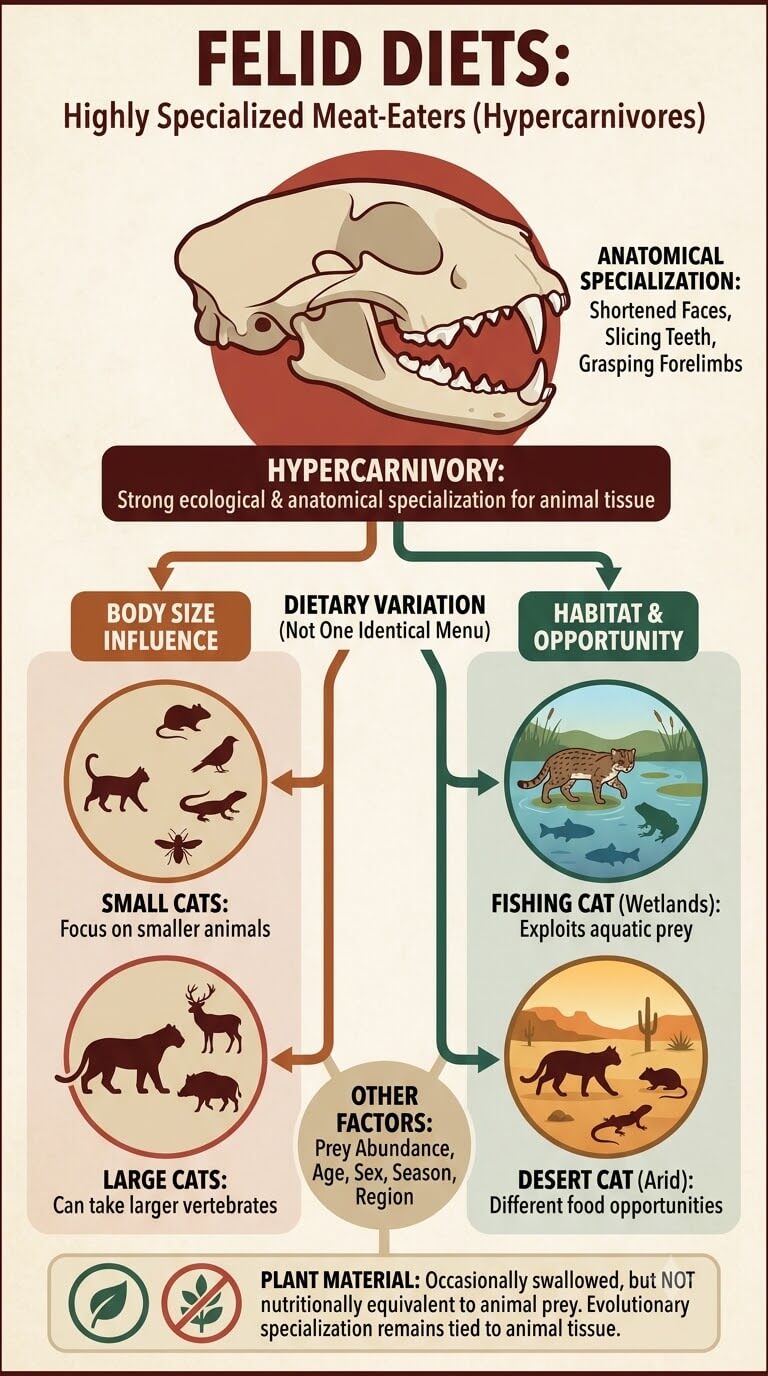
Living cats are among the most meat-specialized carnivorans. The Animal Diversity Web overview of Felidae describes felids as highly specialized for animal prey, with diets that consist largely of other animals. Their shortened faces, slicing cheek teeth, grasping forelimbs, and hunting behavior fit that overall pattern.
Hypercarnivory and Prey Specialization Without Assuming Every Cat Eats the Same Prey
Hypercarnivory refers to a strong ecological and anatomical specialization for eating animal tissue. Many felids fit that pattern, but it does not mean every cat species hunts the same prey or uses the same habitat. Body size alone creates major differences. Small cats often focus on rodents, birds, reptiles, insects, or other relatively small animals, while larger cats can take larger vertebrate prey.
Habitat changes the menu further. A fishing cat can exploit aquatic prey in wetlands, while a desert cat faces a very different set of food opportunities. Even within one species, prey selection can vary with prey abundance, age, sex, season, and region. Calling felids meat-specialists is useful. Treating “cat diet” as one identical menu is not.
Plant material may occasionally be swallowed by some cats, but that does not make plant foods nutritionally equivalent to animal prey for felids. Their evolutionary specialization remains strongly tied to animal tissue. This article stays at the wildlife and comparative-biology level rather than turning that fact into feeding advice for domestic cats.
Canid Diets From Predation to Flexible Omnivory
Canids show a broader feeding range than the stereotypical image of wolves chasing large prey suggests. The Animal Diversity Web account of Canidae notes that canids can consume invertebrates, plant material, and carrion as well as prey they kill. The balance differs greatly among wolves, foxes, jackals, coyotes, and other species.
Prey, Carrion, Fruit, Invertebrates, and Seasonal Foods
Large canids may depend heavily on vertebrate prey in some ecosystems, while smaller or more generalist species may combine rodents, insects, fruit, carrion, and other foods. Foxes are especially useful examples because some species make substantial use of insects and fruit when those foods are abundant.
Flexibility can reduce dependence on one prey species. It may also allow a canid to remain in habitats where food availability changes through the year. That does not mean every canid is an indiscriminate omnivore. Some populations and species are far more prey-dependent than others, and a diet that works in one ecosystem may not describe the same species elsewhere.
Scavenging is also part of the picture. Eating carrion can save the energetic cost and risk of killing live prey, although finding and competing for carcasses presents its own challenges. Scavenging should not be treated as a lesser form of feeding. It is one of several ways carnivorans obtain usable energy from their environments.
Bears as a Case Study in Dietary Diversity
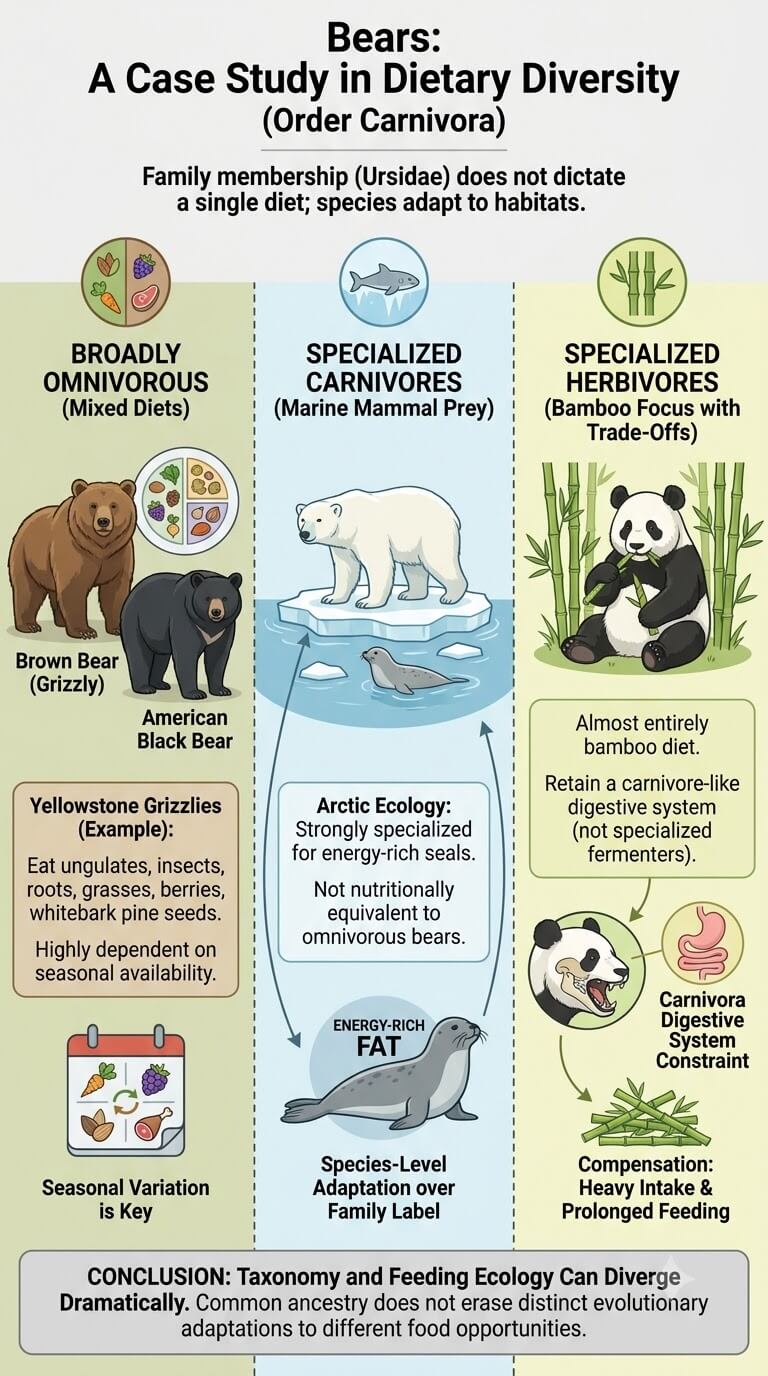
Bears make the carnivoran-versus-carnivore distinction especially easy to see. Ursidae contains species with sharply different feeding ecologies. Brown bears and American black bears can use a wide mixture of plant and animal foods, while polar bears are strongly specialized toward marine mammal prey. Giant pandas represent an even more dramatic shift toward plant feeding.
Polar-Bear Meat Specialization, Mixed Ursus Diets, and Species-Level Variation
A single label such as “bears are omnivores” hides too much variation. In the Greater Yellowstone Ecosystem, for example, grizzly bears can eat ungulates, insects, roots, grasses, berries, whitebark pine seeds, and other seasonally available foods. The National Park Service summary of Yellowstone bear food habits emphasizes how strongly availability changes across seasons and years.
Polar bears sit at a very different point on the bear diet spectrum. Their Arctic ecology is closely tied to energy-rich marine mammal prey, especially seals. Other foods may be eaten when available, but they do not make polar bears nutritionally equivalent to the more broadly omnivorous feeding patterns seen in many brown and black bear populations.
This contrast matters because family membership does not erase species-level adaptation. Bears share ancestry and many aspects of anatomy, yet their feeding strategies can diverge dramatically when habitats and food opportunities differ.
Giant Panda Bamboo Specialization and Its Evolutionary Trade-Offs
Giant pandas are bears and therefore carnivorans, but wild giant pandas feed almost entirely on bamboo. The Smithsonian National Zoo’s giant panda profile explains that pandas have powerful jaws and large molars for processing tough bamboo while retaining a digestive system more similar to that of a carnivore than to the highly specialized fermenting systems of many plant-eating mammals.
That combination creates a useful evolutionary lesson. Specializing on a plant does not automatically rebuild every inherited feature of an animal’s digestive anatomy. Giant pandas compensate partly through behavior, food selection, prolonged feeding, and heavy intake of bamboo. They also select different bamboo parts as availability and plant quality change.
It would be misleading to describe giant pandas as simply “herbivores that happen to be bears” without discussing those constraints. It would be equally misleading to insist that they must eat a meat-dominated diet because their ancestors belong to Carnivora. Their biology shows that taxonomy and feeding ecology can move in different directions.
Fruit, Invertebrates, and Mixed Diets in Procyonids and Viverrids
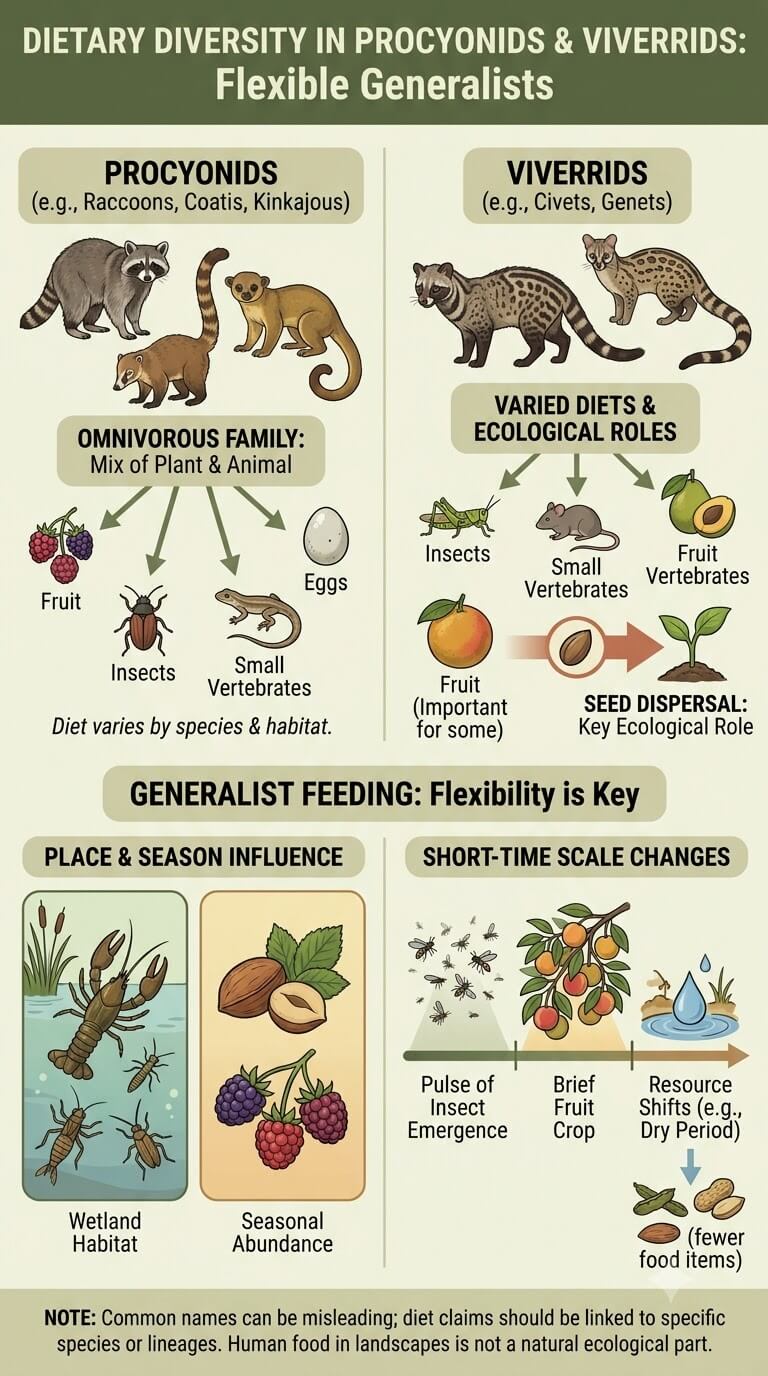
Raccoons, coatis, kinkajous, and their procyonid relatives illustrate another route away from heavy meat specialization. The Animal Diversity Web overview of Procyonidae characterizes the family as omnivorous, with both plant and animal material in the diet. Depending on the species and habitat, foods can include fruit, insects, eggs, small vertebrates, and other items.
Why Generalist Feeding Can Change With Place and Season
Generalist feeding is not the same as eating everything in equal amounts. A raccoon living near a productive wetland may encounter crayfish, aquatic insects, eggs, and other animal foods. Another population may rely more heavily on seasonal fruits or nuts. In human-dominated landscapes, some individuals also encounter garbage or intentionally provided food, but that does not mean human food is a natural or appropriate part of their ecology.
Viverrids add more variety. Many civets and genets take insects and small vertebrates, while fruit can be important for some species. The mix can influence ecological roles beyond predation because fruit-eating carnivorans may also move seeds through the landscape. The importance of that role depends on the particular species, fruit, and ecosystem.
This kind of mixed feeding can change on short time scales. A fruit crop may become briefly abundant, an insect emergence may create a temporary pulse of animal food, or a dry period may reduce one resource while concentrating another. Flexible feeders can respond without changing their taxonomic identity. What changes is the proportion of foods they use and the places where they search for them.
Common names can be misleading here. Not every animal called a civet belongs to the same family, so diet claims should be attached to a clearly identified species or lineage rather than to a loose common-name category.
Mongooses and Other Small Carnivorans
Insects, Small Vertebrates, Eggs, Fruit, and Opportunistic Foods
Mongooses are often portrayed almost entirely as snake hunters, but snake predation is only part of a much broader feeding picture. Across Herpestidae, species may eat insects, other invertebrates, small mammals, birds, eggs, reptiles, amphibians, crabs, fruit, roots, or other foods. The exact mix reflects body size, habitat, local abundance, and species-specific behavior.
Insect-rich diets can be especially important for small carnivorans because insects may be abundant, widely distributed, and easier to obtain than larger vertebrate prey. Digging, probing, turning over debris, searching vegetation, and rapid ground foraging can all expose small food items that a large predator would barely notice.
Some small carnivorans are opportunistic enough to switch between animal and plant foods. Others are more specialized. The useful pattern is diversity, not a rule that “small Carnivora eat insects.” Size changes the economics of feeding, but lineage and habitat still matter.
Mustelids, Otters, and Aquatic Foraging Diets
Fish, Invertebrates, Shellfish, and Other Prey
Mustelidae includes terrestrial hunters such as weasels and badgers as well as semi-aquatic and marine otters. Many mustelids are strongly carnivorous, but their prey can differ enormously. Small terrestrial mustelids may focus on rodents or other small vertebrates, while otters exploit aquatic food webs.
Freshwater otters commonly take fish and can also eat crustaceans, amphibians, and other aquatic prey. Sea otters are particularly notable for consuming benthic invertebrates such as sea urchins, crabs, clams, mussels, and other hard-shelled prey, with local diets varying according to prey availability and individual specialization.
These foods create different processing problems from tearing flesh from a terrestrial carcass. Aquatic carnivorans may need to locate prey in turbid water, handle slippery or armored prey, dive repeatedly, and process shells. Those demands help explain why diet, sensory biology, behavior, and anatomy cannot be separated cleanly when studying feeding ecology.
Individual specialization can add another layer. In some otter populations, neighboring animals do not necessarily focus on identical prey even when they share the same coastline. Differences in experience, prey access, handling skill, age, or local microhabitat can make one individual more successful with certain foods than another. That is a reminder that a species-level diet summary describes a range of behavior, not a menu followed equally by every individual.
Pinniped Diet Diversity
Fish, Squid, Crustaceans, and Species-Specific Specialization
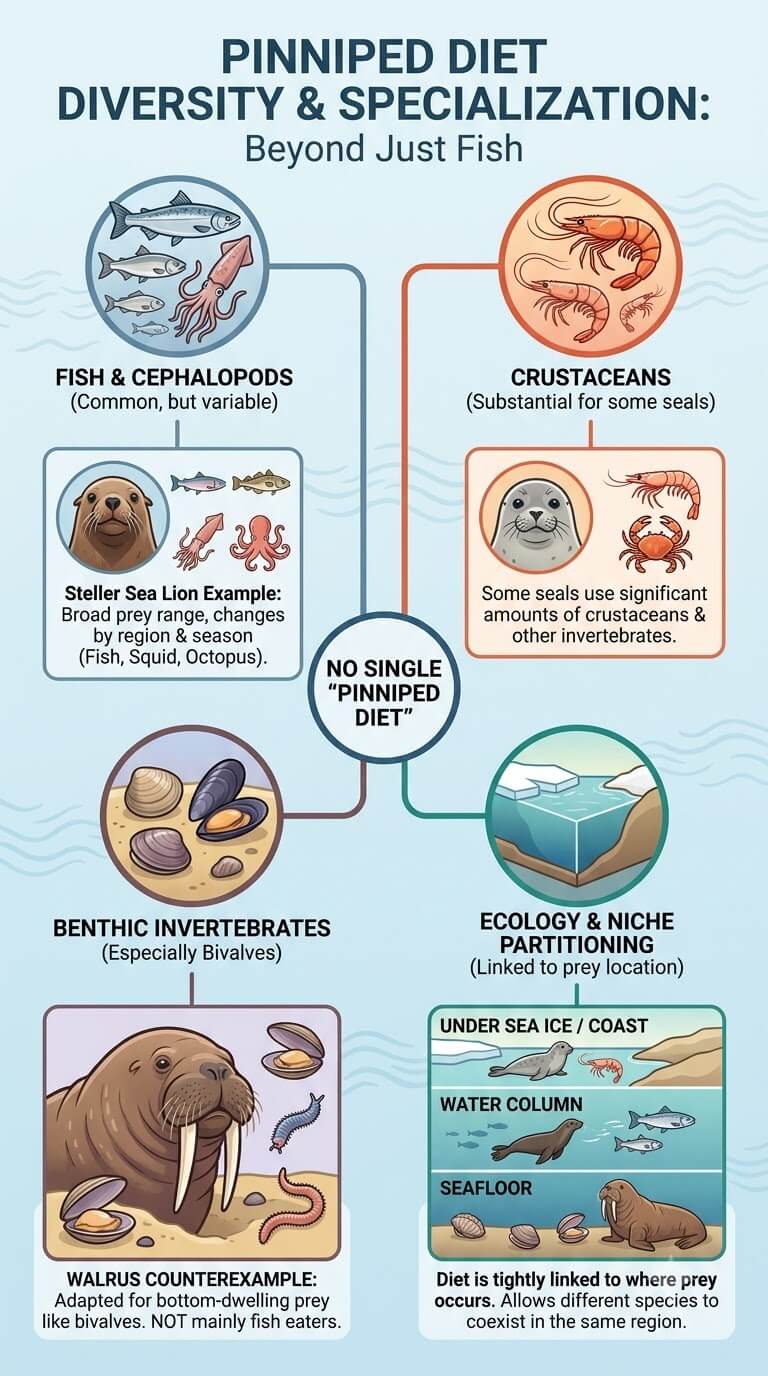
Seals, sea lions, fur seals, and walruses are caniform carnivorans, but there is no single “pinniped diet.” Many species eat fish and cephalopods, while others include crustaceans, mollusks, or other marine animals. A recent NOAA Fisheries profile of the Steller sea lion, for example, describes a broad prey range that includes many fish species as well as squid and octopus, with diet changing by region and season.
Walruses provide an especially clear counterexample to the idea that all pinnipeds are mainly fish eaters. They are adapted to feeding on bottom-dwelling invertebrates, especially bivalves and other benthic prey. Some seals also use substantial amounts of crustaceans or other invertebrates, while particular seal and sea lion species may be more fish-focused.
Marine feeding ecology is tightly linked to where prey occurs in the water column, on the seafloor, under sea ice, or near coasts. That is why two pinnipeds living in the same broad ocean region can still exploit different prey communities.
Anatomy and Digestive Trade-Offs
Teeth, Jaw Function, Gut Constraints, and Food Processing
Carnivoran teeth carry the imprint of ancestry, but their form also reflects dietary evolution. The ancestral carnivoran pattern includes carnassial teeth, a shearing pair formed by the upper fourth premolar and lower first molar. In lineages that remain strongly meat-specialized, those blades can be prominent. In more omnivorous forms, broader crushing surfaces may become more important.
Teeth do not act alone. Jaw shape, chewing motion, tongue use, forepaw manipulation, body size, and digestive physiology all influence which foods can be processed efficiently. Giant pandas, for example, combine robust jaws and enlarged grinding surfaces with a digestive system that is not equivalent to the fermentation-based systems of many specialized herbivores.
Likewise, a marine carnivoran that swallows fish with limited chewing faces a different mechanical problem from a bear grinding plant material or an otter opening hard-shelled prey. Carnassials are part of the story, not a universal meat-only stamp.
Seasonality, Availability, and Dietary Flexibility
Why the Same Species May Shift Foods Across Seasons or Regions
Food availability changes. Fruits ripen and disappear. Insects emerge seasonally. Fish runs peak. Young ungulates become available during calving seasons. Sea ice expands and contracts. Drought changes plant growth and prey abundance. A carnivoran able to switch foods may respond to these cycles very differently from a narrow specialist.
Seasonal change is especially obvious in generalists such as many bears. Spring foods may differ from late-summer or fall foods because plants, insects, carcasses, fish, and fruit do not become abundant at the same time. Similar shifts occur in foxes, raccoons, some civets, seals, sea lions, and other carnivorans.
Flexibility has trade-offs. A generalist may survive on a wider menu but be less efficient at exploiting one difficult food than a specialist. A specialist can be exceptionally effective when its preferred resource is abundant, yet more vulnerable when that resource declines. Neither strategy is automatically “better.” Each works under particular ecological conditions.
Young animals can also differ from adults because body size, hunting ability, tooth wear, and experience change which foods are accessible. Reproductive condition can alter energetic demands, while competition may push individuals toward less preferred foods. For that reason, a diet described from one age class or one season should not automatically be treated as the complete diet of a species.
Common Myths and Mistakes
Carnivora Does Not Mean Every Species Needs a Meat-Dominated Diet
The name Carnivora reflects the evolutionary history and traditional naming of the order, not a rule that every living member must eat mostly meat. Giant pandas are the clearest familiar example, but they are not the only carnivorans that rely heavily on plant foods. Fruit, seeds, leaves, roots, and other plant material occur in the diets of multiple lineages.
The reverse mistake is just as important: an animal does not become a carnivoran merely because it eats meat. Owls, crocodiles, sharks, snakes, frogs, and many predatory insects can be carnivores, but none belongs to the mammalian order Carnivora.
Not All Bears or Cats Eat the Same Things
Family-level labels are useful starting points, not finished diet descriptions. Polar bears, brown bears, black bears, and giant pandas illustrate major differences inside Ursidae. Felids are more consistently meat-specialized, yet prey still varies with body size, habitat, range, and opportunity.
Whenever a diet claim sounds universal, it is worth asking whether it applies to an entire family, one species, one population, or one study site. That distinction prevents broad statements such as “all bears are omnivores in the same way” or “all cats hunt the same prey.”
How Diet Shapes Teeth, Foraging, Habitat Use, and Ecology
Carnassial Teeth and Food Processing
Diet helps explain why carnassial teeth differ so much across Carnivora. Strong slicing surfaces are useful for processing animal tissue, while broader crushing or grinding surfaces can improve the handling of mixed or plant-heavy foods. The same inherited tooth positions can therefore be modified in different ways as lineages specialize.
Food properties also influence how an animal uses its jaws and the rest of its body. A cat cutting flesh, a bear crushing mixed foods, a giant panda processing fibrous bamboo, and an otter handling shellfish place different demands on the feeding apparatus.
Hunting, Foraging, Habitats, and Ecosystem Roles
What an animal eats is inseparable from how and where it gets food. Meat-specialized predators may stalk, ambush, chase, or search for prey. Omnivores may switch between digging, grazing, fruit feeding, scavenging, and predation. Aquatic carnivorans may dive, probe the bottom, pursue fish, or search along shorelines.
Those choices also shape ecological effects. Predation can influence prey populations and behavior. Scavenging recycles carrion. Fruit eating can move seeds. Digging can disturb soil. Marine feeding can transfer nutrients through coastal and ocean food webs. The role depends on what the species eats, how much it eats, and where feeding occurs.
FAQ
Which carnivorans regularly eat fruit?
Fruit is a regular part of the diet for a number of carnivorans, especially among some procyonids, viverrids, bears, and canids. Kinkajous are strongly fruit-oriented procyonids, while raccoons, coatis, some civets, foxes, and bears may also eat fruit when it is available. The importance of fruit varies by species, location, and season, so it is better to describe individual feeding patterns than to label an entire family as fruit-eating.
Do carnivoran diets change with the seasons?
Many do. Seasonal foods such as berries, insects, fish runs, young prey, nuts, bamboo shoots, and marine prey can change in availability through the year. Generalists often shift toward whatever foods provide a good energetic return at that time. Specialists may show narrower changes, but even they can alter prey choice, feeding location, or foraging effort as conditions change.
Do all pinnipeds mainly eat fish?
No. Fish are important for many seals and sea lions, but pinniped diets also include squid, octopus, crustaceans, mollusks, and other marine animals. Walruses are strongly associated with bottom-dwelling invertebrate prey rather than a fish-dominated diet. Even within fish-eating species, prey can vary with age, region, season, and local abundance.
Final Thoughts
The answer to “what do carnivorans eat?” is much broader than “meat.” Carnivora contains some of the most specialized vertebrate predators on Earth, but it also contains flexible omnivores, insect and fruit eaters, bamboo specialists, shellfish feeders, fish hunters, scavengers, and species whose diets shift with season and place.
The most useful takeaway is that ancestry sets a starting point, not a fixed menu. Teeth, jaws, digestive physiology, habitat, prey availability, plant resources, body size, and behavior have pushed different carnivoran lineages toward very different feeding strategies. That diversity is exactly what makes Carnivora such a powerful example of how evolution can reshape feeding ecology within a single mammalian order.

Ethan Walker is the founder and research editor of Animal Fact Central. He creates and reviews educational animal facts content using trusted wildlife, pet care, and science-based sources. His work focuses on making animal behavior, adaptations, habitats, and species facts clear, accurate, and engaging for everyday readers.
Read More Details About Ethan Walker: https://animalfactcentral.com/ethan-walker/