
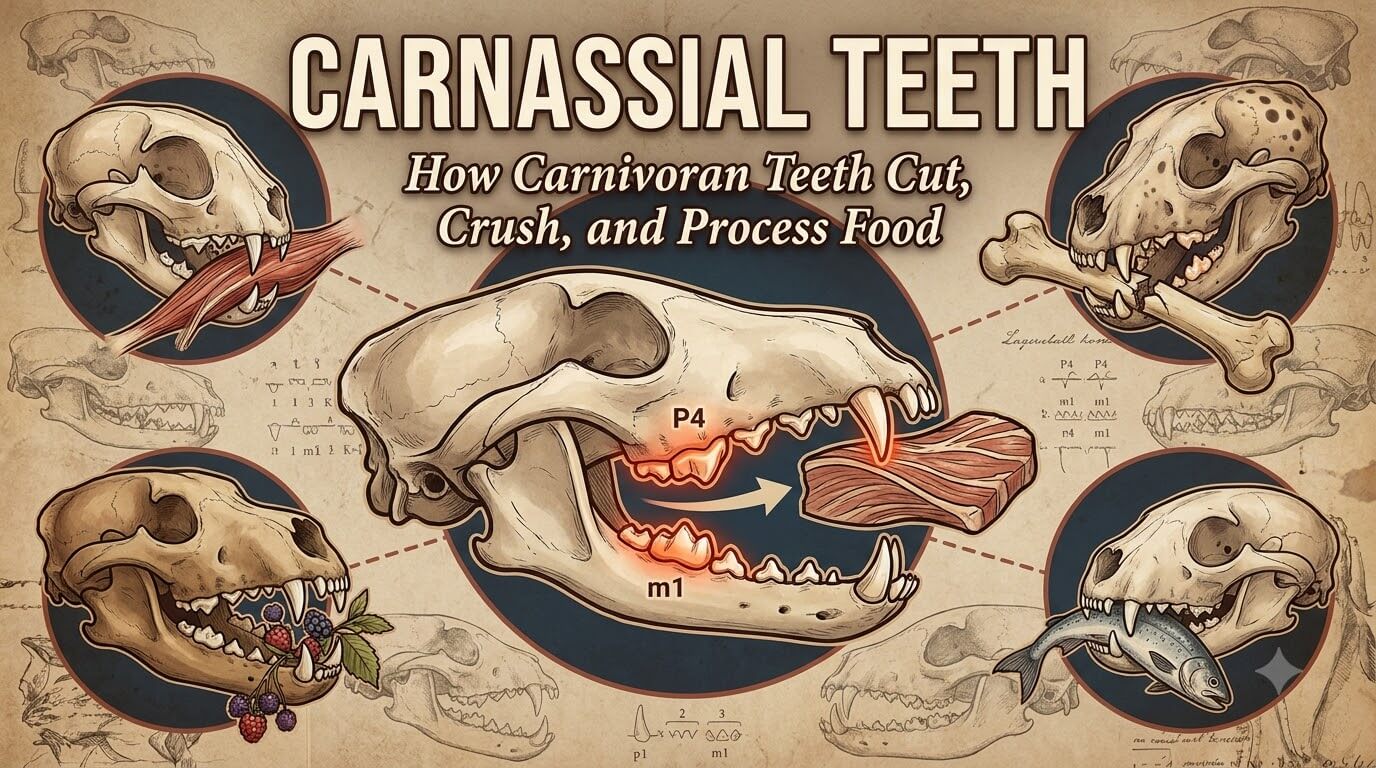
Carnassial teeth are the specialized cheek teeth that form the main shearing pair in the ancestral dental pattern of carnivoran mammals. In a typical carnivoran, the upper fourth premolar and lower first molar meet like opposing blades, helping slice tough food as the jaws close. They are not the long canine teeth at the front of the mouth, and they do not prove that an animal eats only meat.
That distinction matters because the order Carnivora includes much more than meat specialists. Cats retain strongly blade-like carnassials, bone-cracking hyenas combine shearing teeth with powerful crushing premolars, many bears have broader surfaces for grinding and crushing, giant pandas have extensively modified cheek teeth for bamboo, and pinnipeds have moved even farther from the classic terrestrial pattern. The same inherited tooth positions can therefore be reshaped as feeding ecology changes.
Carnassials are best understood as part of a functional system that includes tooth shape, precise contact between upper and lower teeth, jaw movement, skull mechanics, and the physical properties of food.
Quick Answer
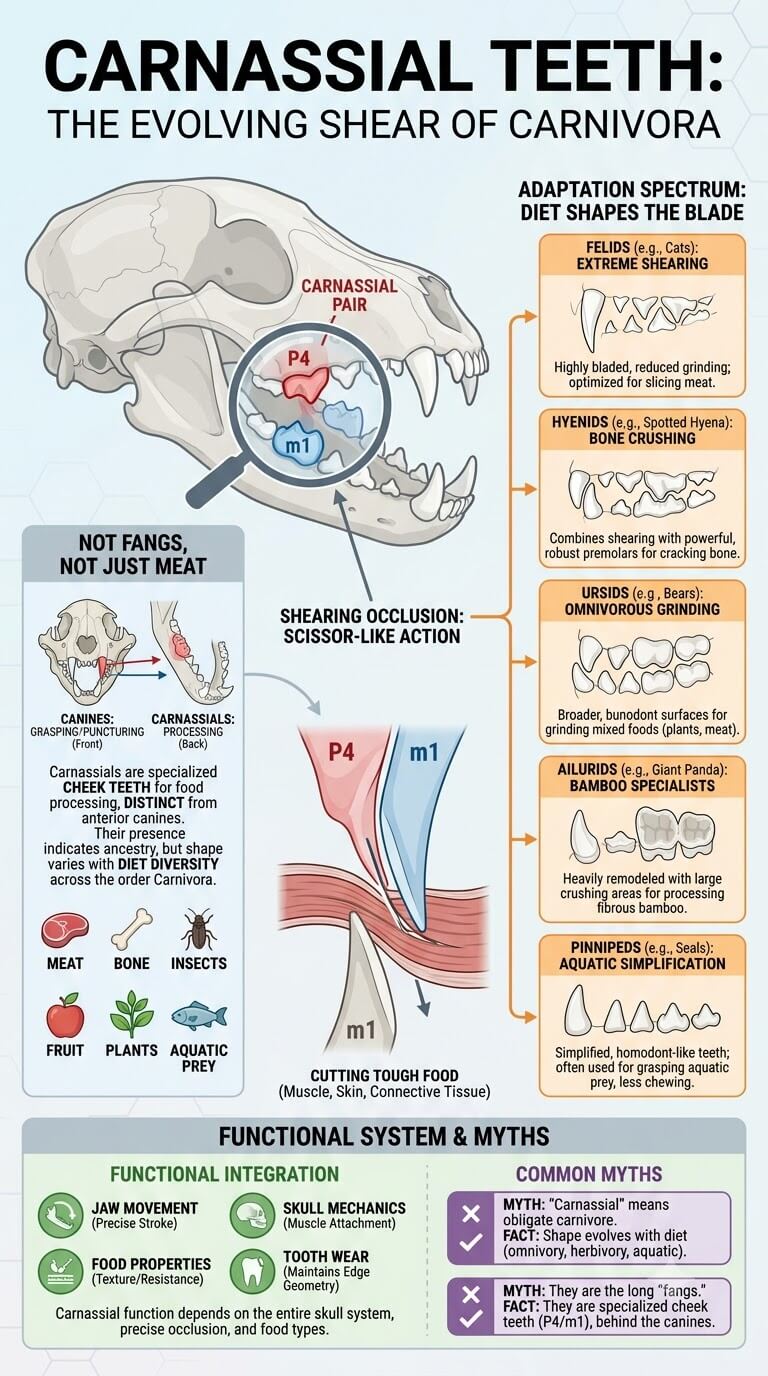
In most terrestrial members of Carnivora, the carnassial pair consists of the upper fourth premolar, usually written P4, and the lower first molar, usually written m1. Animal Diversity Web describes these enlarged teeth as an efficient shear and also notes that the pattern has been secondarily modified in groups such as bears, raccoons, and seals in its overview of the order Carnivora.
The basic action is easier to picture as scissors than as a nutcracker. Long cutting crests on the upper and lower teeth pass close to one another as the jaw closes. That concentrated contact can divide skin, connective tissue, and muscle efficiently. Other parts of the cheek-tooth row may add crushing or grinding surfaces, and those surfaces become especially important in omnivorous or plant-eating carnivorans.
What Carnassial Teeth Actually Are
The Typical Upper Fourth Premolar and Lower First Molar Pair
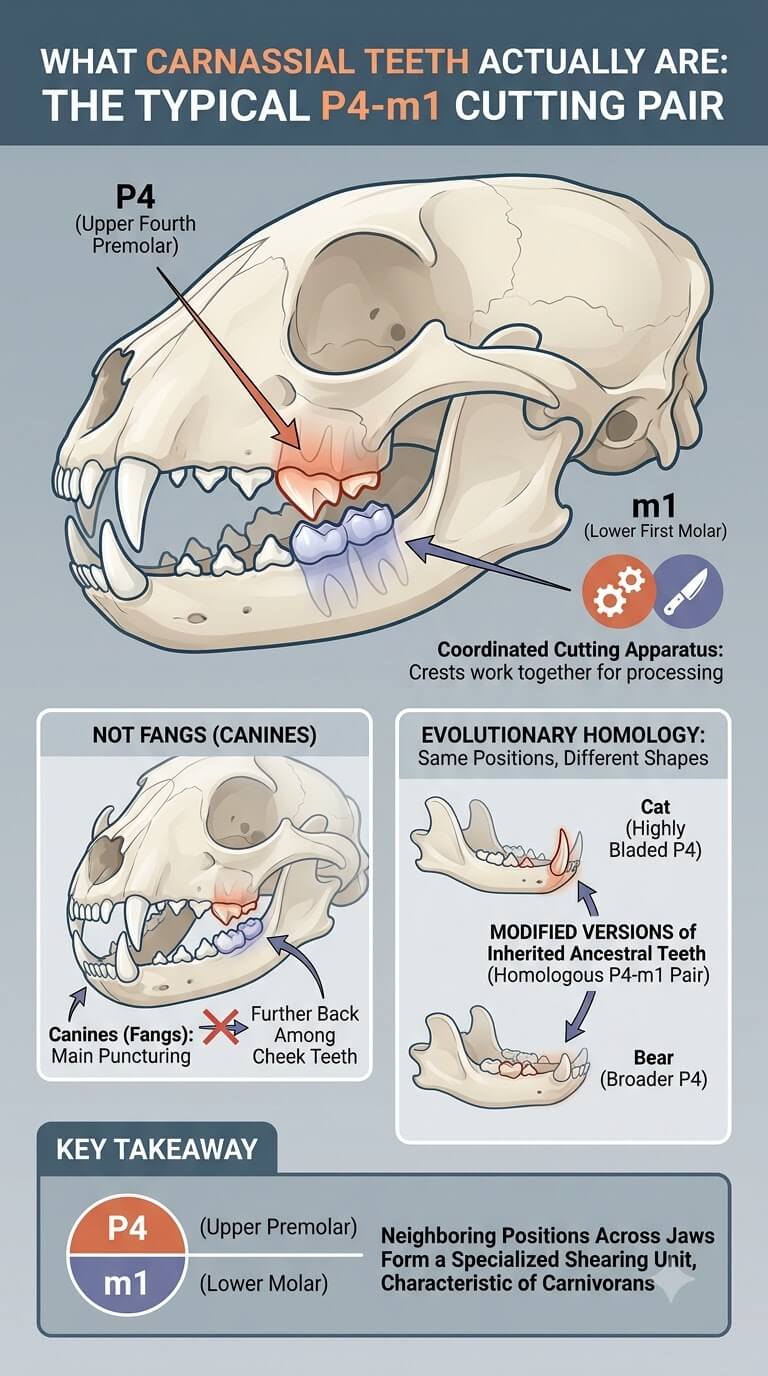
Mammalian teeth are named partly by their position. In the conventional notation used by mammalogists, uppercase letters describe upper teeth and lowercase letters describe lower teeth. A typical carnivoran carnassial pair is therefore P4 above and m1 below. These teeth occupy neighboring positions across the upper and lower jaws rather than forming a matched upper-and-lower version of the same tooth class.
That detail is one reason carnassials are more interesting than simply saying carnivorans have sharp teeth. The upper member of the pair is a premolar, while the lower member is a molar. Evolution has modified the two so their crests work together as a coordinated cutting apparatus.
Carnassial-like cutting systems evolved in other mammal groups too, but they are not made from the same tooth positions. The P4-m1 pair is characteristic of carnivorans and their close fossil relatives, which is why dental anatomy is so informative when scientists study the history of this group.
This is an example of homology: the same inherited tooth positions can be recognized across related animals even when their modern shapes and functions have changed. A cat’s highly bladed P4 and a bear’s broader P4 are not independent inventions placed coincidentally in the same spot. They are modified versions of corresponding teeth inherited through carnivoran ancestry. That distinction lets researchers compare feeding adaptations without assuming that every family still uses the teeth in exactly the ancestral way.
Carnassials Are Cheek Teeth, Not Fangs
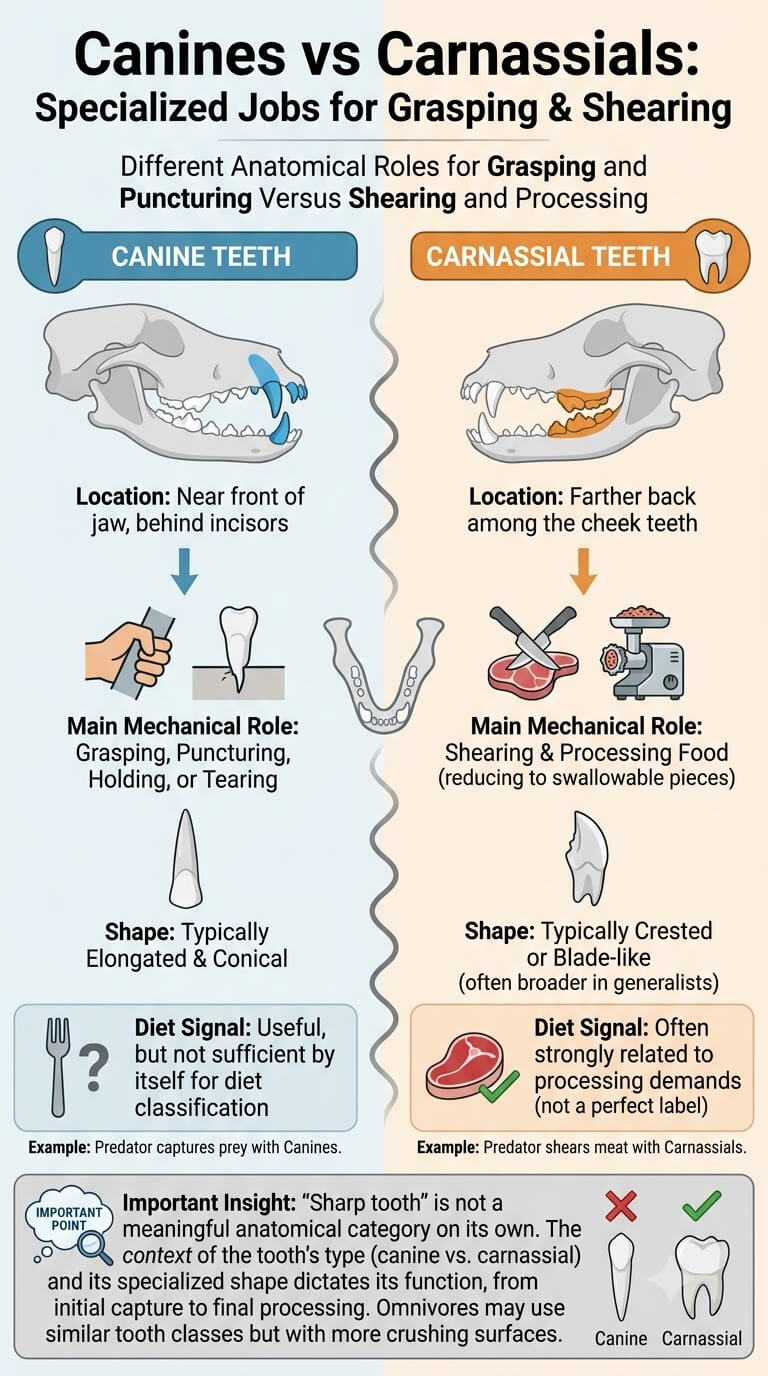
The word fang is often used casually for a long pointed tooth, but carnassials are not the prominent canines beside the incisors. Carnassials sit farther back in the mouth among the cheek teeth. Their key job is food processing after food has been seized, rather than serving as the main puncturing teeth.
This difference is especially obvious in a cat skull. The long canines project near the front of the jaw, while the carnassial blades lie behind them. Both sets of teeth can contribute to feeding, but they contact food differently and are shaped for different mechanical tasks.
Where Carnassials Sit in the Carnivoran Tooth Row
Position Relative to Canines, Premolars, and Molars
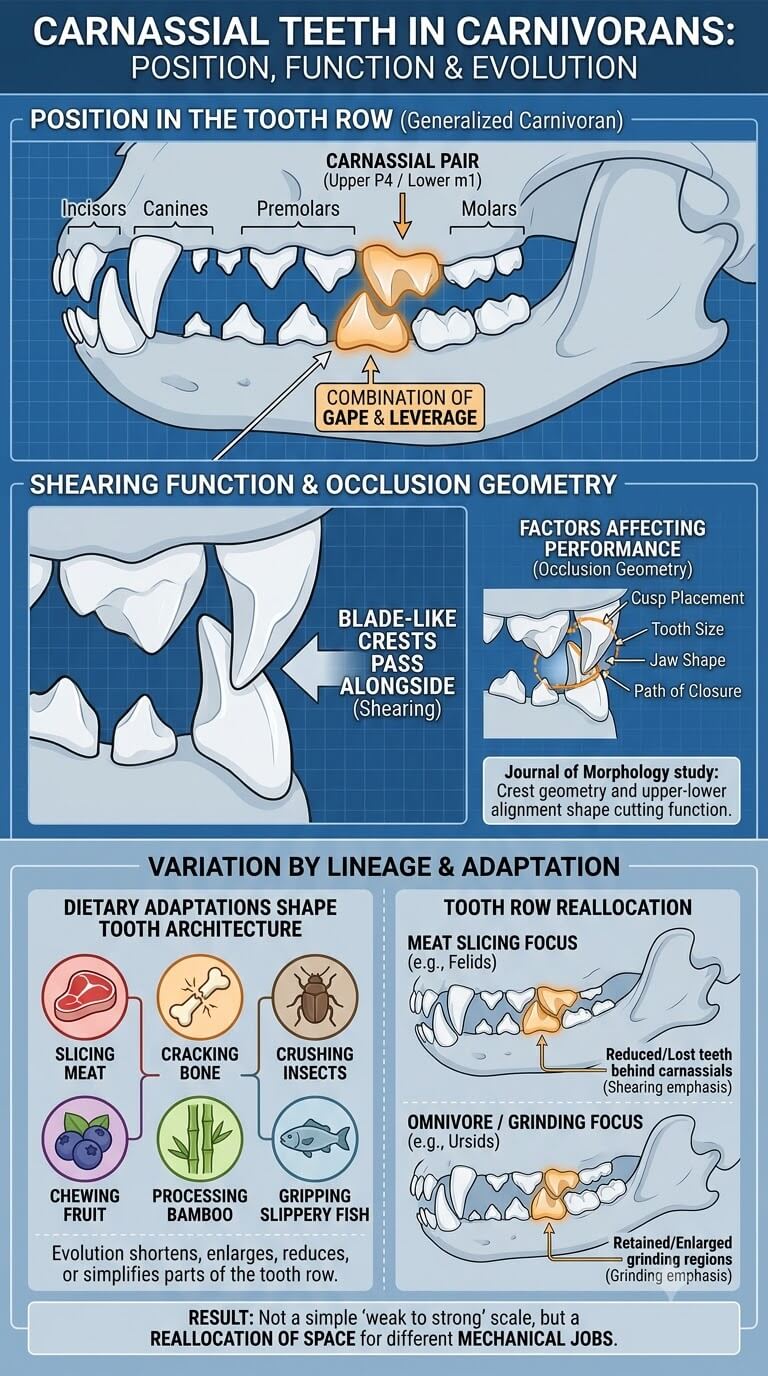
Moving backward from the front of a generalized carnivoran mouth, a reader encounters incisors, then canines, followed by premolars and molars. The carnassial pair sits near the transition between premolars and molars. This position gives it a useful combination of gape and leverage for shearing food.
The pair should not be imagined as two teeth meeting tip to tip. Their blade-like crests pass alongside one another. Research on mammalian dental function emphasizes that tooth performance depends on the geometry of occlusion, the way opposing teeth meet and move past each other. A Journal of Morphology study of carnivore tooth occlusion examined how crest geometry and upper-lower alignment shape the cutting function of carnassial teeth.
Because the cutting edges must approach one another closely, changes in tooth size, cusp placement, jaw shape, and the path of jaw closure can all affect how the pair works.
Why Exact Tooth Counts and Shapes Vary by Lineage
There is no single tooth count that safely describes every living carnivoran. Evolution has shortened, enlarged, reduced, or simplified different parts of the tooth row in different families. Even when the ancestral carnassial positions remain identifiable, their shape and relative importance can be very different.
That variation is useful rather than messy. It records a long history of adaptation to foods with different mechanical demands. Slicing meat, cracking bone, crushing insects, chewing fruit, processing bamboo, and gripping slippery fish do not reward exactly the same tooth architecture.
Tooth reduction also matters. A lineage can lose or shrink teeth behind the carnassial pair, increasing the relative importance of the shearing blades. Another lineage can retain or enlarge grinding regions behind or around the pair. The result is not a simple scale from “weak” to “strong” teeth. It is a reallocation of tooth-row space toward different mechanical jobs.
How Carnassial Shearing Works
Occlusion and Blade-Like Contact
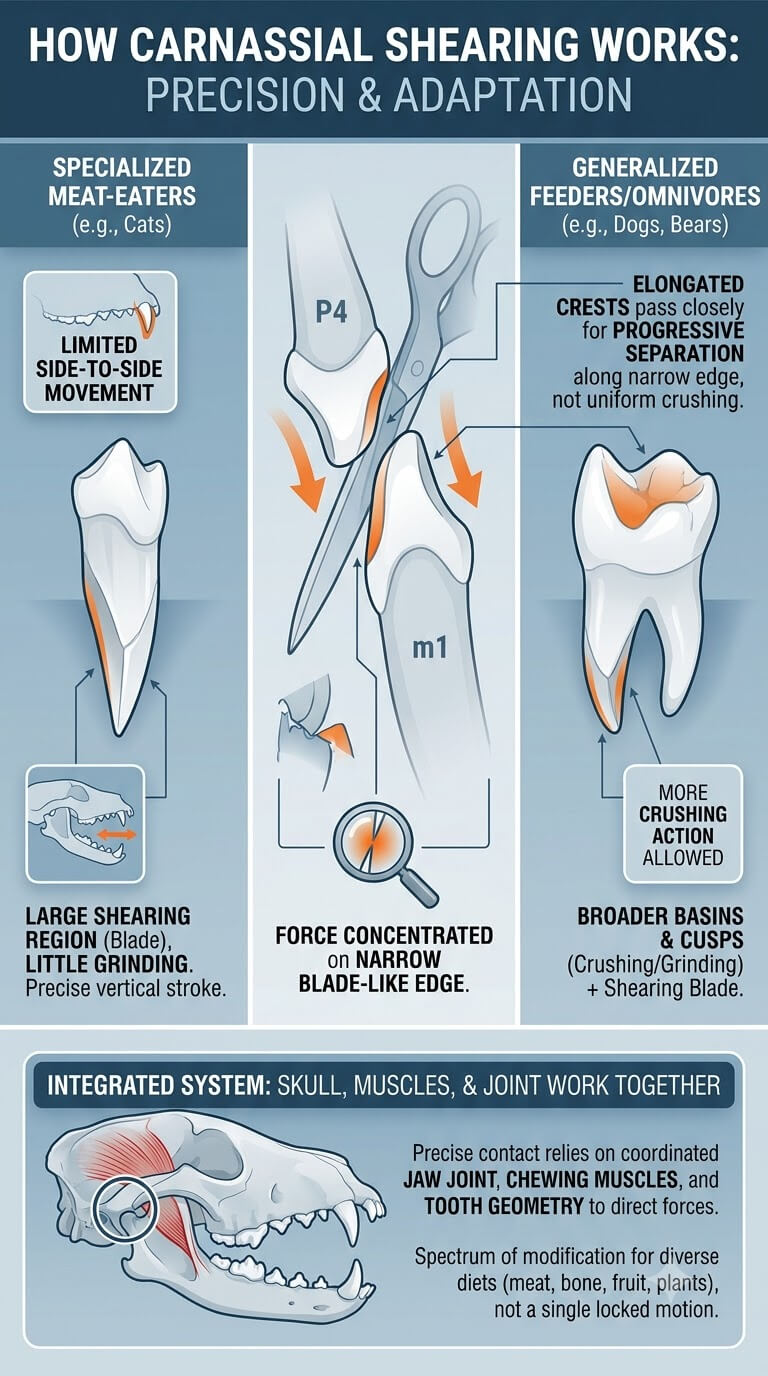
A blade works best when force is concentrated along a narrow edge. Carnassials use the same general principle. Instead of pressing broad flat surfaces directly together, their elongated crests pass closely enough to generate a shearing action. The contact is often compared with scissors because the food is separated progressively along the edge rather than crushed uniformly beneath a flat surface.
In meat-specialized carnivorans, the cutting region can occupy a large share of the useful cheek-tooth surface. In more generalized feeders, broader basins and rounded cusps increase the area available for crushing and grinding. A broad comparative study of carnivoran dentition found coordinated evolutionary change between the relative size of molars and the balance of shearing versus grinding regions, helping explain how the order diversified into very different feeding niches. That pattern is discussed in a peer-reviewed study of dietary adaptation in Carnivora.
Jaw Movement and the Cutting Stroke
Strong carnassial shearing is associated with a jaw movement that brings the cutting edges past one another with relatively little side-to-side grinding compared with many herbivorous mammals. The jaw joint, chewing muscles, and tooth surfaces work as a system, so a carnassial tooth cannot be understood fully in isolation from the skull around it.
Precise contact is especially important because cutting edges lose efficiency if they miss each other or collide incorrectly. Wear can change the surfaces over time, but the underlying geometry still directs where forces are concentrated during chewing.
Carnivorans with broader omnivorous diets often allow more crushing or grinding action elsewhere in the tooth row. That does not mean their jaws suddenly work like those of grazing ungulates. It means the carnivoran feeding apparatus can be modified along a spectrum rather than locked into one motion.
Cutting Flesh Is Only Part of the Functional Story
Carnassials are famous for slicing meat, but real feeding involves foods with very different textures. Tendons resist cutting differently from muscle. Bone may require crushing rather than shearing. Fruit can reward broad crushing surfaces. Invertebrate shells may demand puncture or fracture. Fibrous plants benefit from repeated crushing and grinding.
As diets broaden, natural selection can change the relative proportions of blade, basin, cusp, and grinding surface. This is why a tooth can still occupy the ancestral carnassial position while looking much less like the narrow blade of a cat.
Canines vs Carnassials: Different Jobs
Grasping and Puncturing Versus Shearing and Processing
| Feature | Canine teeth | Carnassial teeth |
|---|---|---|
| Location | Near the front of the jaw, behind the incisors | Farther back among the cheek teeth |
| Typical carnivoran members | Upper and lower canines | Upper P4 and lower m1 |
| Main mechanical role | Grasping, puncturing, holding, or tearing depending on species | Shearing and processing food, with varying crushing or grinding contributions |
| Shape | Usually elongated and conical | Typically crested or blade-like in meat specialists, broader in many generalists |
| Diet signal | Useful but not sufficient by itself | Often strongly related to food-processing demands, but not a perfect diet label |
A predator may use its canines while capturing prey and its carnassials while reducing food to swallowable pieces. An omnivore may use the same general tooth classes but place more emphasis on crushing surfaces. The important point is that “sharp tooth” is not a meaningful anatomical category by itself.
Strong Carnassial Specialization in Many Felids
Reduced Grinding Surface and a Meat-Focused Dentition
Living cats provide one of the clearest examples of strong carnassial specialization. Their cheek-tooth rows emphasize slicing, with reduced post-carnassial grinding compared with many more omnivorous carnivorans. This architecture fits a lineage in which animal tissue makes up the diet across living felids, although prey type and feeding behavior differ greatly among cat species.
The important adaptation is not simply “sharp teeth.” It is the proportion of the tooth row devoted to cutting and the close occlusion of the blades. A highly specialized shearing system performs one kind of food processing extremely well, but specialization can reduce the broad crushing and grinding capacity seen in more generalized feeders.
That trade-off helps explain why tooth form often carries ecological information. It does not justify treating every difference in carnassial length as a direct measurement of how much meat an individual animal ate. Phylogeny, body size, prey properties, wear, and other parts of the skull also matter.
Felid feeding also shows why canines and carnassials should be kept conceptually separate. The canines help with prey capture and holding, while the cheek teeth do much of the slicing that prepares tissue for swallowing. A skull can therefore combine very conspicuous front teeth with an equally important processing system farther back, even though photographs tend to draw attention to the canines first.
Bone Processing and Crushing in Hyenas
How Robust Premolars and Carnassials Work Together
Hyenas are an excellent reminder that carnassials do not perform every heavy-duty feeding task alone. In the bone-cracking hyenas, robust premolars are strongly involved in breaking hard materials, while the carnassial region remains important for shearing. The spotted hyena, brown hyena, and striped hyena have feeding systems adapted for handling bone to degrees not seen in the insect-eating aardwolf.
Peer-reviewed work describing spotted-hyena cranial and dental adaptations highlights enlarged, robust premolars, specialized enamel, and skull architecture that supports powerful jaw muscles. Those features are summarized in research on bone-cracking adaptations in spotted hyenas.
This division of labor matters. Calling carnassials “bone-crushing teeth” would be misleading because crushing performance can depend heavily on other premolars, molars, jaw muscles, and skull shape. Hyenas show how a carnivoran can retain a shearing system while adding exceptional resistance to hard-object feeding.
The aardwolf makes the contrast within Hyaenidae even clearer. It is specialized for eating termites and has reduced cheek teeth compared with the bone-cracking hyenas. Treating “hyena teeth” as one fixed design would therefore hide meaningful variation inside a single family. Family membership constrains the inherited starting point, but diet can push the final form in very different directions.
Omnivorous Carnivorans and Broader Crushing Surfaces
Bears and Procyonids as Examples of Mixed Processing
Many omnivorous carnivorans have less blade-dominated cheek teeth than felids. Bears and raccoon relatives illustrate how the carnassial region can be broadened and combined with rounded cusps and expanded grinding surfaces. These shapes are useful when a diet includes foods that benefit from crushing as well as cutting.
“Omnivorous” still covers a wide range of feeding ecologies. A raccoon, a brown bear, and a kinkajou do not eat identical foods or use their teeth identically. Even within bears, the polar bear and giant panda sit at very different ends of dietary specialization. Tooth form therefore reflects a lineage-specific solution rather than one standard omnivore design.
The broader pattern is that increasing grinding area tends to trade some pure shearing efficiency for versatility. A tooth row that can crush fruit, seeds, vegetation, invertebrates, and mixed foods may look less knife-like than one optimized mainly for cutting vertebrate tissue.
This is also why broad labels such as “bear teeth” or “raccoon teeth” need context. Tooth form reflects the foods a lineage has repeatedly processed, but behavior determines which surfaces are actually used in a given feeding event. A generalist can bite, crush, scrape, or chew different foods with different parts of the same tooth row rather than relying on one specialized cutting stroke every time.
Giant Panda Dental Modification
Plant Processing Without Losing Carnivoran Ancestry
The giant panda is one of the most useful examples for separating ancestry from diet. It belongs to the bear family, Ursidae, within Carnivora, yet its feeding apparatus is strongly modified for a bamboo-dominated diet. Smithsonian notes that giant pandas have large molar teeth and strong jaw muscles for crushing bamboo.
Detailed anatomical research adds another layer. Compared with more carnivorous bears, giant pandas have enlarged premolar and molar areas, and their jaw joint permits lateral movements that help position teeth for processing bamboo. Their premolars and molars have therefore been remodeled far beyond the narrow shearing emphasis associated with many meat-specialized carnivorans.
None of this makes the panda “less of a carnivoran.” Taxonomic membership follows descent. The panda’s teeth demonstrate that an inherited carnivoran tooth row can be extensively modified when a lineage shifts toward a very different food resource.
The panda example also warns against labeling individual teeth only by what the ancestral version did. The P4 position remains homologous with the upper carnassial of other carnivorans, but its modern contribution must be interpreted within the panda’s entire chewing system. Tooth identity and tooth function are related questions, not identical ones.
Pinniped Dentition and Why the Terrestrial Model Has Limits
Diverse Aquatic Prey and Modified Cheek Teeth
Seals, sea lions, fur seals, and walruses are caniform carnivorans, but their teeth should not be forced into a cat-or-wolf model. Aquatic feeding changed what the mouth needed to do. Many pinnipeds seize prey underwater and swallow it whole or in large pieces rather than performing extensive chewing.
Comparative research on pinniped teeth reports that the ancestral distinction between premolars and molars became reduced in many species. Their postcanine teeth are often relatively simple and similar in shape, with much less precise upper-lower occlusion than in terrestrial carnivorans that process food heavily before swallowing. A study of dental integration and simplification in pinnipeds connects this pattern with underwater prey capture and limited mastication.
There is substantial diversity within Pinnipedia. Fish-catching seals, squid eaters, filter-feeding crabeater seals, and suction-feeding walruses do not all use the mouth in the same way. The safe conclusion is that aquatic feeding relaxed or redirected some of the mechanical demands that maintain a classic terrestrial carnassial shear.
What Carnassial Shape Can and Cannot Tell Us About Diet
Specialization, Trade-Offs, and Behavioral Context
Dental form is one of the strongest anatomical clues to food processing because teeth contact food directly. Large slicing crests usually indicate greater emphasis on shearing. Broad basins and rounded cusps usually provide more crushing and grinding area. Robust, fracture-resistant teeth can indicate repeated loading on hard foods.
But teeth are not a complete diet record by themselves. Two related species may retain similar features because of shared ancestry even after their diets diverge. Seasonal foods can change what an animal eats without changing its adult tooth shape. Young and old individuals may use foods differently. Behavior can also compensate for anatomy by changing how food is selected, manipulated, or swallowed.
Scientists therefore combine dentition with observations, stomach or fecal evidence, stable isotopes, tooth wear, skull mechanics, habitat, and evolutionary relationships when reconstructing feeding ecology. Carnassials are powerful evidence, but they are one line of evidence.
Common Myths and Mistakes
Carnassials Do Not Mean an Animal Eats Only Meat
The presence of a carnassial heritage tells us something about ancestry and tooth position, not that every living member of Carnivora is an obligate carnivore. Bears, raccoons, kinkajous, giant pandas, and other carnivorans show how far diet can diversify inside the same order.
Likewise, carnivorous animals outside Carnivora do not need P4-m1 carnassials to eat animal tissue. Sharks, crocodilians, owls, snakes, frogs, and predatory insects solve the mechanical problems of carnivory with entirely different mouthparts and evolutionary histories.
Not Every Carnivoran Has Equally Blade-Like Carnassials
The ancestral carnivoran pattern has been reshaped repeatedly. Felids preserve an extreme shearing emphasis. Many bears have broader, more bunodont cheek teeth. Giant pandas show major crushing adaptations for fibrous plants. Pinnipeds often have simplified postcanine teeth that function more in prey capture than chewing.
That variation is not an exception that weakens the concept of carnassials. It is the reason these teeth are so informative. A homologous part of the tooth row has been modified in different directions as lineages encountered different foods and feeding environments.
How Teeth Fit Into the Rest of Carnivoran Feeding Biology
Carnassials Are One Part of the Mammalian Tooth System
Incisors, canines, premolars, and molars all contribute to feeding in mammals, and the proportions of those tooth classes vary widely. Carnassials are a specialized Carnivora-focused example within that broader dental framework. Understanding them does not require turning every premolar or molar into a carnassial, nor does it erase the roles of the rest of the tooth row.
The most useful mental model is functional: front teeth can crop, grasp, or puncture; cheek teeth process food; and within Carnivora, the P4-m1 pair became especially important as a shearing apparatus. Later evolution then modified that apparatus in multiple directions.
Diet, Foraging, and Family History All Shape the Final Result
A cat’s carnassials make sense in the context of meat processing. A hyena’s teeth make sense only when shearing is considered alongside bone-cracking premolars and skull strength. A bear’s broad cheek teeth reflect mixed processing. A panda’s enlarged grinding surfaces fit bamboo feeding. A seal’s simplified postcanines fit underwater prey capture.
These are not separate stories. They show how anatomy, feeding behavior, and evolutionary history interact. Teeth constrain what can be processed efficiently, while changes in food use create evolutionary pressure on tooth form over many generations.
FAQ
Are carnassial teeth the same as canine teeth?
No. Canines are the elongated teeth near the front of the jaw behind the incisors. Carnassials are specialized cheek teeth farther back. In a typical carnivoran, the upper fourth premolar and lower first molar form the carnassial pair. Canines often help grasp or puncture, while carnassials primarily shear and process food.
Do giant pandas still have carnassial teeth?
Giant pandas retain the carnivoran tooth positions inherited from their bear ancestry, including the teeth homologous to the P4-m1 carnassial pair, but their cheek teeth are heavily modified for processing bamboo. Their enlarged premolars and molars, broad crushing surfaces, strong jaws, and greater lateral jaw movement make them very different from the narrow, blade-dominated condition of a cat.
Do all carnivorans have the same carnassial shape?
No. Carnassial shape varies substantially among families and species. Meat-specialized felids emphasize long shearing blades, whereas many omnivorous carnivorans have broader crushing and grinding surfaces. Giant pandas show strong plant-processing modifications, and pinnipeds have simplified postcanine dentitions in which the classic terrestrial carnassial system is greatly reduced.
Final Thoughts
Carnassial teeth are best understood as a specialized shearing system, not as a synonym for fangs or a stamp that says “meat eater.” The typical carnivoran pair is the upper fourth premolar and lower first molar, and its cutting action depends on precise occlusion, tooth shape, and jaw mechanics. What makes the system especially revealing is its variation. Cats emphasize slicing, bone-cracking hyenas combine shearing with powerful crushing teeth, many bears broaden the grinding surface, giant pandas remodel the cheek teeth for bamboo, and pinnipeds reduce the classic pattern as underwater feeding changes how food is handled. That diversity shows how one inherited dental framework can be reshaped to meet very different feeding demands.

Ethan Walker is the founder and research editor of Animal Fact Central. He creates and reviews educational animal facts content using trusted wildlife, pet care, and science-based sources. His work focuses on making animal behavior, adaptations, habitats, and species facts clear, accurate, and engaging for everyday readers.
Read More Details About Ethan Walker: https://animalfactcentral.com/ethan-walker/