
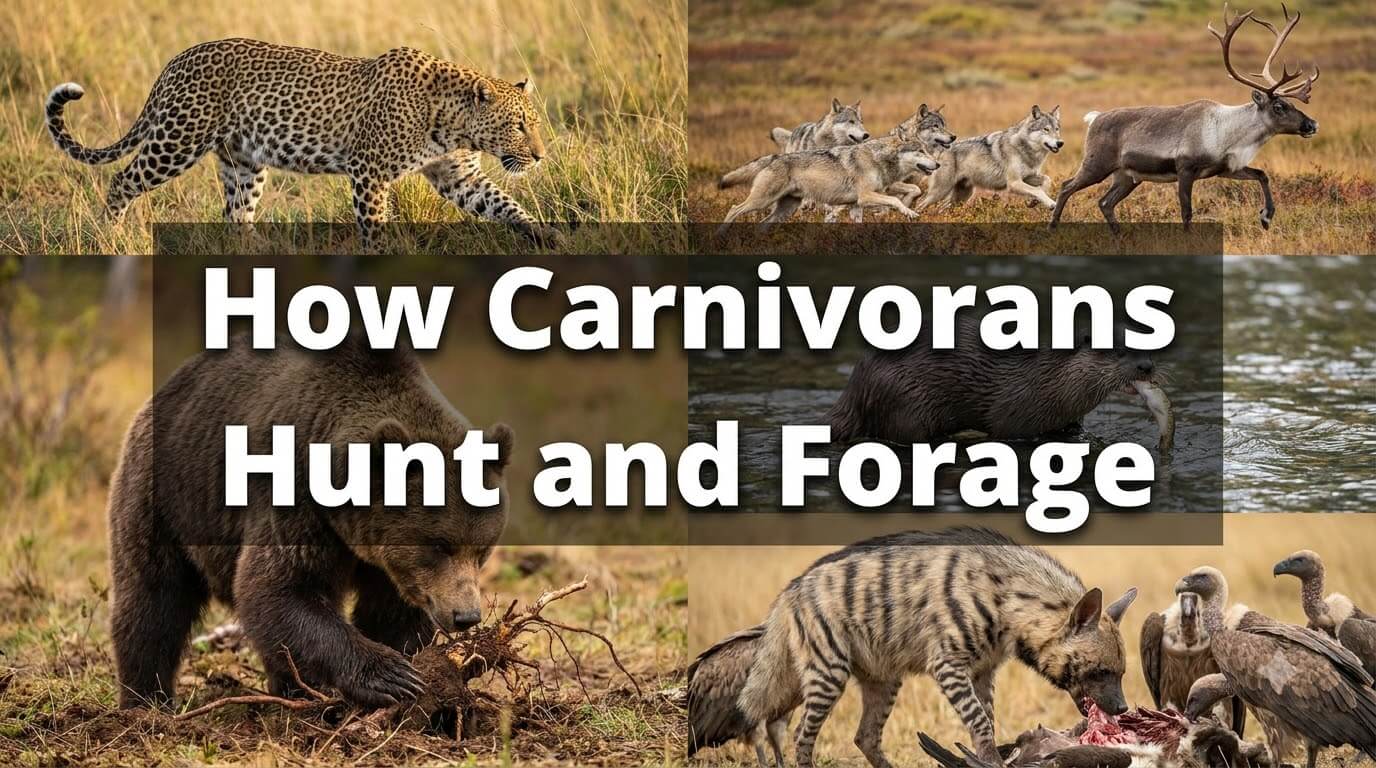
Carnivorans use far more feeding strategies than the familiar image of a big predator chasing prey. Some cats stalk and ambush. Wolves can pursue large prey cooperatively. Bears dig, graze, pick berries, catch fish, and search for insects. Raccoons probe and manipulate objects. Sea otters dive for bottom-dwelling invertebrates. Pinnipeds pursue prey underwater. Giant pandas spend much of their feeding time selecting, handling, and chewing bamboo.
The broad term foraging covers all of these behaviors because it means finding and obtaining food. Hunting is only one kind of foraging, and scavenging is another. Looking for fruit, digging up buried food, cracking a shell, or selecting bamboo stems can all be foraging even when no prey is chased at all.
Quick Answer
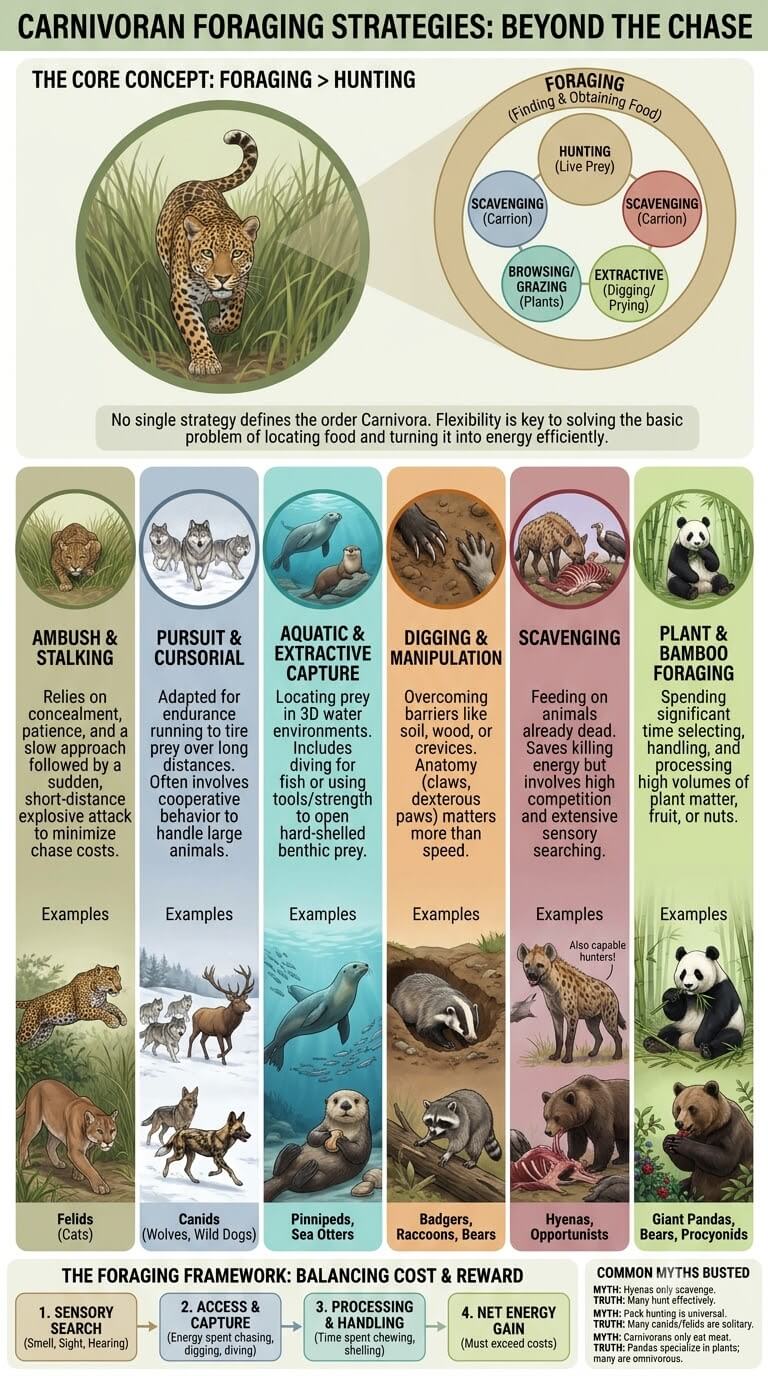
How carnivorans hunt and forage depends on what they eat, where that food occurs, how mobile it is, and what their bodies can do efficiently. A stalk-and-pounce strategy works when an animal can approach prey closely under cover. Pursuit works when a hunter can keep moving and force prey into a costly escape. Digging or prying works when food is hidden behind soil, bark, rocks, shells, or other barriers. Aquatic carnivorans must locate, capture, and handle food in water. Generalists may switch among animal prey, carrion, insects, fruit, seeds, roots, or other foods as conditions change.
No single strategy defines the order Carnivora. The useful pattern is diversity. Members of the same mammalian order have evolved different ways to solve the same basic problem: locating food and turning it into usable energy without spending more time, effort, or risk than the food is worth.
Hunting, Foraging, and Scavenging Are Not the Same Thing
Why Feeding Behavior Needs More Than a Predator Label
Hunting usually means actively locating, pursuing, ambushing, or capturing live prey. Scavenging means feeding on an animal that is already dead. Foraging is broader than either term. It can include hunting, scavenging, browsing on plants, digging for insects, searching for shellfish, gathering fruit, or selecting particular parts of bamboo.
This distinction matters because calling every carnivoran a hunter hides much of the order’s biology. A giant panda is a carnivoran, but its normal feeding routine is dominated by bamboo foraging rather than prey capture. Many bears may hunt at times, yet can spend long periods searching for berries, roots, nuts, grasses, insects, or carrion. Raccoons and many other generalists often search, probe, climb, or manipulate food rather than perform a classic chase.
Even species known as predators may scavenge when the opportunity is profitable. Likewise, a species with a reputation for scavenging may be a capable hunter. Feeding behavior is therefore better understood as a flexible set of tactics than as a permanent label.
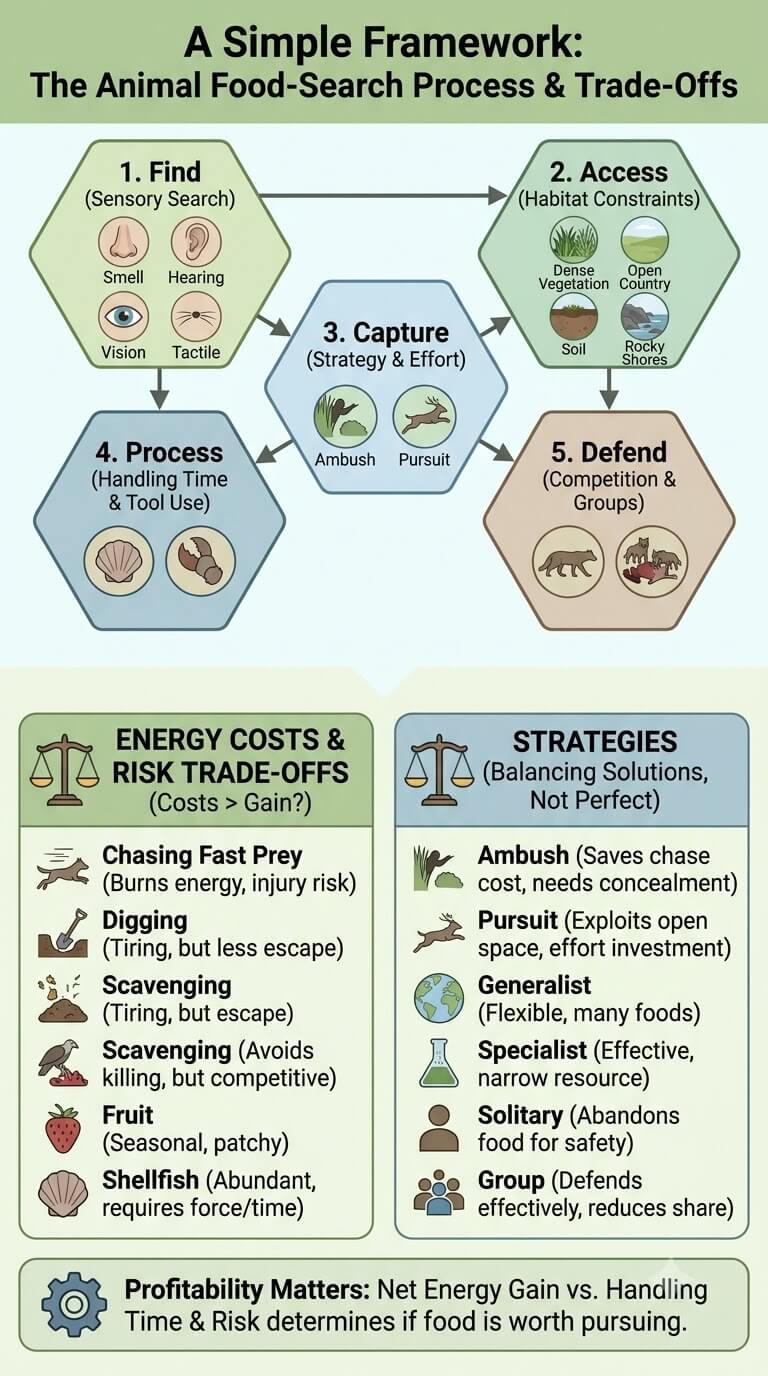
A Simple Framework: Find, Access, Capture, Process, and Defend Food
Sensory Search and Habitat Constraints
Before an animal can eat, it must first find a potential food item. Smell can reveal carrion, buried prey, fruit, or scent left by other animals. Hearing can expose rodents moving under leaves or snow. Vision can help a cat detect motion across open ground or a marine predator track fish underwater. Whiskers and other tactile systems can help locate food in dark burrows, murky water, or close contact.
Habitat determines which sensory cues are reliable. Dense vegetation can limit long-distance vision but provide concealment for stalking. Open country may favor visual detection and sustained movement. Soil creates opportunities for digging specialists. Rocky shores and shallow seafloors offer prey that can be pried, crushed, or pulled from crevices. The same food-search problem is solved differently in a forest, grassland, desert, river, sea-ice environment, or coastal ocean.
Energy Costs and Risk Trade-Offs
Food is valuable only if an animal can obtain it at an acceptable cost. Chasing fast prey burns energy and can cause injury. Digging can be tiring but may uncover food that cannot escape once reached. Scavenging avoids the cost of killing prey but may involve competition with larger animals. Fruit can be easy to pick but seasonal and patchy. Shellfish may be abundant yet require time and force to open.
This is why feeding strategies often look like trade-offs rather than perfect solutions. Ambush hunters save the cost of a long chase but need concealment and a close approach. Pursuit hunters can exploit more open spaces but may fail after investing substantial effort. Generalists gain flexibility by accepting many food types, while specialists can become exceptionally effective at handling a narrower resource.
Competition changes the calculation too. A solitary carnivoran may abandon a food item when a larger competitor arrives. A group can sometimes defend a carcass more effectively, but more mouths also reduce each individual’s share. Food handling time matters as well. A hard-shelled prey item may contain plenty of energy yet remain unprofitable if opening it takes too long. These pressures help explain why animals often ignore food that appears available to a human observer.
Ambush, Stalking, and Pouncing
Many Felids as Familiar Examples
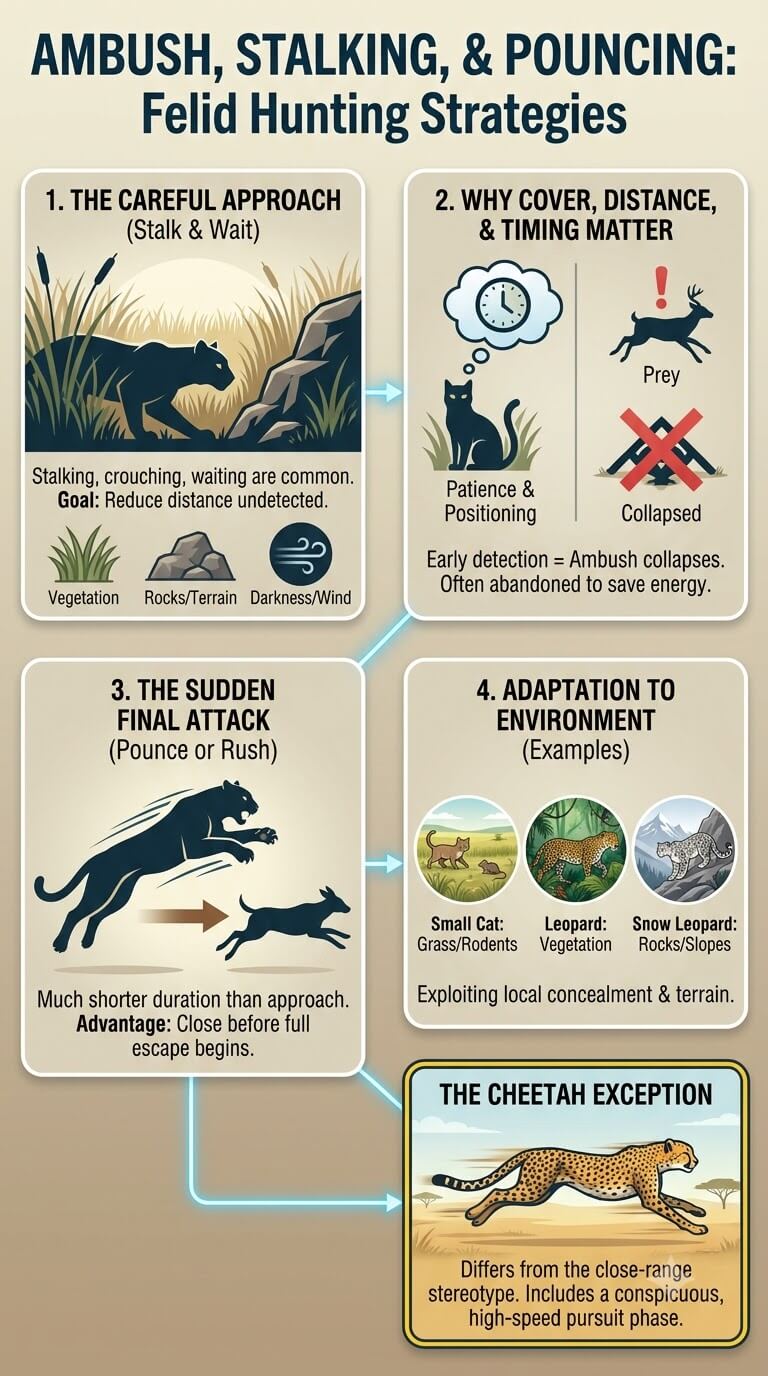
Many cats combine careful approach with a sudden final attack. The Animal Diversity Web overview of Felidae describes stalking, crouching, waiting, and pouncing as common parts of felid hunting. The details vary among species, prey types, and habitats, but the basic advantage is clear: get close before the prey has time to begin a full escape.
A small cat hunting rodents in grass, a leopard using vegetation and terrain, and a snow leopard using rocks and slopes are not performing identical hunts. Each is exploiting concealment, distance, and timing in a way suited to the local environment. Cheetahs also remind us not to turn the family into a single template because their hunts include a much more conspicuous high-speed pursuit phase than the classic close-range ambush stereotype.
Why Cover, Distance, and Timing Matter
Stalking works best when the hunter can reduce the distance without being detected. Vegetation, rocks, darkness, uneven ground, and wind direction can all influence whether prey notices an approach. The final pounce or rush is usually much shorter than the slow approach that came before it.
The trade-off is that an ambush can collapse if prey detects the hunter too early. The hunter may then abandon the attempt rather than spend more energy on a poor chase. In this strategy, patience and positioning are often as important as acceleration.
Pursuit and Cursorial Hunting
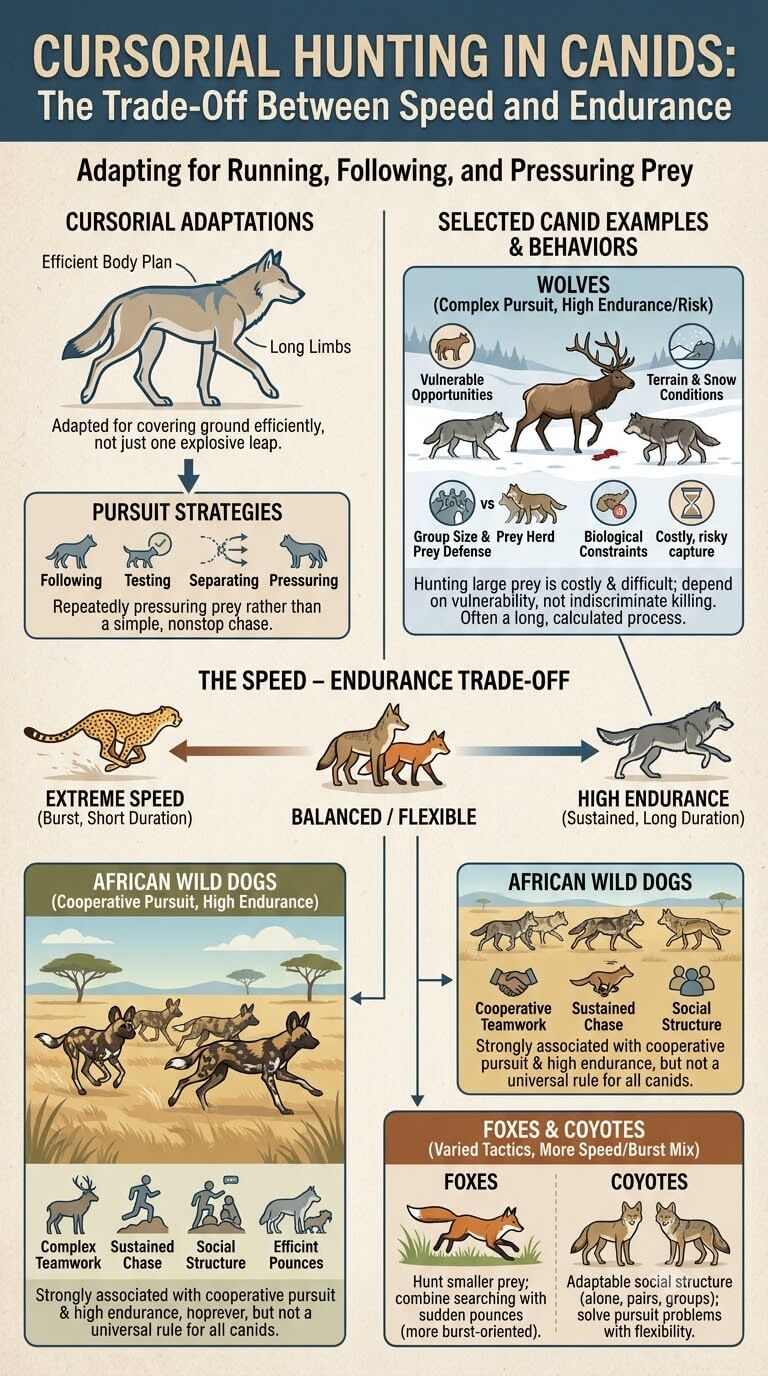
Selected Canids and the Trade-Off Between Speed and Endurance
Cursorial describes animals adapted for running. Many canids have relatively long limbs and a body plan suited to covering ground efficiently. Pursuit can involve following, testing, separating, or repeatedly pressuring prey rather than relying on one explosive leap.
Wolves provide a familiar example, but even wolf hunting is not a simple nonstop chase. Prey selection, terrain, snow conditions, group size, prey defense, and the condition of individual animals all affect an encounter. Yellowstone researchers note that hunting large prey is difficult and risky, and wolves often depend on vulnerable opportunities rather than killing indiscriminately. National Park Service research on Yellowstone wolves emphasizes the biological constraints that make large-prey capture costly rather than effortless.
Other canids solve the pursuit problem differently. Some foxes hunt much smaller prey and may combine searching with sudden pounces. Coyotes can hunt alone, in pairs, or in changing social circumstances. African wild dogs are strongly associated with cooperative pursuit, but their behavior should not be treated as a rule for every member of Canidae.
Cooperative Hunting
Wolves, African Wild Dogs, Lions, and Why Cooperation Is Not Universal
Cooperation can allow carnivorans to handle prey or defend food in ways that would be difficult for one individual. Group members may spread out, approach from different directions, follow the same fleeing animal, or take advantage of openings created by companions. Wolves, African wild dogs, lions, and spotted hyenas can all hunt cooperatively, but the social structure and hunting sequence differ among them.
For wolves, pack life is usually rooted in family relationships rather than the rigid dominance caricature popularized from some captive-wolf observations. The Yellowstone wolf ecology overview describes packs as complex social families in which cooperative hunting of large prey is one benefit of group living.
Cooperation also has costs. More hunters can improve the ability to locate, pursue, or overpower some prey, but the resulting food may have to be shared. Small prey may not support many group members. This helps explain why social hunters can change group cohesion or hunting tactics when prey size and abundance change.
It is also wrong to assume that social living automatically means cooperative hunting. Some carnivorans gather for breeding, rest near one another, or share parts of a home range without routinely hunting as a coordinated team.
Digging, Prying, and Extractive Foraging
Burrowing Prey, Insects, Roots, and Hidden Foods
Many foods are protected less by speed than by barriers. Rodents disappear underground. Insects live in nests, rotten wood, or soil. Roots and tubers are buried. Crabs and shellfish may hide under rocks or within sediment. Reaching these foods favors digging, pawing, probing, biting, prying, or pulling.
Badgers are famous diggers, but extractive foraging appears in many other carnivorans. Bears can tear into logs, overturn objects, and excavate soil while searching for insects or plant foods. Mongooses may scratch or probe for invertebrates and small vertebrates. Raccoons use highly mobile forepaws to investigate crevices and handle many kinds of food.
Extractive foraging changes the importance of anatomy. Long claws, powerful forelimbs, dexterous paws, narrow snouts, sensitive touch, or strong jaws can matter more than running speed. The challenge is not catching a fleeing animal but reaching a food item that is mechanically difficult to access.
Climbing and Arboreal Food Search
Fruit, Eggs, Small Animals, and Canopy Resources
Trees add another dimension to food search. Arboreal and scansorial carnivorans can encounter fruit, insects, nests, eggs, small vertebrates, and other resources that ground-living animals may use less easily. Civets, genets, kinkajous, some raccoons and coatis, martens, and many cats vary greatly in how much time they spend climbing, but all illustrate that Carnivora is not restricted to feeding on the ground.
Climbing creates its own trade-offs. Narrow branches reward balance and gripping ability. Dense foliage can hide food and predators alike. Fruit may be abundant for a short period and scarce later. An arboreal generalist can benefit from tracking changing food patches through the canopy rather than depending on one prey type.
Fishing and Aquatic Capture
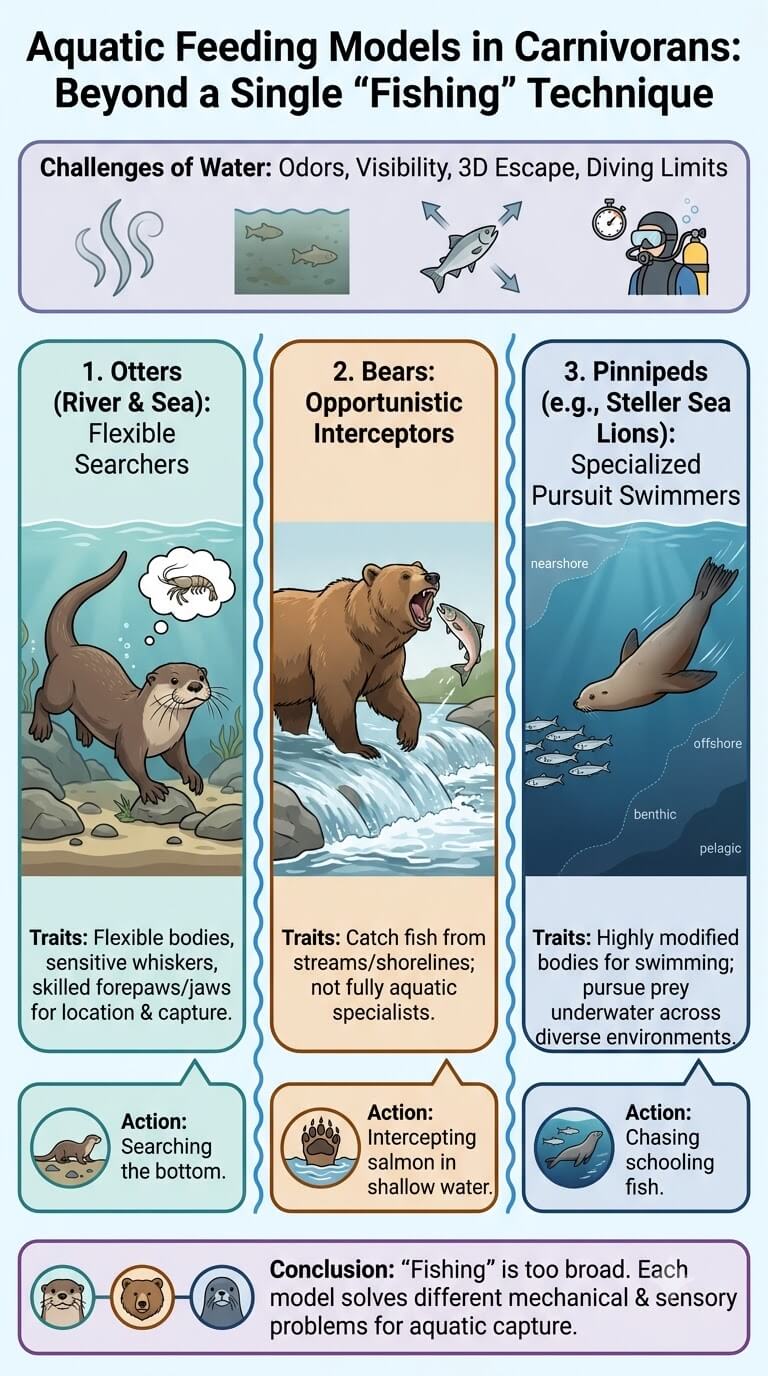
Otters, Bears, and Pinnipeds as Different Aquatic Feeding Models
Water changes nearly every part of food capture. Odors move differently, visibility can be poor, prey can escape in three dimensions, and diving imposes time and oxygen constraints. Carnivorans have entered aquatic feeding niches in several different ways rather than evolving one universal fishing technique.
River otters and sea otters use flexible bodies, sensitive whiskers, and skilled forepaws or jaws to locate and capture aquatic prey. Bears may catch fish from streams or shorelines without being fully aquatic specialists. Pinnipeds, in contrast, have bodies highly modified for swimming and can pursue fish, squid, and other prey underwater. NOAA notes that Steller sea lions forage across nearshore, offshore, benthic, and pelagic environments, with diets that vary by place and season.
These examples show why “fishing” is too broad to describe one behavior. A bear intercepting salmon in shallow water, an otter searching the bottom, and a sea lion chasing schooling fish are solving different mechanical and sensory problems.
Shellfish and Manipulative Foraging
Sea Otter Tool Use as a Brief Specialized Example
Sea otters provide one of the clearest examples of food handling becoming as important as prey capture. They often dive for benthic invertebrates and bring prey to the surface for processing. Depending on the prey and the individual, teeth, forepaws, or objects can be used to open hard shells.
Tool use is real, but it should not be turned into a universal sea otter behavior. A 2024 U.S. Geological Survey summary of southern sea otter research found that tool use helped some individuals gain access to harder or larger prey and was associated with less tooth damage. Earlier work also showed large differences among individuals in how frequently tools were used.
The broader lesson is about processing costs. Capturing food is only part of foraging. If a prey item is protected by a shell or exoskeleton, the animal must also open it efficiently enough to make the meal worthwhile.
Scavenging and Carcass Use
Hyenas Can Hunt as Well as Scavenge
Hyenas are a useful correction to one of the most persistent carnivoran stereotypes. The family includes species with very different diets, including the termite-eating aardwolf, and the familiar large hyenas are not simply animals that wait for other predators to leave food behind. The Animal Diversity Web account of Hyaenidae notes that hyenas can both hunt and scavenge, with cooperative hunting important in some species and situations.
Spotted hyenas in particular can kill substantial prey themselves, while striped and brown hyenas rely more heavily on scavenging in many settings. Treating the entire family as one feeding type erases these differences. It also misses the fact that scavenging is not an inferior form of feeding. Carrion is a valuable resource, and finding it can require extensive travel, sensory detection, and competition.
Opportunistic Carcass Use Across Other Carnivorans
Carcass use occurs far beyond hyenas. Wolves may return to previous kills. Bears can feed on carcasses they discover. Foxes, coyotes, mustelids, and many other carnivorans may use dead animals when available. Even a species that usually hunts can save energy by scavenging rather than making a fresh kill.
The decision depends on risk and competition. A carcass occupied by larger carnivores may be too dangerous to approach. A carcass in a quiet area may provide a high-value meal. Scavenging therefore fits naturally into a flexible feeding repertoire rather than forming a sharp opposite to predation.
Plant, Fruit, and Bamboo Foraging
Bears, Procyonids, Viverrids, and Giant Pandas
Plant foraging is another reminder that Carnivora is a taxonomic order, not a promise that every member spends its life hunting. Many bears search extensively for fruit, nuts, roots, shoots, grasses, or other plant material. Procyonids and some viverrids can include substantial fruit or other plant foods in mixed diets. These foods require search, selection, handling, and often seasonal movement among patches.
Giant pandas make the contrast especially clear. Wild pandas feed overwhelmingly on bamboo and spend a large part of the day obtaining and processing it. The Smithsonian’s giant panda profile explains how the enlarged wrist bone that functions as a pseudo-thumb helps pandas grasp bamboo while powerful jaws and teeth process the fibrous plant.
A panda’s feeding strategy is not a failed version of predation. It is a highly specialized way of exploiting an abundant plant resource. The panda remains a bear and a carnivoran because taxonomy reflects ancestry, not because its daily feeding behavior resembles that of a tiger or wolf.
Flexibility, Seasonality, and Learning
Why One Species May Switch Tactics With Food Availability
Foraging behavior can change without any change in species identity. A bear may focus on newly available vegetation in one season, berries in another, insects when colonies are accessible, and animal food when opportunities arise. A raccoon may search stream edges, trees, wetlands, or forest floor depending on local conditions. A sea lion may follow changes in prey distribution through the year.
Young animals also have to refine feeding skills. Practice can improve stalking, prey handling, digging, shell opening, or recognition of profitable food patches. Social species may learn by following parents or other group members, while solitary juveniles can still gain experience through repeated attempts.
Flexibility is useful when food varies, but it has limits. Anatomy, digestive physiology, body size, competition, and habitat still constrain what an animal can profitably eat. A generalist is not capable of exploiting every possible food, and a specialist is not necessarily behaviorally inflexible in every situation.
Behavioral flexibility can also operate on a short time scale. A hunter may stop pursuing one prey animal and investigate carrion moments later. A bear moving through berry patches may interrupt plant feeding to dig for insects. An otter may switch prey types when one patch becomes depleted. These changes do not mean the animal has abandoned its usual ecology. They show that real feeding decisions are made repeatedly as opportunities, costs, and risks change.
Common Myths and Mistakes
Not Every Foraging Strategy Is Hunting
Searching for berries, digging roots, cracking shellfish, eating carrion, or selecting bamboo are all forms of foraging. Calling them hunting confuses the broader feeding process with active prey capture. This distinction is especially important in Carnivora because dietary diversity is so wide.
Cooperative Hunting Is Not Universal in Felidae or Canidae
Lions make social hunting familiar among cats, but most felid species do not live or hunt in prides. Wolves and African wild dogs demonstrate cooperative pursuit among canids, yet many foxes and other canids commonly forage alone or in pairs. Family membership does not dictate one social hunting system.
Hyenas Are Not Simply Thieves of Other Predators’ Kills
Some hyenas use carrion heavily, while spotted hyenas can be formidable hunters. Food can also move in both directions between competing predators: lions may take carcasses from hyenas just as hyenas may exploit kills made by other carnivores. The ecological reality is competition and opportunity, not a simple thief-versus-hunter story.
How Feeding Strategies Fit With the Rest of Carnivoran Biology
Diet and Carnassial Function
What an animal eats influences which feeding behaviors are profitable, while teeth and jaws influence how food can be processed after it is obtained. Sharp carnassial surfaces are useful for slicing flesh in many carnivorans, but omnivorous and plant-specialized lineages show important modifications. The mechanics of the tooth row do not by themselves tell us whether an animal stalks, digs, scavenges, fishes, or browses.
Senses, Social Behavior, Habitat, and Ecology
Feeding also intersects with sensory ecology and social behavior. A nocturnal hunter may depend on different cues than a daytime forager. Group hunters face coordination and food-sharing problems. A coastal species can exploit prey unavailable to an inland relative. Scavengers interact with other predators and decomposers, while fruit-eating carnivorans can move seeds through ecosystems.
Those connections help explain why feeding behavior cannot be reduced to a list of attack techniques. It emerges from the whole animal: anatomy, senses, learning, social system, habitat, competition, and the distribution of food.
FAQ
Do hyenas mostly scavenge instead of hunt?
It depends on the hyena species and local conditions. Spotted hyenas can hunt large prey effectively and may obtain much of their food through their own kills in some ecosystems. Striped and brown hyenas are generally more strongly associated with scavenging, while the aardwolf is highly specialized for eating termites. Treating all hyenas as primarily scavengers is inaccurate.
Do all canids hunt in packs?
No. Pack hunting is important in wolves and African wild dogs, but canids show many social and feeding systems. Some foxes commonly hunt small prey alone, coyotes can forage alone or with others depending on circumstances, and even social canids may split into smaller hunting units when food is small or dispersed. Pack hunting is one canid strategy, not a defining rule for the family.
Which carnivorans forage for food without hunting?
Many do, either regularly or seasonally. Giant pandas mainly forage for bamboo. Bears can spend extensive time searching for plant foods and insects. Procyonids and some viverrids may gather fruit or invertebrates. Sea otters dive and search for shellfish and other benthic prey that often require extraction and processing rather than a long chase. Scavenging carnivorans can also obtain animal food without killing it themselves.
Final Thoughts
How carnivorans hunt and forage is best understood as a spectrum of solutions rather than a single predator blueprint. Ambush, pursuit, cooperation, digging, climbing, aquatic capture, shell opening, scavenging, fruit gathering, and bamboo feeding all occur within Carnivora because different foods create different challenges.
The central lesson is simple: hunting is only one part of foraging. A carnivoran may chase prey, wait in cover, dig into soil, search a tree canopy, dive to the seafloor, exploit a carcass, or spend hours processing plants. Those strategies make sense only when they are viewed together with the animal’s habitat, anatomy, senses, social life, and the costs of obtaining food.

Ethan Walker is the founder and research editor of Animal Fact Central. He creates and reviews educational animal facts content using trusted wildlife, pet care, and science-based sources. His work focuses on making animal behavior, adaptations, habitats, and species facts clear, accurate, and engaging for everyday readers.
Read More Details About Ethan Walker: https://animalfactcentral.com/ethan-walker/