

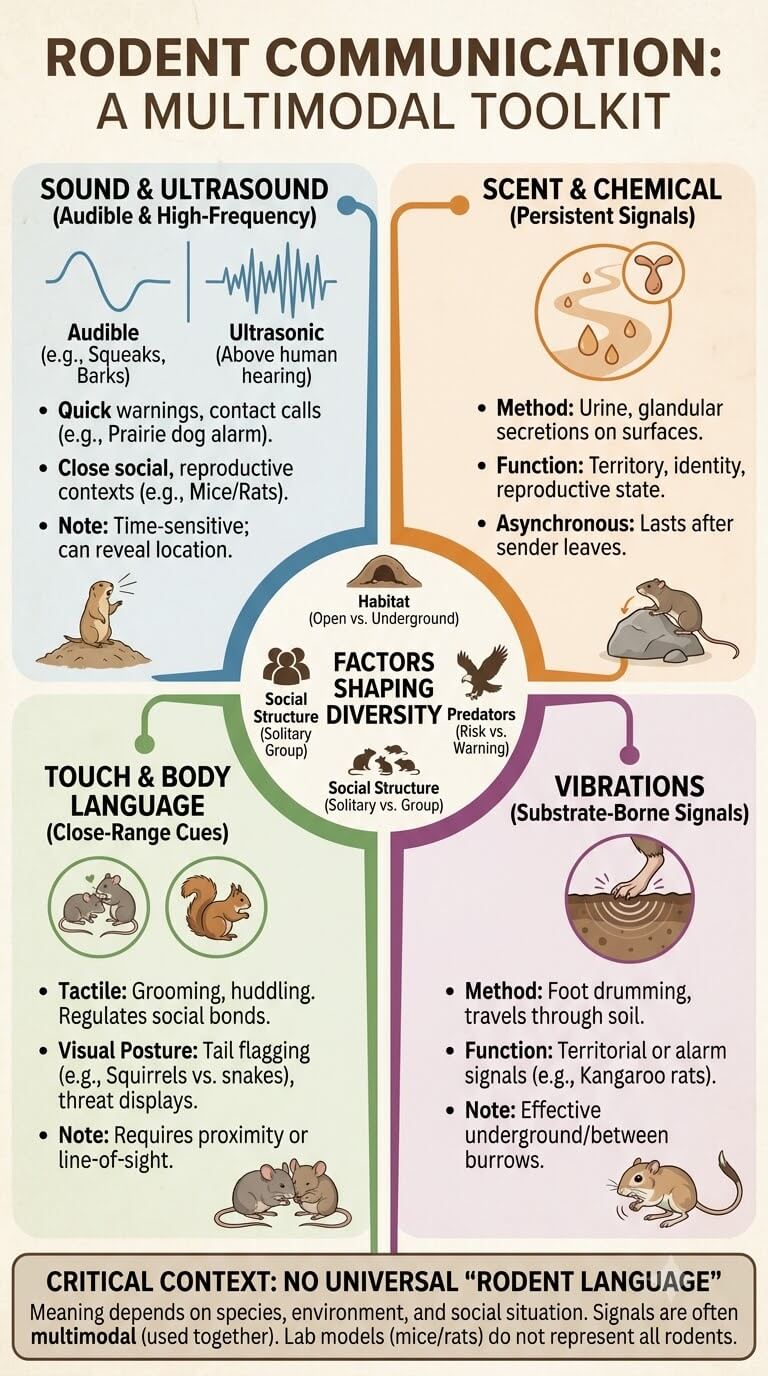
Rodents communicate in far more ways than squeaks. Depending on the species and situation, they may use audible calls, ultrasonic vocalizations, scent marks, urine, glandular secretions, touch, grooming, posture, facial movements, tail signals, foot drumming, or vibrations that travel through the ground. No single communication system represents all of Rodentia.
That diversity makes sense because rodents live in very different environments. A prairie dog calling across open grassland faces a different signaling problem from a mouse communicating at close range, a squirrel confronting a snake, or a kangaroo rat sending vibrations through desert soil. Signals work only when another animal can detect them, so habitat, sensory abilities, social relationships, predators, and distance all shape how communication evolves.
Rodent communication is also highly context dependent. The same broad channel, such as sound or scent, can carry different information in mating, territorial encounters, parent-young interactions, alarm situations, or routine social contact. Scientists therefore interpret a signal by studying who produces it, who receives it, what happens before and after it, and whether the pattern changes across species, ages, sexes, or environments.
Quick Answer: Rodents Communicate Through Multiple Channels
Sound and vibration can deliver information quickly
Sound is useful when a message must reach another animal without direct contact. Some rodents make calls humans can hear, while others also produce ultrasonic vocalizations above the upper range of normal human hearing. Vibrational signals can travel through soil or other surfaces, allowing communication even when animals are separated by burrow walls.
Acoustic signals are especially useful when information is time-sensitive, such as during predator encounters or close social interactions. Their weakness is that sounds fade quickly and may also reveal the sender to predators or competitors.
Chemical signals can remain after the sender leaves
Scent works differently. A rodent can deposit a chemical signal on a surface and move away while the mark remains available to later visitors. Research on rodent scent marking shows that receivers can use chemical cues to assess information related to identity, sex, reproductive condition, and social context. A review of rodent responses to scent marks emphasizes that the meaning and response depend on both the sender and the situation.
This persistence makes scent useful for territories, routes, burrow entrances, reproductive communication, and other situations where two animals do not need to be present at the same time.
Touch, posture, and movement add close-range information
Rodents also communicate through body position and physical contact. Grooming, nose-to-body contact, approach and retreat, freezing, threat postures, and other movements can influence a social interaction. A review of body-language signals in rodents notes that research has historically focused more heavily on odors and vocalizations, while facial and postural signals are receiving increasing attention.
These cues can work together. A nearby animal may smell a scent, hear a call, watch the sender’s posture, and feel physical contact during the same interaction.
Why Rodent Communication Is So Diverse
Habitat changes which signals travel well
An open grassland favors different communication conditions from a dense forest, underground tunnel, or rocky desert. Airborne sound may travel differently around vegetation and terrain, while scent persistence changes with wind, moisture, temperature, and the surfaces on which chemicals are deposited.
Burrowing species face an additional challenge because soil blocks or weakens many visual and airborne signals. Vibrations, touch, odor, and close-range sounds can become especially useful underground.
Social structure changes what information matters
A territorial animal may need to advertise occupancy or warn rivals. A group-living species may benefit from alarm calls, contact calls, individual recognition, or signals that reduce conflict. Parents and young may use vocal and tactile cues during periods of close dependence.
This does not mean social species automatically have more complex communication than solitary species. Even a largely solitary rodent may use sophisticated chemical or acoustic signals during territorial disputes and reproduction.
Predators create both reasons and risks for signaling
Alarm signals can warn nearby animals, but calling may also draw attention. Signal design therefore reflects a trade-off between transmitting useful information and limiting unwanted detection.
Some rodents adjust their signals according to the predator involved. California ground squirrels, for example, use conspicuous tail flagging during snake encounters, and experiments have shown that the display changes when squirrels face infrared-sensitive rattlesnakes. Such predator-directed signals show that rodent communication can involve receivers outside the rodent’s own species.
Audible Vocalizations

Rodents make more than one kind of audible call
Squeaks are the sound most people associate with rodents, but audible repertoires can include chirps, barks, whistles, grunts, chatters, and other call types depending on the species. The labels people give the sounds are less important than their acoustic structure and behavioral context.
A call produced during restraint or aggression may have a very different function from one exchanged between group members. Researchers therefore compare recordings with observed behavior rather than assigning meaning from sound alone.
Alarm calls can change the behavior of nearby animals
Ground squirrels and prairie dogs provide well-known examples of audible alarm signaling. When a predator appears, a caller can alter the behavior of nearby group members, prompting increased vigilance, retreat, or other defensive responses.
The value of an alarm call depends on more than volume. Timing, repetition, call structure, caller identity, and the kind of predator can all influence how receivers respond.
Calls can maintain contact at close or moderate range
Some calls function during routine social interactions rather than emergencies. They may help animals locate one another, coordinate movement, maintain contact between mothers and young, or regulate the distance between individuals.
Because those functions vary so widely, there is no universal translation such as “one squeak always means fear.” Behavioral context matters.
Ultrasonic Communication

Ultrasound means frequencies above normal human hearing
Ultrasonic vocalizations, often shortened to USVs in research, occur above the upper frequency limit of typical human hearing. Specialized microphones are therefore needed to record and analyze them accurately.
Mice and rats are among the most studied examples. A 2023 review of mouse and rat ultrasonic vocalizations describes USVs in multiple social and affective contexts while also emphasizing methodological challenges in interpreting what a particular vocalization means.
Laboratory mice and rats provide detailed evidence, not a universal rodent rule
Decades of laboratory research have revealed rich ultrasonic repertoires in mice and rats. Young animals can vocalize during separation, and adults produce USVs during courtship, social investigation, play, aversive situations, and other contexts depending on species and age.
Those findings are valuable because laboratory conditions allow precise recording and repeated experiments. They should not automatically be transferred to squirrels, beavers, capybaras, porcupines, or every other rodent. The safest conclusion is that ultrasonic communication is well established in some rodents and still unevenly studied across the order.
Not every ultrasonic sound has the same function
Even within rats or mice, interpreting USVs requires caution. Call structure can vary with age, sex, strain, social setting, arousal, and experimental conditions. A 2026 review of mouse bioacoustics notes that the functions of many mouse vocalizations remain incompletely understood despite increasingly sophisticated recording and analysis methods.
It is therefore better to describe documented associations than to claim that every ultrasonic syllable has a fixed emotional meaning.
Alarm Calls and Information About Predators

Prairie dog alarm calls can vary with the threat
Prairie dogs have been studied intensively because their alarm calls change in structured ways during predator encounters. Research on black-tailed and Gunnison’s prairie dogs has reported acoustic variation associated with predator categories and characteristics. A study of black-tailed prairie dog alarm calls also found geographic variation among colonies.
These findings show that alarm calls can carry more information than a simple undifferentiated warning. They do not prove that prairie dogs use language in the same sense humans do.
Squirrels also use alarm signals in different sensory channels
Ground squirrels can combine vocal alarms with visible movement. Tail flagging can signal to predators or nearby squirrels, and the signal may change depending on the type of predator and its sensory abilities.
Richardson’s ground squirrels provide another unusual example: researchers have documented a purely ultrasonic alarm signal used in the wild. This shows that ultrasound is not restricted to laboratory mice and rats.
Calling can be shaped by risk to the sender
An alarm signal must be detectable enough to matter, but conspicuous signaling can reveal the sender’s location. Rodents may therefore alter when, where, or how strongly they signal according to immediate danger.
This trade-off helps explain why alarm systems are not identical even among closely related species. Predator community, habitat openness, group structure, and sensory biology all change the costs and benefits.
Scent Marking and Chemical Communication

Urine and glandular secretions can carry information
Rodents may deposit urine, glandular secretions, or other odor-bearing material on objects and travel routes. These marks contain chemical mixtures rather than a single universal “rodent pheromone.”
House mice are especially well studied. Research on urinary scent marks shows that mice can communicate information related to individual identity, sex, reproductive condition, dominance, and familiarity through chemical cues. Other rodents use scent differently, so mouse results should not be treated as a complete model for the order.
Scent can advertise occupancy without a face-to-face encounter
A scent mark can remain after its owner leaves, which gives chemical communication a major advantage over a brief call. An animal entering a territory, nest area, or frequently used path can inspect previous marks and adjust its behavior before meeting the sender.
This delayed communication can reduce unnecessary encounters, help animals locate potential mates, or provide information about recent activity in an area.
Receivers interpret scent in context
The presence of an odor does not produce one automatic response. A receiver may investigate, avoid, overmark, approach, or ignore a scent depending on its own sex, reproductive state, familiarity with the sender, and current social situation.
Chemical communication is therefore interactive. The signal matters because another animal’s sensory and nervous systems evaluate it.
Touch and Social Contact

Physical contact can regulate close-range interactions
Touch becomes especially useful when animals share a nest, huddle, mate, play, fight, or care for young. The direction and intensity of contact can influence whether an encounter continues, escalates, or ends.
Because tactile signals require close proximity, they are usually layered on top of odor, sound, and body posture rather than functioning alone.
Grooming can carry social information
Grooming is not only coat maintenance. Allogrooming, in which one animal grooms another, can occur in affiliative and social contexts. The amount, location, and timing of grooming can reflect relationships among individuals.
At the same time, grooming has several functions, including hygiene, thermoregulation, and self-regulation. Seeing one rodent groom another does not justify a single human-style interpretation such as “friendship.”
Parents and young rely on close-range cues
Young rodents often experience communication at very short distances through warmth, touch, odor, and vocal cues. Mothers can respond to the location and condition of offspring, while young respond to maternal presence and contact.
The exact pattern differs widely among species, so parent-young communication should be described from species-specific studies rather than one generalized mouse model.
Body Signals, Tails, and Posture

Posture can change the meaning of an encounter
Body orientation, approach speed, freezing, crouching, rearing, and threat postures can alter how another animal responds. These visual cues are especially useful at close range when both animals can see one another clearly.
Rodent body language is still less studied than scent and sound in many species. That makes cautious wording important when assigning meaning to a particular posture.
Tail movements can be signals in some squirrels
California ground squirrels use tail flagging when confronting snakes. In experiments with infrared-sensitive rattlesnakes, the squirrels increased heat emitted from the tail while flagging, creating an infrared component detectable by the predator. This work is summarized in a study of infrared signaling in ground squirrels.
This is a striking example of a rodent signal shaped by the receiver’s sensory system. It should not be generalized into a claim that all squirrel tail movements carry the same message.
Visual signals work best where they can be seen
A posture or tail signal is most useful when line of sight is available. Dense vegetation, darkness, tunnels, and obstacles reduce that advantage. In those conditions, rodents may rely more heavily on smell, touch, sound, or vibration.
Communication systems therefore reflect both anatomy and environment. The same species may favor different channels at different distances.
Foot Drumming and Substrate-Borne Signals
Some kangaroo rats drum their hind feet
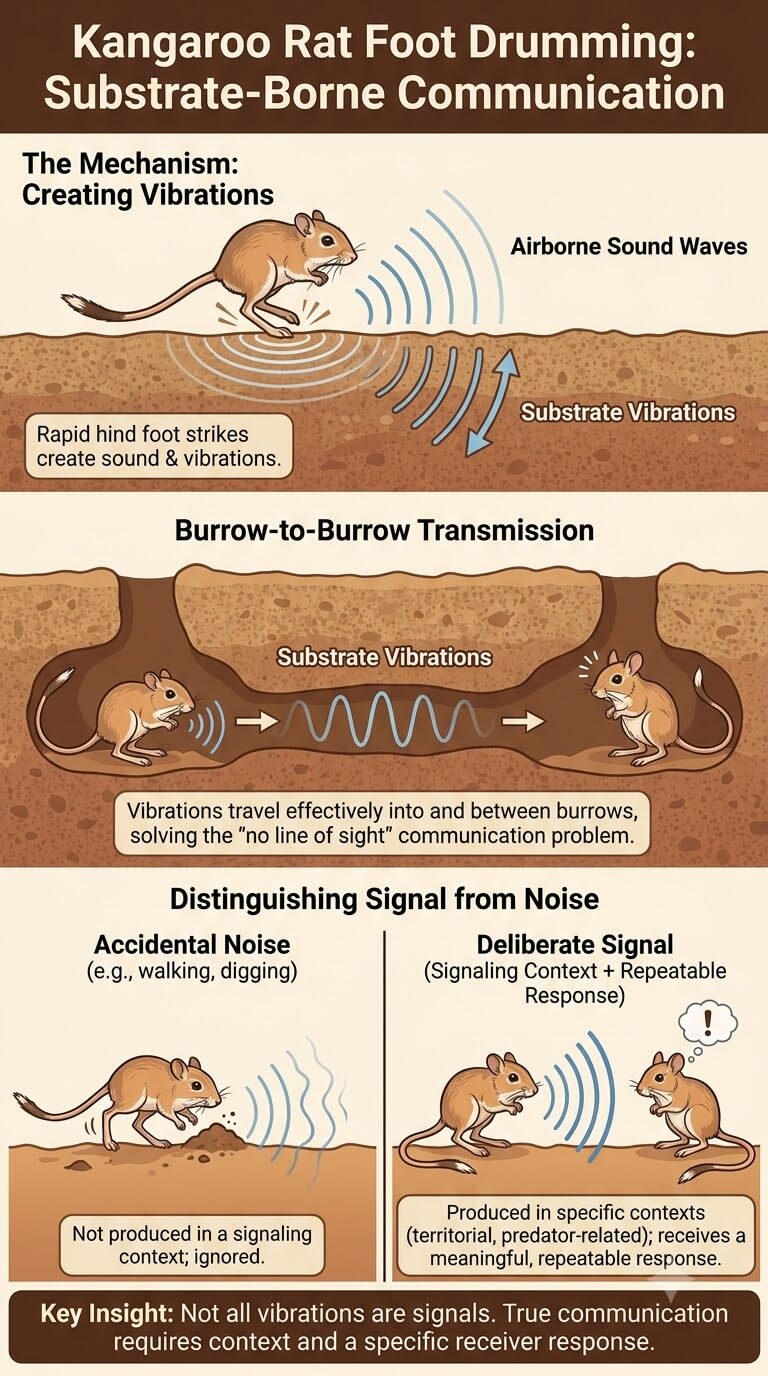
Foot drumming is one of the most distinctive rodent signals. Kangaroo rats can rapidly strike the ground with their hind feet, creating airborne sound and vibrations that travel through the substrate.
The behavior can occur in territorial or predator-related contexts depending on species. It is not a universal feature of kangaroo rats, much less of all rodents.
Vibrations can travel between burrows
Experiments with banner-tailed kangaroo rats showed that substrate-borne components of foot drumming can transmit effectively into burrows. In a study of seismic communication in banner-tailed kangaroo rats, animals responded to vibration patterns transmitted through the ground even when airborne sound was strongly reduced.
This solves an important communication problem. A rodent inside a burrow can receive a signal from another animal without needing a direct line of sight.
Not every vibration is a deliberate signal
Animals create vibrations simply by walking, digging, feeding, or moving objects. To call a vibration communication, researchers look for evidence that it is produced in a signaling context and that receivers respond in a meaningful, repeatable way.
This distinction prevents accidental noise from being mistaken for a specialized message.
Communication in Different Rodent Lifestyles
Territorial rodents can advertise boundaries or occupancy
Solitary or territorial rodents still need to communicate. Scent marks, calls, drumming, and threat displays can reduce surprise encounters by indicating that an area is occupied.
These signals may help space individuals apart rather than bring them together, showing that communication is not the same thing as sociability.
Group-living rodents benefit from rapid social information
Prairie dogs, some ground squirrels, capybaras, and other social rodents regularly interact with nearby group members. Alarm calls, contact signals, scent, touch, and posture can help regulate those interactions.
Communication supports group living, but it is only one part of social organization. Family structure, dominance, cooperation, dispersal, and parental care are broader behavioral systems.
Underground, arboreal, and semiaquatic rodents face different constraints
Underground rodents have limited opportunities for long-range visual signaling. Tree-dwelling rodents may benefit more from calls and visible postures across branches. Semiaquatic rodents encounter changing conditions at the boundary between air, land, vegetation, and water.
These habitat differences help explain why Rodentia contains such a varied communication toolkit rather than one standard signaling system.
Common Myths About Rodent Communication

Myth: Rodents only squeak
Rodents can communicate acoustically, chemically, visually, tactilely, and through substrate vibration. Even within sound, audible calls are only part of the picture because some species use ultrasound.
Myth: Every ultrasonic sound is a social message
Ultrasonic calls must be interpreted from context. Researchers study the sender, receiver, acoustic structure, and behavioral response before assigning function. Some associations are well supported in laboratory mice and rats, while many details remain under investigation.
Myth: Prairie dogs speak a human-like language
Prairie dog alarm calls can contain structured information about threats, which is scientifically impressive on its own. Calling the system human-like language goes beyond what alarm-call experiments establish and can obscure the actual evidence.
Myth: Lab mice and rats represent all rodents
Mice and rats are exceptionally important research animals, so scientists know far more about some of their signals than about those of many wild rodents. That uneven research base can create an illusion of universality. Findings from one model species should be extended to the rest of Rodentia only when comparative evidence supports the step.
How Signals Work With Senses and Social Life
A signal only works if another animal can detect it
Communication begins with the sender but depends equally on the receiver. Ultrasonic calls require hearing sensitive to those frequencies. Scent marks require chemical detection. Tail displays require visibility, and seismic signals require sensitivity to vibrations.
This is why communication and sensory biology are tightly linked. Evolution can favor signals that fit the receiver’s strongest sensory channels and the physical environment through which the signal travels.
Social relationships affect when signals are useful
The same species may signal differently toward a mate, offspring, neighbor, rival, predator, or unfamiliar animal. Familiarity and previous interactions can change the receiver’s response as well.
Communication therefore helps maintain social relationships without being identical to social organization. Calls and scent marks are mechanisms; colonies, family groups, territories, and cooperative systems are broader patterns of life.
Multiple channels can reinforce or modify one another
Rodent signals rarely exist in isolation. A nearby animal may hear a call while also seeing the caller’s posture and smelling scent marks in the area. These channels can reinforce the same information or provide different pieces of context.
Studying communication as a multimodal system gives a more realistic picture than asking what one sound or one smell “means” by itself.
FAQ
Can humans hear all rodent sounds?
No. Humans can hear many rodent squeaks, chatters, whistles, and other audible calls, but ultrasonic vocalizations are above the normal human hearing range. Researchers use ultrasonic microphones and specialized software to record and analyze those signals.
Why do some rodents use ultrasonic calls?
Ultrasound can function in social, reproductive, alarm, or affect-related contexts depending on the species. Mice, rats, and Richardson’s ground squirrels provide documented examples. The advantage and meaning of ultrasound vary, so it should not be assigned one universal function.
How do rodents communicate with scent?
Many rodents deposit urine or glandular odors on surfaces. Other animals can investigate those marks later and may obtain information related to the sender’s identity, sex, reproductive state, territory use, or social condition. The receiver’s response depends on species and context.
Do squirrels use their tails to communicate?
Some do. Ground squirrels can use tail flagging during predator encounters, and other squirrel species use tail movements in social or alarm contexts. However, tail movements are species-specific, so one display should not be translated the same way across all squirrels.
Do prairie dogs have a language?
Prairie dog alarm calls can vary in ways associated with predator type and other threat characteristics, showing sophisticated information transfer. Scientists can describe those demonstrated signal properties without equating the system with human language, which involves additional structural and cognitive features.
Final Thoughts
Rodent communication is a multimodal system rather than a collection of squeaks. Sounds, ultrasound, scent, touch, posture, tail displays, foot drumming, and ground vibrations allow different species to solve different signaling problems. A prairie dog broadcasting a predator warning and a kangaroo rat drumming outside a burrow are both communicating, but they are using systems shaped by very different habitats and social pressures.
The most useful way to interpret any rodent signal is to keep the species and context in view. Research on mice and rats reveals extraordinary detail, but it cannot stand in for every member of Rodentia. By comparing signals across rodents, the broader pattern becomes clearer: communication evolves around what receivers can sense, what the environment allows to travel, and what information matters at that moment. The variety of these signals reflects the broader diversity of rodents across Rodentia.

Ethan Walker is the founder and research editor of Animal Fact Central. He creates and reviews educational animal facts content using trusted wildlife, pet care, and science-based sources. His work focuses on making animal behavior, adaptations, habitats, and species facts clear, accurate, and engaging for everyday readers.
Read More Details About Ethan Walker: https://animalfactcentral.com/ethan-walker/