

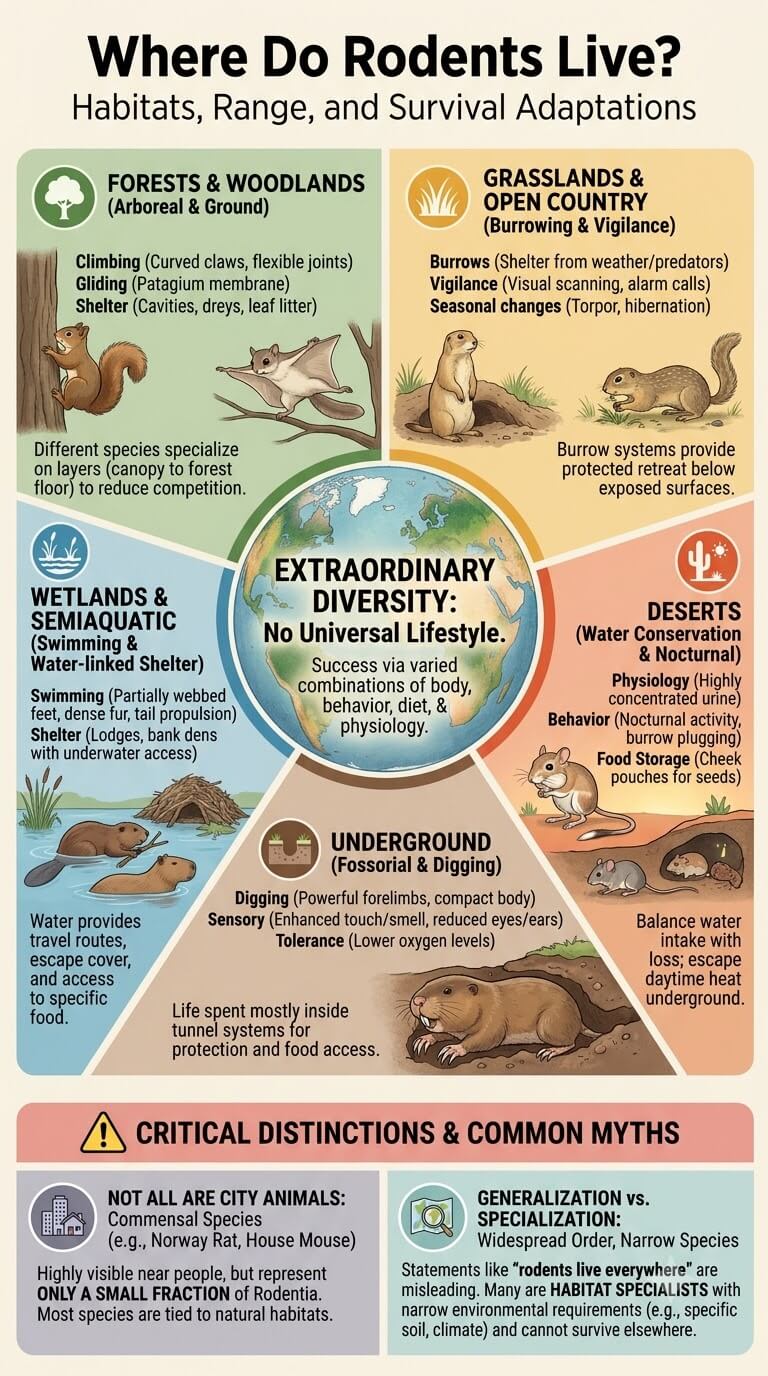
Rodents live in an extraordinary range of environments, from tropical forests and temperate woodlands to grasslands, deserts, mountains, wetlands, farms, and cities. Some spend most of their lives in trees, others underground, and a few are strongly associated with freshwater. Their success comes not from one universal lifestyle, but from many different combinations of body structure, behavior, diet, shelter use, and physiology.
A flying squirrel crossing a forest canopy, a kangaroo rat surviving on dry desert seeds, a pocket gopher tunneling through soil, and a beaver swimming through a freshwater pond are all rodents. Their habitats place very different demands on them. Claws and gliding membranes help in trees, powerful forelimbs and compact bodies help underground, water-conserving physiology matters in deserts, and dense fur, swimming ability, or partially webbed feet can help semiaquatic species.
It is also important not to confuse rodents with the small number of rats and mice that thrive around people. Human-associated species are highly visible, but they represent only one part of Rodentia. Most rodent species are tied to natural habitats and many have much narrower environmental requirements than a city rat.
Quick Answer: Rodents Occupy an Extraordinary Range of Habitats
Forests and woodlands
Forests support tree squirrels, flying squirrels, woodrats, mice, porcupines, and many other rodents. Some spend much of their time above ground in branches, while others forage through leaf litter, use fallen logs, or shelter underground. A large rodent family such as Cricetidae alone includes species from forests, grasslands, deserts, wetlands, agricultural areas, and human settlements, illustrating how broad habitat diversity can be even within one branch of Rodentia. The Animal Diversity Web overview of Cricetidae describes this family across dry, wet, warm, and cold environments.
Forest structure creates multiple layers of habitat. Food and shelter may occur underground, on the forest floor, inside tree cavities, along trunks, or high in the canopy. Different rodents specialize on different layers rather than all competing for the same space.
Grasslands, deserts, mountains, and underground habitats
Open habitats can expose rodents to heat, cold, wind, and predators. Burrowing is one common solution because soil provides cover and buffers some surface extremes. Prairie dogs and ground squirrels use burrows in grasslands, kangaroo rats retreat underground in deserts, and pocket gophers spend most of their lives inside tunnel systems.
Mountain rodents face additional challenges such as colder temperatures, seasonal snow, rocky terrain, and shorter growing seasons. Some use rock crevices, dense fur, seasonal fat storage, hibernation, or changes in activity, but these adaptations occur in selected species rather than throughout Rodentia.
Wetlands, freshwater edges, farms, and cities
Beavers, muskrats, capybaras, and other rodents live close to water, while some rats, mice, squirrels, and voles readily use agricultural or suburban landscapes. The shared feature is not a single body plan, but the ability of each species to exploit the resources and shelter available in its environment.
Human-modified habitats are only one part of the picture. A species that succeeds in barns or cities may be highly flexible, while another rodent may depend on a particular soil type, forest structure, water source, or plant community and may not tolerate urban conditions at all.
Rodent Distribution and Range
Why distribution differs among species and lineages
Rodentia has a near-global distribution, but individual species can have ranges that are enormous, moderate, or extremely small. Geographic range depends on evolutionary history, climate, food, predators, competitors, barriers such as oceans or mountains, and the ability to survive local environmental conditions.
Even closely related rodents can occupy different parts of the same region. One may prefer dry grassland, another moist forest, and another streamside vegetation. Habitat suitability therefore determines where a species can persist within its broader geographic range. This habitat range reflects the broader biological diversity of Rodentia.
Native range versus introduced range
A native range is the area where a species occurs through its natural evolutionary and dispersal history. An introduced range is an area reached with direct or indirect human assistance. This difference is especially important for highly mobile commensal rodents.
The Norway rat is a useful example. Despite its common name, it is native to Asia and has spread widely with human trade and settlement. The Smithsonian’s Norway rat profile describes a species now found across much of the world because of its close association with people. That global success should not be used to describe the natural distribution of all rodents.
Why broad global claims need caution
Statements such as “rodents live everywhere” hide important biogeographic details. Remote islands may have few or no native terrestrial rodents, while introduced rats and mice can later become widespread. On large continents, one rodent family may be diverse in one region and absent from another.
For this reason, range questions are best answered at the species or family level when precision matters. The order as a whole is widespread, but individual rodents can be habitat specialists with very limited distributions.
Forest and Woodland Rodents
Tree squirrels and arboreal movement
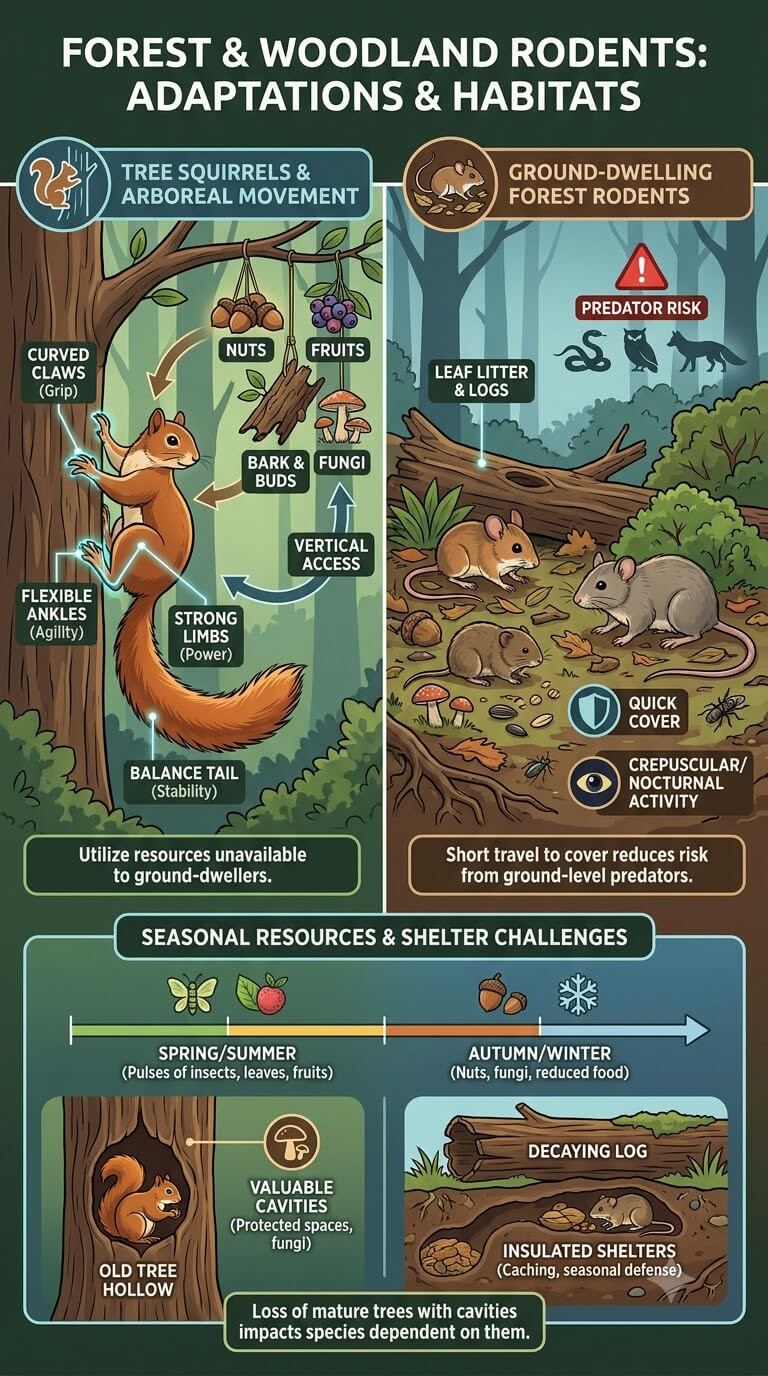
Tree squirrels have curved claws, flexible ankles, strong limbs, and excellent balance that help them climb bark and move through branches. Their long tails can help with balance and body control, especially during jumps between supports.
Forest life also gives them access to nuts, seeds, fruits, buds, bark, fungi, insects, and tree cavities. The exact diet and shelter depend on species and season, but vertical movement allows tree squirrels to use resources unavailable to strictly ground-dwelling rodents.
Ground-dwelling forest rodents
Many forest rodents remain near the ground. Deer mice, voles, woodrats, and other small species move through leaf litter, logs, shrubs, roots, and low vegetation. Fallen wood and dense understory create cover while seeds, fungi, fruits, and invertebrates provide food.
Living on the ground places animals within reach of snakes, owls, foxes, mustelids, and other predators. Short travel routes to cover, nocturnal or crepuscular activity in some species, and strong smell or hearing can reduce risk.
Food, cover, cavities, and seasonal resources
Forests change through the year. Nuts and seeds may appear in seasonal pulses, leaves and insects vary with temperature, and winter can reduce food availability in temperate regions. Rodents respond through flexible diets, caching, seasonal changes in activity, or use of insulated shelters.
Old trees and dead wood can be especially valuable because they provide hollows, decaying wood, fungi, and protected spaces. Species that depend on cavities may be affected when forests lose mature trees even if the total area remains wooded.
Grassland and Open-Country Rodents

Burrowing provides shelter from exposure
Grasslands offer food and visibility, but they can leave small mammals exposed to predators and weather. Burrows provide a protected retreat below the surface, where wind is reduced and temperature changes more slowly.
Ground squirrels, prairie dogs, voles, pocket gophers, and other rodents use underground space in different ways. Some forage mainly above ground and retreat below for safety. Others spend most of their lives inside tunnels.
Prairie dogs, ground squirrels, and other representative examples
Prairie dogs are especially associated with North American grasslands, where burrow systems provide shelter and social space. Ground squirrels occupy a broader range of open habitats and can use grasslands, meadows, rocky slopes, and disturbed areas depending on species.
These animals are often visible near burrow entrances because they must balance feeding with vigilance. An open landscape makes visual scanning useful, while alarm calls can warn nearby animals of approaching predators.
Living with temperature swings and variable vegetation
Open-country rodents experience rapid changes in heat, wind, rainfall, and plant growth. Food can be abundant after rain or during seed production and scarce later. Burrowing, food storage, seasonal dormancy, and changes in activity time can help selected species bridge those fluctuations.
No single strategy applies to every grassland rodent. Some remain active year-round, some hibernate, and others use short periods of torpor or simply alter daily activity.
Desert Rodents

Water conservation is a major challenge
Desert rodents must balance water intake with water lost in urine, feces, breathing, and evaporation. Kangaroo rats are famous for extremely efficient water conservation. The National Park Service guide to kangaroo rat desert adaptations explains that these rodents obtain much of their water from food and metabolic processes while producing highly concentrated urine and limiting water loss.
This adaptation belongs to kangaroo rats and related desert specialists, not all rodents. A beaver, capybara, or forest vole has very different access to water and therefore faces a different physiological problem.
Burrowing and avoiding daytime heat
Desert surfaces can become extremely hot, while burrows provide shade and a more stable microclimate. Many desert rodents stay underground through the hottest parts of the day and forage at night or around dusk and dawn.
At White Sands National Park, kangaroo rats plug burrow entrances with sand, which can help maintain a cooler and more humid refuge compared with the exposed surface. The behavior also shows how shelter architecture and habitat adaptation work together.
Food storage and seasonal activity
Desert seeds may appear in pulses after rainfall, so storing food can reduce dependence on finding a fresh seed crop every night. External cheek pouches allow kangaroo rats to move dry seeds efficiently before caching them.
Some desert rodents also shift activity according to moonlight, temperature, predators, and food conditions. A dark night may reduce exposure to visually hunting predators, while extreme cold or heat can make staying inside the burrow safer.
Mountain and Cold-Climate Rodents
Insulation and seasonal changes
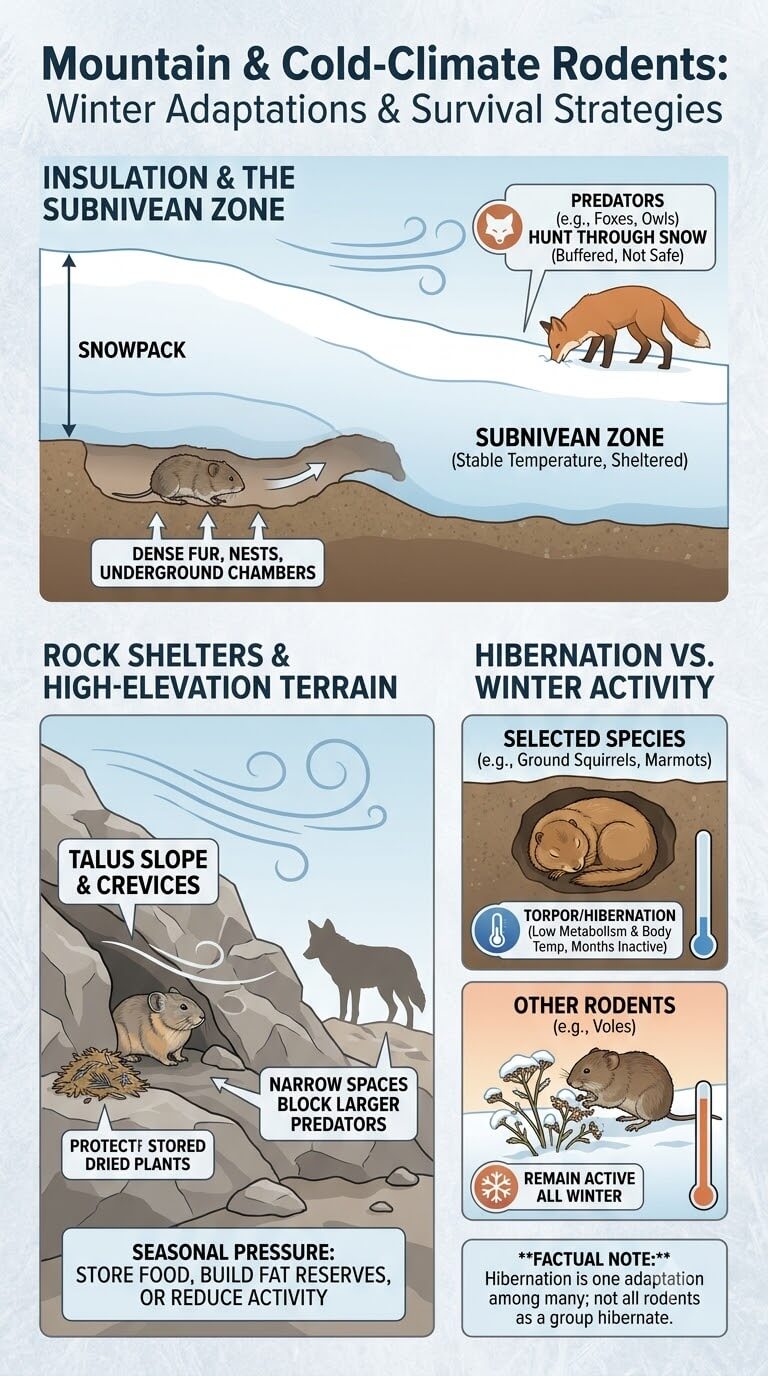
Cold-climate rodents benefit from dense fur, sheltered nests, underground chambers, and the insulating effect of snow. Snow can create a subnivean zone, the space between the ground and snowpack, where temperatures may be more stable than the air above.
Voles and other small rodents can move and feed beneath snow while remaining partly protected from wind and extreme cold. Predators such as owls and foxes still hunt them through or under the snow, so the environment is buffered rather than safe.
Rock shelters and high-elevation terrain
Mountain rodents may use talus slopes, crevices, boulder fields, or burrows in alpine soil. Rocky refuges provide narrow spaces that larger predators cannot easily enter and can reduce exposure to wind.
Food availability is often seasonal at high elevation, creating pressure to store food, build fat reserves, or reduce activity during winter.
Hibernation and torpor occur in selected species
Ground squirrels and marmots are well-known rodent hibernators. During hibernation, metabolism and body temperature drop for extended periods, allowing the animal to survive months when food is scarce and temperatures are low.
Other rodents remain active all winter. It is therefore incorrect to say that rodents as a group hibernate. Hibernation is one adaptation among many.
Underground and Fossorial Rodents

Digging limbs, body form, and tunnel life
Fossorial means adapted for digging and spending much of life underground. Pocket gophers provide a clear example. The Animal Diversity Web overview of pocket gophers describes compact bodies, short powerful limbs, broad forefeet, enlarged claws, and skull and incisor features suited to excavation.
Some pocket gophers can close their lips behind the incisors, allowing them to loosen soil or roots without filling the mouth with dirt. Their tunnel systems also provide access to underground plant parts while keeping much of their activity hidden from surface predators.
Sensory shifts underground
Vision is less useful in a dark tunnel than it is in a tree canopy or open grassland. Many fossorial rodents have reduced external ears or smaller eyes and rely strongly on touch, smell, vibration, and memory.
Whiskers, sensitive tails, and contact with tunnel walls can provide information about nearby objects and direction. These sensory shifts are adaptations to darkness, not evidence that every underground rodent is completely blind.
Soil and oxygen create their own challenges
Living underground reduces exposure to surface weather but creates new problems. Dense soil can be costly to excavate, poorly ventilated tunnels can have lower oxygen and higher carbon dioxide, and wet soils may flood or collapse.
Fossorial rodents are therefore shaped not just by darkness, but by the physical chemistry and structure of soil. Species distributions can be strongly limited by whether local ground is suitable for digging.
Wetland and Semiaquatic Rodents

Beavers and capybaras show different semiaquatic lifestyles
Beavers live along ponds, lakes, streams, and rivers, where water provides travel routes, escape cover, food, and access to lodges or bank dens. The Animal Diversity Web profile of American beavers describes their association with freshwater habitats and their use of lodges and water-linked shelter systems.
Capybaras represent a different branch of Rodentia. They live in South American grasslands, marshes, lowland forests, and other habitats where water remains accessible. Their partially webbed feet and high placement of eyes, ears, and nostrils suit a semiaquatic lifestyle.
Swimming changes how rodents use landscapes
Semiaquatic rodents can move through water to reach food, escape threats, or travel between resting sites. A body adapted for swimming may have dense fur, strong hind limbs, partly webbed feet, or a tail that assists propulsion or steering depending on species.
These traits vary. A beaver’s broad tail and a capybara’s foot structure are not interchangeable versions of the same adaptation.
Freshwater edges provide both food and shelter
Wetlands and riparian zones can support grasses, aquatic vegetation, woody plants, roots, and dense cover. Beavers feed on bark, cambium, leaves, and aquatic plants, while capybaras graze heavily on grasses and other vegetation.
Water access shapes more than diet. It affects predator escape, thermoregulation, social behavior, and the location of shelters.
Arboreal and Gliding Rodents
Claws, balance, and branch movement
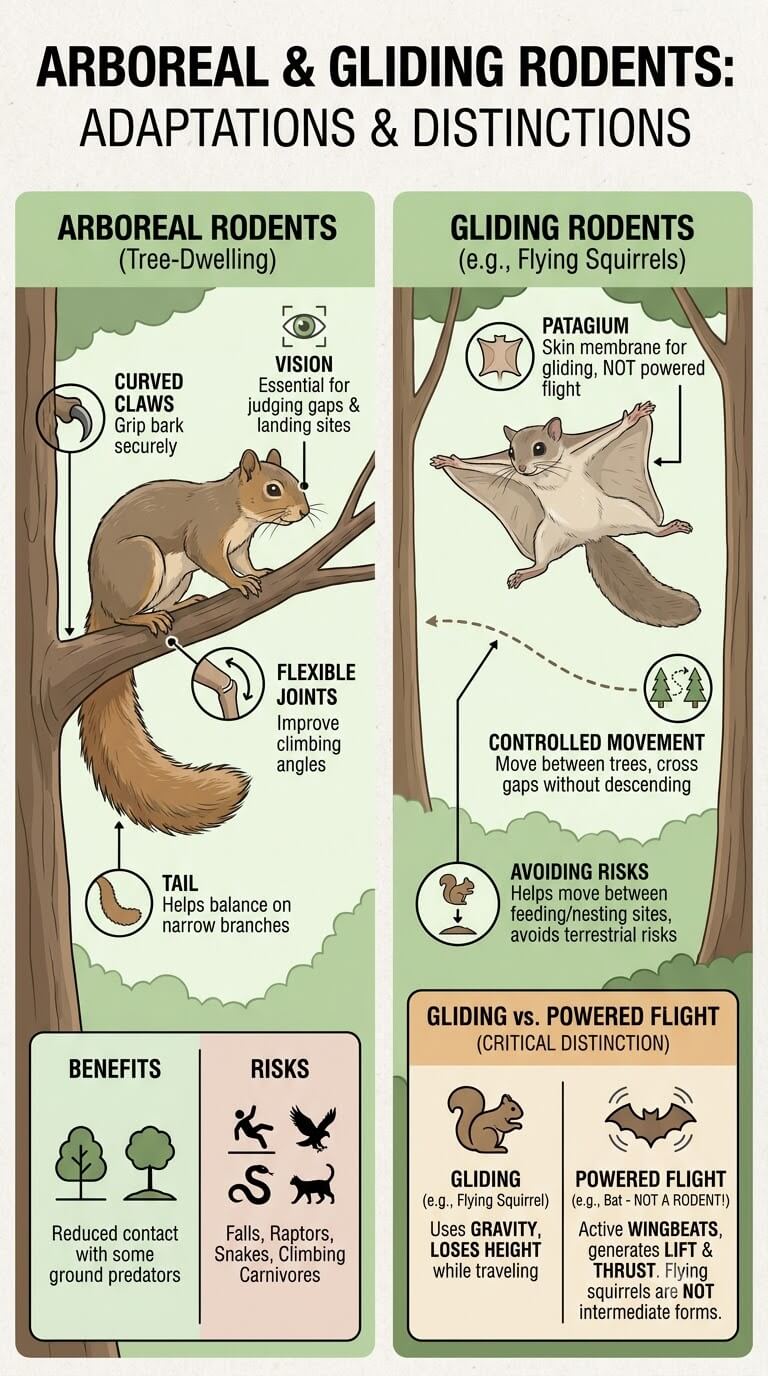
Arboreal rodents live or forage extensively in trees. Curved claws grip bark, flexible joints improve climbing angles, and tails can help balance on narrow branches. Visual information also becomes especially important when an animal must judge gaps and landing sites.
Tree living can reduce contact with some ground predators, but it creates new risks from falls, raptors, snakes, and climbing carnivores.
Flying squirrels use a gliding membrane
Flying squirrels do not perform powered flight. They glide using a membrane of skin called a patagium stretched between the limbs. The Animal Diversity Web profile of southern flying squirrels describes the patagium extending between the front and hind limbs and allowing controlled movement between trees.
Gliding lets these squirrels cross gaps without descending to the ground, helping them move between feeding and nesting sites while avoiding some terrestrial risks.
Gliding is different from powered flight
A gliding animal loses height as it travels and uses gravity to maintain forward movement. A bat generates lift and thrust through active wingbeats. Flying squirrels therefore belong with gliding mammals, not flying mammals in the aerodynamic sense.
This distinction matters because bats are not rodents, and flying squirrels are not intermediate forms between squirrels and bats.
Agricultural and Human-Modified Landscapes
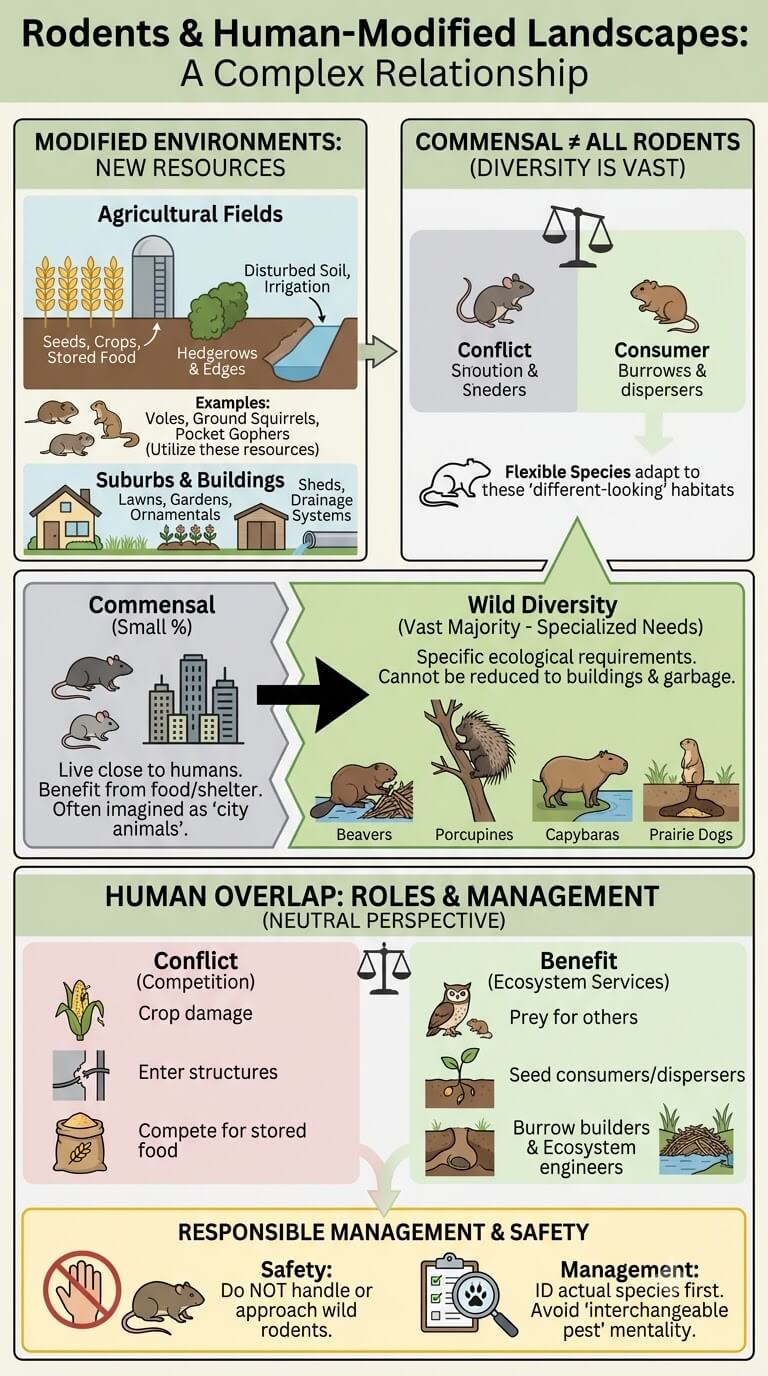
Some species use farms, buildings, and planted environments
Agricultural fields can provide seeds, crops, irrigation, field edges, hedgerows, stored food, and disturbed soil. Some voles, mice, rats, ground squirrels, and pocket gophers can take advantage of these resources.
Suburbs may offer trees, lawns, gardens, sheds, drainage systems, and ornamental plantings. Flexible species can use these environments even when the landscape looks very different from their ancestral habitat.
Commensal rats and mice are only a small part of Rodentia
Commensal species live in close association with humans and benefit from human food, shelter, or infrastructure. Norway rats and house mice are the most familiar examples, which is why rodents are often imagined as city animals.
But beavers, capybaras, flying squirrels, porcupines, prairie dogs, chinchillas, and countless other rodents have ecological requirements that cannot be reduced to buildings and garbage.
Human overlap should be described neutrally
Rodents can damage crops, enter structures, or compete for stored food, but they also serve as prey, seed consumers, seed dispersers, burrow builders, and ecosystem engineers. Whether a species creates conflict depends on where it lives and how its behavior overlaps with human activity.
Wild rodents should not be handled or approached closely. When conflict occurs around buildings or property, identification and management are best based on the actual species rather than treating all rodents as interchangeable pests.
How Habitat Changes the Way Rodents Live
Activity timing responds to local conditions
Desert heat can favor nighttime activity, while many tree squirrels are active in daylight. Cold climates may favor seasonal dormancy in some species, and predators can alter when animals leave shelter.
There is therefore no universal rodent activity schedule. Nocturnal, diurnal, crepuscular, and flexible patterns all occur.
Shelter is one adaptation within a habitat
A burrow, nest, cavity, lodge, or rock crevice is a protected site inside the broader environment. Desert rodents may use burrows to avoid heat, tree squirrels use cavities or dreys in forests, and beavers use water-linked shelters in freshwater habitats.
The shelter makes sense only when viewed within the environmental challenge it solves.
Food storage and social behavior also change with habitat
Seasonal seed crops can favor caching, while stable grazing resources may favor different feeding strategies. Burrow architecture can influence whether animals live alone or tolerate neighbors, and open landscapes can favor alarm systems that rapidly warn nearby animals.
Habitat shapes behavior indirectly by changing the costs and benefits of movement, feeding, shelter, communication, and group living.
Common Myths About Rodent Habitats
Myth: Rodents all live underground
Many rodents burrow, but others live in trees, wetlands, rock crevices, grasslands, forests, or human structures. Flying squirrels are arboreal, beavers are semiaquatic, and capybaras remain closely tied to water.
Myth: Rodents are mainly city animals
City rats and mice are highly visible because they live close to people. Rodentia as a whole is primarily a wildlife group occupying natural environments around the world.
Myth: All rodents are nocturnal
Rodents include day-active tree squirrels and ground squirrels as well as nocturnal mice, rats, flying squirrels, and desert specialists. Activity time varies with species, temperature, predators, and season.
Myth: All rodents hibernate
Some ground squirrels and marmots hibernate, while many mice, rats, squirrels, beavers, capybaras, and other rodents remain active. Hibernation is a specialized solution to particular seasonal conditions.
Edge Cases and Biogeographic Cautions
Islands can have introduced rodent populations
Oceanic islands may lack native terrestrial rodents yet support introduced rats or mice brought unintentionally by ships or human settlement. These introductions can dramatically change local ecology because island plants and animals may have evolved without comparable mammalian predators or seed consumers.
That is why an animal’s current presence does not automatically indicate native range.
Some rodents have narrow habitat requirements
A rodent can be widespread as a family while one species is restricted to a particular mountain range, soil type, forest structure, wetland, or climatic zone. Pocket gophers are a good example of how soil texture can limit a fossorial animal even when nearby habitat looks superficially suitable.
Habitat specialists may be far less flexible than commensal rats and mice.
Generalizations can hide conservation-sensitive specialists
Calling rodents universally adaptable can obscure species that depend on shrinking habitats or very specific environmental conditions. Conservation status must be evaluated species by species and can change with updated assessments.
A rodent order known for ecological flexibility still contains specialists that are vulnerable when forests, grasslands, wetlands, or soils are altered.
FAQ
Do rodents live on every continent?
Rodents have a near-global distribution and occur across all major inhabited continents, but broad statements need care because native and introduced ranges differ. Antarctica does not support resident terrestrial rodent populations, while many oceanic islands gained rats or mice only after human transport.
Which rodents live in deserts?
Kangaroo rats, pocket mice, some ground squirrels, gerbils, jerboas, and several other rodent groups include desert-adapted species. Their adaptations can include burrowing, nocturnal activity, efficient water conservation, seed storage, long hind limbs, or tolerance of highly seasonal food supplies.
Are there aquatic or semiaquatic rodents?
Yes. Beavers, muskrats, capybaras, nutria, and other rodents are strongly associated with water. They still breathe air and are mammals, but swimming ability, fur, foot structure, body shape, and shelter use help them exploit freshwater and wetland habitats.
Do all rodents live near people?
No. Norway rats and house mice are unusually successful around people, but many rodents live primarily in forests, deserts, mountains, wetlands, grasslands, or underground systems. Some habitat specialists avoid heavily altered landscapes.
How do underground rodents survive in burrows?
Fossorial rodents have adaptations such as strong digging limbs, compact bodies, specialized claws or incisors, tactile sensory systems, and physiology suited to the lower-oxygen, higher-carbon-dioxide conditions that can occur underground. Their burrows also reduce exposure to predators and surface weather, although digging and ventilation create their own challenges.
Final Thoughts
Where rodents live depends on the species, not on a single rodent lifestyle. Forest canopies favor climbing and gliding, grasslands favor burrows and vigilance, deserts reward water conservation and heat avoidance, underground habitats favor digging and tactile sensing, and wetlands favor swimming and water-linked shelter. Farms and cities support only the subset of species able to exploit human-modified conditions.
The most useful way to understand rodent habitats is to connect each environment with the problem it creates and the adaptation that helps solve it. Rodents are widespread because different lineages evolved different solutions, not because every rodent can live everywhere. That distinction explains both the remarkable ecological range of Rodentia and the narrow habitat needs of many individual species.

Ethan Walker is the founder and research editor of Animal Fact Central. He creates and reviews educational animal facts content using trusted wildlife, pet care, and science-based sources. His work focuses on making animal behavior, adaptations, habitats, and species facts clear, accurate, and engaging for everyday readers.
Read More Details About Ethan Walker: https://animalfactcentral.com/ethan-walker/