
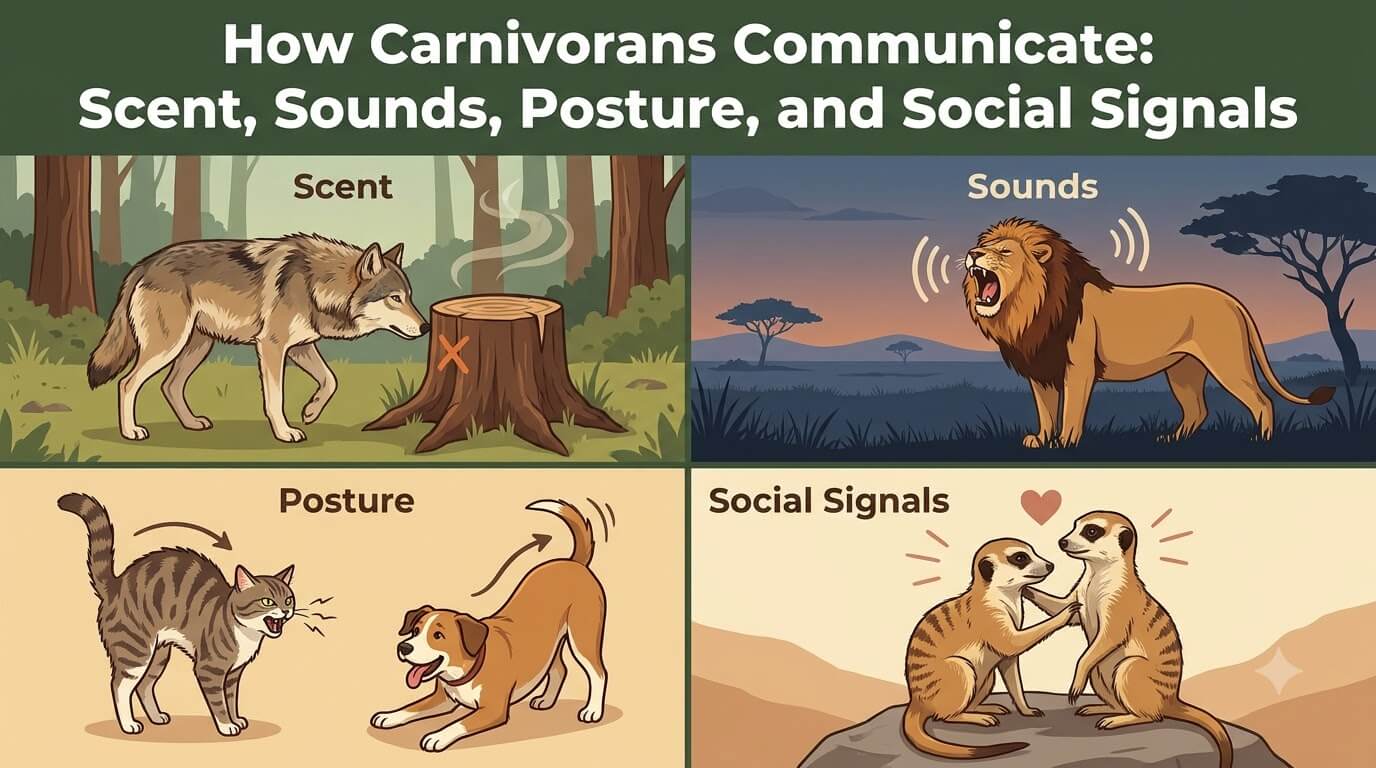
Carnivorans communicate through more than howls, roars, growls, and barks. Members of the order Carnivora also exchange information with scent, facial expression, ear and tail position, body posture, touch, and combined signals. A solitary cat scent-marking, a wolf pack howling, a spotted hyena pasting odor onto grass, and a sea lion mother calling to her pup all illustrate systems shaped by different social lives and environments.
There is no single carnivoran “language.” The meaning of a sound or posture depends on the species, the individual, the setting, and the signals that accompany it. Even closely related animals can emphasize different channels. Some depend heavily on scent because receivers may arrive hours later. Others use conspicuous calls because group members must coordinate over distance. The pattern is diversity, not one universal code.
Quick Answer
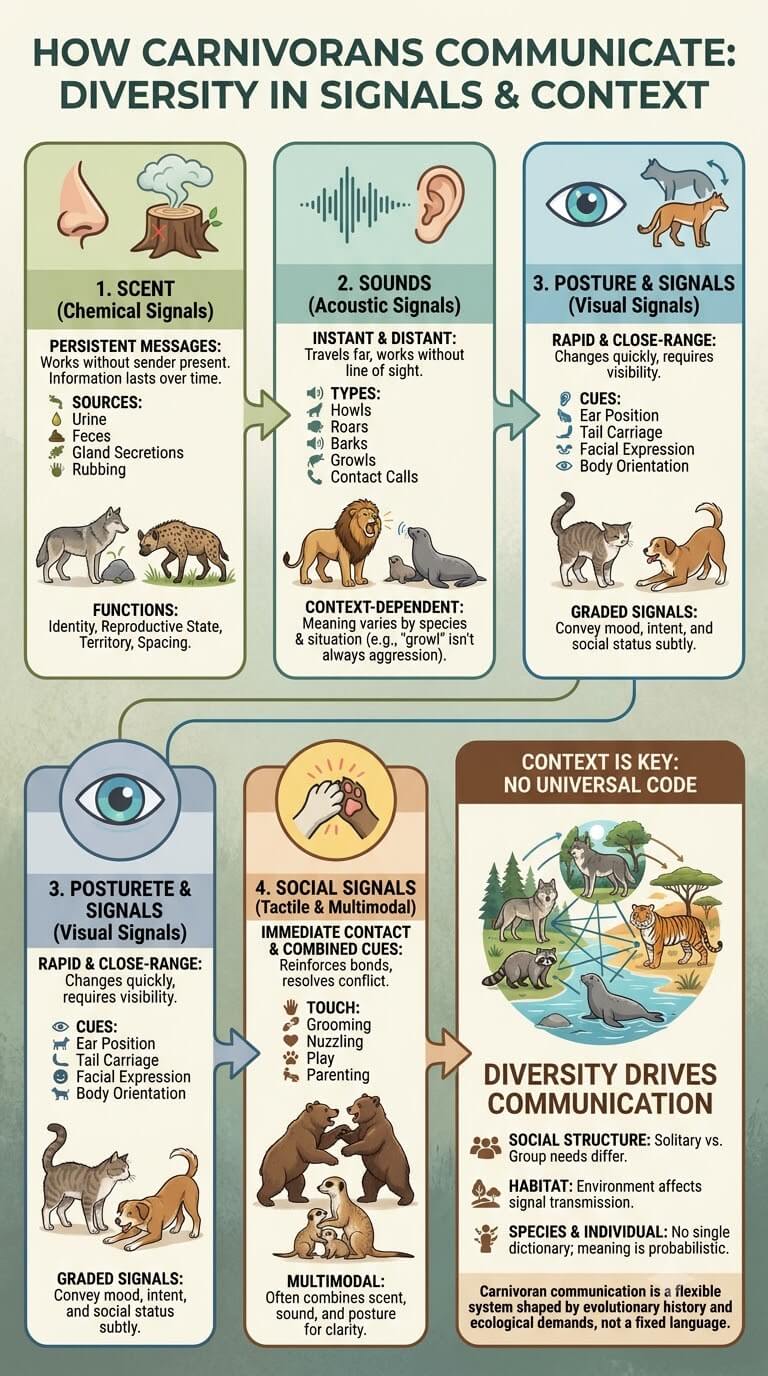
Carnivorans communicate with chemical, acoustic, visual, and tactile signals. Chemical communication includes urine, feces, gland secretions, rubbing, scratching, and other scent-associated behaviors. Acoustic communication includes calls such as howls, roars, barks, growls, contact calls, alarm calls, and pup calls. Visual communication uses body orientation, facial expression, ears, tails, mouth position, and movement. Touch can matter during greeting, grooming, courtship, play, conflict resolution, and parent-young interactions.
A broad overview from the Animal Diversity Web account of Carnivora describes chemical, acoustic, visual, and tactile communication across the order. That variety is important because Carnivora includes highly social species, mostly solitary species, forest dwellers, open-country hunters, climbers, burrow users, and aquatic pinnipeds. Their communication systems reflect these different ways of living.
Why Carnivoran Communication Is So Diverse
A signal only works if another animal can detect it under the conditions where communication matters. A scent mark can remain after the sender has left. A loud call can travel far but may also reveal the caller’s position. A facial expression can change rapidly and provide precise information at close range, but it is useless if the receiver cannot see the sender. Touch is even more local, yet it can be important in bonds between parents and young or between members of a social group.
Solitary, Social, Terrestrial, Arboreal, and Aquatic Contexts
Social structure changes the communication problem. A largely solitary carnivoran may need to advertise reproductive condition, identity, or recent presence without meeting another individual face to face. A group-living species may need signals for spacing, reunion, conflict, play, care of young, or coordinated movement. Neither lifestyle is simpler. Solitary animals still encounter mates, competitors, neighbors, and offspring, while social animals also need signals that work when group members separate.
Habitat matters as well. Dense vegetation can limit long-distance vision. Wind, vegetation, terrain, and background noise affect sound. Water changes how acoustic and chemical cues travel. Arboreal animals must signal while moving in three-dimensional spaces, while animals using dens may communicate in darkness or at close range. The result is not one evolutionary recipe but many combinations of signals.
Scent Communication
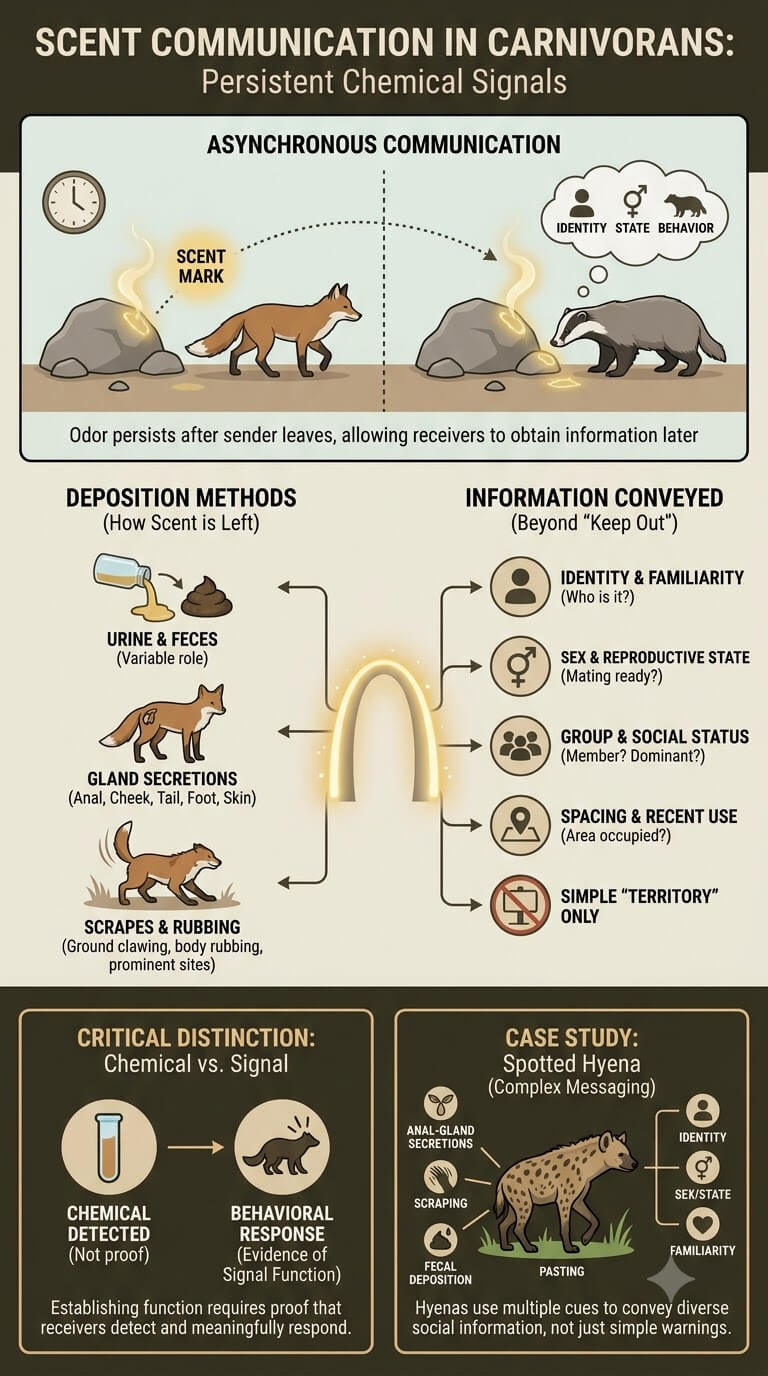
Chemical signals are especially important in many carnivorans because odor can persist after an animal leaves. That makes scent useful for communication that does not require sender and receiver to be present at the same time. A receiver can investigate a mark later and obtain information that may affect where it goes, how it behaves, or whether it seeks or avoids another individual.
A recent review in Chemical Senses on chemical signaling in Carnivora found substantial diversity in the substances and behavioral contexts studied across the order. The authors also cautioned that detecting a chemical in a secretion does not automatically prove that the chemical functions as a signal. Establishing a behavioral function requires evidence that receivers detect and respond to it in a meaningful way.
Urine, Feces, Gland Secretions, Scrapes, and Rubbing
Scent can be deposited in several ways. Urine and feces may carry information, but their communicative role varies by species and context. Anal, cheek, tail, foot, or other skin glands can contribute odors. Some carnivorans rub parts of the body on objects, scrape the ground, claw trees, or repeatedly visit prominent marking sites. The visible mark and the odor may work together.
These behaviors should not be reduced to the statement that carnivorans “mark territory.” A scent deposit can have more than one possible function. Depending on the species, it may be associated with identity, sex, reproductive state, familiarity, group membership, spacing, dominance interactions, or recent use of an area. In some cases, researchers know the behavior well but still do not know exactly which chemical components carry the important information.
Identity, Reproduction, Space Use, and Social Information
Odor can be particularly valuable when individuals need to recognize one another without direct contact. Repeated use of scent posts may create information-rich locations where several animals investigate deposits over time. Such sites can help neighbors assess who has been present and may reduce the need for direct encounters.
Spotted hyenas provide a well-studied example of complex chemical and social communication. A detailed Mammalian Species account of the spotted hyena describes pasting with anal-gland secretions, scraping, fecal deposition, vocal signaling, and visual postures. Research summarized there shows that some odor cues can convey information about sex, reproductive state, familiarity, and individual identity. Hyenas are therefore a useful reminder that scent communication can carry much more than a simple “keep out” message.
Vocal Communication
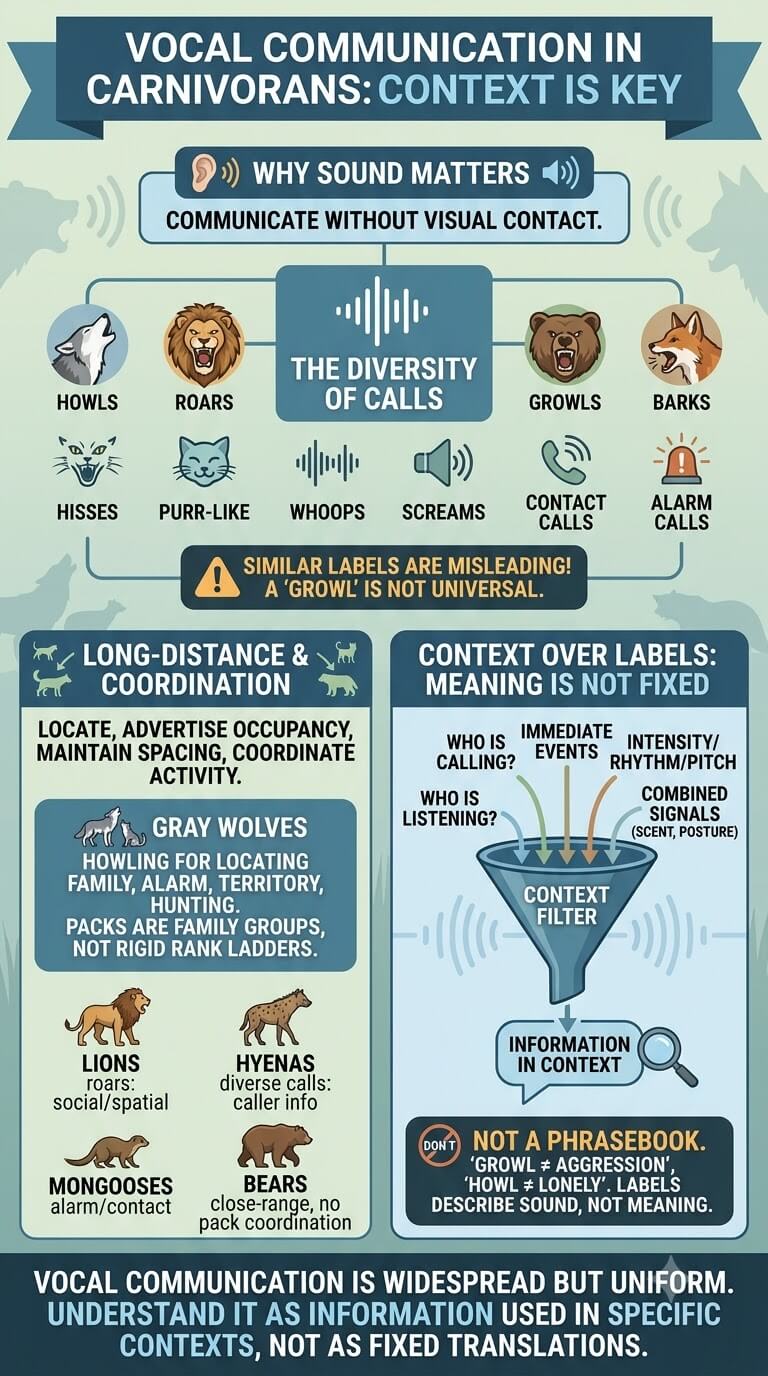
Sound is useful when animals need to communicate without being in visual contact. Carnivorans produce an enormous range of calls, including howls, roars, barks, growls, hisses, purr-like sounds, whoops, screams, contact calls, pup calls, and alarm calls. Similar labels can be misleading, however. A “growl” in one species is not automatically equivalent to a growl in another, and even within a species the same broad call type can vary with context.
Roars, Howls, Growls, Contact Calls, Alarm Calls, and Group Coordination
Long-distance calls can help animals locate one another, advertise occupancy, maintain spacing, or coordinate social activity. Gray wolves are a familiar example. The National Park Service overview of wolf ecology notes that howling can occur in several contexts, including locating separated pack members, alarm, territorial signaling, and periods around hunting. Wild wolf packs are usually family groups, so their calls occur within a social system built largely around parents and offspring rather than a rigid captive-style rank ladder.
Other carnivorans use very different vocal systems. Lions use roars in social and spatial contexts. Hyenas have diverse calls that can carry information about the caller and situation. Mongooses may use alarm or contact calls when group members need to monitor one another. Bears generally do not depend on pack-level vocal coordination, but they still vocalize during close social interactions, conflict, courtship, or mother-young contact. Vocal communication is widespread without being uniform.
Why Similar-Sounding Calls Do Not Have One Universal Meaning
Human labels encourage overinterpretation. We hear a low-frequency sound and call it a growl, or hear a sharp repeated sound and call it a bark. Those labels describe acoustic resemblance, not a universal message. Meaning depends on who is calling, who is listening, what happened immediately before the call, and what other signals are present.
Even within one species, a call can vary in intensity, rhythm, pitch, duration, or sequence. Receivers may also combine sound with scent, posture, familiarity, and location. For this reason, statements such as “a growl means aggression” or “a howl means the animal is lonely” are too rigid. Communication is better understood as information used in context, not as a phrasebook with one fixed translation per sound.
Visual Signals and Posture
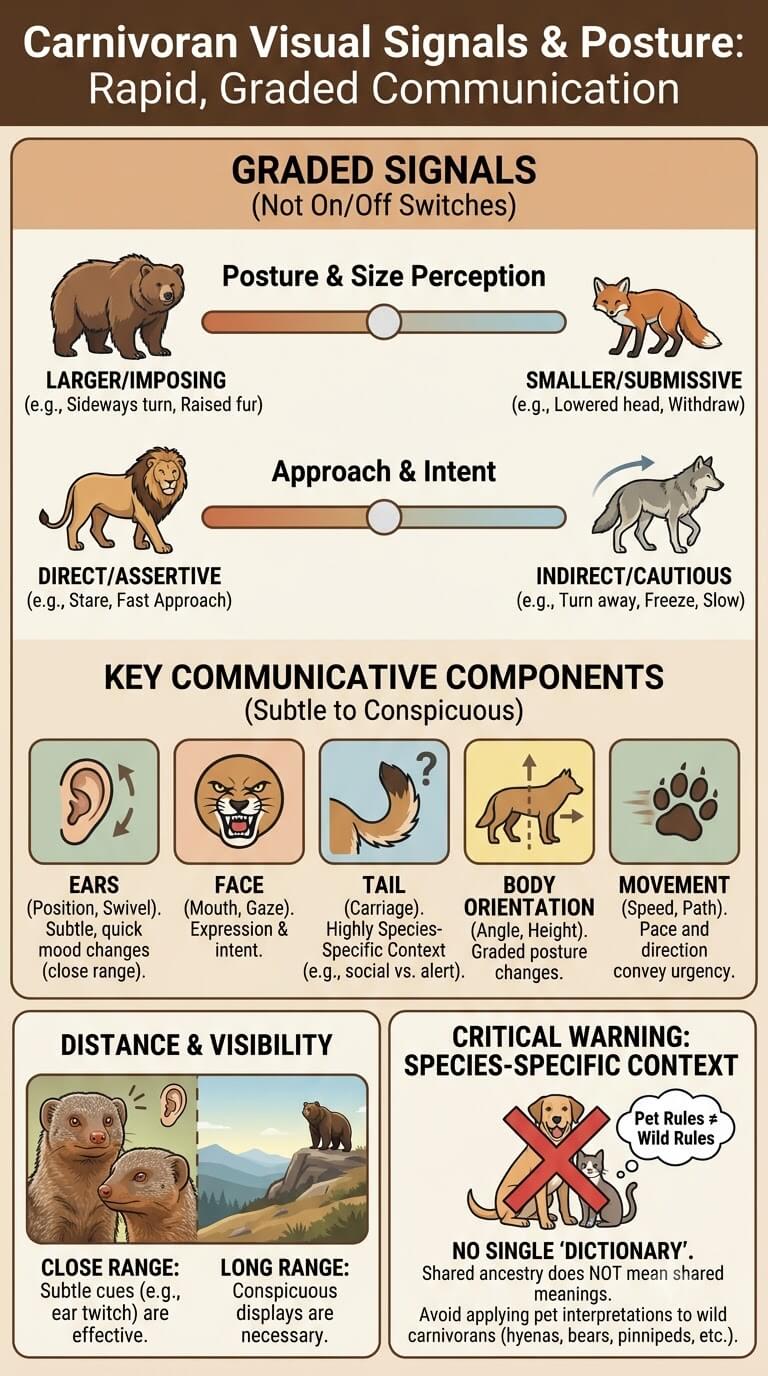
Visual communication can change in fractions of a second. Carnivorans may alter ear position, tail carriage, head angle, mouth shape, body height, gaze, orientation, fur position, or movement speed. These signals are especially useful at close or moderate range, where another animal can see subtle changes and respond quickly.
Ears, Face, Tail, Body Orientation, and Movement
Body posture often works as a graded signal rather than an on-off switch. An animal can make itself look larger or smaller, approach directly or indirectly, turn sideways, freeze, withdraw, lower its head, expose teeth, pin its ears, or change tail position. The same body part can be used differently across species. A tail held high in one carnivoran may occur in a social context that has no close equivalent in another.
Facial and postural cues also interact with distance. A subtle ear movement may be useful between nearby group members but irrelevant across a valley. Conversely, a conspicuous body display can be visible at longer range. Readers familiar with domestic dogs or cats should resist applying pet-specific interpretations to wild felids, hyenas, bears, mongooses, or pinnipeds. Shared ancestry does not create a single body-language dictionary.
Tactile Communication
Touch is the most immediate communication channel because sender and receiver must be close enough to make contact. It appears in grooming, nuzzling, licking, rubbing, play, courtship, greeting, maternal care, and conflict. Touch can reinforce information already communicated by odor, sound, or posture.
Grooming, Contact, Parent-Young Interactions, and Social Bonding
Parent-young communication is a clear example. Young carnivorans may use calls, movement, scent, and direct contact to stay connected with a parent. Mothers can respond to vocal or odor cues, while nursing and grooming add tactile information. In group-living carnivorans, physical contact may also help maintain tolerance or affiliation between familiar animals.
Not every touch is friendly. Contact can occur during competition, restraint, mounting, displacement, or fighting. Interpreting tactile behavior therefore requires the same contextual caution as interpreting calls or postures. A lick, nuzzle, paw contact, bite, or body rub can have different functions in different settings.
Multimodal Signals
Animals rarely communicate through isolated channels. A wolf approaching another wolf may combine posture, facial expression, scent information, vocalization, and movement. A hyena investigating a scent mark may also respond to nearby individuals visually or acoustically. A mother pinniped calling to a pup can later use smell at close range. Combining signals can make communication more reliable when one channel is blocked or ambiguous.
Why Scent, Sound, and Posture Often Work Together
Different channels have different strengths. Scent can persist, sound can travel without line of sight, visual signals can change rapidly, and touch works at close range. Combining channels lets an animal match communication to distance, habitat, urgency, and social situation.
Multiple signals can also help receivers avoid mistakes. A sound that might be ambiguous on its own can become clearer when paired with body orientation or movement. A scent mark may identify who used an area, while fresh tracks, sounds, or visual contact reveal whether that animal is still nearby. Communication is therefore often a process of integrating clues rather than decoding one cue in isolation.
Family Contrasts Within Carnivora
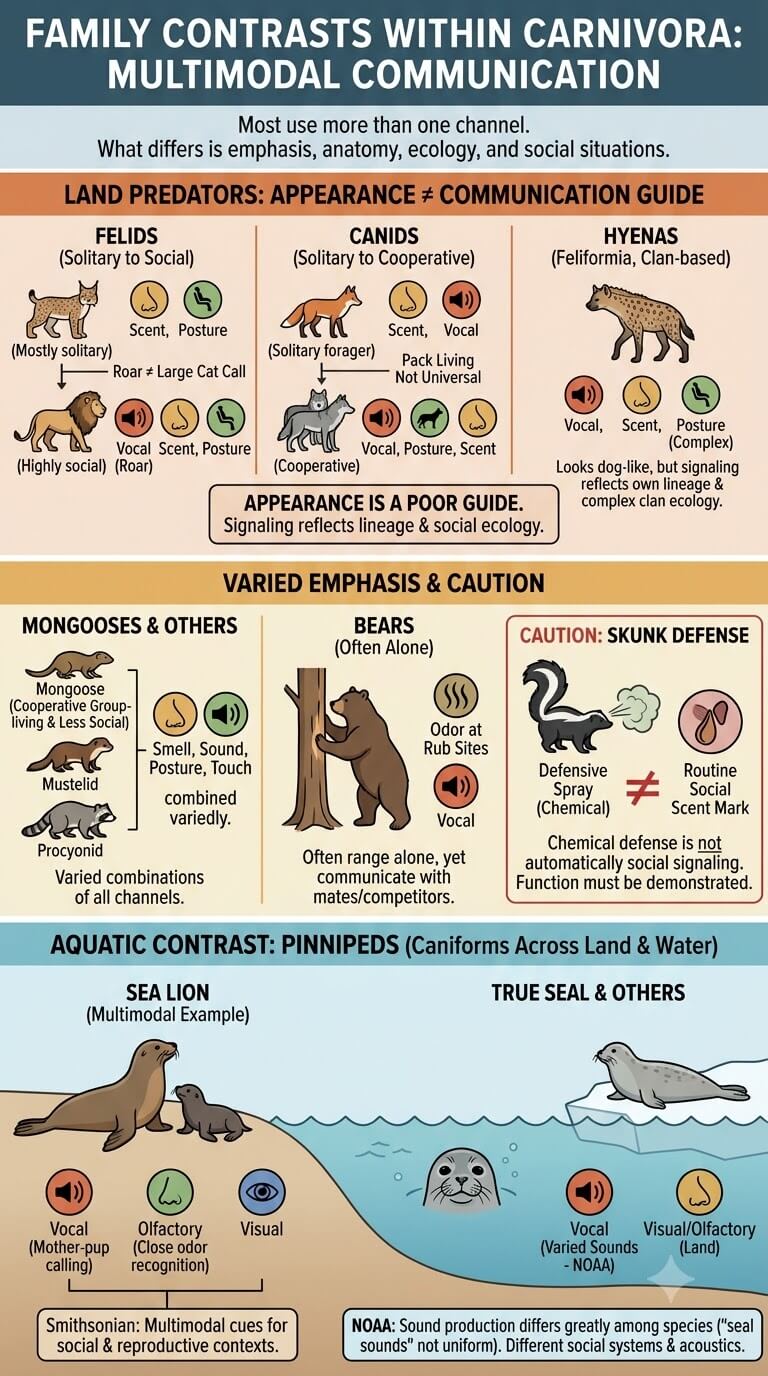
The major carnivoran families do not divide neatly into “scent communicators,” “vocal communicators,” or “visual communicators.” Most use more than one channel. What differs is emphasis, anatomy, ecology, and the social situations in which signaling occurs.
Felids, Canids, and Hyenas
Felids range from mostly solitary species to the highly social lion, using scent, calls, rubbing, scratching, and posture in different proportions. Canids also span solitary foragers, pairs, family groups, and larger cooperative groups, so pack living is not universal. Spotted hyenas add a contrasting system built around socially complex clans.
Appearance is a poor guide to communication. Hyenas may look dog-like, but they belong to Feliformia, and their signaling system reflects their own lineage and social ecology. A lion roar likewise should not be treated as simply a larger domestic cat call.
Mongooses, Bears, Mustelids, and Procyonids
Mongooses range from cooperative group-living species to much less social ones. Bears often range alone yet still communicate with mates, offspring, competitors, and neighbors, including through odors at rub sites. Mustelids and procyonids add further variation in how smell, sound, posture, and touch are combined.
Skunks provide another caution. Their powerful defensive spray is chemically obvious, but a defensive secretion is not automatically the same thing as a routine social scent mark. Animals can use chemicals for defense, communication, or both, and the function has to be demonstrated rather than assumed from odor alone.
Pinnipeds as a Brief Aquatic Contrast
Pinnipeds, the caniform group containing seals, sea lions, and walruses, show what happens when a carnivoran lineage communicates across both land and water. NOAA Fisheries notes that pinnipeds produce varied sounds in social and reproductive contexts, with many species vocalizing during mating, competition, contact, or other interactions. Sound production differs greatly among species, so “seal sounds” should not be treated as one uniform repertoire.
California sea lions provide a familiar example of multimodal communication. The Smithsonian National Zoo profile of California sea lions describes vocal, visual, and olfactory cues, including mother-pup calling and close-range odor recognition. This does not mean all pinnipeds communicate exactly like sea lions. True seals, fur seals, sea lions, and walruses have different social systems, breeding environments, and acoustic behavior.
Communication in Solitary vs Group-Living Species
Group-living and solitary carnivorans face different communication tasks. Group members may coordinate movement, spacing, recognition, conflict, and care of young. Solitary animals often need to advertise presence or reproductive state without frequent face-to-face encounters.
Solitary Does Not Mean Silent or Socially Isolated
A mostly solitary cat may still communicate through scent marks, scrapes, calls, and visual signals during courtship, territorial encounters, or mother-young interactions. A bear may range alone for much of the year but still obtain information from scent left by other bears. “Solitary” describes a pattern of association, not the absence of social information.
Seeing two normally solitary carnivorans interact does not make the species group-living. Flexible encounters can occur around food, mating, offspring, or seasonal concentrations without forming stable social groups.
Group Coordination Raises Different Signaling Demands
In group-living species, communication can help organize spacing and activity among animals that know one another. Calls may help separated members reunite. Postures can regulate close interactions. Odors may identify group members or mark frequently used areas. Parent-young signals can be especially important when offspring are mobile but still dependent.
Cooperative hunting adds another communication problem, but it does not define sociality. Wolves, African wild dogs, lions, and spotted hyenas can coordinate around prey while maintaining very different social systems.
Territory, Home Range, and Scent Posts Without Overgeneralizing
Territory and home range are not synonyms. A home range is the area an animal normally uses. A territory is an area defended against certain intruders. Some carnivorans defend all or part of their usual range; others overlap extensively. Scent marking may contribute to spacing, but finding a scent mark does not automatically prove strict territorial defense.
Spatial Signals as Context, Not a Universal Territorial Rule
Repeated scent sites can communicate recent presence, identity, or reproductive information even when animals do not defend a rigid border. Marks can also occur at travel routes, den areas, feeding sites, or socially important locations. Their function may change with season, sex, reproductive condition, or local density.
Researchers therefore look for patterns rather than assuming intent. Where are marks placed? Who leaves them? Who investigates them? Does marking change during breeding? Are marks concentrated at boundaries or throughout a range? Do receivers alter their behavior after encountering them? Those questions are more informative than simply labeling every urine spray, scrape, or gland secretion as a territorial sign.
Is Carnivoran Communication a Language?
In everyday speech, people often call animal communication a language. In biology, the word can carry stricter implications. Animals clearly transmit information, recognize individuals, learn associations, and respond flexibly to calls and other signals. That does not automatically mean their communication has the open-ended syntax and generative properties associated with human language.
What Scientists Mean by Signals, Calls, and Language Criteria
A signal is a trait or behavior that influences a receiver and has evolved, at least in part, because of that communicative effect. A cue can provide information without having evolved for communication. For example, an animal may smell another individual’s body odor even when that odor was not deliberately deposited as a mark. Distinguishing cues from signals can be difficult and often requires experiments.
Calls can also carry surprisingly detailed information without forming a human-like language. Acoustic structure may vary with identity, age, sex, emotional arousal, or context. Receivers can learn to react differently to those variations. The safest wording is to describe demonstrated information and responses rather than claim that a howl, roar, or whoop translates directly into a human sentence.
Common Mistakes and Myths
The biggest mistakes come from treating familiar examples as universal rules. Domestic dogs and cats make carnivoran communication easy to notice, but they are not templates for the entire order. Wild species differ in anatomy, ecology, domestication history, social systems, and signal use.
A Growl, Tail Position, or Ear Posture Does Not Mean the Same Thing in Every Species
One body movement can occur in several emotional or social contexts. A low vocalization might accompany defense, competition, discomfort, warning, or another interaction depending on the animal. Tail and ear positions are similarly context dependent. Interpreting them correctly requires knowledge of the species and the surrounding behavior.
This is also why approaching a wild carnivoran to “test” its signals is unsafe and scientifically unhelpful. Defensive displays are meant to influence distance and behavior. Wildlife should be observed from an appropriate distance without feeding, cornering, baiting, touching, or deliberately provoking a response.
Do Not Translate Animal Signals Into Fixed Human Sentences
Popular explanations often turn signals into captions such as “this means I am angry” or “this howl says come here.” That may be convenient, but it removes uncertainty and context. A more accurate interpretation is probabilistic: a signal may be associated with a class of situations, and its effect can depend on the receiver’s identity, prior experience, location, and simultaneous cues.
Scientific studies usually test narrower questions. Researchers may ask whether receivers distinguish familiar from unfamiliar odors, whether call structure carries individual identity, whether a posture predicts approach or withdrawal, or whether marking frequency changes with reproductive condition. Those questions produce stronger conclusions than assigning a human sentence to every signal.
Communication Depends on Senses, Social Life, and Habitat
Communication cannot be separated from perception. An odor is useful only if another animal can detect and interpret it. A call depends on hearing and on how sound travels through the environment. Visual displays depend on light, distance, background, and the receiver’s vision. Whiskers and other tactile structures matter when contact or nearby movement becomes important.
Senses and Signal Detection
Different carnivorans weight sensory information differently. Many canids and bears are highly responsive to odor. Felids combine scent with acute hearing and vision. Pinnipeds shift between air and water, where sound and smell behave differently. Vibrissae, commonly called whiskers, can provide tactile information about nearby objects or water movement, but they do not work like radar.
Signal production and sensory biology therefore evolve together. A species that relies on persistent scent marks benefits from the ability to discriminate odor information. A species using long-distance calls must produce and hear frequencies that work in its habitat. These are tendencies shaped by ecology, not rankings of which carnivoran has the “best” sense.
Social Behavior, Hunting Coordination, and Habitat Context
Social organization creates recurring situations in which communication becomes useful. Parents and offspring need contact. Group members may coordinate travel or feeding. Rivals may signal before physical conflict. Mates must locate and assess one another. Habitat determines which channels can operate effectively during those interactions.
Communication can also affect hunting and foraging without being only about prey capture. Group hunters may use movement and social cues around a chase, while solitary foragers may advertise ownership or avoid competitors near food. These behaviors make sense only when considered alongside diet, senses, social structure, and habitat rather than as isolated tricks.
FAQ
Do solitary carnivorans still communicate with one another?
Yes. Solitary living does not mean an animal has no social interactions. Mostly solitary carnivorans still encounter mates, competitors, neighbors, and their own young. Scent marks are especially useful because one animal can leave information that another detects later, but solitary species can also use calls, posture, rubbing, scratching, and direct contact when they meet.
Why do some carnivorans return to scent-marking sites?
Repeated sites can concentrate information. Depending on the species, animals may deposit new odor, investigate marks from others, or monitor a location used by neighbors, potential mates, or group members. The function is not always territorial. Researchers distinguish among possible roles by studying who marks, where marks occur, when they are revisited, and how other animals respond.
Do pinnipeds use different signals on land and in water?
Many pinnipeds communicate in both environments, but the balance varies among species. Vocalizations can occur on land and underwater, especially in reproductive and social contexts. At haul-out or breeding sites, close-range smell, posture, and direct contact can also matter. Because seals, sea lions, fur seals, and walruses differ substantially, there is no single land-versus-water rule that applies to every pinniped.
Final Thoughts
How carnivorans communicate depends on who they are, where they live, and how they interact with others. Scent can persist after the sender leaves, sound can bridge distance, posture can change rapidly during face-to-face encounters, and touch can carry information at the closest range. Many species combine these channels rather than relying on only one.
The most useful way to understand carnivoran communication is to avoid one-size-fits-all translations. A wolf howl, lion roar, hyena scent mark, bear rub, mongoose call, or sea lion pup call belongs to a specific biological context. Looking at the sender, receiver, habitat, social system, and accompanying cues gives a far more accurate picture than treating Carnivora as if every member shares the same signals or meanings.

Ethan Walker is the founder and research editor of Animal Fact Central. He creates and reviews educational animal facts content using trusted wildlife, pet care, and science-based sources. His work focuses on making animal behavior, adaptations, habitats, and species facts clear, accurate, and engaging for everyday readers.
Read More Details About Ethan Walker: https://animalfactcentral.com/ethan-walker/