

Carnivoran senses are not built around one universal superpower. Cats, dogs, bears, mustelids, hyenas, raccoons, seals, and their relatives solve very different sensory problems, so they do not rely on smell, hearing, vision, or touch in exactly the same way. A stalking cat benefits from detecting faint movement in dim light. A canid following a trail may depend heavily on odor. A seal hunting underwater can gain information from sensitive facial whiskers as well as vision and hearing.
That diversity is the useful way to understand sensory biology in the order Carnivora. Rather than asking which carnivoran has the “best” nose or eyes, it is more accurate to ask what information a species needs, where it lives, and how several senses work together. The Oxford Academic overview of carnivoran sensory biology emphasizes that sensory abilities vary across the order and reflect different ecological challenges.
Quick Answer
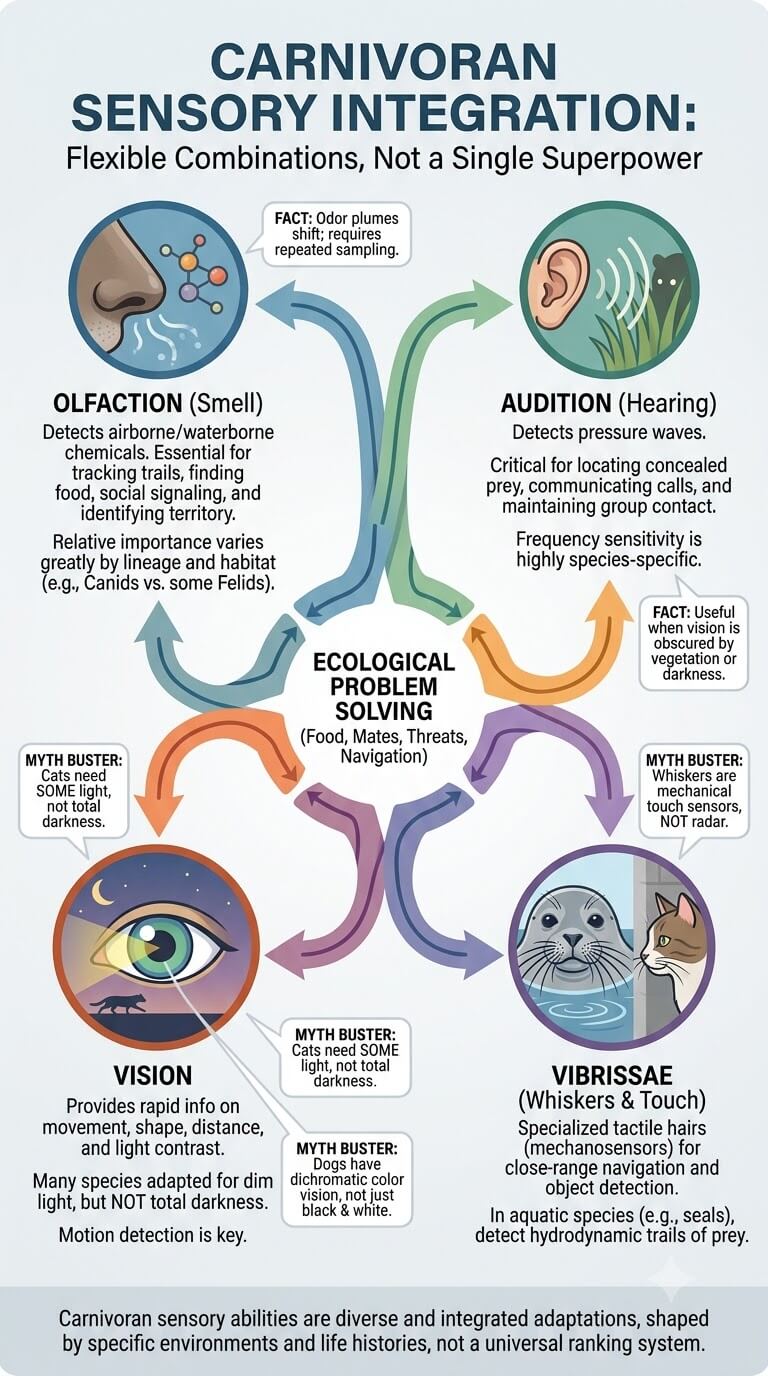
Carnivorans use a combination of olfaction, hearing, vision, touch, and other sensory pathways to locate food, recognize other animals, avoid threats, care for young, navigate habitats, and coordinate behavior. Many species have strong smell and hearing, but those broad patterns have important exceptions and differences in degree.
Vision can be especially important for detecting movement and judging distance. Smell can reveal food, trails, reproductive cues, or recent animal activity. Hearing can locate calls and movement that cannot be seen. Vibrissae, the specialized hairs commonly called whiskers, provide tactile information at close range. In aquatic carnivorans such as seals, whiskers can also detect water movement associated with prey.
No single sensory formula defines Carnivora. A bear, a cheetah, a mongoose, an otter, and a harbor seal all belong to the same mammalian order, but their sensory priorities reflect different bodies, habitats, foods, activity patterns, and social systems.
Sensory Ecology: Different Problems Favor Different Senses
Sensory ecology asks how an animal gathers information that matters in its environment. That information may come through reflected light, airborne or waterborne sound, chemicals, touch, temperature, pressure, or movement. The useful signal also changes with distance. Odor can linger after an animal leaves. Sound can travel beyond visual barriers. Vision can provide rapid detail about movement and position. Touch becomes especially informative at close range.
Finding Food, Competitors, Mates, Offspring, and Threats
Finding food is only one sensory challenge. Carnivorans also need to recognize competitors, locate mates, maintain contact with offspring, assess unfamiliar animals, choose travel routes, and detect danger. A scent deposited hours earlier can tell a different story from an animal that is visible in front of the observer. A distant call can matter when vegetation blocks the view. Whisker contact can help when the face is too close to an object for useful visual focus.
These channels often overlap. During foraging, an animal may detect an odor, orient toward a sound, then use vision for the final approach. The sequence depends on species and circumstances rather than a fixed order-wide pattern.
An Animal Diversity Web account of Carnivora describes vision, hearing, smell, tactile hairs, and chemical perception as important across the order while also illustrating the broad behavioral diversity that makes simple sensory rankings unreliable.
Smell and Olfaction
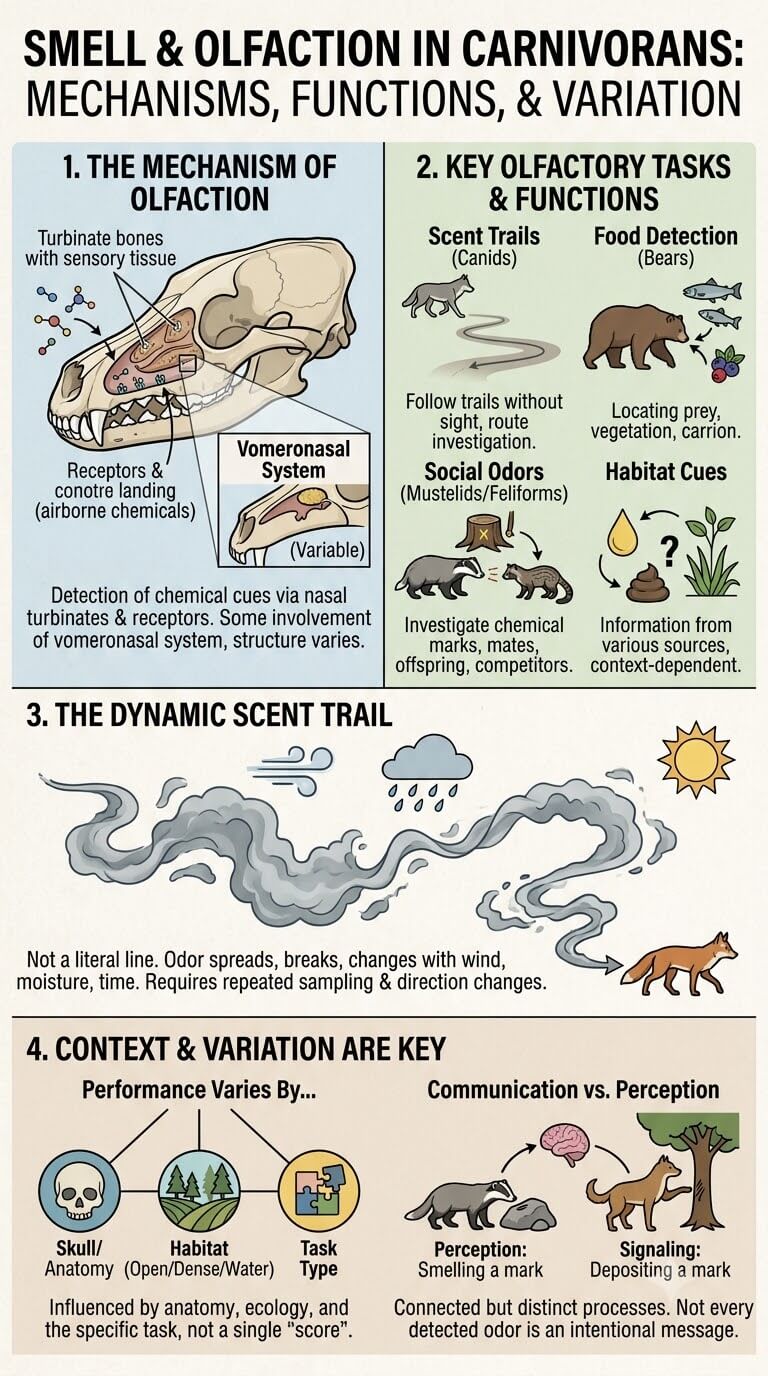
Olfaction is the detection and processing of airborne or waterborne chemicals. In many carnivorans, the nasal cavity contains elaborate turbinate bones covered with sensory tissue. Odor molecules reach receptors there and contribute to information about food, animals, and the surroundings. Some chemical information can also involve the vomeronasal system, although its structure and importance vary among carnivoran lineages.
Scent Trails, Food Detection, Social Odors, and Habitat Cues
Odor can be useful because it does not require a direct line of sight. Canids can investigate scent left along travel routes. Bears can use smell while searching for foods or detecting other animals. Mustelids and many feliforms investigate chemical marks. Scents associated with urine, feces, skin glands, prey, vegetation, carrion, or nesting material may provide different information depending on species and context.
A scent trail is not a literal painted line on the ground. Odor spreads, breaks apart, adheres to surfaces, and changes with wind, moisture, temperature, and time. An animal following odor may need to sample repeatedly and change direction as concentrations shift. The same sensory ability that helps locate food can also help an animal investigate a mate, offspring, competitor, den site, or recently used path.
Chemical detection also intersects with communication. Smelling a mark is sensory perception, while depositing a mark can be a signaling behavior. Those processes are connected, but they are not identical. Not every odor an animal detects was intentionally produced as a message.
Why Smell Importance Varies Across Families and Situations
It is tempting to say that every carnivoran has an extraordinary sense of smell, but that overstates the evidence. Skull shape, nasal anatomy, receptor biology, behavior, habitat, and the type of task all influence olfactory performance. Long-snouted caniforms often provide familiar examples of extensive olfactory anatomy, while other carnivorans may place relatively more emphasis on vision or touch in particular situations.
Even within one family, sensory priorities shift with ecology. Open country, dense forest, and water present different odor and visual conditions. Sensory ability should therefore be discussed in relation to a task, not as one score for an entire family.
Hearing
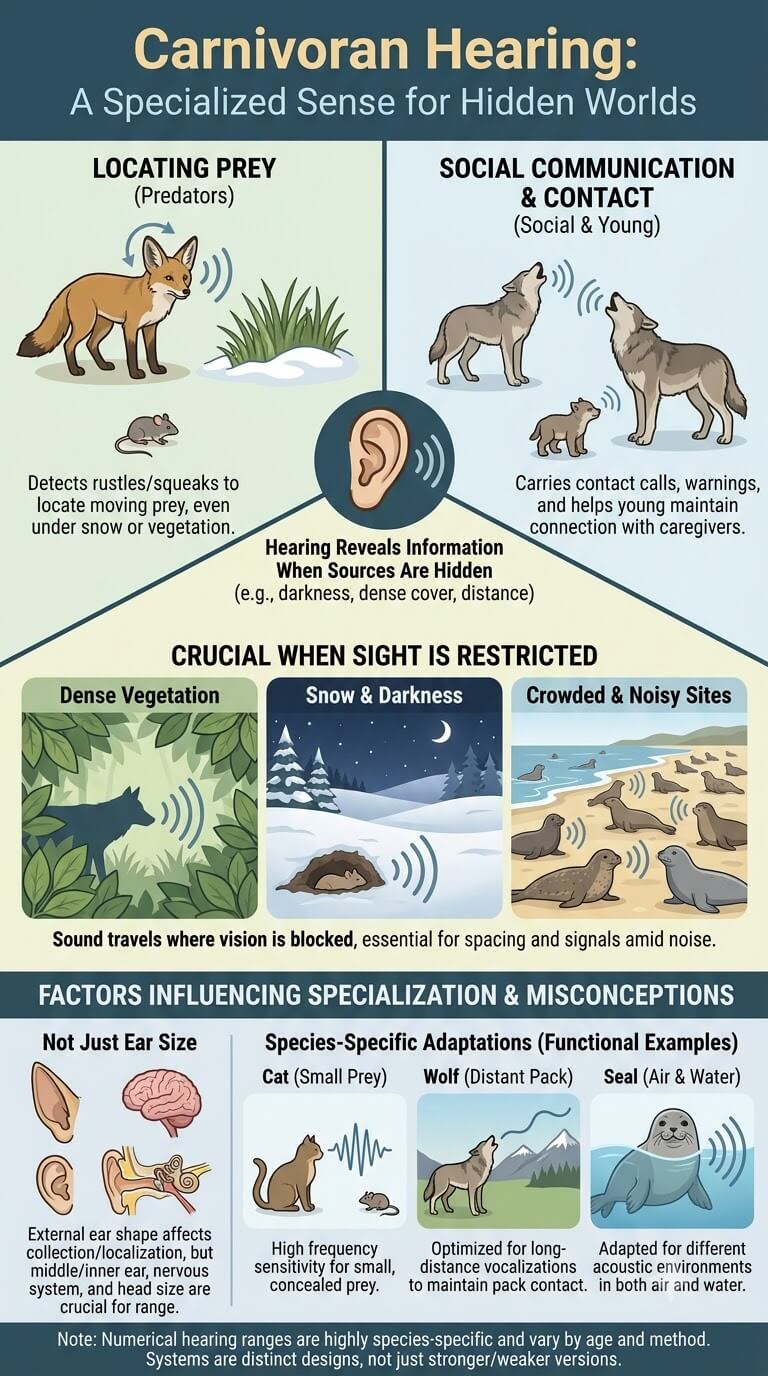
Hearing allows carnivorans to detect pressure waves that reach the ears. It can reveal information when the source is hidden by grass, darkness, terrain, snow, water, or distance. For predators, hearing may help locate moving prey. For social animals, it can carry contact calls or warnings. For young animals, familiar calls can help maintain contact with caregivers.
Locating Prey, Detecting Movement, and Receiving Social Calls
A small rustle or squeak can be useful to an animal searching for concealed prey, but hearing does more than assist hunting. Calls can help animals maintain spacing, locate group members, advertise reproductive condition, or respond to conflict. The importance of sound depends strongly on whether a species lives alone, in pairs, family groups, colonies, or larger social systems.
Sound is particularly useful when sight is restricted. Dense vegetation can block visual contact while still allowing calls to travel. Snow may hide prey from view but transmit movement sounds. At a crowded pinniped breeding site, vocal signals can function amid many animals and intense background noise. These situations create different hearing problems, which is why one species’ auditory specialization should not be generalized to the whole order.
Ear Shape, Frequency Sensitivity, and Species-Specific Evidence
External ear shape can influence how sound is collected and localized, but visible ear size alone does not reveal an animal’s full hearing range. The middle ear, inner ear, nervous system, head size, and behavioral ecology also matter. Carnivorans span an enormous range of body sizes and habitats, so the frequencies that are useful to one species may not be equally useful to another.
Some carnivorans can hear frequencies above the upper range of typical human hearing, including species that listen for small prey. That does not mean all members of Carnivora share the same upper limit. Numerical hearing ranges are strongly species-specific and can also vary with age, testing method, and whether measurements are behavioral or physiological.
A useful comparison is therefore functional: a cat listening for small prey, a wolf listening for distant pack members, and a seal hearing in both air and water face different acoustic environments. Their hearing systems are not simply stronger or weaker versions of one design.
Vision
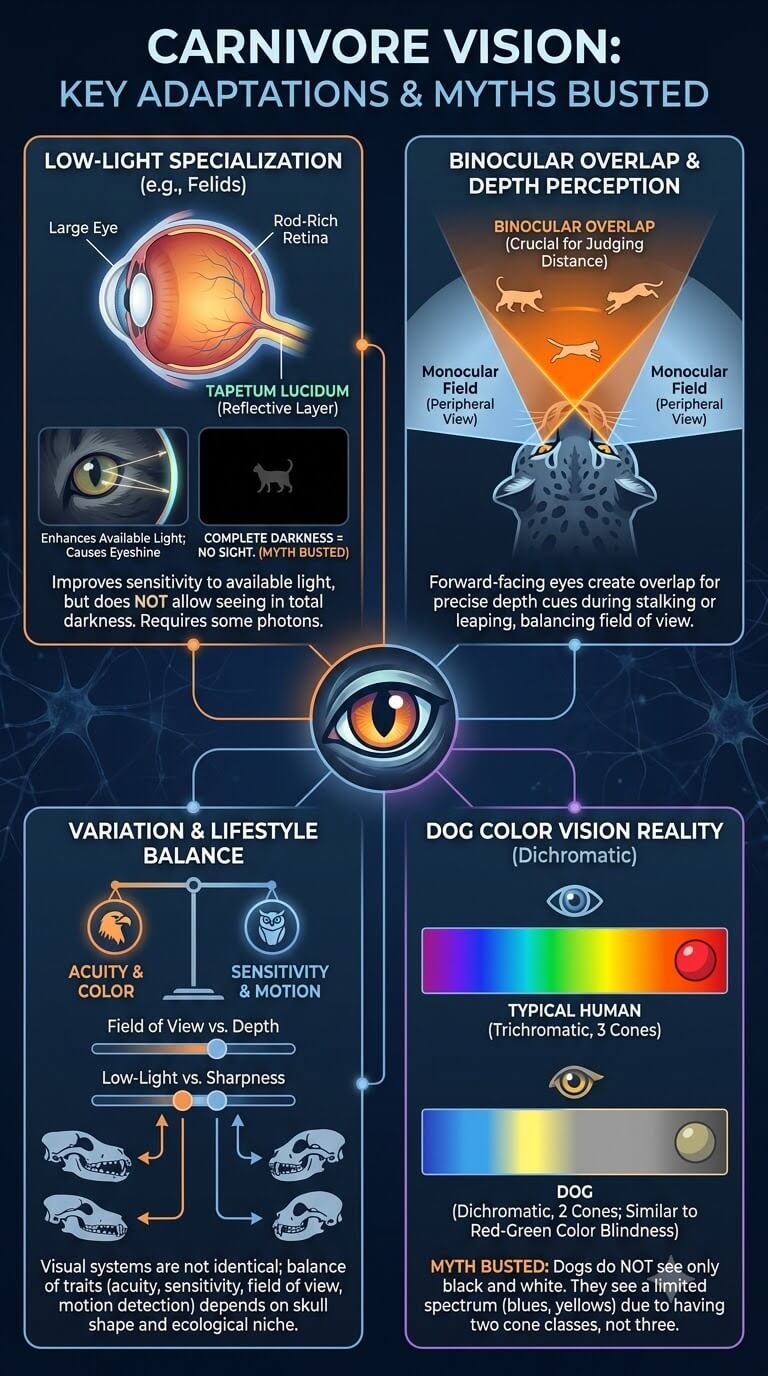
Vision gives rapid information about direction, movement, shape, distance, and contrast. Many carnivorans have eyes that perform well under relatively dim conditions, but visual performance includes several separate traits. Sensitivity to low light is not the same as sharp visual acuity, color discrimination, wide field of view, or precise depth perception.
Low-Light Adaptation, Motion Detection, and Binocular Overlap
Felids provide familiar examples of low-light specialization. Many have relatively large eyes, rod-rich retinas, and a reflective tapetum lucidum behind the retina that can improve sensitivity when light is limited. These features help explain why eyeshine is common when light strikes the eyes at night. They do not make the eye capable of producing an image without incoming light.
Forward-facing eyes can create binocular overlap, meaning both eyes view part of the same scene. That overlap can contribute to judging distance during stalking, leaping, climbing, or reaching. Yet carnivoran visual systems are not identical, and the balance among field of view, depth cues, motion detection, low-light sensitivity, and acuity differs with skull shape and lifestyle.
Movement can be especially informative because prey, rivals, mates, and offspring rarely behave like stationary objects. Detecting that something moved is only one step, though. The animal may still combine the visual cue with smell or sound before deciding how to respond.
Why Low-Light Vision Is Not the Same as Seeing in Complete Darkness
A common myth says cats can see in complete darkness. They cannot. Low-light adaptations make better use of available photons, but no ordinary eye can form a visual scene when no usable light reaches the retina. In extremely dark conditions, a felid must depend more heavily on hearing, smell, memory, and touch.
Another myth says dogs see only black and white. Research instead supports dichromatic color vision, meaning dogs have two major cone classes rather than the three used in typical human trichromatic vision. A behavioral study of canine color discrimination found evidence consistent with red-green color blindness rather than an absence of color vision. The peer-reviewed study of dog color vision is a useful reminder that human color categories should not be projected directly onto another mammal’s visual experience.
Vibrissae and Touch
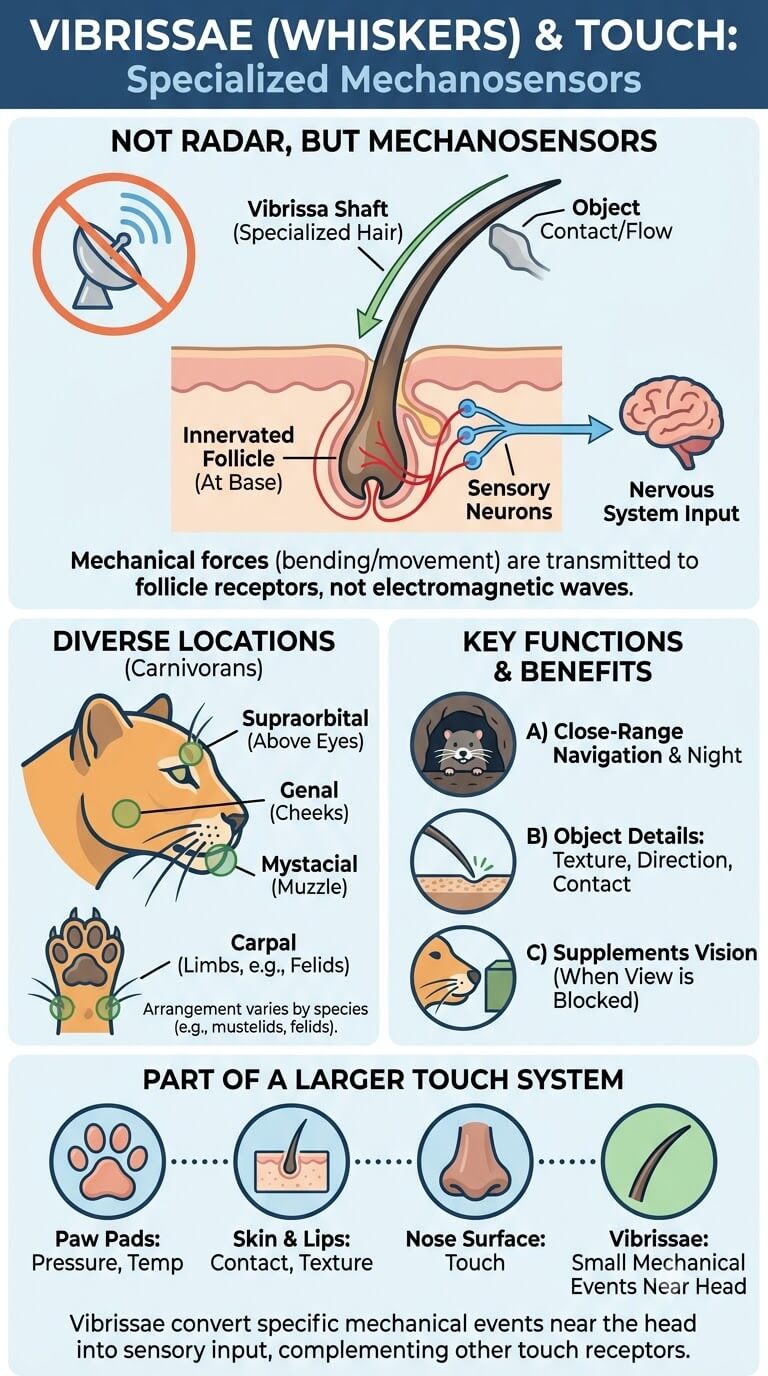
Vibrissae are specialized tactile hairs, usually thicker and more deeply rooted than ordinary fur. The most obvious are the whiskers around the muzzle, but carnivorans can also have tactile hairs above the eyes, along the cheeks, or on parts of the limbs. Their arrangement varies among species.
Whiskers as Specialized Tactile Hairs Linked to Sensory Systems
The whisker shaft itself is not a tiny nerve antenna filled with receptors along its length. Mechanical forces bend or move the hair, and those forces are transmitted to a richly innervated follicle at its base. Sensory neurons then carry information into the nervous system. Work on mammalian vibrissae shows how this arrangement can provide information about object contact, direction, and texture. A study of tapered mammalian whiskers explains the mechanical role of vibrissae and includes felid whiskers among the examples examined.
That is why “whiskers are radar” is misleading. Radar involves sending electromagnetic waves and analyzing their reflections. Vibrissae are mechanosensors. They respond to physical movement, contact, vibration, or flow that bends the hair and stimulates receptors at the follicle.
Face, Muzzle, and Limb Vibrissae in Different Carnivorans
Facial whiskers can be useful when an animal is close to vegetation, rocks, prey, a burrow entrance, another animal, or a narrow passage. Close-range tactile information can supplement vision, especially at night or when the muzzle blocks a clear view of what is directly in front of the face.
Felids can also have tactile hairs on the forelimbs, adding information when the paws are close to an object or prey. Mustelids, including otters, carry their own vibrissal specializations. The details differ among species, and researchers should not assume that all carnivorans actively move their whiskers in the same rhythm or use every whisker field for the same purpose.
Touch also extends beyond whiskers. Paw pads, skin, lips, and nose surfaces provide pressure, texture, temperature, and contact information. Vibrissae are important because they convert small mechanical events near the head into sensory input, not because they replace every other form of touch.
Aquatic Sensory Adaptations
Water changes the sensory environment dramatically. Light is absorbed and scattered with depth and turbidity. Sound travels differently in water than in air. Moving animals leave fluid disturbances behind them. Pinnipeds therefore provide one of the clearest examples of how Carnivora diversified beyond a terrestrial sensory setting.
Pinniped Vibrissae and Water-Movement Detection
Experimental and field research shows that seals can use their facial vibrissae to detect hydrodynamic information, including water disturbances associated with moving prey. This ability can remain useful when vision is limited. Researchers studying northern elephant seals in natural foraging conditions found that whiskers play an important role in prey detection during deep, dark dives. The field study of whiskers as hydrodynamic prey sensors also stresses that seals use multiple senses rather than a single isolated channel.
Pinniped whiskers are not identical across species. True seals, sea lions, and walruses differ in vibrissal shape, mobility, and ecology. Some phocid seals have undulating whisker surfaces that reduce self-generated vibration during swimming, improving the contrast between background flow and external disturbances. That specialized morphology should not be copied onto every pinniped in an illustration or treated as universal.
Why This Does Not Mean Whiskers Work Like Radar
Hydrodynamic sensing is sometimes described with technological metaphors because it seems remarkable, but the mechanism remains mechanical. A fish or object moving through water creates wakes and vortices. Those disturbances can move a seal’s vibrissae. Receptors associated with the follicles detect the resulting motion, and the nervous system processes the pattern.
Nor should pinniped whiskers be confused with echolocation. Toothed whales actively emit sounds and analyze returning echoes. Pinnipeds are not known to use that same biosonar system for prey detection. NOAA Fisheries notes that seals combine strong underwater sensory abilities with highly developed whiskers, and its overview of seal senses describes whisker sensitivity, hearing, and underwater vision as complementary capabilities.
How Carnivorans Combine Multiple Senses
Sensory Integration During Hunting, Foraging, Navigation, and Social Encounters
Animals rarely receive information through only one channel at a time. A canid may detect odor on the ground while listening to surrounding sounds and scanning ahead. A felid may use hearing to orient toward hidden prey, vision to time an approach, and whisker contact at close range. An otter searching underwater can integrate touch, vision, smell at the surface, and learned knowledge of the environment.
This integration makes sensory behavior flexible. If one channel becomes unreliable, another may become more important. Wind can scatter scent. Darkness reduces visual information. Loud water can mask sound. Dense vegetation blocks sight. Turbid water changes underwater visibility. The animal’s nervous system has to weigh imperfect evidence rather than wait for a perfect signal.
Experience matters too. Young animals learn which cues predict food, danger, caregivers, or familiar places. Sensory organs collect information, but behavior depends on how that information is interpreted in context.
Family-Level Contrasts
Felids and Canids
Felids often provide strong examples of combining low-light vision, hearing, and close-range tactile sensing during stalking and capture. Many species have large eyes and prominent facial vibrissae. Their ears can orient toward sounds, while smell contributes to investigation and social information. This does not mean vision dominates in every felid situation or that all cats share identical sensory thresholds.
Canids are frequently associated with olfaction, and their elongated rostra can provide substantial space for nasal structures. Smell can be important during travel, food search, and social investigation. Hearing and vision are also significant. Domestic dogs illustrate the danger of oversimplification: they use color information even though their color vision differs from ours, and they do not navigate the world by smell alone.
Bears, Mustelids, and Other Caniforms
Bears often use smell while searching for widely scattered foods, other bears, or environmental cues, but their visual and auditory systems still contribute to navigation and decision-making. A feeding bear may need to identify moving animals, assess nearby objects, and monitor sounds as well as investigate odors.
Mustelids occupy unusually varied settings, including forests, grasslands, burrows, rivers, coasts, and marine habitats. A terrestrial weasel moving through tight cover faces different tactile and acoustic problems from an otter swimming in cloudy water. Raccoons, skunks, and red pandas add still more combinations of manual exploration, smell, hearing, and vision. Caniformia therefore cannot be reduced to “the smell-oriented carnivorans.”
Pinnipeds as an Aquatic Contrast
Pinnipeds show what happens when a caniform lineage becomes strongly adapted to life in water while still spending some time at the surface or on land and ice. They must gather sensory information across two physical media. Eyes, ears, and whiskers function under conditions that change dramatically between air and water.
The best-known vibrissal experiments should not obscure the rest of the sensory system. Seals do not simply close their eyes and hunt with whiskers all the time. Species, depth, prey type, light, water clarity, and individual behavior influence how much each channel contributes.
Sensory Trade-Offs Across Habitats
Forest, Open Country, Underground, Nocturnal, and Aquatic Contexts
Dense forest limits long sightlines but can hold scent and create many surfaces for close-range touch. Open country can make distant visual cues more available while wind carries odors in shifting plumes. Burrows and narrow spaces favor tactile feedback and near-field hearing. Nocturnal activity reduces available light but does not eliminate it. Aquatic settings change the physics of light, sound, and mechanical flow.
Body size also changes the problem. A small mongoose searching through leaf litter encounters a different acoustic and tactile scale from a large bear crossing open terrain. A seal pursuing fish through dark water experiences a different stream of information from a fox listening above snow. Sensory ecology is therefore about matching information systems to real conditions, not perfecting one organ.
There are trade-offs as well. Structures that improve sensitivity may have costs in energy, anatomy, processing demands, or vulnerability to noise. More sensory tissue is not automatically better if the information is irrelevant. Natural selection favors combinations that work well enough for the particular challenges animals repeatedly face.
Common Myths and Mistakes
Cats Cannot See in Total Darkness
Cats are excellent low-light animals, but low light still means some light is present. Their pupils, rod-rich retinas, and tapetum lucidum increase sensitivity when illumination is weak. In total darkness, vision provides no useful image, so hearing, smell, touch, spatial memory, and whiskers become more important.
Dogs Do Not See Only Black and White
Dogs have color vision, but it is not the same as typical human color vision. Their dichromatic system makes some color distinctions that are easy for people much harder for dogs. Saying “dogs see only black and white” removes real visual information they can use and confuses reduced color discrimination with complete color blindness.
Whiskers Are Not Radar
Whiskers are mechanical sensory hairs. They bend when they contact objects or encounter moving air or water, and receptors at their follicles detect those forces. Seal vibrissae can provide extraordinarily useful flow information, but the animal is not transmitting radio waves or using a technological radar process. The metaphor may sound intuitive, but it hides the real biology.
How Senses Shape Feeding, Signaling, and Habitat Use
Finding and Handling Food
Senses help explain why different feeding strategies work. Ambush depends on detecting prey without being detected. Pursuit requires rapid tracking of movement and terrain. Digging can shift emphasis toward sound and smell when prey is hidden. Aquatic foraging may combine vision with vibrissal flow sensing. These are sensory components of feeding behavior, not evidence that one sense determines diet.
Communication and Habitat Adaptation
Communication also begins with perception. A howl matters only if another animal can hear it. A scent mark matters only if it can be detected and interpreted. A posture needs sufficient visibility. Touch requires close contact. Habitat therefore shapes not only how carnivorans find food but also which social signals remain effective.
The same principle applies to long-term adaptation. Forests, deserts, mountains, rivers, coasts, sea ice, and open ocean present different combinations of light, sound, odor movement, surface structure, and water flow. Sensory systems are part of the larger suite of traits that allows Carnivora to occupy such a broad range of environments.
FAQ
Can carnivorans see in complete darkness?
No. Some carnivorans, especially many felids, are highly sensitive to dim light, but an eye still needs light to form a visual image. Structures such as a wide pupil, rod-rich retina, and tapetum lucidum help make better use of limited illumination. When there is effectively no light, animals must rely on other senses such as hearing, smell, touch, and spatial memory.
How do carnivoran whiskers actually work?
Whiskers, or vibrissae, are specialized hairs rooted in sensory follicles. When a whisker bends or vibrates, mechanical forces reach receptors around the follicle. The nervous system processes that information as touch, object contact, vibration, or flow. In terrestrial carnivorans, whiskers can assist close-range navigation and object detection. In pinnipeds, vibrissae can also detect hydrodynamic disturbances in water.
Do all carnivorans rely heavily on smell?
No. Olfaction is important in many carnivorans, but its relative importance varies with lineage, habitat, behavior, and task. A canid following an odor trail, a felid visually tracking motion, and a seal detecting water movement with vibrissae illustrate different sensory priorities. Most carnivorans combine several senses rather than depending exclusively on one.
Final Thoughts
Carnivoran senses are best understood as flexible combinations rather than a contest for the strongest nose, sharpest ears, or best eyes. Smell can reveal trails and chemical information. Hearing can expose hidden movement and distant calls. Vision can track motion and distance under a wide range of lighting conditions. Vibrissae can provide precise tactile information, and in pinnipeds they can become highly specialized for sensing water movement.
The diversity of Carnivora makes simple rules unreliable. Cats cannot see without light, dogs are not restricted to black-and-white vision, and whiskers are not radar. What matters is how each species combines sensory channels to solve the problems created by its food, social life, body, and habitat.

Ethan Walker is the founder and research editor of Animal Fact Central. He creates and reviews educational animal facts content using trusted wildlife, pet care, and science-based sources. His work focuses on making animal behavior, adaptations, habitats, and species facts clear, accurate, and engaging for everyday readers.
Read More Details About Ethan Walker: https://animalfactcentral.com/ethan-walker/