
Caniformia is one of the two major living branches of the mammalian order Carnivora. The name literally points toward a “dog-like” branch, but that label can be misleading if taken too literally. Caniforms include dogs and foxes, yet they also include bears, red pandas, raccoons, skunks, weasels, otters, seals, sea lions, and walruses. Some run on long legs, some climb, some dig, and some spend much of their lives in the ocean.
That diversity is exactly why Caniformia is useful to understand. Classification follows evolutionary relationships, not a checklist based on body shape or diet. A giant panda remains a caniform bear even though bamboo dominates its diet. A sea otter is a marine mammal but still belongs to the weasel family. A seal looks nothing like a fox, yet seals sit within the same broad caniform branch of Carnivora.
The clearest way to understand Caniformia is to start with ancestry and families, then look at how body form, locomotion, feeding, and habitat diversified within that shared history.
Quick Answer
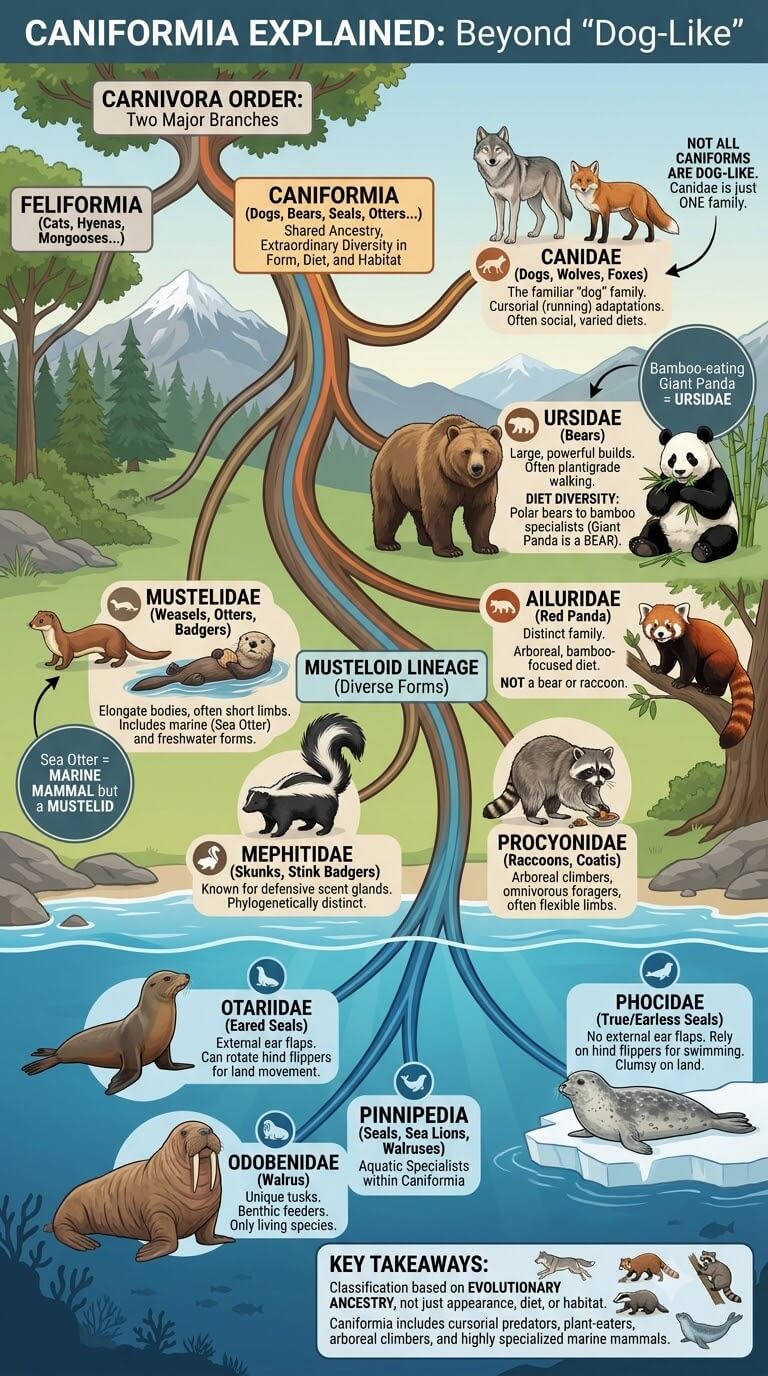
Caniformia is the caniform suborder of Carnivora. In the current mammal taxonomy framework used here, its living families are Canidae, Ursidae, Ailuridae, Mephitidae, Mustelidae, Procyonidae, Phocidae, Otariidae, and Odobenidae. The Mammal Diversity Database currently recognizes 16 living and recently extinct-era families within Carnivora overall; the nine families above make up the living caniform side of that modern framework.
The other major living carnivoran branch is Feliformia, which contains cats, hyenas, mongooses, civets, Malagasy carnivorans, and their relatives. “Caniform” therefore does not mean “a dog,” just as “feliform” does not mean “a cat.” These names describe broad evolutionary branches.
Why Caniformia Is More Than Dogs
The familiar dog family, Canidae, is only one part of Caniformia. Wolves, coyotes, jackals, foxes, and domestic dogs make Canidae easy to recognize, but they do not define the full range of caniform biology. Bears are caniforms. So are raccoons and coatis. Skunks and stink badgers belong here. Weasels, badgers, wolverines, and otters are caniforms too.
The branch becomes even more surprising at the shoreline. True seals, eared seals, and walruses are also caniform carnivorans. Their flippers and streamlined bodies are highly modified for aquatic life, but those adaptations do not erase their evolutionary placement inside Carnivora.
Calling the entire branch “dog-like” is therefore best treated as a historical shorthand rather than a body plan. A walrus is not dog-shaped. A red panda is not dog-shaped. A badger, giant panda, and sea lion solve very different ecological problems with very different bodies.
Where Caniformia Fits Within Carnivora
Caniformia as One of the Two Major Living Branches
Carnivora is a formal mammalian order, and its living members are commonly divided into Feliformia and Caniformia. Molecular phylogenetic work has repeatedly recovered Caniformia as a natural evolutionary group and has also supported Pinnipedia, the seals, sea lions, fur seals, and walrus, within the caniform radiation. One influential broad carnivoran analysis described supported caniform groupings including Caniformia, Pinnipedia, Ursidae, and the musteloid lineages in a molecular phylogeny of Carnivora.
This does not mean every detail of caniform relationships has always been settled. Taxonomic ranks and names can change as evidence improves. It does mean that modern classification is based on shared ancestry rather than the old idea that aquatic pinnipeds must sit outside the same branch simply because their bodies became specialized for swimming.
Why Caniform Does Not Mean Member of Canidae
Canidae is the dog family. Caniformia is much broader. A gray wolf is both a canid and a caniform. A brown bear is a caniform but not a canid. A raccoon is a caniform but not a canid. A harbor seal is also a caniform but not a canid.
This distinction is similar to the difference between a family and a larger branch on a family tree. Members of Canidae share a more recent common ancestry with one another than they do with bears or seals, but all of those lineages sit on the caniform side of Carnivora.
Living Caniform Families in a Current Taxonomy Framework
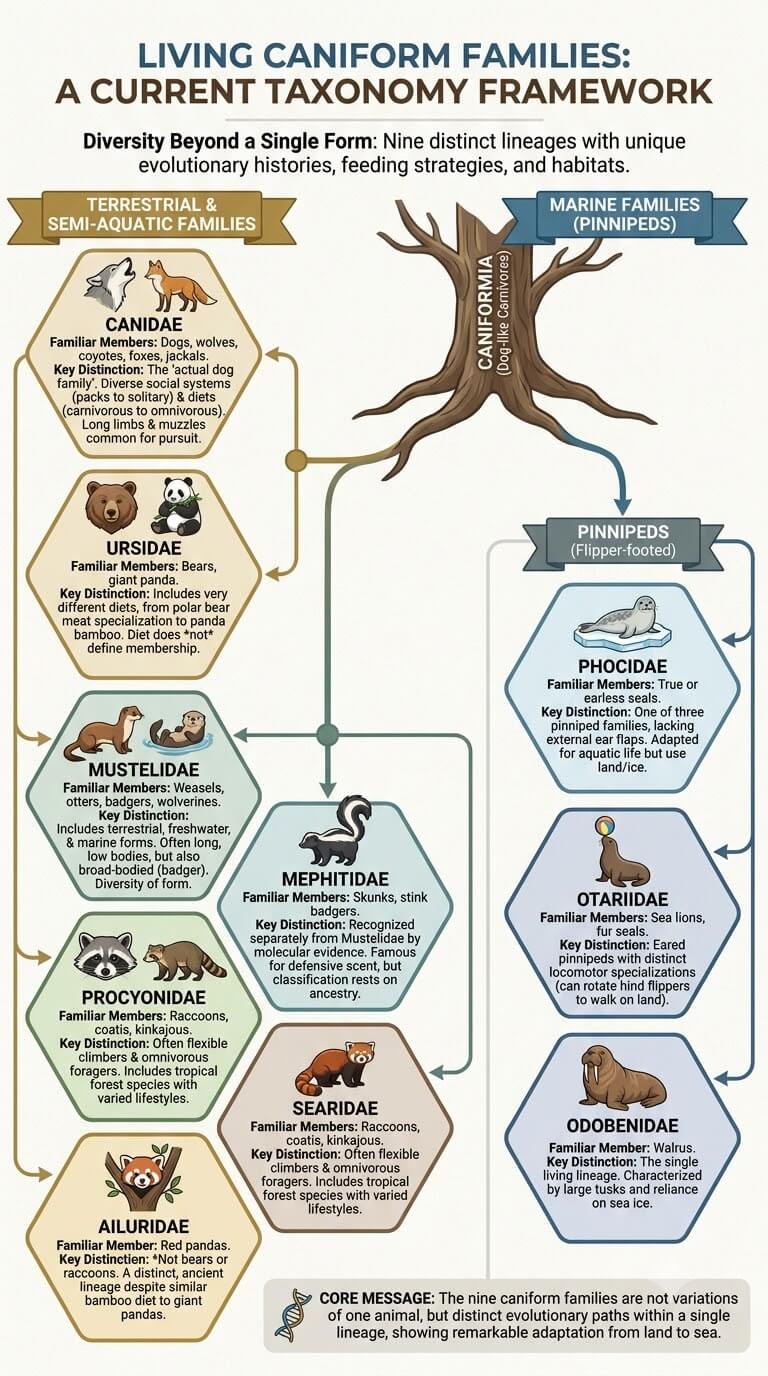
A family-level view makes the diversity easier to see. The nine living caniform families are not nine versions of the same animal. Each represents its own long evolutionary history and contains a different mix of feeding strategies, body forms, habitats, and social systems.
| Family | Familiar members | Useful distinction |
|---|---|---|
| Canidae | Dogs, wolves, coyotes, foxes, jackals | The actual dog family |
| Ursidae | Bears, including giant panda | Includes very different diets, from bamboo specialization to meat-heavy feeding |
| Mustelidae | Weasels, otters, badgers, wolverines, martens | Includes terrestrial, freshwater, and marine forms |
| Mephitidae | Skunks and stink badgers | Recognized separately from Mustelidae in modern classification |
| Procyonidae | Raccoons, coatis, kinkajous, olingos | Often flexible climbers and omnivorous foragers |
| Ailuridae | Red pandas | Red pandas are not bears or raccoons |
| Phocidae | True or earless seals | One of three living pinniped families |
| Otariidae | Sea lions and fur seals | Eared pinnipeds with distinct locomotor specializations |
| Odobenidae | Walrus | The living walrus lineage |
Canidae and Ursidae
Canidae contains the animals people most readily associate with the word caniform: dogs, wolves, coyotes, foxes, and jackal-like canids. Many have relatively long limbs and muzzles, and several species are capable of sustained travel or pursuit. Even within Canidae, however, there is no single social or dietary formula. Some canids live in family groups or cooperative units, while others spend much of their time alone or in pairs. Diets can include vertebrate prey, insects, carrion, fruit, and other plant foods depending on species and season.
Ursidae is the bear family. Bears immediately show why taxonomic membership cannot be read from diet. Polar bears are strongly adapted to feeding on marine mammals, many brown and black bear populations use a broad mix of plant and animal foods, and the giant panda is highly specialized for bamboo. The Smithsonian lists the giant panda in Ursidae, so its bamboo-centered feeding ecology does not make it any less a bear or a member of Carnivora.
Mustelidae and Mephitidae
Mustelidae includes weasels, stoats, martens, badgers, wolverines, mink, and otters. A long, low body is common in many mustelids, especially forms that move through burrows, crevices, dense vegetation, or water, but the family also includes broad-bodied badgers and the much larger sea otter. This is another reminder that family membership does not require one exact silhouette.
Skunks and stink badgers are placed in Mephitidae. Older classifications often grouped skunks with mustelids, but molecular work supported treating them as a distinct family, a placement also reflected in current mammal taxonomy. Their famous defensive scent glands are a striking feature, but defensive chemistry is not what makes them caniforms. Their placement rests on ancestry.
Procyonidae and Ailuridae
Procyonidae includes raccoons, coatis, kinkajous, olingos, and close relatives. Many are capable climbers, and several combine plant and animal foods rather than fitting a narrow meat-eating stereotype. Raccoons are particularly familiar in North America, but the family also includes tropical forest species with very different lifestyles.
Ailuridae is represented today by red pandas. Their common name causes repeated confusion because giant pandas are bears, while red pandas are not. The Smithsonian red panda profile places them in Ailuridae and notes their evolutionary distinction from giant pandas. Both feed heavily on bamboo, but similar food use does not make them members of the same family.
Phocidae, Otariidae, and Odobenidae
The three living pinniped families occupy the marine end of caniform diversity. Phocidae contains true seals. Otariidae contains sea lions and fur seals. Odobenidae is represented today by the walrus. The Marine Mammal Center’s pinniped overview uses these same three groups and emphasizes that all are flipper-footed marine mammals that still use land or ice for important parts of their life cycles.
Their marine bodies can make pinnipeds feel disconnected from bears, mustelids, and other land-oriented caniforms. Evolutionary classification shows the opposite. Aquatic specialization changed their limbs, locomotion, insulation, and feeding ecology, but it occurred within the caniform lineage.
Body-Form and Locomotor Diversity
Cursorial Canids, Plantigrade Bears, Elongate Mustelids, and Climbing Generalists
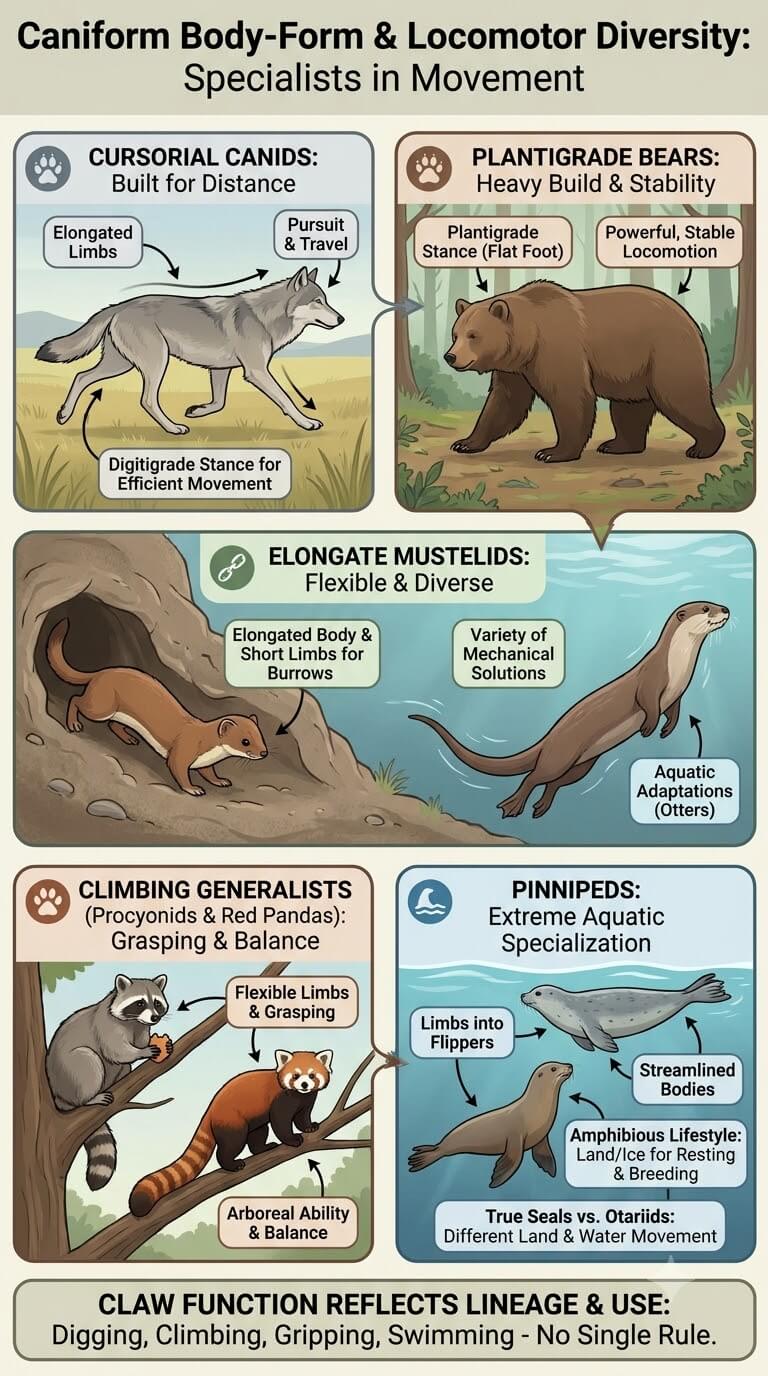
Canids often illustrate a cursorial tendency, meaning a body suited for traveling and, in some species, pursuing prey over distance. Their elongated limbs and digitigrade stance, with the heel raised from the ground, differ strongly from a bear’s heavier build. Bears are plantigrade, placing more of the foot on the ground during ordinary walking. These are useful patterns, not universal tests for identifying every caniform.
Many mustelids follow a different mechanical solution. Weasels and similar forms have elongated bodies and short limbs that can be useful when entering narrow spaces or following small prey through cover. Badgers emphasize digging power. Otters combine mustelid ancestry with bodies shaped for swimming. Procyonids and red pandas provide still other combinations, including climbing ability, flexible limbs, grasping behavior, and balance in trees.
No single claw rule works either. It is tempting to say caniforms have exposed, nonretractile claws while feliforms retract theirs, but the real pattern is more complicated. Claw shape and mobility reflect lineage and function. Digging, climbing, running, handling food, gripping substrates, and swimming can favor different structures.
How Pinnipeds Show the Extreme Aquatic End of Caniform Diversification
Pinnipeds push caniform body modification furthest toward an amphibious marine life. Their limbs function as flippers, their bodies are streamlined, and their feeding takes place largely at sea. Yet they return to land or ice for activities such as resting, molting, giving birth, or breeding, with details varying by species.
True seals and otariids also move differently. True seals rely heavily on the hind flippers for propulsion in water and cannot rotate those hind flippers under the body in the same way as sea lions. Otariids use powerful foreflippers for swimming and can bring their hind flippers under the body for more effective movement on land. These differences are important within pinniped biology, but they do not change the broader fact that both families are caniform carnivorans.
Diet Diversity Within Caniformia
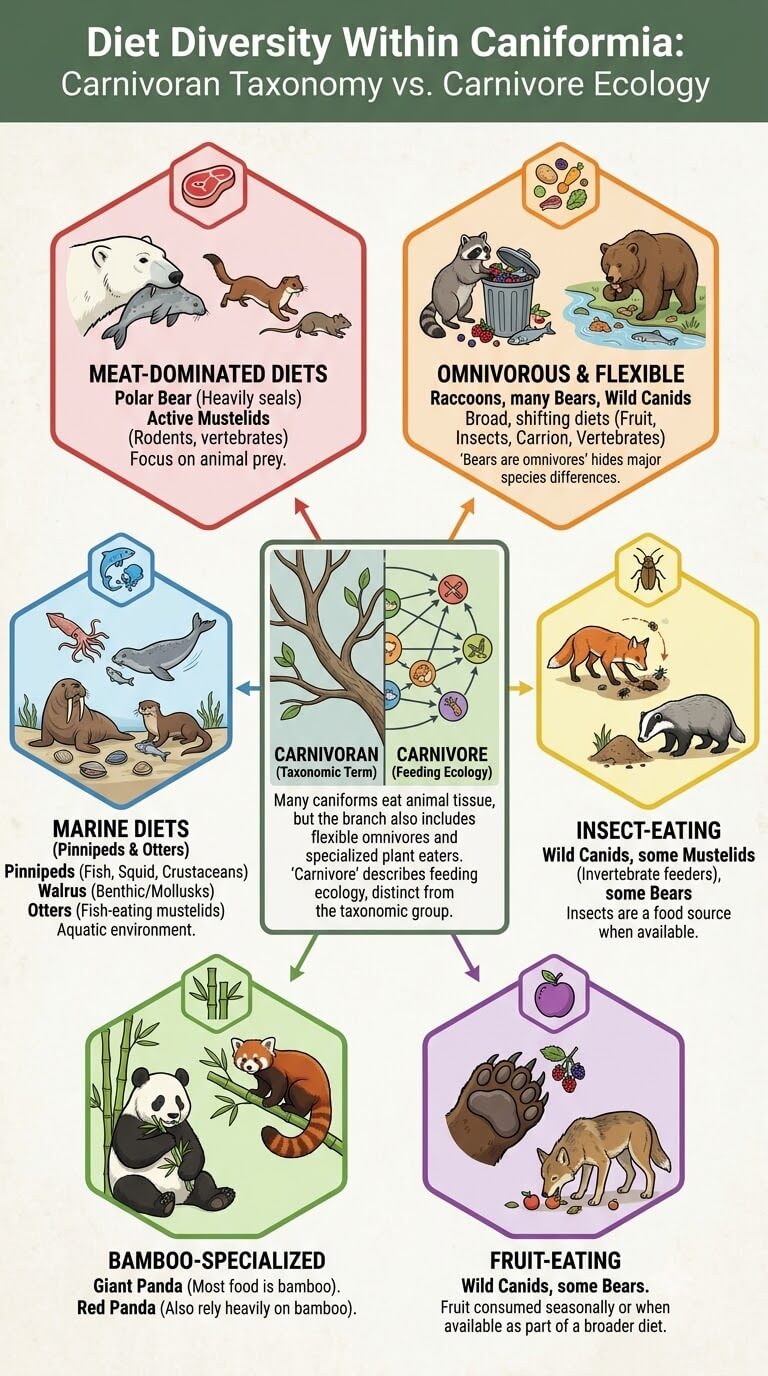
Meat-Dominated, Omnivorous, Insect-Eating, Fruit-Eating, Bamboo-Specialized, and Marine Diets
Caniformia makes the difference between carnivoran and carnivore especially clear. Carnivoran is a taxonomic term. Carnivore usually describes feeding ecology. Many caniforms eat substantial amounts of animal tissue, but the branch also includes flexible omnivores and highly specialized plant eaters.
Wild canids often consume vertebrate prey, yet many also eat insects, fruit, carrion, or other foods when available. Mustelids include active predators of rodents and other vertebrates, fish-eating otters, invertebrate feeders, and opportunists. Raccoons and many other procyonids use broad diets that shift with habitat and season.
Bears span an unusually visible dietary spectrum. A polar bear’s ecology is centered heavily on animal prey, especially seals, while giant pandas obtain most of their food from bamboo. Other bears may combine fruit, nuts, vegetation, insects, fish, carrion, and vertebrate prey in proportions that change across place and season. Saying “bears are omnivores” can be a useful first approximation for some species, but it hides major differences within Ursidae.
Red pandas also rely heavily on bamboo, although they are not bears. Pinnipeds occupy a different feeding environment, taking marine prey such as fish, squid, crustaceans, and other animals in species-specific combinations. The walrus is especially associated with benthic feeding, including mollusks and other seafloor prey.
Key Classification Examples Readers Often Mix Up
Giant Panda Is Ursidae
The giant panda is a bear. It belongs to Ursidae, even though its feeding ecology is dominated by bamboo. Its position is an excellent example of why diet does not define membership in Carnivora or Caniformia. Evolutionary ancestry and the broader anatomical and genetic evidence place it with bears.
Red Panda Is Ailuridae
The red panda is not a small bear, a miniature giant panda, or a raccoon. It belongs to Ailuridae. Historical classifications moved red pandas among different groups as scientists worked with the evidence available at the time, but modern genetic research supports their distinct family placement.
Red and giant pandas do share conspicuous ecological similarities. Both are strongly associated with bamboo feeding, and both possess a modified wrist structure often called a pseudo-thumb that helps with grasping. Those similarities are fascinating examples of adaptation, not proof that the two pandas belong to the same family.
Sea Otter Is Mustelidae, Not a Pinniped
Sea otters are marine mammals, but they are not seals. They are otters in the family Mustelidae. The U.S. Fish and Wildlife Service taxonomic tree places the sea otter in Caniformia and Mustelidae. That means a sea otter is more directly classified with other mustelids than with the three pinniped families, even though both groups have independently developed extensive adaptations for life in water.
This is a useful case where ecological categories and taxonomic categories overlap without being identical. “Marine mammal” describes mammals that depend on marine environments in major ways. “Mustelidae” identifies an evolutionary family. One animal can fit both descriptions.
Skunks and Stink Badgers Are Mephitidae
Skunks were historically placed with mustelids in some classifications. Modern molecular evidence supports a separate family, Mephitidae, which includes skunks and stink badgers. Calling a skunk “a type of weasel” therefore reflects older classification rather than the family framework used today.
This change also shows why taxonomy should not be treated as a frozen list of names. Classifications are scientific hypotheses about relationships, and they are revised when new anatomical, fossil, or genetic evidence changes the best-supported picture.
Pinnipeds Inside the Caniform Branch
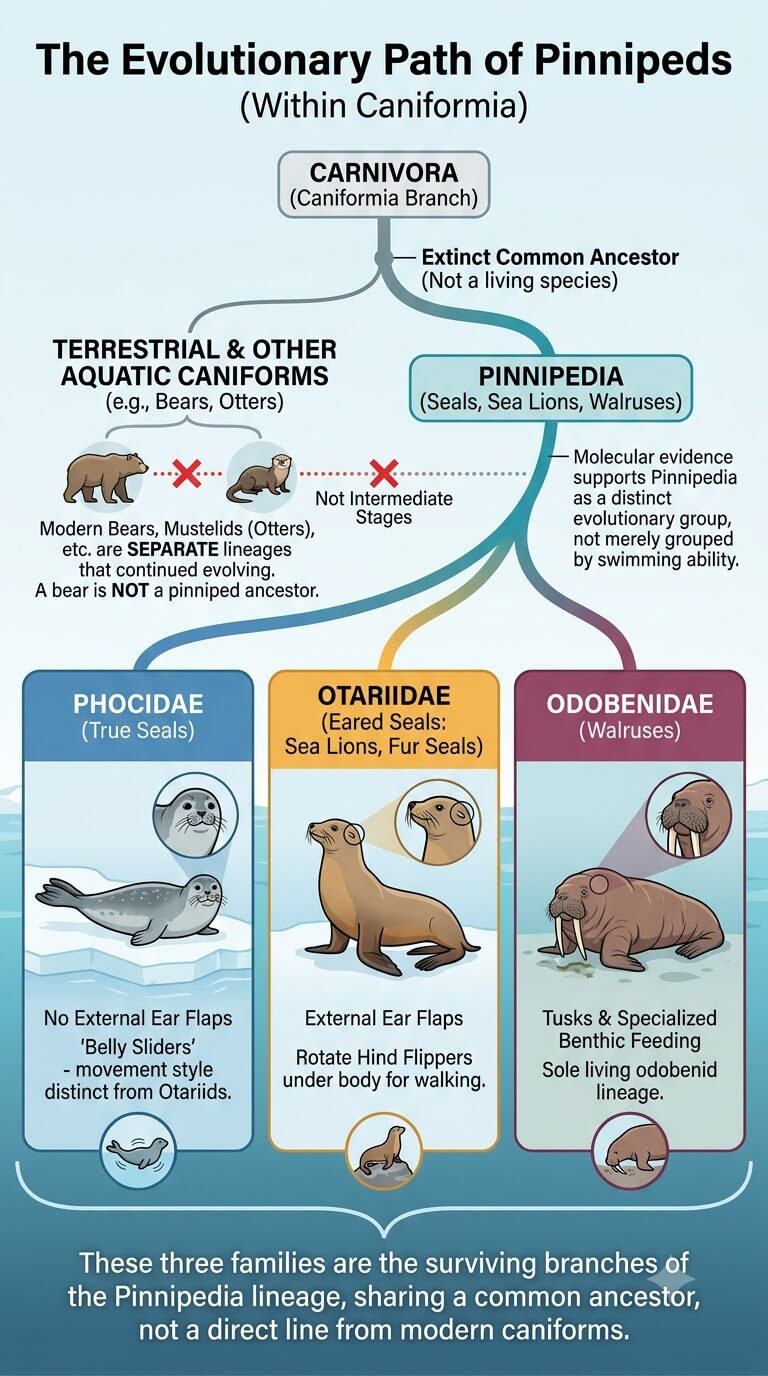
True Seals, Eared Seals, and Walruses
Pinnipedia brings together three living families: Phocidae, Otariidae, and Odobenidae. True seals lack external ear flaps and have a style of terrestrial movement very different from sea lions. Otariids, including sea lions and fur seals, have external ear flaps and can rotate their hind flippers under the body. Walruses form the living odobenid lineage and are immediately recognizable by their tusks and specialized benthic feeding.
These families are not merely grouped together because they swim. Molecular studies support Pinnipedia as an evolutionary group within the caniform side of Carnivora. That placement matters because whales, manatees, and other marine mammals also swim, but they belong to very different mammalian lineages.
Shared Ancestry Does Not Mean Seals Evolved From Modern Bears or Otters
Evolutionary trees are frequently misunderstood as ladders in which one living animal turns into another. A seal did not evolve from a modern bear. A walrus did not evolve from a living otter. Modern bears, mustelids, pinnipeds, and other caniforms are surviving branches whose lineages trace backward toward extinct common ancestors.
That distinction is more than wording. Living species have all continued evolving along their own branches. A modern bear is not a preserved model of a pinniped ancestor, and a sea otter is not an intermediate stage on the way to becoming a seal.
Habitats and Ecological Variety
Forests, Grasslands, Deserts, Rivers, Coasts, Sea Ice, and Open Ocean
Caniforms occupy an exceptionally broad range of environments. Foxes and other canids occur in forests, grasslands, deserts, tundra, mountains, and human-modified landscapes. Bears range from tropical and temperate forests to Arctic sea-ice systems. Raccoons and several relatives use wooded habitats and wetlands, while some thrive close to people.
Mustelids extend the range still further. Badgers may be strongly terrestrial and fossorial, meaning adapted for digging. Martens are capable climbers. River otters specialize in aquatic and shoreline environments. Sea otters live along marine coasts. Pinnipeds forage at sea and use beaches, rocky shores, remote islands, or sea ice depending on species.
Habitat does not map neatly onto family boundaries. Even close relatives can specialize differently because temperature, prey, vegetation, water availability, substrate, competition, and reproductive needs create different ecological pressures. That is why a classification article becomes more useful when the family tree is paired with real biology rather than treated as a name list.
Common Myths and Oversimplifications
Not All Caniforms Are Dog-Like
The term caniform is sometimes translated as “dog-like carnivore,” but that wording should not be read as a universal description of appearance. Wolves and foxes fit the mental picture. Bears, skunks, kinkajous, red pandas, otters, and walruses often do not. The scientific value of Caniformia is evolutionary, not visual.
Likewise, bears are caniforms but are not oversized canids. Red pandas are caniforms but are not tiny bears. Sea lions are caniforms but are not aquatic dogs. Resemblance can be useful for casual recognition, yet it is unreliable as a taxonomic rule.
Claws, Smell, Diet, and Sociality Do Not Follow One Universal Caniform Rule
Caniform diversity defeats many simple rules. Not every caniform has the same claw mobility. Not every species has the same dependence on smell. Not every canid lives in a pack. Not every bear uses the same foods or seasonal strategy. Not every mustelid has an extremely narrow weasel-like body. Not every pinniped forms the same kind of breeding aggregation.
Even strong family tendencies need context. Olfaction is highly important in many caniforms, but sensory priorities differ with habitat and behavior. Social organization may shift with food distribution, mating systems, parental care, and local ecology. Diet can vary seasonally or geographically within one species, not just between families.
The safer scientific habit is to use traits as evidence to understand a lineage, not as rigid passwords that every member must satisfy.
How Caniform Traits Fit Into the Larger Carnivoran Picture
Caniforms and Feliforms Share Carnivoran Ancestry
Caniformia makes most sense when contrasted gently with Feliformia. Both are branches of Carnivora, so both inherit a deeper carnivoran history. Yet each branch contains its own family radiations. Hyenas belong with feliforms despite a somewhat dog-like outline. Pinnipeds belong with caniforms despite their aquatic bodies. These cases show why ancestry can be more informative than superficial resemblance.
The comparison also explains why no single diet separates the two branches. Cats include strongly meat-dependent hunters, but caniforms range from predators to omnivores and bamboo specialists. Feliforms also contain dietary diversity. Suborder membership is not a feeding label.
Teeth, Feeding, Movement, and Habitat Reveal Different Solutions
Caniforms retain the carnivoran heritage that includes carnassial teeth, but the degree and shape of cutting, crushing, and grinding surfaces varies with diet. A wolf, bear, giant panda, raccoon, otter, and seal do not process food in identical ways. Dental structure changes with the mechanical demands of prey, plant material, hard foods, fish, invertebrates, and mixed diets.
Feeding behavior also ranges far beyond pursuit hunting. Caniforms stalk, chase, dig, fish, search shorelines, manipulate food, scavenge, browse plant foods, gather fruit, and forage for insects. In marine lineages, swimming and diving transform how prey is found and captured. The same evolutionary branch therefore contains very different solutions to obtaining energy.
That variety carries into communication, social systems, and habitat use. A canid family group, a mostly solitary bear, a social mongoose relative in another branch of Carnivora, and a pinniped breeding colony should not be forced into one behavioral template. Classification tells us who is related; ecology helps explain what each lineage does with the opportunities and constraints of its environment.
FAQ
Is the red panda a bear?
No. Red pandas belong to Ailuridae, while bears, including the giant panda, belong to Ursidae. Red pandas and giant pandas share bamboo-focused feeding and some striking functional similarities, but modern classification does not place them in the same family.
Are seals related to other caniform carnivorans?
Yes. True seals, sea lions, fur seals, and walruses are pinnipeds within the caniform branch of Carnivora. They share deeper ancestry with other caniform lineages, including bears and musteloid relatives, but they did not evolve from any modern bear, otter, or dog.
Is a sea otter a pinniped?
No. A sea otter is a mustelid, a member of Mustelidae, while pinnipeds belong to Phocidae, Otariidae, or Odobenidae. Sea otters and pinnipeds are both marine mammals and both are caniform carnivorans, but they reached marine life along different branches.
Final Thoughts
Caniformia is far more diverse than the phrase “dog-like carnivores” suggests. The branch includes Canidae, Ursidae, Mustelidae, Mephitidae, Procyonidae, Ailuridae, and the three pinniped families Phocidae, Otariidae, and Odobenidae. Their members range from foxes and giant pandas to raccoons, skunks, sea otters, seals, and walruses.
The most useful takeaway is that classification follows ancestry, not appearance, habitat, or diet alone. A bamboo-eating giant panda can be a bear. A red panda can be neither bear nor raccoon. A sea otter can be a marine mammal without being a pinniped. A seal can be an aquatic caniform even though it looks nothing like a dog. Understanding those distinctions makes the extraordinary diversity of Caniformia much easier to see without forcing its members into a single body type or feeding strategy.

Ethan Walker is the founder and research editor of Animal Fact Central. He creates and reviews educational animal facts content using trusted wildlife, pet care, and science-based sources. His work focuses on making animal behavior, adaptations, habitats, and species facts clear, accurate, and engaging for everyday readers.
Read More Details About Ethan Walker: https://animalfactcentral.com/ethan-walker/