

Carnivorans matter in ecosystems for far more reasons than simply eating other animals. Members of the mammalian order Carnivora can act as large predators, mid-level predators, scavengers, omnivores, seed dispersers, diggers, nutrient movers, and aquatic consumers. The importance of any one role depends on the species, its abundance, the habitat, available food, competitors, and the rest of the local community.
That diversity is easy to miss because lions, wolves, tigers, and other famous hunters dominate popular images of Carnivora. Yet bears may carry salmon nutrients into forests, fruit-eating carnivorans can move seeds, badgers can disturb soil while digging, hyenas can both hunt and scavenge, and sea otters can alter nearshore food webs by eating sea urchins. Carnivorans are therefore best understood as participants in many interacting ecological processes, not as one uniform category of apex predators.
Quick Answer
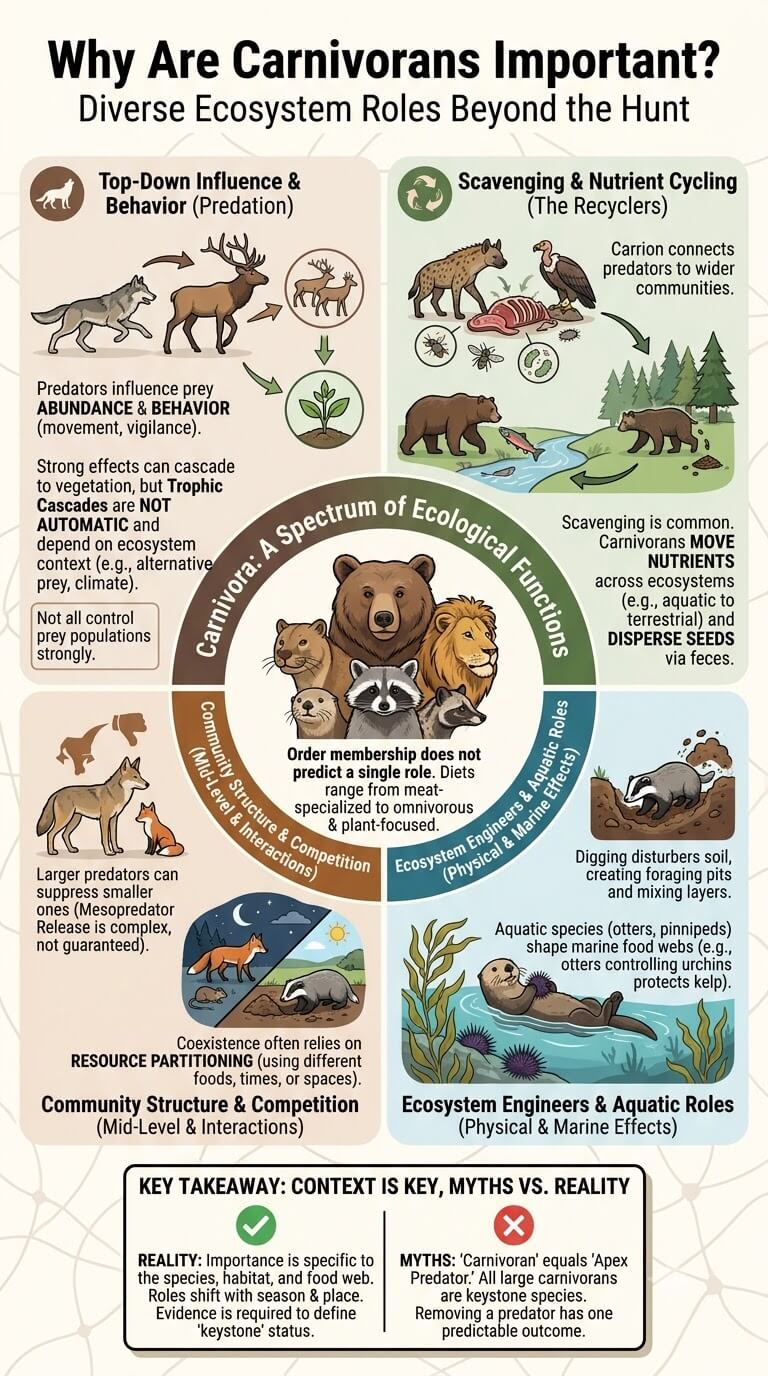
Carnivorans are important because their feeding and movement can influence prey, competitors, carrion, plants, soil, nutrient movement, and food-web structure. Some species exert strong top-down effects as predators. Others have more modest or localized effects. Still others contribute through scavenging, fruit consumption, digging, or by linking aquatic and terrestrial environments.
The Animal Diversity Web overview of Carnivora describes the order as ecologically diverse, with members occupying terrestrial and aquatic environments and filling many feeding roles. That broad diversity is the starting point for understanding why no single ecological label fits every carnivoran.
Carnivorans Fill More Roles Than Predator
The word carnivoran refers to taxonomic membership in Carnivora. It does not mean that every member lives by hunting large prey. Cats are strongly meat-specialized, but the order also includes omnivorous bears, bamboo-specialized giant pandas, fruit-eating or mixed-feeding civets and procyonids, shellfish-eating sea otters, fish-eating pinnipeds, insect-eating mongooses, and many flexible generalists.
This dietary variety creates ecological variety. An animal that kills vertebrate prey affects its community differently from one that eats berries, digs for insects, scavenges carcasses, or hunts marine invertebrates. Even one species can perform several of those roles during the same year.
Order Membership Does Not Predict One Ecological Function
Taxonomy tells us about evolutionary relationships. Ecological function describes what an organism does in a particular place. The two overlap, but they are not interchangeable. A wolf and a giant panda are both caniform carnivorans, yet their usual effects on food webs are very different. A sea otter and a wolverine are both mustelids, but one feeds in coastal waters while the other lives mainly on land.
This is why statements such as “carnivorans control prey” or “carnivorans are keystone predators” need qualification. Some species do have powerful effects on prey or vegetation through food-web interactions. Others may be uncommon, highly specialized, mostly plant-eating, or influential through different pathways.
Large Predators and Top-Down Effects
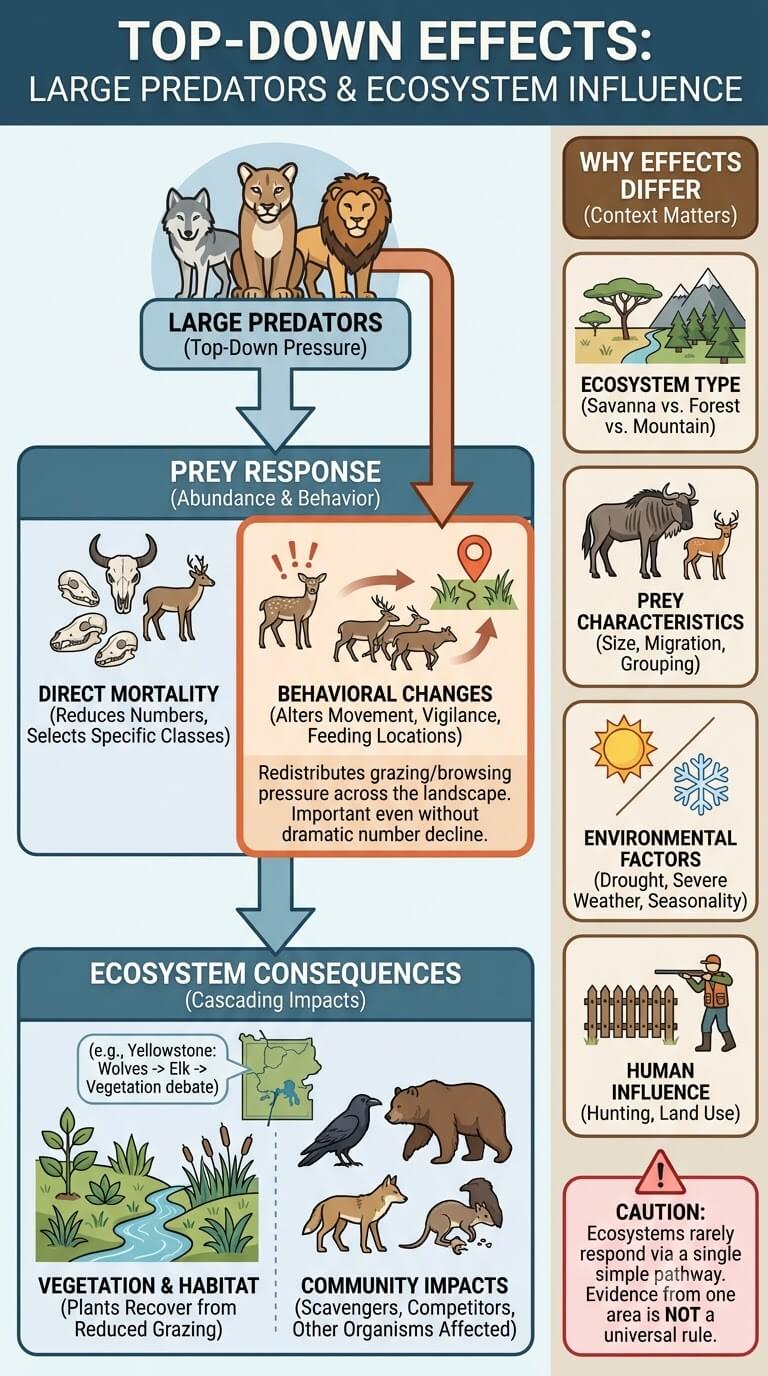
Large carnivorans can influence ecosystems through what ecologists call top-down effects. A predator may reduce the abundance of certain prey, change which age or condition classes are most likely to be killed, or alter where and when prey animals feed. Those effects can then influence vegetation, competitors, scavengers, and other organisms.
Yellowstone National Park provides one of the best-known examples. The National Park Service discussion of Yellowstone trophic processes explains that wolves contributed to changes in elk numbers and behavior after their restoration, while also emphasizing continuing scientific debate about the extent, mechanisms, and causes of vegetation responses. That caution is important because ecosystems rarely respond to predators through a single simple pathway.
When Large Carnivorans Influence Prey Behavior, Abundance, or Space Use
Predators can affect prey directly by killing them, but direct mortality is only part of the story. Prey may alter movement, feeding locations, vigilance, group size, or timing when predation risk changes. These behavioral responses can redistribute grazing or browsing pressure across a landscape.
The strength of these effects depends on how often predators and prey encounter one another, how easily prey can move elsewhere, whether alternative prey are available, and whether weather or human activity already limits the prey population. A predator can be ecologically important without causing a dramatic decline in prey numbers.
Why Effects Differ by Ecosystem and Species
A lion on an African savanna, a cougar in a mountain system, and a wolf in a northern forest do not operate in interchangeable food webs. Their prey differ in body size, migration, reproduction, grouping behavior, and vulnerability. The landscapes also differ in plant productivity, seasonality, competitors, scavengers, and human influence.
Predator effects can also change through time. A drought can reduce prey condition. A severe winter can change carcass availability. Human hunting or land use can alter both predators and prey. For that reason, evidence from one protected area should not automatically be treated as a universal rule for all large carnivorans.
Mesopredators and Mid-Level Predation
Many carnivorans occupy the middle of food webs rather than the top. Ecologists often call them mesopredators or mesocarnivores, depending on the context. Examples can include foxes, raccoons, skunks, mongooses, martens, and other small to medium carnivorans. Their effects may be especially important for rodents, birds, reptiles, amphibians, insects, eggs, and other relatively small prey.
A U.S. Geological Survey review of western mesocarnivores notes that these animals can have significant ecological effects and may even function as top predators in landscapes where larger carnivores are absent. This illustrates how ecological rank depends on the local community rather than body size alone.
Competition, Prey Choice, and Interactions With Larger Predators
Mid-level carnivorans do not simply sit between large predators and small prey. They also compete with one another and with larger carnivores for food or space. A larger predator may kill, displace, or suppress a smaller one, but it can also provide carrion that smaller scavengers use. The same pair of species may therefore have both negative and positive interactions.
When large predators decline, some mesopredators can become more abundant or expand their activity. This pattern is often called mesopredator release. It can increase pressure on smaller prey in some systems, but it is not automatic. Food subsidies, habitat fragmentation, disease, human persecution, and other predators can all change the outcome.
Scavenging and Carrion Use
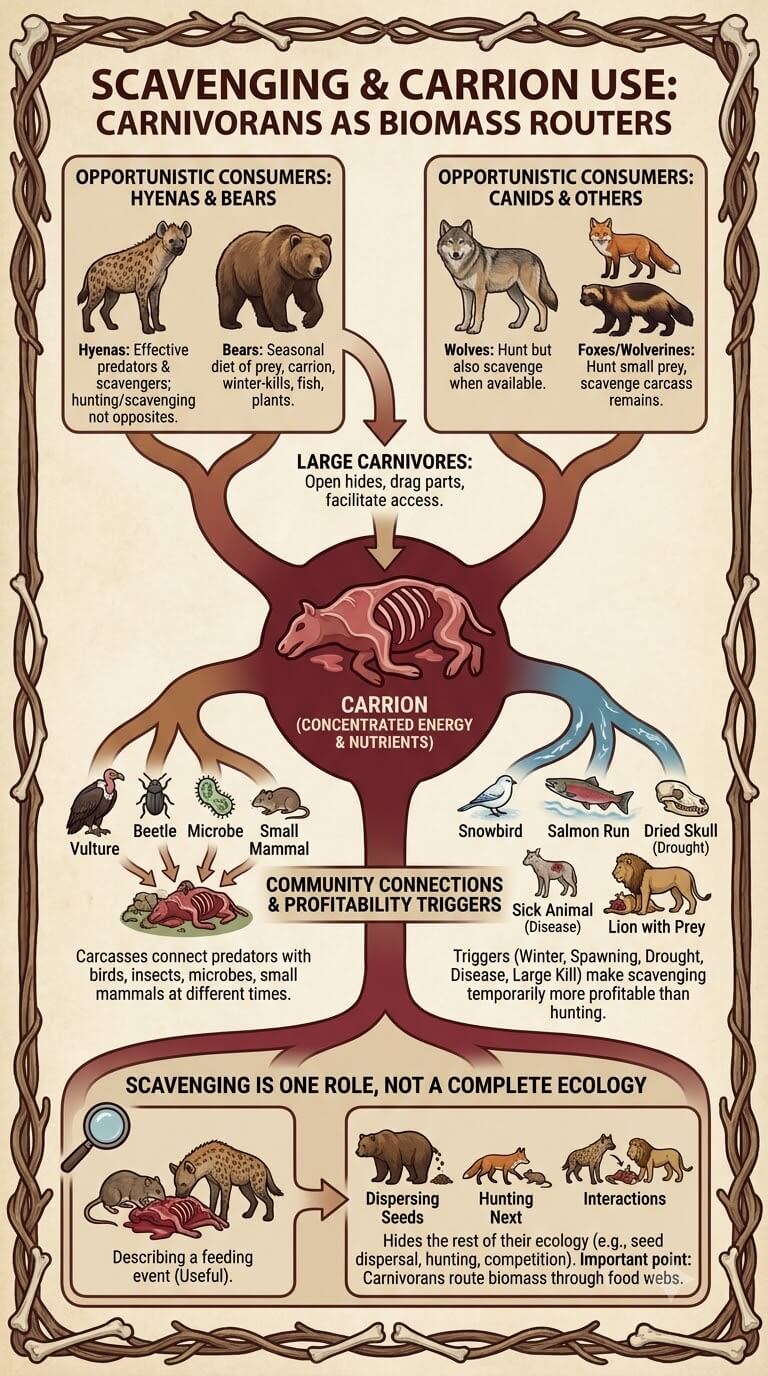
Carrion is a concentrated package of energy and nutrients. Many carnivorans use it when the opportunity arises, including species that are also capable hunters. Wolves, bears, foxes, jackals, hyenas, wolverines, and many other carnivorans may feed on animals they did not kill.
Scavenging matters because carcasses connect predators with a much larger community. Birds, insects, microbes, and other mammals can feed at the same resource at different times. Large carnivorans can open thick hides, drag carcass parts, or leave remains that become accessible to smaller consumers.
Hyenas, Bears, Canids, and Other Opportunistic Carrion Consumers
Hyenas are a useful reminder that hunting and scavenging are not opposite lifestyles. Spotted hyenas are effective predators as well as scavengers. Brown bears may kill prey, steal carcasses, consume winter-killed animals, fish for salmon, and eat large amounts of plant material depending on season and location. Wolves hunt but also scavenge when carrion is available.
Which role dominates can vary with species and conditions. A carcass-rich winter, spawning run, drought, disease event, or large-predator kill can temporarily make scavenging more profitable than searching for live prey.
Scavenging Is One Role, Not a Complete Description
Calling an animal a scavenger can be useful when describing a feeding event, but it may hide the rest of its ecology. A bear feeding on carrion can later disperse fruit seeds. A fox that scavenges one night may hunt rodents the next. A hyena can kill prey and then lose that carcass to a larger competitor.
For ecosystems, the important point is that carnivorans help route animal biomass through food webs. They can consume carrion, create carrion through predation, move carcass material, and influence which other species gain access to it.
Predators That Are Also Scavengers, Omnivores, or Generalists
Ecological labels describe behaviors, not permanent job titles. Many carnivorans switch among food sources as availability changes. Black bears may eat berries, nuts, insects, carrion, fish, or vertebrate prey. Raccoons can consume fruits, seeds, aquatic prey, eggs, insects, and human-associated foods. Foxes may take small mammals during one season and more fruit or insects during another.
Why Ecological Roles Can Shift With Season and Place
A species’ role can change as foods appear and disappear. Fruiting plants may become important in late summer or fall. Salmon runs can create a short pulse of marine-derived food in coastal watersheds. Insect abundance can rise during warm months. Winter can increase dependence on carrion or stored fat.
Local conditions matter just as much as season. Two populations of the same species may eat different foods because their habitats provide different opportunities. That means an ecological description that is accurate in one region may be incomplete somewhere else.
Seed Dispersal and Fruit-Eating Carnivorans
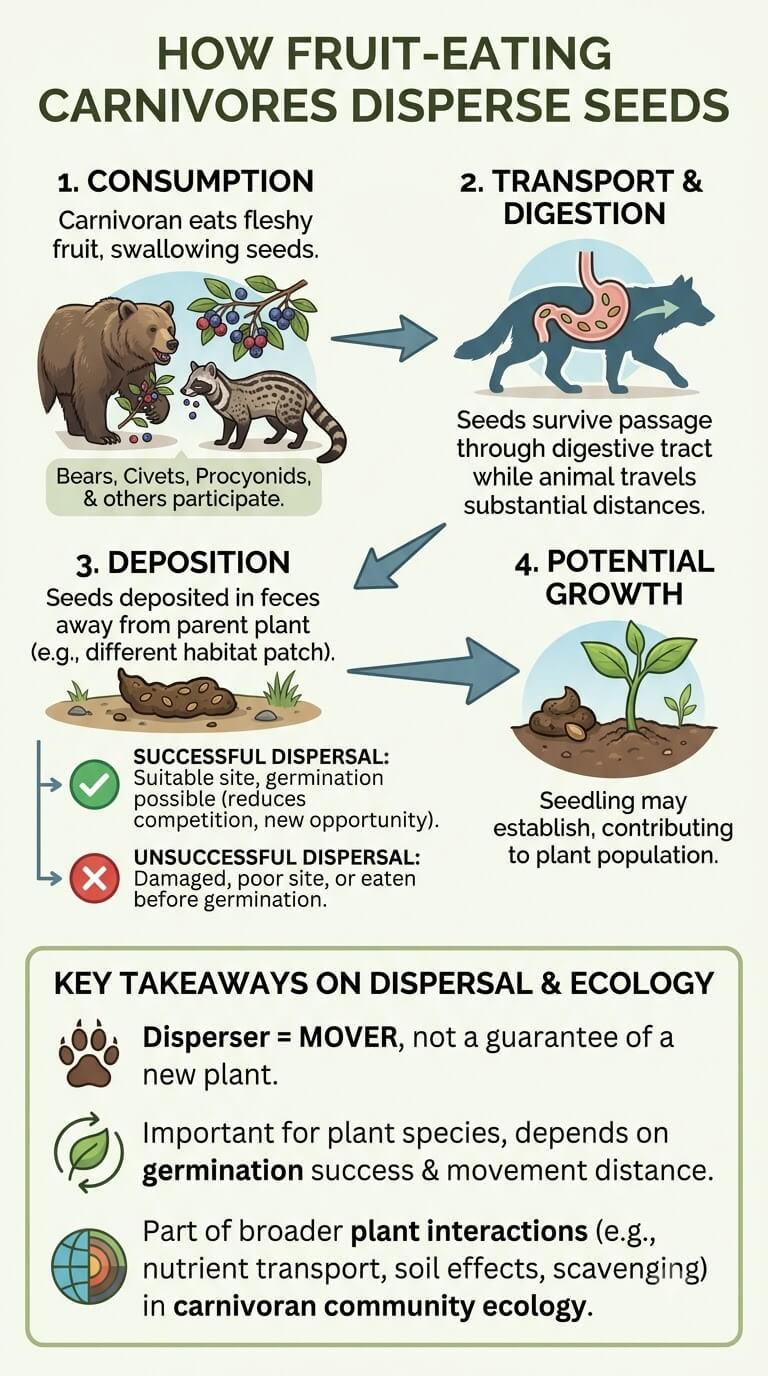
Predation is not the only way carnivorans affect plants. Species that eat fleshy fruits can swallow seeds and later deposit them in feces away from the parent plant. Bears, civets, some procyonids, and other fruit-eating carnivorans can participate in seed dispersal when seeds survive passage through the digestive tract and are deposited in suitable places.
A recent synthesis in Oxford Academic’s treatment of carnivoran community ecology highlights seed dispersal as a well-documented plant interaction in Carnivora, alongside nutrient transport, soil effects, scavenging, and other community processes. The ecological importance of dispersal still depends on the plant species, germination success, movement distance, and where seeds are deposited.
Civets, Bears, Procyonids, and Other Seed Movers
Fruit-eating carnivorans can be especially interesting seed movers because many travel substantial distances between feeding and resting sites. A seed carried in a gut may end up beyond the immediate shade of the parent plant, potentially reducing competition or exposing it to a different patch of habitat.
Not every swallowed seed benefits. Some seeds are damaged, deposited in poor sites, or eaten before germination. The phrase seed disperser therefore describes movement, not a guarantee that a new plant will establish.
Digging, Soil Disturbance, and Habitat Modification
Some carnivorans physically modify the ground while searching for food or making dens. Badgers can excavate deeply for burrowing prey. Bears may dig for roots, insects, or small mammals. Foxes and other species can create dens, foraging pits, or disturbed patches.
Foraging Pits, Burrows, and Small-Scale Physical Effects
Digging mixes soil layers, exposes mineral soil, changes small-scale water movement, and creates depressions that can collect organic matter or seeds. The Oxford synthesis cited above specifically notes badger digging as a direct soil effect. How important such disturbance becomes depends on digging frequency, soil type, vegetation, rainfall, and the density of the animals doing the digging.
It would be an overstatement to call every digging carnivoran a major ecosystem engineer. In some places, physical disturbance is frequent enough to matter. In others, it is a minor effect compared with fire, floods, grazing, burrowing rodents, or human land use.
Nutrient Transfer
Animals move nutrients simply by eating in one place and depositing waste or food remains in another. Carnivorans can make that movement especially visible when they cross boundaries between ecosystems. A bear that catches salmon in a stream and carries part of the fish into the forest is moving marine-derived nutrients onto land.
The National Park Service overview of bears in ecosystems describes both seed dispersal and the movement of marine-derived nitrogen into forests around salmon streams. This does not mean bears are the only nutrient movers, but it shows how a carnivoran can connect aquatic production with terrestrial plants and decomposers.
Moving Marine, River, Carrion, and Plant-Derived Nutrients
Nutrient transfer happens on smaller scales too. A carnivore can drag prey from open ground into cover, carry food to young at a den, defecate after feeding on fruit, or leave uneaten remains that decomposers process. Each movement redistributes carbon, nitrogen, phosphorus, and other materials.
These pathways are often diffuse rather than dramatic. Their importance builds from repeated feeding and movement across many individuals and seasons. Nutrient cycling is therefore another reason carnivorans cannot be understood only through kill rates.
Aquatic Food-Web Roles
Carnivora extends into rivers, coasts, sea ice, and the ocean through otters and pinnipeds. Aquatic carnivorans interact with fish, shellfish, crustaceans, sea urchins, and other prey, and they can themselves become prey for larger marine predators. Their effects are shaped by local food webs just as terrestrial carnivoran effects are.
Otters and Pinnipeds as Aquatic Examples
Sea otters provide a well-studied example of strong top-down influence in some kelp systems. By consuming sea urchins, otters can reduce grazing pressure on kelp. NOAA Fisheries reports that areas of coastal Alaska with longer sea otter occupation showed more kelp in the surveys examined, consistent with the species’ documented role in nearshore trophic interactions.
Pinnipeds also occupy important positions in marine food webs, but their effects vary by species, prey, region, and abundance. Seals and sea lions consume fish, squid, and invertebrates, while also being eaten by predators such as killer whales and large sharks. Their ecological importance should therefore be studied within specific marine systems rather than assigned one universal role.
Competition and Community Structure
Carnivorans affect one another as well as their prey. Species can compete for carcasses, hunting areas, den sites, or particular prey. Larger carnivores sometimes kill smaller carnivores, while smaller species may avoid places or times associated with dominant competitors.
Carnivoran Interactions and Resource Partitioning
Coexisting carnivorans often reduce direct competition by using different prey sizes, habitats, elevations, activity periods, or hunting methods. This division of resources is called resource partitioning. It is rarely perfect, but it can help multiple predators persist in the same landscape.
Competition can also reshape behavior. A smaller carnivoran may abandon a rich carcass when a larger species arrives. Another may become more nocturnal, shift into denser vegetation, or focus on smaller prey. These adjustments can influence the broader community even when no animal is directly killed.
Trophic Cascades: Powerful but Not Automatic
A trophic cascade occurs when effects at one feeding level spread indirectly to other levels. For example, a predator might affect herbivore abundance or behavior, which then changes vegetation. Another pathway could run from a large carnivore to a smaller predator and then to that smaller predator’s prey.
These cascades are scientifically important because they show how one species can have indirect effects far beyond the animals it eats. They are also easy to oversimplify. A visually appealing story of predator return followed by ecosystem recovery may leave out climate, hunting, disease, changing plant productivity, other predators, and the time needed for vegetation to respond.
Conditions That Can Strengthen or Weaken Cascading Effects
Cascades tend to depend on interaction strength. If a predator strongly affects abundant prey, if those prey strongly affect vegetation, and if alternative pathways are limited, a cascade may be easier to detect. If prey can switch habitats or foods, if several predators share the same prey, or if climate is the dominant limit on vegetation, the signal can be weaker or harder to separate from other causes.
Human land use adds another layer. Roads, livestock, hunting, artificial food, fences, and habitat fragmentation can change predator density, prey movement, carrion availability, and competitive interactions. Results from a large protected park may therefore differ from those in farmland, suburbs, or heavily harvested landscapes.
Why Removing a Predator Does Not Guarantee One Predictable Outcome
Predator loss can release prey or smaller predators from pressure, but what happens next depends on the remaining community. Another predator may compensate. Prey may be limited by food or weather rather than predation. Human activity may become the strongest source of mortality. Invasive species may alter the food web before native species respond.
This uncertainty does not make predators unimportant. It means ecological importance should be demonstrated with evidence from the relevant system rather than assumed from the predator’s body size or reputation.
Keystone Species Claims Need Evidence
A keystone species has an ecological effect that is unusually large relative to its abundance. The term is useful, but it should not be treated as a synonym for large predator, apex predator, charismatic species, or conservation priority.
Large, Charismatic, or Apex Does Not Automatically Mean Keystone
Some carnivorans are well-supported keystone examples in particular ecosystems, such as sea otters in many kelp-forest systems. Other large predators may have important but more variable effects. A species can also be highly valuable for biodiversity, culture, or conservation without meeting a strict ecological definition of keystone.
The most careful question is not “Is this carnivoran important?” but “What effects does this population have here, through which mechanisms, and under what conditions?” That approach allows strong evidence to remain strong without turning one case study into a universal rule.
Human Pressure and Conservation Context
Human activities can change the ecological roles of carnivorans by changing their numbers, prey base, movement, and habitat. Habitat conversion may separate populations or reduce hunting and denning areas. Roads can increase mortality and fragment movement. Persecution can reduce large predators, while garbage or other human food can subsidize adaptable mesopredators.
Habitat Change, Prey Loss, and Recovery
When a carnivoran declines or returns, ecological effects should be evaluated species by species and place by place. Recovery may restore some interactions, but it does not rewind an ecosystem to an earlier state automatically. Habitats, prey communities, climate, competitors, and human land use may have changed in the meantime.
Conservation status is also species-specific. Carnivora contains species with very different population trends and legal protections, so the order as a whole cannot be assigned one threat level. Ecological importance and conservation status are related questions, but they are not the same question.
Common Myths and Mistakes
Not Every Carnivoran Controls Prey Populations
Some predators strongly influence prey abundance, but others take only a small share of available prey or focus on species controlled mainly by food, weather, disease, or other mortality. Plant-eating and omnivorous carnivorans may have little direct predatory effect at all. The magnitude of control has to be measured rather than assumed.
Not Every Large Carnivoran Is a Keystone Species
Size and fame do not establish keystone status. A large carnivoran can be ecologically influential without having a disproportionate effect across the whole community. Conversely, a smaller species can have a strong effect if it controls an important consumer or modifies a critical process.
Carnivorans Can Move Seeds and Nutrients as Well as Consume Animals
The stereotype of Carnivora as a collection of meat-eating hunters misses major ecological functions. Fruit-eating species can disperse seeds. Bears can carry salmon-derived nutrients onto land. Digging can disturb soil. Scavengers redistribute carrion. Aquatic members can influence prey communities in rivers and oceans.
Ecology Changes With Diet, Habitat, and Feeding Behavior
The ecological role of a carnivoran grows from the interaction between what it eats, how it gets food, where it lives, and how it responds to competitors. Those traits are not independent. Habitat determines which foods are available, senses help locate those foods, and social behavior can affect whether an animal hunts alone, shares carcasses, or defends resources.
Hunting, Diet, and Scavenging
A meat-specialized cat can influence vertebrate prey through ambush hunting. A generalist canid may hunt, scavenge, and eat fruit. A bear can shift among plants, insects, fish, carrion, and mammals. These feeding differences explain why simply knowing that an animal belongs to Carnivora tells us relatively little about its exact ecological function.
Habitats, Food Webs, Marine Ecology, and Conservation
Habitat determines the community in which those feeding behaviors matter. Sea otters interact with kelp-forest grazers, wolves with terrestrial ungulates and competitors, and fruit-eating civets with tropical plants. Conservation changes become ecologically meaningful when they change these interactions, not merely because the animal belongs to a famous mammal group.
FAQ
Are all carnivorans keystone species?
No. Some carnivorans have strong, disproportionate effects in particular ecosystems, but keystone status must be supported by evidence for the species and system being discussed. Being a carnivoran, a large predator, or an apex predator does not automatically make an animal a keystone species.
Do carnivorans always reduce prey populations?
No. Predation can reduce prey abundance in some systems, but prey may also be limited by food, weather, disease, habitat, human activity, or other predators. Carnivorans can also change prey behavior or space use without causing a large population decline. Some members of Carnivora eat relatively little vertebrate prey.
Can carnivorans disperse seeds?
Yes. Bears, civets, procyonids, and other fruit-eating carnivorans can swallow fruits and later deposit viable seeds away from the parent plant. Whether that movement benefits the plant depends on seed survival, distance, germination, and the quality of the place where the seed is deposited.
Final Thoughts
Why are carnivorans important? Because members of Carnivora participate in ecosystems through a wide range of processes. Some are influential predators, some are mesopredators, many scavenge, some disperse seeds, some disturb soil, some move nutrients across habitat boundaries, and aquatic species can reshape local food-web interactions.
The most useful lesson is that ecological importance is specific rather than automatic. A wolf, bear, civet, badger, sea otter, and seal can all matter for very different reasons. Understanding those reasons requires looking at the actual species, food web, habitat, and evidence instead of assuming that every carnivoran plays the same role.
Ethan Walker is the founder and research editor of Animal Fact Central. He creates and reviews educational animal facts content using trusted wildlife, pet care, and science-based sources. His work focuses on making animal behavior, adaptations, habitats, and species facts clear, accurate, and engaging for everyday readers.
Read More Details About Ethan Walker: https://animalfactcentral.com/ethan-walker/